















Europe Non-Lethal Weapons Market Outlook to 2030
Region:Europe
Author(s):Yogita Sahu
Product Code:KROD4805
December 2024
94
About the Report
Europe Non-Lethal Weapons Market Overview
- The Europe Non-Lethal Weapons Market is valued at USD 2.1 billion, based on a five-year historical analysis. This market is largely driven by growing demand from law enforcement agencies for crowd control, the increasing need for military-grade non-lethal weapons in domestic defense, and advancements in non-lethal technologies such as directed energy weapons and incapacitating chemicals.
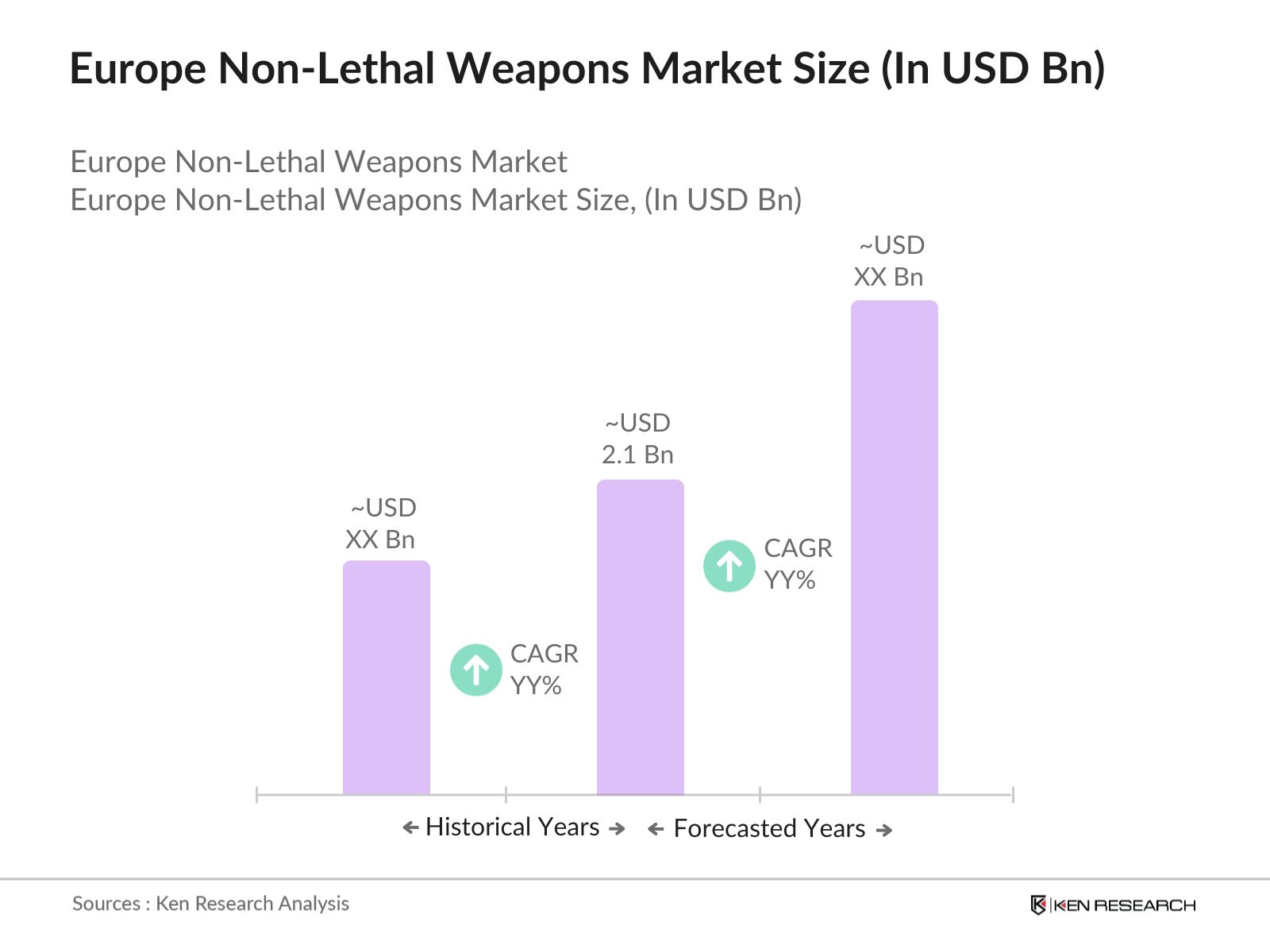
- Key countries dominating the market in Europe include the United Kingdom, Germany, and France. These countries lead in market dominance due to their large-scale investment in military technology and their robust law enforcement infrastructure. Additionally, stringent regulatory frameworks and government support for non-lethal defense capabilities have driven adoption within their defense and law enforcement agencies.
- The European Union allocated 750 million in 2024 for the Law Enforcement Safety Initiative, which aims to enhance the use of non-lethal weapons across member states. This program includes subsidies for local police departments to procure certified non-lethal options, enabling smaller municipalities to equip their forces with advanced equipment.
Europe Non-Lethal Weapons Market Segmentation
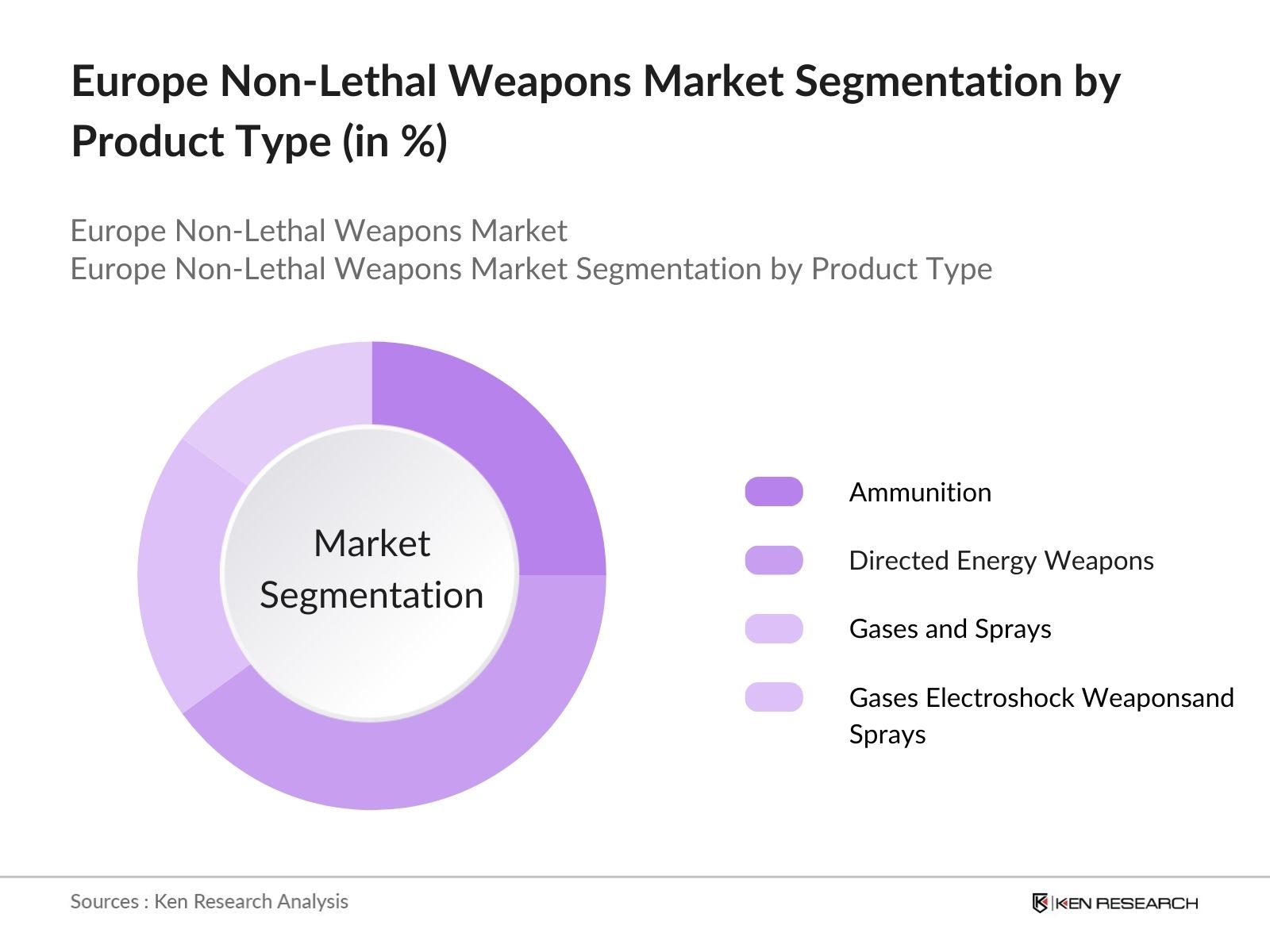
By Product Type: The market is segmented by product type into ammunition, directed energy weapons, gases and sprays, and electroshock weapons. Currently, directed energy weapons hold a dominant market share within this segment. This dominance is attributed to their increasing adoption by defense agencies due to the precision and reduced collateral damage they offer compared to traditional weaponry. The ability to immobilize targets effectively without lasting harm is a critical factor in their favor, especially for crowd control and area denial operations.
By Technology: The market segmentation by technology includes mechanical and kinetic, acoustic/light, chemical, and electromagnetic weapons. Electromagnetic weapons are the leading sub-segment due to their increased use in law enforcement agencies for their non-invasive but effective means of subduing suspects and controlling crowds. The efficiency of electromagnetic pulses in disabling electronic equipment and neutralizing threats without causing permanent harm has further boosted their popularity.

Europe Non-Lethal Weapons Market Competitive Landscape
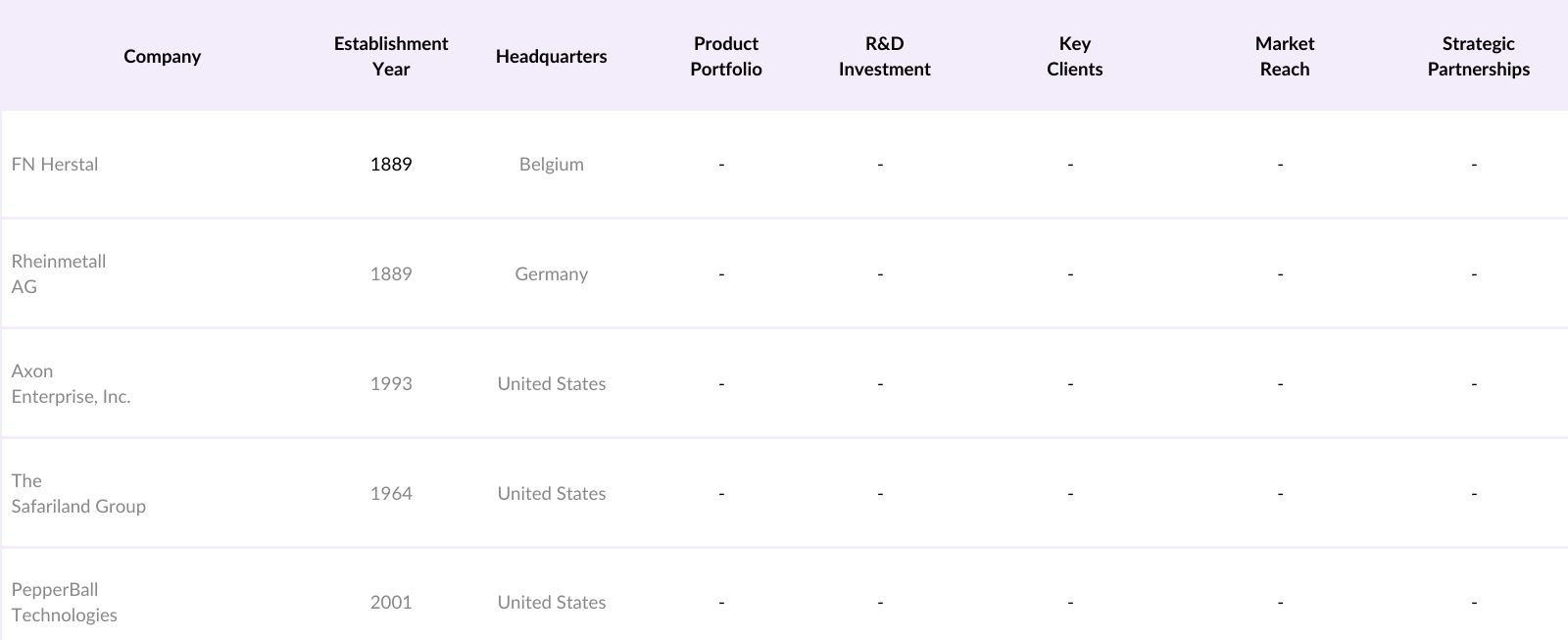
The market is dominated by several key players who are continuously innovating and expanding their market share through strategic initiatives. These players have established strong research and development (R&D) capabilities, partnerships, and a solid presence across European regions, which helps maintain their competitive edge.
Europe Non-Lethal Weapons Market Analysis
Market Growth Drivers
- Increased Investment in Law Enforcement and Border Control: Governments across Europe have escalated budgets for public safety and border management, with France and Germany leading investments. In 2024, France allocated 1.2 billion specifically for security measures, including non-lethal weapon procurement for law enforcement. The rise in funds is driven by cross-border tensions and urban security concerns, motivating police forces to employ safer crowd-control measures.
- Growing Demand from Private Security Services: The private security industry in Europe has shown substantial growth, as evidenced by a rise in registered security agenciesover 100,000 across Europe in 2024. With stricter regulations on private firearm use, non-lethal alternatives are increasingly utilized. Non-lethal options provide companies with legally compliant solutions for personnel and asset protection.
- Rising Incidents of Civil Unrest in Urban Areas: European cities have witnessed a notable increase in protests and demonstrations, with over 4,500 incidents recorded in major cities in 2024, as reported by Eurostat. This surge has led local governments to adopt safer, non-lethal crowd-control measures. In response, non-lethal weapons like rubber bullets, tear gas, and acoustic devices are increasingly incorporated into police arsenals, minimizing fatal incidents and addressing public outcry against excessive force.
Market Challenges
- Complex Regulatory Approvals and Usage Guidelines: Regulatory bodies in Europe impose strict controls on non-lethal weapons. A 2024 report from the European Police Office highlights that complex approval processes for certain non-lethal devices lead to extended waiting periods for deployment. For instance, acoustic devices face stringent regulations in Sweden and Denmark due to potential health risks, delaying their adoption by up to two years.
- Limited Public Acceptance and Trust Issues: Public skepticism around the safety of non-lethal weapons remains a challenge. According to a 2024 survey by the European Social Survey (ESS), 48 million people across Europe expressed concern over the potential misuse of non-lethal weapons by law enforcement. This perception hinders adoption, as governments are under pressure to ensure the ethical and responsible use of these weapons to gain public trust.
Europe Non-Lethal Weapons Market Future Outlook
Over the next five years, the Europe Non-Lethal Weapons industry is expected to experience steady growth, propelled by ongoing governmental support, increased adoption by law enforcement agencies, and advancements in technologies that ensure minimal harm.
Future Market Opportunities
- Integration of AI-Driven Non-Lethal Solutions in Law Enforcement: By 2029, AI-enabled non-lethal weapons are expected to become integral to European law enforcement. Automated control systems for non-lethal tools will optimize deployment based on real-time crowd dynamics, enhancing safety and precision. A report by the EU Future of Law Enforcement Initiative anticipates that AI-driven solutions will account for 60% of non-lethal weapon deployments by 2029.
- Increased Adoption of Biometric-Based Non-Lethal Tools: Biometric identification for weapon access is expected to be widely adopted by 2028, minimizing unauthorized use of non-lethal weapons. The European Defense Agency estimates that biometric-enabled non-lethal devices will become a standard in over 70% of European law enforcement agencies, allowing only trained personnel to access these tools.
Scope of the Report
|
Product Type |
Ammunition |
|
Technology |
Chemical |
|
End User |
Law Enforcement Agencies |
|
Application |
Crowd Control |
|
Region |
United Kingdom |
Products
Key Target Audience Organizations and Entities Who Can Benefit by Subscribing This Report:
Defense Contractors and Suppliers
Law Enforcement Agencies (Europol, UK Police)
Non-Governmental Organizations (NGOs)
Private Security Firms
Investor and Venture Capitalist Firms
Government and Regulatory Bodies (European Defence Agency, EU Commission)
Homeland Security Agencies
Military Procurement Agencies
Companies
Players Mentioned in the Report:
FN Herstal
Rheinmetall AG
Fiocchi Munizioni SpA
General Dynamics Ordnance and Tactical Systems
RUAG Group
Axon Enterprise, Inc.
The Safariland Group
PepperBall Technologies, Inc.
Combined Systems, Inc.
Condor Non-Lethal Technologies
Table of Contents
1. Europe Non-Lethal Weapons Market Overview
1.1. Definition and Scope
1.2. Market Taxonomy
1.3. Market Growth Rate
1.4. Market Segmentation Overview
2. Europe Non-Lethal Weapons Market Size (In USD Million)
2.1. Historical Market Size
2.2. Year-On-Year Growth Analysis
2.3. Key Market Developments and Milestones
3. Europe Non-Lethal Weapons Market Analysis
3.1. Growth Drivers
3.1.1. Increasing Political Disputes and Civil Unrest
3.1.2. Militarization of Law Enforcement Agencies
3.1.3. Technological Advancements in Non-Lethal Weapons
3.1.4. Rising Defense Expenditures in Emerging Economies
3.2. Market Challenges
3.2.1. Stringent Environmental and Governmental Regulations
3.2.2. Declining Defense Budgets in Advanced Economies
3.2.3. Apprehensions Among End Users
3.3. Opportunities
3.3.1. Increasing Research and Development Activities
3.3.2. Expansion into Emerging Markets
3.3.3. Integration with Unmanned Systems
3.4. Trends
3.4.1. Adoption of Directed Energy Weapons
3.4.2. Development of Non-Lethal Weapons Complying with Human Rights Standards
3.4.3. Use of Non-Lethal Weapons in Peacekeeping Missions
3.5. Government Regulations
3.5.1. European Union Directives on Non-Lethal Weapons
3.5.2. National Regulations and Compliance Requirements
3.5.3. Certification Processes
3.6. SWOT Analysis
3.7. Stakeholder Ecosystem
3.8. Porter’s Five Forces Analysis
4. Europe Non-Lethal Weapons Market Segmentation
4.1. By Product Type (In Value %)
4.1.1. Ammunition
4.1.2. Area Denial Weapons
4.1.3. Directed Energy Weapons
4.1.4. Electroshock Weapons
4.1.5. Explosives
4.1.6. Gases and Sprays
4.2. By Technology (In Value %)
4.2.1. Chemical
4.2.2. Electromagnetic
4.2.3. Mechanical & Kinetic
4.2.4. Acoustic/Light
4.3. By End User (In Value %)
4.3.1. Law Enforcement Agencies
4.3.2. Military
4.3.3. Personalized Applications
4.4. By Application (In Value %)
4.4.1. Crowd Control
4.4.2. Self-Defense
4.4.3. Combat Operations
4.4.4. Others
4.5. By Region (In Value %)
4.5.1. United Kingdom
4.5.2. France
4.5.3. Germany
4.5.4. Italy
4.5.5. Spain
4.5.6. Rest of Europe
5. Europe Non-Lethal Weapons Market Competitive Landscape
5.1. Detailed Profiles of Major Companies
5.1.1. FN Herstal
5.1.2. Rheinmetall AG
5.1.3. Fiocchi Munizioni SpA
5.1.4. General Dynamics Ordnance and Tactical Systems
5.1.5. RUAG Group
5.1.6. Axon Enterprise, Inc.
5.1.7. The Safariland Group
5.1.8. PepperBall Technologies, Inc.
5.1.9. Combined Systems, Inc.
5.1.10. Condor Non-Lethal Technologies
5.1.11. Lamperd Less Lethal
5.1.12. ISPRA by EL Ltd.
5.1.13. Zarc International, Inc.
5.1.14. Nonlethal Technologies, Inc.
5.1.15. Taser International
5.2. Cross Comparison Parameters (Number of Employees, Headquarters Location, Year of Establishment, Annual Revenue, Product Portfolio, Regional Presence, R&D Investment, Strategic Initiatives)
5.3. Market Share Analysis
5.4. Strategic Initiatives
5.5. Mergers and Acquisitions
5.6. Investment Analysis
5.7. Venture Capital Funding
5.8. Government Grants
5.9. Private Equity Investments
6. Europe Non-Lethal Weapons Market Regulatory Framework
6.1. Environmental Standards
6.2. Compliance Requirements
6.3. Certification Processes
7. Europe Non-Lethal Weapons Future Market Size (In USD Million)
7.1. Future Market Size Projections
7.2. Key Factors Driving Future Market Growth
8. Europe Non-Lethal Weapons Future Market Segmentation
8.1. By Product Type (In Value %)
8.2. By Technology (In Value %)
8.3. By End User (In Value %)
8.4. By Application (In Value %)
8.5. By Region (In Value %)
9. Europe Non-Lethal Weapons Market Analysts Recommendations
9.1. Total Addressable Market (TAM), Serviceable Available Market (SAM), and Serviceable Obtainable Market (SOM) Analysis
9.2. Customer Cohort Analysis
9.3. Marketing Initiatives
9.4. White Space Opportunity Analysis
Disclaimer
Contact Us
Research Methodology
Step 1: Identification of Key Variables
This phase involves mapping the ecosystem of stakeholders in the Europe Non-Lethal Weapons market. Through extensive desk research, primary databases, and secondary data sources, critical variables influencing market dynamics are identified and defined.
Step 2: Market Analysis and Construction
In this stage, historical data on non-lethal weapons penetration is compiled, alongside an evaluation of technology adoption across law enforcement agencies. Key metrics such as revenue growth and adoption rates are analyzed to ensure accuracy.
Step 3: Hypothesis Validation and Expert Consultation
Hypotheses on market growth and segmentation are formulated and validated via interviews with industry experts from law enforcement and defense agencies. These consultations provide essential insights for refining data accuracy.
Step 4: Research Synthesis and Final Output
The final step involves corroborating data with insights from non-lethal weapon manufacturers and key market players, ensuring a validated, comprehensive analysis that reflects the current market scenario.
Frequently Asked Questions
01. How big is the Europe Non-Lethal Weapons Market?
The Europe Non-Lethal Weapons Market is valued at USD 2.1 billion, driven by increased investments in law enforcement and defense, as well as the growing demand for crowd control solutions.
02. What are the challenges in the Europe Non-Lethal Weapons Market?
Key challenges in the Europe Non-Lethal Weapons Market include stringent regulations surrounding the ethical use of non-lethal weapons and potential hesitancy from agencies due to the high costs associated with advanced non-lethal technologies.
03. Who are the major players in the Europe Non-Lethal Weapons Market?
Prominent players in the Europe Non-Lethal Weapons Market include FN Herstal, Rheinmetall AG, Axon Enterprise, The Safariland Group, and PepperBall Technologies, each excelling in product innovation and strategic market presence.
04. What drives growth in the Europe Non-Lethal Weapons Market?
The Europe Non-Lethal Weapons Market is propelled by increased investment in public safety, advancements in non-lethal technology, and heightened public and political awareness surrounding humane control measures.
Why Buy From Us?

What makes us stand out is that our consultants follows Robust, Refine and Result (RRR) methodology. i.e. Robust for clear definitions, approaches and sanity checking, Refine for differentiating respondents facts and opinions and Result for presenting data with story

We have set a benchmark in the industry by offering our clients with syndicated and customized market research reports featuring coverage of entire market as well as meticulous research and analyst insights.

While we don't replace traditional research, we flip the method upside down. Our dual approach of Top Bottom & Bottom Top ensures quality deliverable by not just verifying company fundamentals but also looking at the sector and macroeconomic factors.

With one step in the future, our research team constantly tries to show you the bigger picture. We help with some of the tough questions you may encounter along the way: How is the industry positioned? Best marketing channel? KPI's of competitors? By aligning every element, we help maximize success.

Our report gives you instant access to the answers and sources that other companies might choose to hide. We elaborate each steps of research methodology we have used and showcase you the sample size to earn your trust.

If you need any support, we are here! We pride ourselves on universe strength, data quality, and quick, friendly, and professional service.