















Europe Robotic Palletizers and De palletizers Market Outlook to 2030
Region:Europe
Author(s):Paribhasha Tiwari
Product Code:KROD9931
December 2024
99
About the Report
Europe Robotic Palletizers and De palletizers Market Overview
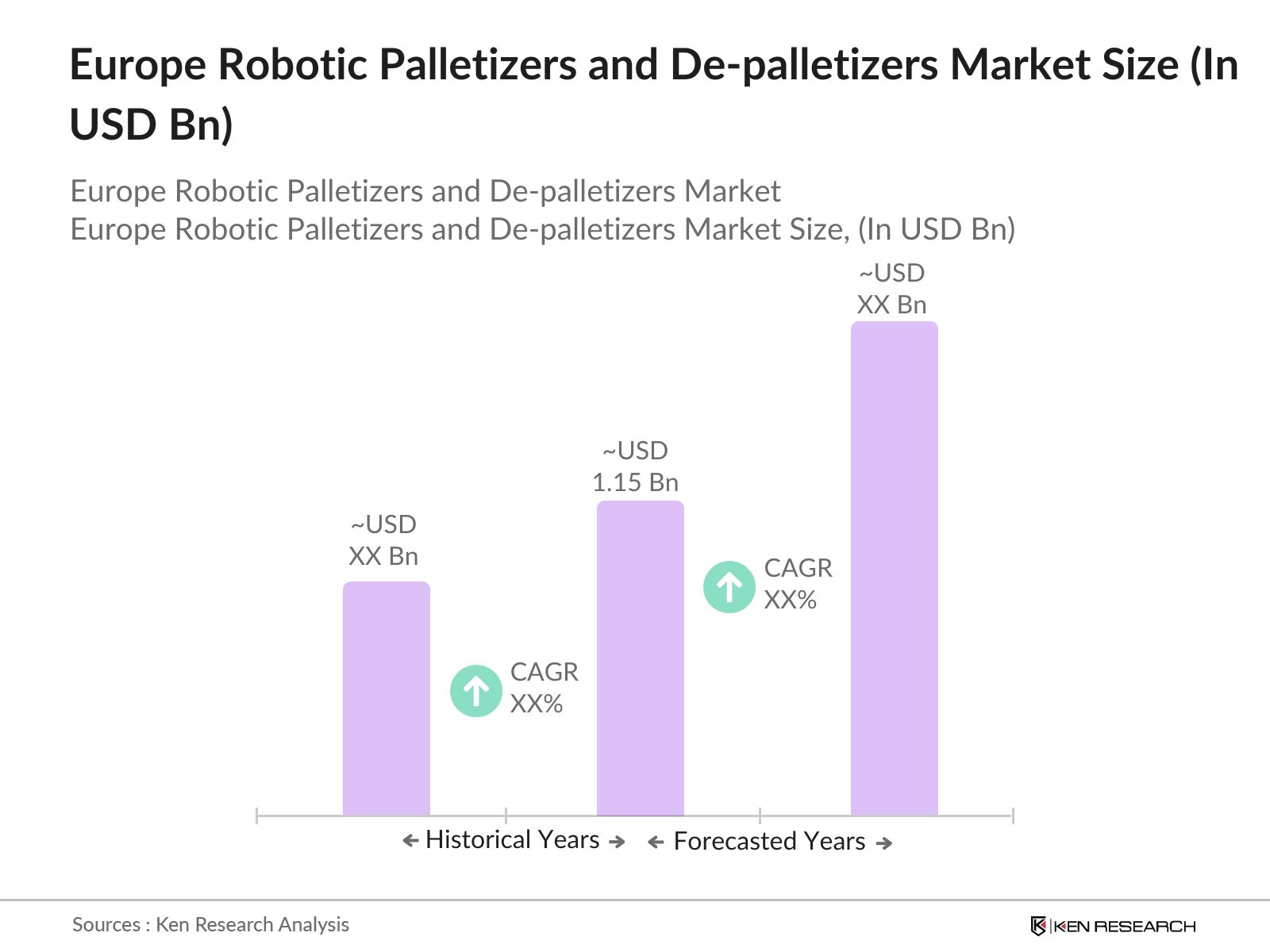
- The Europe robotic palletizers and de-palletizers market is valued at USD 1.15 billion, based on a five-year historical analysis. This growth is driven by the adoption of Industry 4.0 technologies, labor cost optimization, and the demand for automation in manufacturing processes. The integration of advanced robotics enhances operational efficiency and meets the increasing need for flexible and efficient material handling solutions.
- Germany leads the market due to its strong industrial base and early adoption of automation technologies. The country's emphasis on manufacturing excellence and technological innovation has positioned it at the forefront of robotic palletizing solutions. Other countries like France and the United Kingdom also contribute significantly, driven by investments in automation to improve productivity and address labor shortages.
- Tesla announced plans to develop humanoid robots, aiming to surpass human labor in manufacturing by 2040. This ambitious project envisions robots performing labor-intensive tasks, potentially transforming global labor markets and reducing operational costs. Teslas robotic advancements could accelerate the shift towards fully automated factories, setting a new standard in automated manufacturing.
Europe Robotic Palletizers and De palletizers Market Segmentation
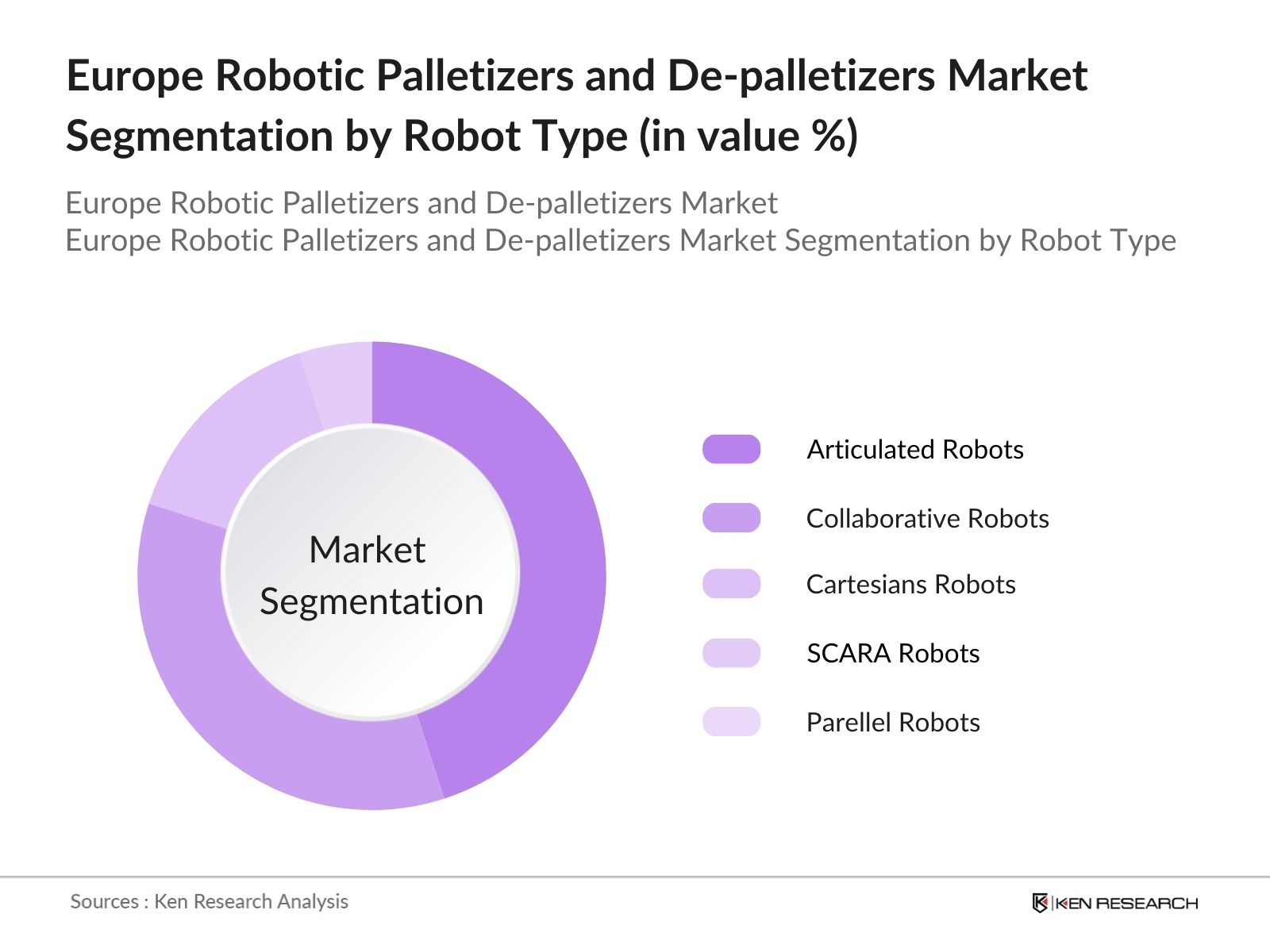
By Robot Type: The Europe robotic palletizers and de-palletizers market is segmented by robot type into articulated robots, collaborative robots, Cartesian robots, SCARA robots, and parallel robots. Articulated robots dominate this segment due to their versatility and ability to handle complex palletizing tasks across various industries. Their multi-jointed structure allows for a wide range of movements, making them suitable for diverse applications.
By Application: The market is also segmented by application into case palletizing, bag palletizing, pail and drum palletizing, de-palletizing, and mixed load palletizing. Case palletizing holds a dominant market share, driven by the high demand in the food and beverage industry for efficient packaging solutions. The need for precise and rapid handling of boxed products has led to the widespread adoption of robotic case palletizers.

Europe Robotic Palletizers and De palletizers Market Competitive Landscape
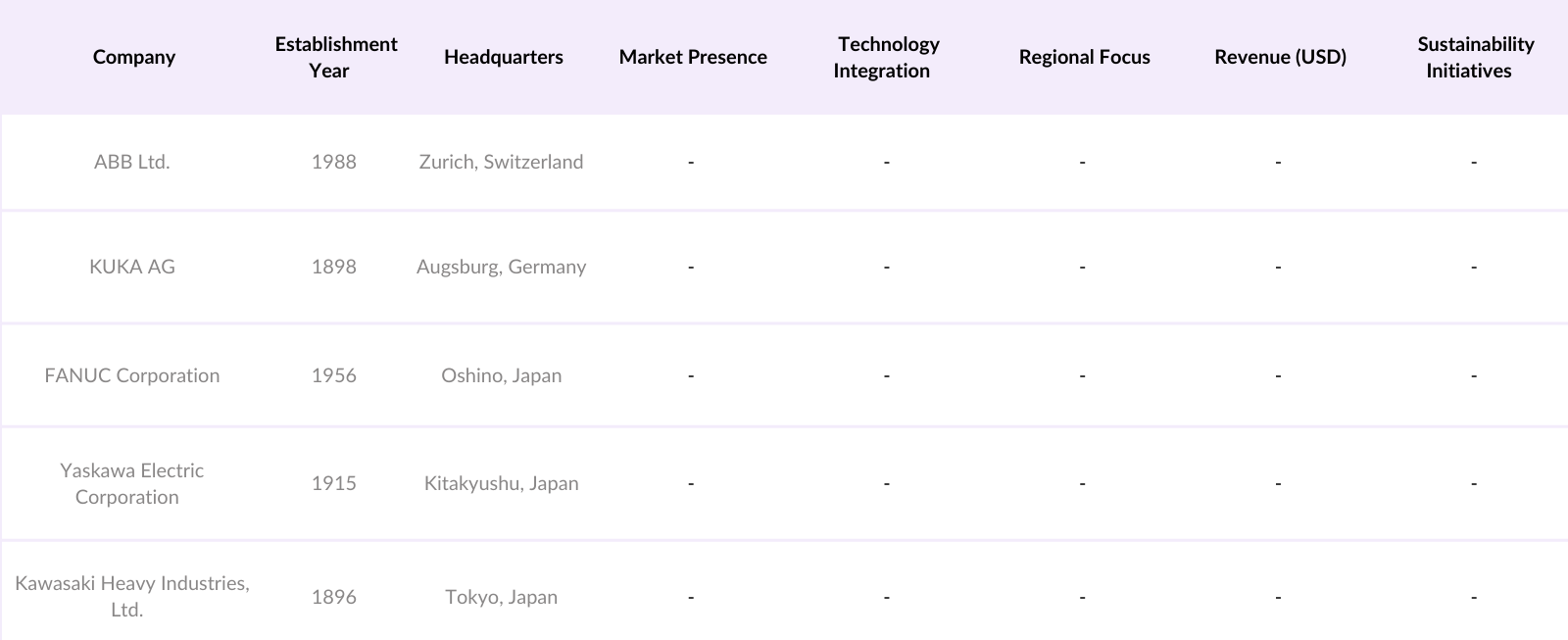
The Europe robotic palletizers and de-palletizers market is characterized by the presence of several key players who drive innovation and competition. These companies focus on technological advancements, strategic partnerships, and expanding their product portfolios to maintain a competitive edge.
Europe Robotic Palletizers and De palletizers Market Analysis
Growth Drivers
- Adoption of Industry 4.0: Industry 4.0 has led to a surge in advanced manufacturing practices by incorporating IoT, AI, and robotics. By 2028, the Industry 4.0 market is expected to reach $182 billion, driven by smart factory applications enhancing production precision and efficiency. This adoption enables manufacturers to leverage data-driven insights, boosting productivity and enabling real-time monitoring of production processes.
- Labor Cost Optimization: Automation in manufacturing significantly reduces labor costs by deploying robots for repetitive tasks. In the U.S., the adoption of robotics has saved approximately $16 billion in annual labor expenses, proving to be a cost-effective alternative to human labor. By implementing robots, companies minimize wage expenses, streamline operations, and mitigate risks of human errors, leading to substantial long-term savings.
- Demand for Automation in Manufacturing: The global robotics market is projected to reach $159 billion by 2029, showing a rising demand for automation across industries. Automation addresses critical challenges like speed, accuracy, and productivity in manufacturing environments. Robotics' adaptability and capability to handle complex assembly lines enhance efficiency, allowing companies to meet growing consumer demand faster while reducing overhead and improving product quality.
Market Challenges
- High Initial Investment: Implementing industrial robots remains financially demanding, with units costing between $50,000 and $150,000. High costs limit access for small and medium-sized enterprises, which struggle to afford such substantial upfront capital. These expenses cover not only the machinery but also integration and maintenance, often challenging companies with limited budgets from fully embracing automation.
- Integration Complexities: Integrating new robotic technologies disrupts existing manufacturing workflows, sometimes reducing output by up to 20% during transitional phases. Establishing compatibility with current systems can be complex and requires careful planning and troubleshooting. Companies need to address these integration challenges to prevent extended downtime and ensure smooth adaptation to robotic systems.
Europe Robotic Palletizers and De palletizers Market Future Outlook
Over the next five years, the Europe robotic palletizers and de-palletizers market is expected to show significant growth driven by continuous technological advancements, increasing automation in manufacturing processes, and the need for efficient material handling solutions. The integration of artificial intelligence and IoT in robotic systems is anticipated to further enhance operational efficiency and flexibility.
Market Opportunities
- Expansion in Emerging Markets: Emerging markets like India are rapidly increasing their robotics deployment, exemplified by a record installation of 8,510 industrial robots in 2023. This shift highlights a growing interest in automation within developing economies, where manufacturing and industrial sectors are keen to adopt technologies that drive productivity and reduce costs, signaling strong future growth potential.
- Development of Collaborative Robots: Collaborative robots, or cobots, designed to work alongside humans, are gaining traction with projected deployment surpassing 150,000 units globally by 2025. These robots offer enhanced safety features, enabling manufacturers to maximize space and increase efficiency without needing extensive safety barriers, ultimately fostering a more flexible and dynamic workforce.
Scope of the Report
|
By Robot Type |
Articulated Robots |
|
By Application |
Case Palletizing |
|
By End-Use Industry |
Food & Beverage |
|
By Payload Capacity |
Low Payload (Up to 50 kg) |
|
By Country |
Germany |
Products
Key Target Audience
Manufacturing Companies
Logistics and Warehousing Firms
Automotive Industry Players
Food and Beverage Producers
Pharmaceutical Companies
Consumer Goods Manufacturers
Investors and Venture Capitalist Firms
Government and Regulatory Bodies (e.g., European Commission, National Safety Authorities)
Companies
Players Mnetioned in the Report:
ABB Ltd.
KUKA AG
FANUC Corporation
Yaskawa Electric Corporation
Kawasaki Heavy Industries, Ltd.
Mitsubishi Electric Corporation
Schneider Electric SE
Siemens AG
Universal Robots A/S
Comau S.p.A.
Table of Contents
1. Europe Robotic Palletizers and De palletizers Market Overview
1.1 Definition and Scope
1.2 Market Taxonomy
1.3 Market Growth Rate
1.4 Market Segmentation Overview
2. Europe Robotic Palletizers and De palletizers Market Size (In USD Billion)
2.1 Historical Market Size
2.2 Year-On-Year Growth Analysis
2.3 Key Market Developments and Milestones
3. Europe Robotic Palletizers and De palletizers Market Analysis
3.1 Growth Drivers
3.1.1 Adoption of Industry 4.0
3.1.2 Labor Cost Optimization
3.1.3 Demand for Automation in Manufacturing
3.1.4 Technological Advancements in Robotics
3.2 Market Challenges
3.2.1 High Initial Investment
3.2.2 Integration Complexities
3.2.3 Skilled Workforce Shortage
3.3 Opportunities
3.3.1 Expansion in Emerging Markets
3.3.2 Development of Collaborative Robots
3.3.3 Increasing E-commerce Activities
3.4 Trends
3.4.1 Integration with AI and IoT
3.4.2 Customization and Flexibility in Operations
3.4.3 Focus on Energy Efficiency
3.5 Regulatory Landscape
3.5.1 EU Machinery Directive Compliance
3.5.2 Safety Standards and Certifications
3.5.3 Environmental Regulations
3.6 SWOT Analysis
3.7 Stakeholder Ecosystem
3.8 Porters Five Forces Analysis
3.9 Competitive Landscape
4. Europe Robotic Palletizers and De palletizers Market Segmentation
4.1 By Robot Type (In Value %)
4.1.1 Articulated Robots
4.1.2 Collaborative Robots
4.1.3 Cartesian Robots
4.1.4 SCARA Robots
4.1.5 Parallel Robots
4.2 By Application (In Value %)
4.2.1 Case Palletizing
4.2.2 Bag Palletizing
4.2.3 Pail and Drum Palletizing
4.2.4 De-palletizing
4.2.5 Mixed Load Palletizing
4.3 By End-Use Industry (In Value %)
4.3.1 Food & Beverage
4.3.2 Pharmaceuticals
4.3.3 Consumer Goods
4.3.4 Automotive
4.3.5 Logistics & Warehousing
4.4 By Payload Capacity (In Value %)
4.4.1 Low Payload (Up to 50 kg)
4.4.2 Medium Payload (50 kg to 500 kg)
4.4.3 High Payload (Above 500 kg)
4.5 By Country (In Value %)
4.5.1 Germany
4.5.2 France
4.5.3 United Kingdom
4.5.4 Italy
4.5.5 Spain
4.5.6 Rest of Europe
5. Europe Robotic Palletizers and De palletizers Market Competitive Analysis
5.1 Detailed Profiles of Major Companies
5.1.1 ABB Ltd.
5.1.2 KUKA AG
5.1.3 FANUC Corporation
5.1.4 Yaskawa Electric Corporation
5.1.5 Kawasaki Heavy Industries, Ltd.
5.1.6 Mitsubishi Electric Corporation
5.1.7 Schneider Electric SE
5.1.8 Siemens AG
5.1.9 Universal Robots A/S
5.1.10 Comau S.p.A.
5.1.11 Stubli International AG
5.1.12 BEUMER Group GmbH & Co. KG
5.1.13 Honeywell International Inc.
5.1.14 KION Group AG
5.1.15 Krones AG
5.2 Cross Comparison Parameters (Revenue, Market Share, Product Portfolio, Regional Presence, R&D Investment, Strategic Initiatives, Number of Employees, Year of Establishment)
5.3 Market Share Analysis
5.4 Strategic Initiatives
5.5 Mergers and Acquisitions
5.6 Investment Analysis
5.7 Venture Capital Funding
5.8 Government Grants
5.9 Private Equity Investments
6. Europe Robotic Palletizers and De palletizers Market Regulatory Framework
6.1 Safety Standards
6.2 Compliance Requirements
6.3 Certification Processes
7. Europe Robotic Palletizers and De palletizers Future Market Size (In USD Billion)
7.1 Future Market Size Projections
7.2 Key Factors Driving Future Market Growth
8. Europe Robotic Palletizers and De palletizers Future Market Segmentation
8.1 By Robot Type (In Value %)
8.2 By Application (In Value %)
8.3 By End-Use Industry (In Value %)
8.4 By Payload Capacity (In Value %)
8.5 By Country (In Value %)
9. Europe Robotic Palletizers and De palletizers Market Analysts Recommendations
9.1 Total Addressable Market (TAM), Serviceable Available Market (SAM), and Serviceable Obtainable Market (SOM) Analysis
9.2 Customer Cohort Analysis
9.3 Marketing Initiatives
9.4 White Space Opportunity Analysis
Disclaimer Contact UsResearch Methodology
Step 1: Identification of Key Variables
The initial phase involves constructing an ecosystem map encompassing all major stakeholders within the Europe robotic palletizers and de-palletizers market. This step is underpinned by extensive desk research, utilizing a combination of secondary and proprietary databases to gather comprehensive industry-level information. The primary objective is to identify and define the critical variables that influence market dynamics.
Step 2: Market Analysis and Construction
In this phase, we compile and analyze historical data pertaining to the Europe robotic palletizers and de-palletizers market. This includes assessing market penetration, the ratio of marketplaces to service providers, and the resultant revenue generation. Furthermore, an evaluation of service quality statistics is conducted to ensure the reliability and accuracy of the revenue estimates.
Step 3: Hypothesis Validation and Expert Consultation
Market hypotheses are developed and subsequently validated through computer-assisted telephone interviews (CATIs) with industry experts representing a diverse array of companies. These consultations provide valuable operational and financial insights directly from industry practitioners, which are instrumental in refining and corroborating the market data.
Step 4: Research Synthesis and Final Output
The final phase involves direct engagement with multiple robotic system manufacturers to acquire detailed insights into product segments, sales performance, consumer preferences, and other pertinent factors. This interaction serves to verify and complement the statistics derived from the bottom-up approach, thereby ensuring a comprehensive, accurate, and validated analysis of the Europe robotic palletizers and de-palletizers market.
Frequently Asked Questions
01. How big is the Europe robotic palletizers and de-palletizers market?
The Europe robotic palletizers and de-palletizers market is valued at USD 1.15 billion, driven by rising demand for automation in manufacturing and logistics.
02. What are the major growth drivers in the Europe robotic palletizers and de-palletizers market?
Key drivers in the Europe robotic palletizers and de-palletizers market include the need for efficient material handling, reduction in labor costs, and the adoption of advanced robotics to improve operational efficiency in industries such as food & beverage and pharmaceuticals.
03. Who are the major players in the Europe robotic palletizers and de-palletizers market?
Major players in the Europe robotic palletizers and de-palletizers market include ABB Ltd., KUKA AG, FANUC Corporation, Yaskawa Electric Corporation, and Kawasaki Heavy Industries, Ltd., known for their strong technology integration and regional presence.
04. Which countries dominate the Europe robotic palletizers and de-palletizers market?
Germany is a dominant player in the Europe robotic palletizers and de-palletizers market due to its advanced industrial base, early adoption of automation, and supportive Industry 4.0 initiatives, which have accelerated robotic applications in manufacturing.
Why Buy From Us?

What makes us stand out is that our consultants follows Robust, Refine and Result (RRR) methodology. i.e. Robust for clear definitions, approaches and sanity checking, Refine for differentiating respondents facts and opinions and Result for presenting data with story

We have set a benchmark in the industry by offering our clients with syndicated and customized market research reports featuring coverage of entire market as well as meticulous research and analyst insights.

While we don't replace traditional research, we flip the method upside down. Our dual approach of Top Bottom & Bottom Top ensures quality deliverable by not just verifying company fundamentals but also looking at the sector and macroeconomic factors.

With one step in the future, our research team constantly tries to show you the bigger picture. We help with some of the tough questions you may encounter along the way: How is the industry positioned? Best marketing channel? KPI's of competitors? By aligning every element, we help maximize success.

Our report gives you instant access to the answers and sources that other companies might choose to hide. We elaborate each steps of research methodology we have used and showcase you the sample size to earn your trust.

If you need any support, we are here! We pride ourselves on universe strength, data quality, and quick, friendly, and professional service.