















Global 5G Optical Transceiver Market Outlook to 2030
Region:Global
Author(s):Shubham Kashyap
Product Code:KROD1294
November 2024
88
About the Report
Global 5G Optical Transceiver Market Overview
- The global 5G optical transceiver market is experiencing substantial growth, with an estimated market value of USD 1.85 billion, following a detailed five-year historical analysis. The rapid expansion of 5G networks globally is one of the primary factors driving demand for 5G optical transceivers. These devices are crucial for enabling high-speed data transmission, low latency, and increased bandwidth, which are essential features of 5G technology.
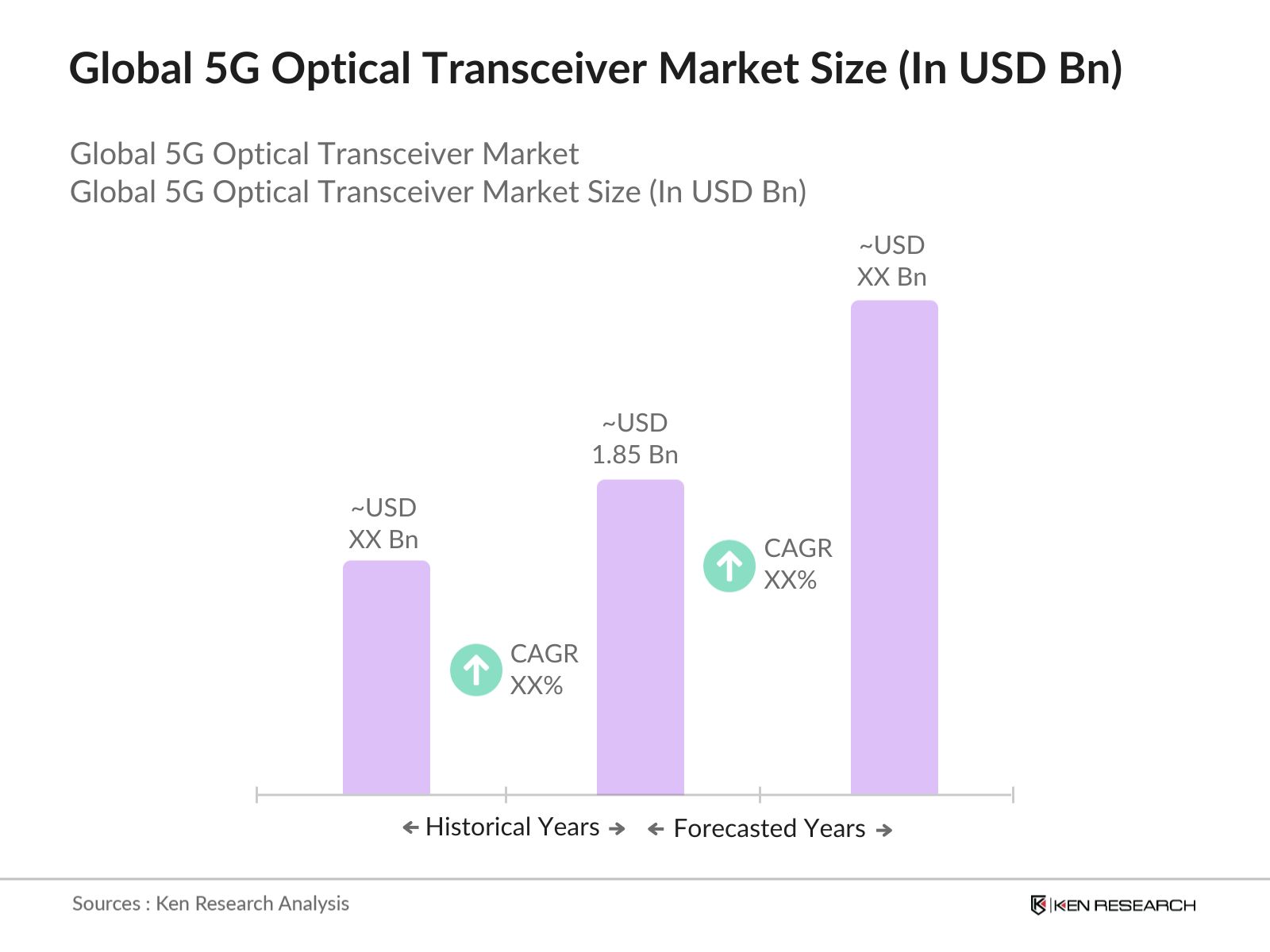
- Countries such as China, the United States, and South Korea are leading the global 5G optical transceiver market. Chinas dominance stems from its aggressive 5G infrastructure expansion plans and large-scale government initiatives to become a leader in telecommunications technology. The U.S. and South Korea are major players due to significant investments in next-generation networking technologies, alongside established technology sectors and strong telecom operators contributing to the rapid deployment of 5G networks.
- Moreover, advancements in optical transceiver technologies, such as increasing data transmission rates, miniaturization, and the integration of artificial intelligence, are contributing to the wider adoption of these components. The market is expected to witness significant investments from key players in developing energy-efficient and high-performance optical transceivers, aimed at meeting the rising data traffic demands.
Global 5G Optical Transceiver Market Segmentation
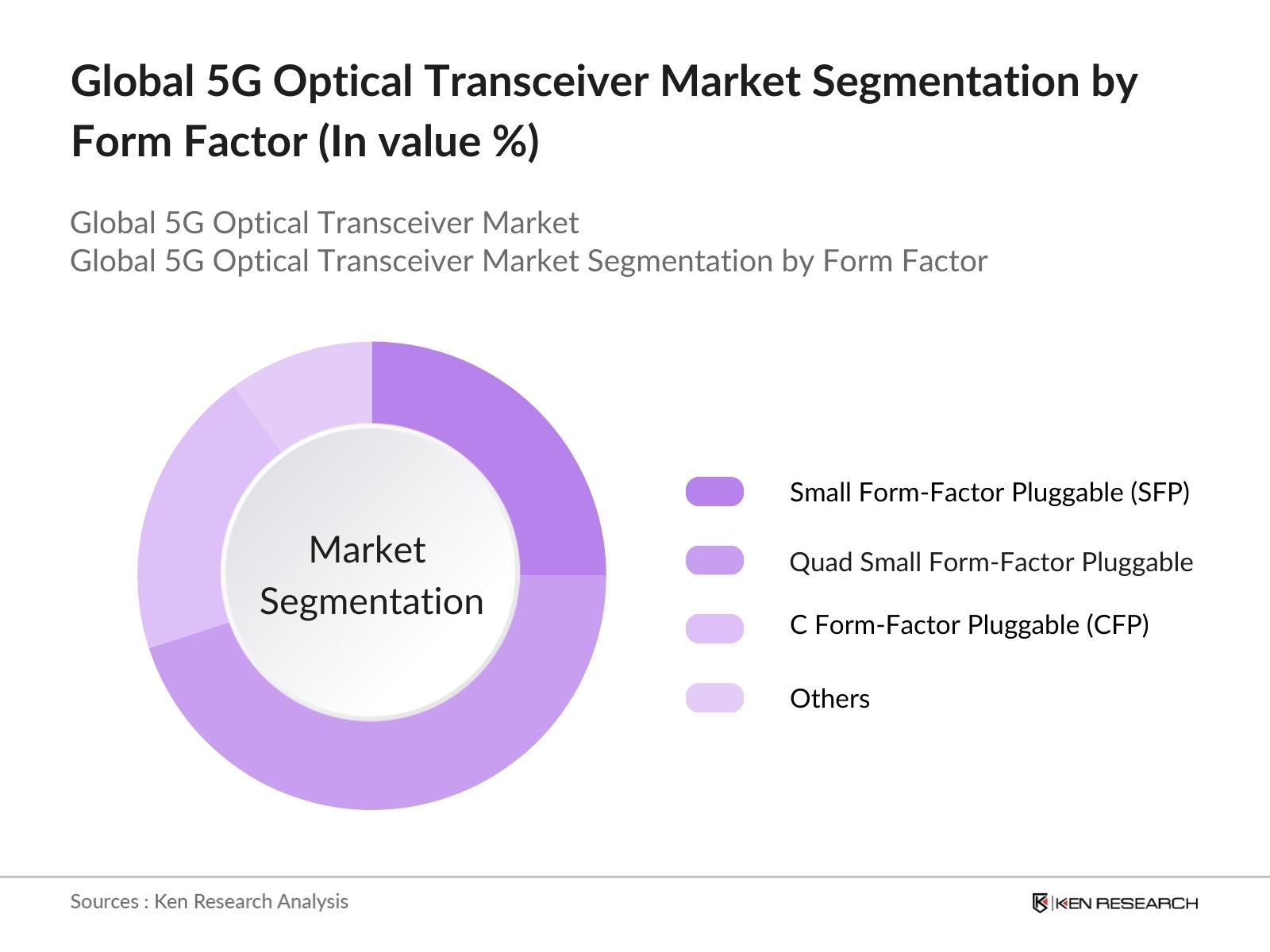
- By Form Factor: The market is segmented into small form-factor pluggable (SFP), quad small form-factor pluggable (QSFP), C form-factor pluggable (CFP), and others. QSFP dominates the segment due to its ability to support high data rates and low power consumption. The increasing demand for data center interconnections and telecommunications networks is driving the growth of the QSFP segment. SFP is also gaining traction in metro networks and enterprise applications due to its compact size and flexibility.
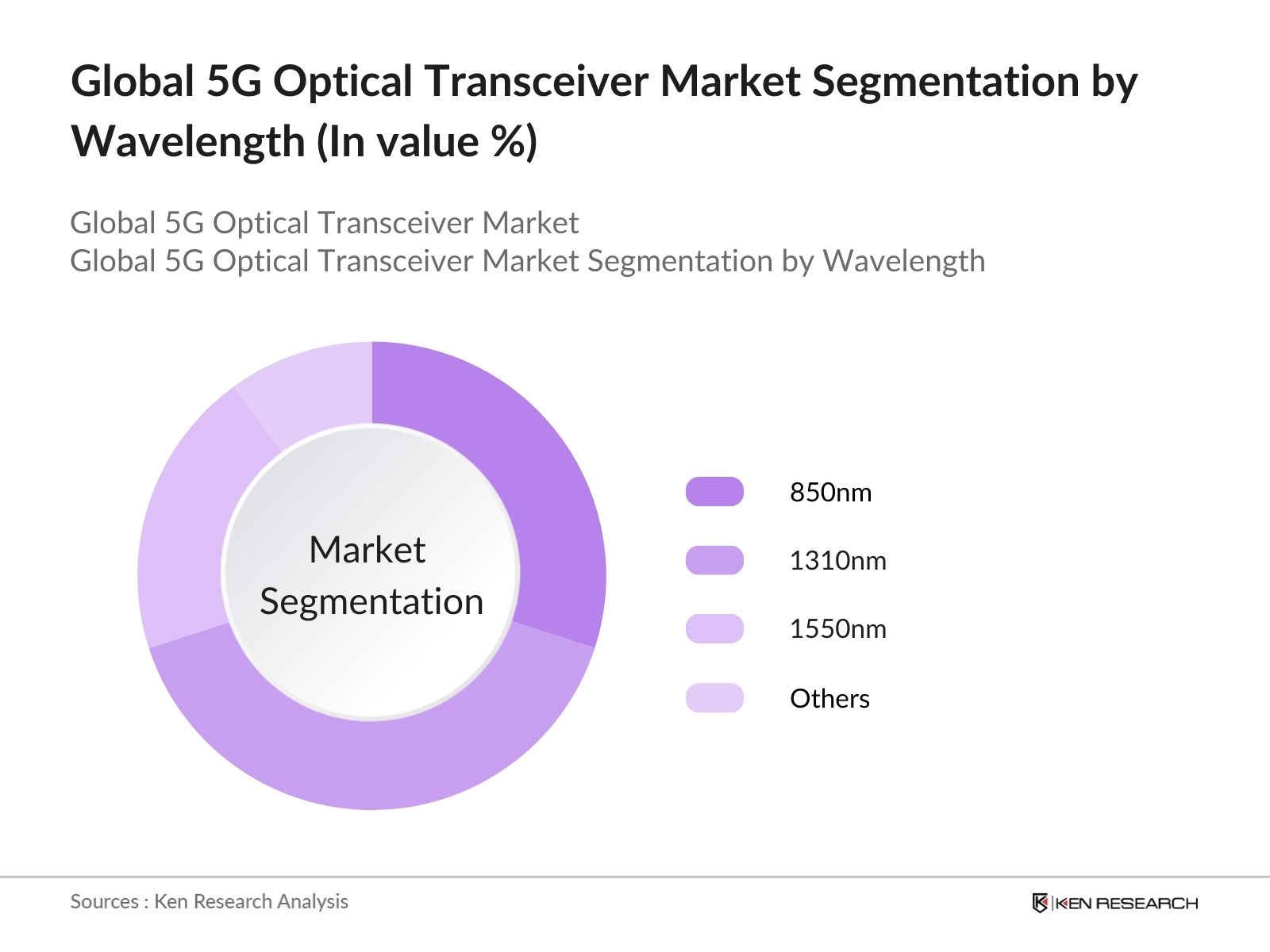
- By Wavelength: Based on wavelength, the market is categorized into 850nm, 1310nm, 1550nm, and others. The 1310nm wavelength is widely used in optical transceivers due to its longer reach in data transmission, making it a preferred choice for metro and long-haul networks. The 850nm segment is primarily used for short-reach data center interconnects and is expected to grow significantly, driven by the increasing need for short-distance high-speed data transfer.
Global 5G Optical Transceiver Market Competitive Landscape
The global 5G optical transceiver market is highly competitive, with key players focusing on innovation and expanding their product portfolios to gain a competitive edge. Leading companies are investing heavily in research and development to introduce high-speed, low-latency optical transceivers that meet the growing demands of 5G networks and data centers.
|
Company Name |
Establishment Year |
Headquarters |
Revenue (2023) |
Market Presence |
R&D Investment |
Global Reach |
Product Portfolio |
Certifications |
|
II-VI Incorporated |
1971 |
Saxonburg, USA |
||||||
|
Lumentum Holdings |
2015 |
Milpitas, USA |
||||||
|
Broadcom Inc. |
1961 |
San Jose, USA |
||||||
|
Sumitomo Electric |
1897 |
Osaka, Japan |
||||||
|
Ciena Corporation |
1992 |
Hanover, USA |
Global 5G Optical Transceiver Market Analysis
Growth Drivers
- Global 5G Network Deployment: The global rollout of 5G networks has accelerated in 2024, with over 220,000 5G base stations deployed in the United States, while China has crossed 1.2 million base stations, according to the World Bank. In Europe, more than 140,000 5G sites have been operational, fostering demand for advanced optical transceivers to support high-speed data transmission. With 5G being essential to modern telecommunications, the need for optical transceivers is vital in handling the increasing bandwidth requirements. This extensive infrastructure build-out directly boosts the demand for optical components to ensure efficient data transmission for 5G.
- Rising Data Traffic (Data Traffic in Terabits per Second): Global data traffic has surged, driven by video streaming, IoT devices, and mobile applications, with data reaching an unprecedented 7.5 terabits per second (Tbps) on some networks in 2024, based on reports by the International Telecommunication Union (ITU). This significant rise in data traffic increases demand for optical transceivers that can handle such capacity. As more consumers and enterprises rely on high-speed connectivity, the role of optical transceivers in efficiently managing and transmitting this vast volume of data becomes critical.
- Expansion of Data Centers: The global data center market has seen exponential growth, with over 8,000 large-scale data centers globally, and more than 2,500 located in North America as of 2024, according to World Bank data. The demand for optical transceivers has correspondingly increased to meet the high-speed data transfer needs of these centers. With each data center requiring a robust optical infrastructure to manage traffic efficiently, optical transceivers play a vital role in supporting the high-volume data processing necessary for cloud services, storage, and edge computing.
Market Challenges:
- High Costs of 5G Infrastructure: The deployment of 5G infrastructure demands substantial capital expenditure, as building the network involves significant investments in base stations, fiber-optic connections, and optical components like transceivers. These high capital requirements pose challenges for network operators, who need to carefully prioritize their spending between infrastructure development and other operational areas. In regions with tighter budgets or where economic constraints are more pronounced, the high costs of initial deployment slow down adoption rates. Consequently, the market for optical transceivers, essential for transmitting high-speed data, faces hurdles in regions where financial resources are limited.
- Technological Complexity: The adoption of advanced modulation formats, including coherent transmission and multiplexing techniques, presents considerable technical challenges for the optical transceiver market. These formats, though offering significant advantages in terms of data transmission speed and capacity, require highly sophisticated and precise manufacturing processes. This complexity delays the widespread implementation of next-generation optical transceivers. Manufacturers must overcome several technological barriers, including ensuring compatibility with newer network demands and maintaining efficiency in transmission, which adds to the overall complexity of product development and market deployment.
Global 5G Optical Transceiver Market Future Outlook
The global 5G optical transceiver market is expected to witness significant growth through 2028, driven by the continuous expansion of 5G networks, increasing data traffic, and advancements in optical transceiver technologies. Market players are likely to focus on developing cost-effective, energy-efficient solutions to meet the growing demand for high-speed data transmission.
Future Market Opportunities:
- Growing Demand in IoT and Edge Computing: The proliferation of IoT devices, projected to surpass 18.8 billion globally in 2024, represents a significant opportunity for the 5G optical transceiver market. As IoT devices increasingly rely on real-time data processing facilitated by edge computing, optical transceivers are critical for delivering high-speed, low-latency connections. ITU reports that by 2024, 65% of IoT devices will be connected via 5G, further driving demand for high-performance transceivers to support this growing market.
- Expansion in Developing Regions: Developing regions such as Southeast Asia and Latin America have started to witness significant investments in 5G infrastructure. Vietnam has invested over USD 2 billion in 5G projects as of 2024, according to the Ministry of Information and Communications. These investments create substantial opportunities for optical transceiver manufacturers, as expanding network infrastructure will require optical components to handle increased traffic and connectivity demands. The growing telecommunications industry in these regions presents a major market opportunity for expansion.
Scope of the Report
|
By Form Factor |
Small Form-Factor Pluggable (SFP) Quad Small Form-Factor Pluggable (QSFP) C Form-Factor Pluggable (CFP) Others |
|
By Wavelength |
850nm 1310nm 1550nm Others |
|
By Data Rate |
Less Than 10 Gbps 10 Gbps to 40 Gbps 40 Gbps to 100 Gbps More Than 100 Gbps |
|
By Application |
Data Centers Telecommunications Enterprise Networks Others |
|
By Region |
North America Europe Asia-Pacific Latin America Middle East & Africa |
Products
Key Target Audience
5G Network Infrastructure Providers
Data Center Operators
Telecommunications Service Providers
Enterprise Network Solutions Providers
Banks and Financial Institutes
Government and Regulatory Bodies (ITU, FCC)
Optical Component Manufacturers
Investments and Venture Capitalist Firms
Technology and Innovation Research Institutes
Companies
Major Players in the Report
II-VI Incorporated
Lumentum Holdings
Broadcom Inc.
Sumitomo Electric
Ciena Corporation
Huawei Technologies
Nokia Corporation
Cisco Systems
Finisar Corporation
Intel Corporation
Arista Networks
InnoLight Technology
Fujitsu Optical Components
NEC Corporation
Acacia Communications
Table of Contents
01 Global 5G Optical Transceiver Market Overview
1.1. Definition and Scope
1.2. Market Taxonomy
1.3. Market Growth Rate
1.4. Market Segmentation Overview
02 Global 5G Optical Transceiver Market Size (In USD Bn)
2.1. Historical Market Size
2.2. Year-On-Year Growth Analysis
2.3. Key Market Developments and Milestones
03 Global 5G Optical Transceiver Market Analysis
3.1. Growth Drivers
3.1.1. Increasing Global Adoption of 5G Networks (Deployment and Expansion)
3.1.2. Rising Demand for High-Speed Data Transmission (Bandwidth Expansion, Latency Reduction)
3.1.3. Technological Advancements in Optical Transceivers (Power Efficiency, Miniaturization)
3.1.4. Growing Data Traffic and Cloud Computing (IoT, Edge Computing)
3.2. Market Challenges
3.2.1. High Initial Deployment Costs (Infrastructure and 5G Hardware)
3.2.2. Compatibility Issues with Legacy Networks (5G Network Upgrades)
3.2.3. Complex Manufacturing Processes (Advanced Optical Technologies)
3.3. Opportunities
3.3.1. Expansion of Data Centers and Cloud Infrastructure (Cloud Services Growth)
3.3.2. Increasing Demand from Emerging Markets (5G Rollout in Developing Economies)
3.3.3. Investments in 5G Infrastructure (Government and Private Sector)
3.4. Trends
3.4.1. Integration of Silicon Photonics (Innovative Technologies)
3.4.2. Adoption of Energy-Efficient Transceivers (Sustainability)
3.4.3. Growth in Use of QSFP-DD Form Factors (High-Density Applications)
3.5. SWOT Analysis
3.5.1. Strengths
3.5.2. Weaknesses
3.5.3. Opportunities
3.5.4. Threats
3.6. Porters Five Forces Analysis
3.6.1. Bargaining Power of Suppliers
3.6.2. Bargaining Power of Buyers
3.6.3. Threat of Substitutes
3.6.4. Threat of New Entrants
3.6.5. Competitive Rivalry
3.7. Stakeholder Ecosystem
3.7.1. Suppliers
3.7.2. Manufacturers
3.7.3. Distributors
3.7.4. End-Users
04 Global 5G Optical Transceiver Market Segmentation
4.1. By Form Factor (In Value %)
4.1.1. Small Form-Factor Pluggable (SFP)
4.1.2. Quad Small Form-Factor Pluggable (QSFP)
4.1.3. C Form-Factor Pluggable (CFP)
4.1.4. Others
4.2. By Wavelength (In Value %)
4.2.1. 850nm
4.2.2. 1310nm
4.2.3. 1550nm
4.2.4. Others
4.3. By Data Rate (In Value %)
4.3.1. Less Than 10 Gbps
4.3.2. 10 Gbps to 40 Gbps
4.3.3. 40 Gbps to 100 Gbps
4.3.4. More Than 100 Gbps
4.4. By Application (In Value %)
4.4.1. Data Centers
4.4.2. Telecommunications
4.4.3. Enterprise Networks
4.4.4. Others
4.5. By Region (In Value %)
4.5.1. North America
4.5.2. Europe
4.5.3. Asia-Pacific
4.5.4. Latin America
4.5.5. Middle East & Africa
05 Global 5G Optical Transceiver Market Competitive Landscape
5.1. Detailed Profiles of Major Companies
5.1.1. II-VI Incorporated
5.1.2. Lumentum Holdings
5.1.3. Broadcom Inc.
5.1.4. Sumitomo Electric
5.1.5. Ciena Corporation
5.1.6. Huawei Technologies
5.1.7. Nokia Corporation
5.1.8. Cisco Systems
5.1.9. Finisar Corporation
5.1.10. Intel Corporation
5.1.11. Arista Networks
5.1.12. InnoLight Technology
5.1.13. Fujitsu Optical Components
5.1.14. NEC Corporation
5.1.15. Acacia Communications
5.2. Cross Comparison Parameters (Form Factor, Wavelength Support, Data Rate, Power Consumption, R&D Investment, Market Presence, Revenue, Product Portfolio)
5.3. Market Share Analysis
5.4. Strategic Initiatives
5.5. Mergers and Acquisitions
5.6. Investment Analysis
5.7. Venture Capital Funding
5.8. Government Grants
5.9. Private Equity Investments
06 Global 5G Optical Transceiver Market Regulatory Framework
6.1. Telecommunication Standards and Certifications
6.2. Compliance with Industry Standards
6.3. Government Regulations and Policies
6.4. Spectrum Allocation for 5G
6.5. Environmental Standards
07 Global 5G Optical Transceiver Future Market Size (In USD Bn)
7.1. Future Market Size Projections
7.2. Key Factors Driving Future Market Growth
08 Global 5G Optical Transceiver Future Market Segmentation
8.1. By Form Factor (In Value %)
8.2. By Wavelength (In Value %)
8.3. By Data Rate (In Value %)
8.4. By Application (In Value %)
8.5. By Region (In Value %)
09 Global 5G Optical Transceiver Market Analyst's Recommendations
9.1. TAM/SAM/SOM Analysis
9.2. Investment Opportunities
9.3. Strategic Market Entry Initiatives
9.4. White Space Opportunity Analysis
Research Methodology
Step 1: Identification of Key Variables
The research process began with constructing a comprehensive map of the 5G optical transceiver market, identifying key players, stakeholders, and technological drivers. Primary data was gathered through secondary databases and proprietary research platforms to capture market trends and external influences shaping the market.
Step 2: Market Analysis and Construction
In this stage, historical data related to market size, technology adoption, and industry penetration were compiled. This analysis helped establish the growth trajectory of the global 5G optical transceiver market, including market penetration in different regions and industries.
Step 3: Hypothesis Validation and Expert Consultation
To validate hypotheses, in-depth interviews were conducted with industry experts and market leaders. These consultations provided insights into market dynamics, demand drivers, and competitive pressures, ensuring accurate and actionable intelligence.
Step 4: Research Synthesis and Final Output
The final phase involved synthesizing data from top-down and bottom-up approaches, complemented by direct feedback from key industry players. This comprehensive analysis enabled the production of an accurate and reliable market report.
Frequently Asked Questions
01. How big is the global 5G optical transceiver market?
The global 5G optical transceiver market was valued at USD 2.3 billion, driven by the increasing demand for high-speed data transmission in telecommunications and data centers.
02. What are the challenges in the global 5G optical transceiver market?
Challenges in the global 5G optical transceiver market include high deployment costs, the complexity of integrating advanced optical technology, and compatibility issues with legacy networks during the transition to 5G.
03. Who are the major players in the global 5G optical transceiver market?
Key players in the global 5G optical transceiver market include II-VI Incorporated, Lumentum Holdings, Broadcom Inc., Sumitomo Electric, and Ciena Corporation, among others, each known for their focus on innovative and energy-efficient transceivers.
04. What are the growth drivers of the global 5G optical transceiver market?
Growth drivers in global 5G optical transceiver the include the rapid deployment of 5G infrastructure, increasing data traffic, and technological advancements in optical transceivers that support high-speed, low-latency data transfer.
Why Buy From Us?

What makes us stand out is that our consultants follows Robust, Refine and Result (RRR) methodology. i.e. Robust for clear definitions, approaches and sanity checking, Refine for differentiating respondents facts and opinions and Result for presenting data with story

We have set a benchmark in the industry by offering our clients with syndicated and customized market research reports featuring coverage of entire market as well as meticulous research and analyst insights.

While we don't replace traditional research, we flip the method upside down. Our dual approach of Top Bottom & Bottom Top ensures quality deliverable by not just verifying company fundamentals but also looking at the sector and macroeconomic factors.

With one step in the future, our research team constantly tries to show you the bigger picture. We help with some of the tough questions you may encounter along the way: How is the industry positioned? Best marketing channel? KPI's of competitors? By aligning every element, we help maximize success.

Our report gives you instant access to the answers and sources that other companies might choose to hide. We elaborate each steps of research methodology we have used and showcase you the sample size to earn your trust.

If you need any support, we are here! We pride ourselves on universe strength, data quality, and quick, friendly, and professional service.