















Global Acrylates Copolymer Market Outlook to 2030
Region:Global
Author(s):Vijay Kumar
Product Code:KROD7838
November 2024
87
About the Report
Global Acrylates Copolymer Market Overview
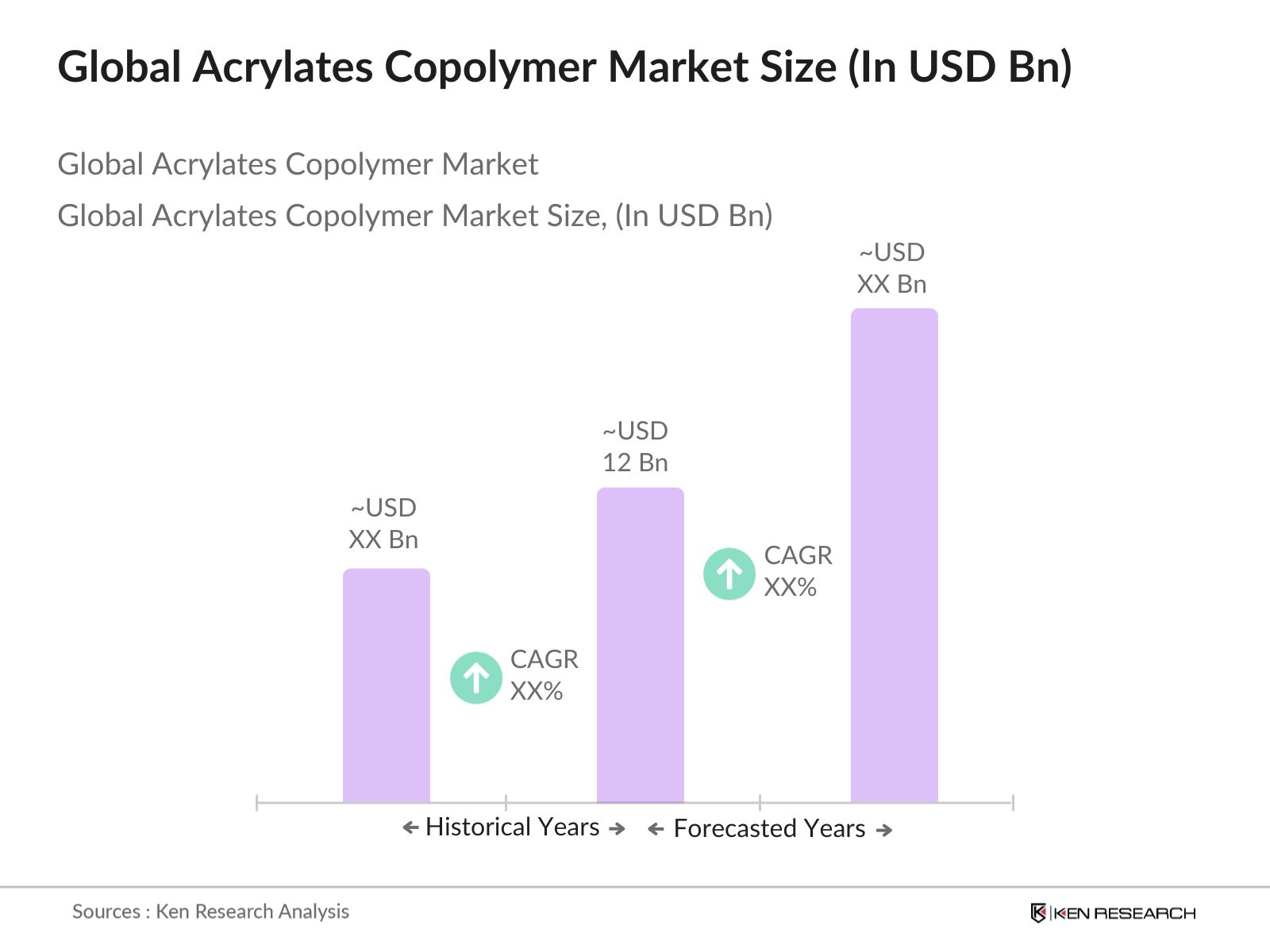
- The global acrylates copolymer market is valued at USD 12 billion, based on a five-year historical analysis. This market is primarily driven by rising demand in industries such as paints & coatings, adhesives, and personal care products. Acrylates copolymers are highly valued for their adhesive properties, flexibility, and ability to enhance durability, making them essential components in these industries. Additionally, the construction and automotive sectors contribute significantly to the market due to the demand for high-performance materials with strong binding and coating properties.
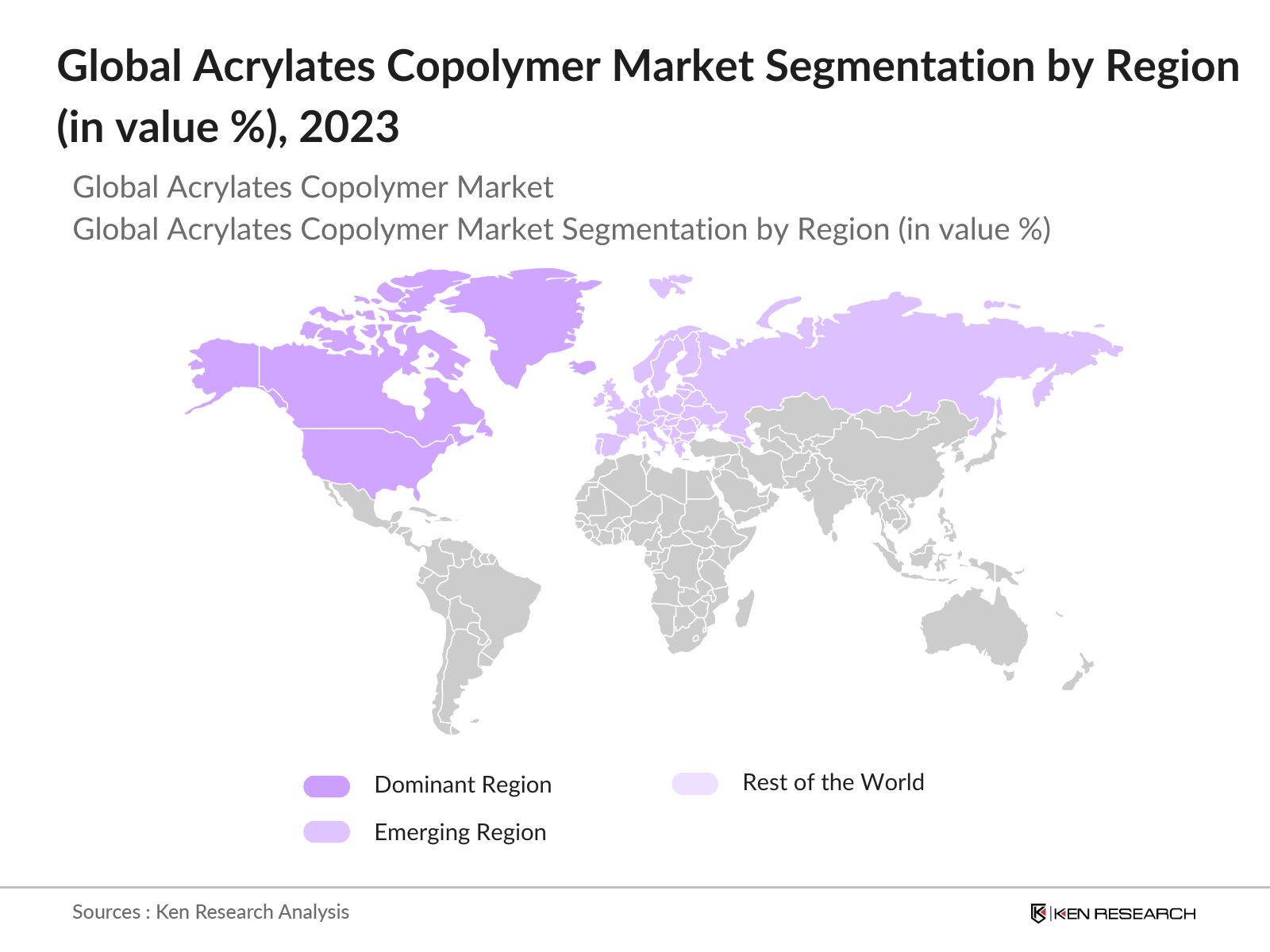
- The global acrylates copolymer market is dominated by the Asia-Pacific (APAC) region, followed by North America and Europe. APAC holds the largest market share due to rapid industrialization, urbanization, and the booming automotive and construction industries in countries like China, India, and Japan. The region's large manufacturing base, coupled with increasing infrastructure projects and growing demand for personal care products, drives substantial growth. North America, led by the United States, benefits from technological advancements in polymerization techniques and a strong demand for sustainable materials, especially in the automotive and construction sectors.
- Regulatory bodies like the EPA in the United States and the ECHA in the European Union have set stringent standards for VOC emissions from acrylates copolymer-based products. In 2024, the maximum allowable VOC content for paints and coatings has been reduced to 50 grams per liter in these regions, pushing manufacturers to develop lower-VOC formulations. Compliance with these guidelines is mandatory to reduce harmful emissions and protect air quality, significantly influencing the market for acrylates copolymers.
Global Acrylates Copolymer Market Segmentation
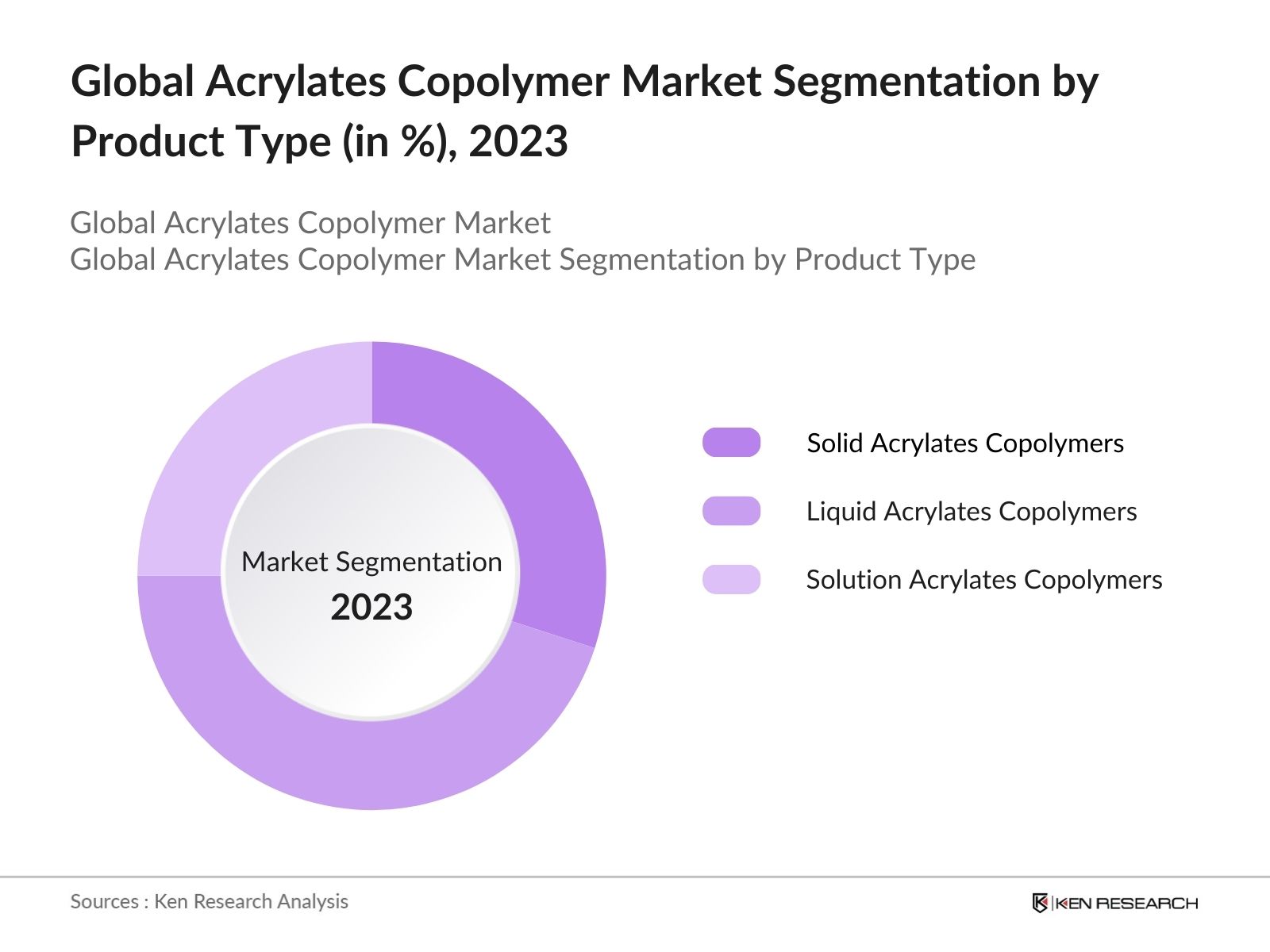
By Product Type: The global acrylates copolymer market is segmented into solid acrylates copolymers, liquid acrylates copolymers, and solution acrylates copolymers. Among these, liquid acrylates copolymers hold the dominant share of 45% in the market for 2023. This dominance is attributed to their wide usage in industries like paints and coatings, adhesives, and textiles.
By Application: The acrylates copolymer market is segmented by application into paints & coatings, adhesives & sealants, personal care products, construction materials, and textiles. Paints & coatings represent the largest market segment with a share of 50% in 2023. The high consumption of paints and coatings in the automotive and construction industries has propelled this segment to the top.
By Region: Geographically, the global acrylates copolymer market is segmented into North America, Europe, Asia-Pacific, Latin America, and the Middle East & Africa. Asia-Pacific holds the highest share at 35% in 2023, largely due to the presence of major manufacturing hubs in China, India, and Japan.
Global Acrylates Copolymer Market Competitive Landscape
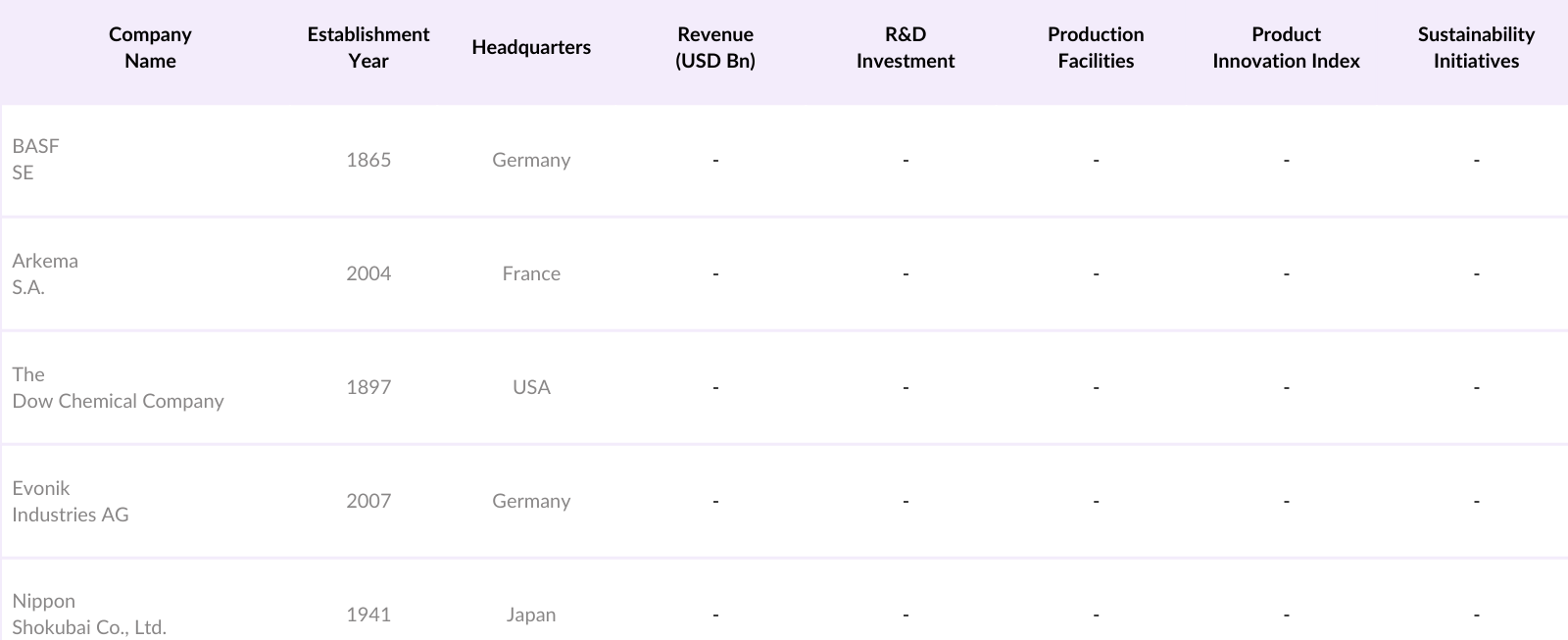
The global acrylates copolymer market is dominated by several key players with extensive R&D capabilities, robust production capacities, and wide geographical presence. The market consolidation is driven by technological advancements, strategic acquisitions, and partnerships that enhance product portfolios. Key companies have also focused on sustainability initiatives, responding to the increasing demand for environmentally friendly and low-VOC materials.
Global Acrylates Copolymer Industry Analysis
Growth Drivers
- Demand from Paints & Coatings (Revenue Contribution from Paints & Coatings): Acrylates copolymer demand from the paints and coatings industry is driven by increased construction activities and automotive manufacturing. In 2024, global construction output is expected to reach USD 12.9 trillion, with significant contributions from the US and China, both experiencing rapid urbanization and infrastructural investments.
- Rising Applications in Personal Care (Market Share by Personal Care Applications): The personal care industry has increasingly integrated acrylates copolymers into products such as hair styling gels, sunscreen lotions, and skincare products due to their film-forming and thickening properties. In 2024, the global personal care products market is estimated to grow with notable momentum, driven by demand from urban populations in emerging markets like India and Brazil, where the combined population exceeds 1.6 billion.
- Growth of Construction Sector (Growth Rate of Construction Industry): The growth of the construction sector significantly impacts acrylates copolymer demand, particularly for water-based adhesives, sealants, and coatings. With global construction output projected at USD 12.9 trillion in 2024, countries like China, India, and the US are leading the charge, contributing to over 50% of this market. Infrastructure projects, housing developments, and commercial real estate expansion require weather-resistant and durable materials, positioning acrylates copolymers as a key component in construction-related applications.
Market Challenges
- Volatility in Raw Material Prices (Price Fluctuation of Key Raw Materials): The acrylates copolymer market faces significant challenges from volatile raw material prices, especially for crude oil derivatives like butyl acrylate and ethyl acrylate, which are essential inputs. In 2024, global crude oil prices have fluctuated between USD 70 and USD 90 per barrel, affecting the cost structure of acrylates production. This price volatility creates uncertainty in the supply chain and compresses profit margins, particularly for small and medium-sized manufacturers who rely on stable input costs to remain competitive.
- Regulatory Constraints (Government Regulations on VOC Emissions): Acrylates copolymers, particularly those used in paints and coatings, face increasing regulatory scrutiny due to volatile organic compound (VOC) emissions. In 2024, stricter emission regulations have been implemented in both the European Union and the United States, where regulatory bodies like the Environmental Protection Agency (EPA) and the European Chemicals Agency (ECHA) enforce stringent VOC limits. These regulations aim to reduce air pollution and improve environmental sustainability, pushing manufacturers towards the development of low-VOC formulations, thus increasing compliance costs.
Global Acrylates Copolymer Market Future Outlook
Over the next five years, the global acrylates copolymer market is expected to witness substantial growth, driven by increased demand for sustainable, high-performance materials. Expanding applications in the automotive, construction, and personal care sectors, combined with technological innovations in polymerization processes, will contribute to market expansion. Moreover, the rise in eco-friendly formulations and the shift towards low-VOC products will enhance market demand, as industries respond to tightening environmental regulations and sustainability goals.
Market Opportunities
- Expansion in Emerging Economies (Geographical Expansion in Developing Regions): Emerging economies in Asia-Pacific, Africa, and Latin America present significant growth opportunities for acrylates copolymers. In 2024, Asia-Pacifics construction sector, driven by urbanization in India and China, is expected to grow by over USD 6.5 trillion. Governments in these regions are investing heavily in infrastructure development, creating a strong demand for high-performance coatings and adhesives.
- Innovation in Sustainable Acrylates (Eco-Friendly Product Development): Sustainability is a growing focus in the acrylates copolymer market, with increasing demand for eco-friendly alternatives. In 2024, Europe and North America have led initiatives in developing bio-based acrylates, driven by regulations aimed at reducing petrochemical dependence and carbon footprints. Major producers are investing in the research and development of bio-based acrylates copolymers, leveraging renewable feedstocks to meet consumer and regulatory demands.
Scope of the Report
|
Product Type |
Solid Acrylates Copolymers Liquid Acrylates Copolymers Solution Acrylates Copolymers |
|
Application |
Paints & Coatings Adhesives & Sealants Personal Care Products Construction Materials Textiles |
|
End-Use Industry |
Automotive Industry Consumer Goods Healthcare Packaging |
|
Polymerization Technique |
Emulsion Polymerization Suspension Polymerization Solution Polymerization |
|
Region |
North America Europe Asia Pacific Latin America Middle East & Africa |
Products
Key Target Audience
Automotive Manufacturers
Construction Companies
Adhesives & Sealants Manufacturers
Personal Care Product Manufacturers
Paints & Coatings Manufacturers
Government and Regulatory Bodies (e.g., EPA, REACH)
Investments and Venture Capital Firms
Sustainability Consulting Firms
Companies
Players Mentioned in the Report
BASF SE
Arkema S.A.
The Dow Chemical Company
Evonik Industries AG
Nippon Shokubai Co., Ltd.
Lubrizol Corporation
Ashland Inc.
Mitsubishi Chemical Holdings
Eastman Chemical Company
LG Chem Ltd.
Table of Contents
1. Global Acrylates Copolymer Market Overview
1.1. Definition and Scope
1.2. Market Taxonomy
1.3. Market Growth Rate
1.4. Market Segmentation Overview
2. Global Acrylates Copolymer Market Size (In USD Bn)
2.1. Historical Market Size
2.2. Year-On-Year Growth Analysis
2.3. Key Market Developments and Milestones
3. Global Acrylates Copolymer Market Analysis
3.1. Growth Drivers
3.1.1. Demand from Paints & Coatings (Revenue Contribution from Paints & Coatings)
3.1.2. Rising Applications in Personal Care (Market Share by Personal Care Applications)
3.1.3. Growth of Construction Sector (Growth Rate of Construction Industry)
3.1.4. Technological Advancements in Polymerization (Impact on Production Cost)
3.2. Market Challenges
3.2.1. Volatility in Raw Material Prices (Price Fluctuation of Key Raw Materials)
3.2.2. Regulatory Constraints (Government Regulations on VOC Emissions)
3.2.3. Competition from Alternative Materials (Substitute Product Penetration)
3.3. Opportunities
3.3.1. Expansion in Emerging Economies (Geographical Expansion in Developing Regions)
3.3.2. Innovation in Sustainable Acrylates (Eco-Friendly Product Development)
3.3.3. Increasing Demand for UV-Resistant Coatings (Growth in UV-Resistant Products)
3.4. Trends
3.4.1. Rise in Water-Based Copolymers (Share of Water-Based vs Solvent-Based Products)
3.4.2. Adoption in Smart Packaging Solutions (Market Adoption in Smart Packaging)
3.4.3. Shift Toward Low VOC Formulations (Low VOC Formulation Trends)
3.5. Government Regulation
3.5.1. Regulatory Standards for Emissions (VOC and Hazardous Emission Guidelines)
3.5.2. Trade Tariffs and Impact on Imports (Tariff Barriers for Acrylates Copolymers)
3.5.3. Environmental Sustainability Mandates (Compliance with Environmental Laws)
3.5.4. Certification Processes (ISO Certifications, Green Label Certifications)
3.6. SWOT Analysis
3.7. Stake Ecosystem (Suppliers, Manufacturers, Distributors, End Users)
3.8. Porters Five Forces (Bargaining Power of Suppliers, Buyers, Substitutes, New Entrants, Rivalry)
3.9. Competition Ecosystem
4. Global Acrylates Copolymer Market Segmentation
4.1. By Product Type (In Value %)
4.1.1. Solid Acrylates Copolymers
4.1.2. Liquid Acrylates Copolymers
4.1.3. Solution Acrylates Copolymers
4.2. By Application (In Value %)
4.2.1. Paints & Coatings
4.2.2. Adhesives & Sealants
4.2.3. Personal Care Products
4.2.4. Construction Materials
4.2.5. Textiles
4.3. By End-Use Industry (In Value %)
4.3.1. Automotive Industry
4.3.2. Consumer Goods
4.3.3. Healthcare
4.3.4. Packaging
4.4. By Polymerization Technique (In Value %)
4.4.1. Emulsion Polymerization
4.4.2. Suspension Polymerization
4.4.3. Solution Polymerization
4.5. By Region (In Value %)
4.5.1. North America
4.5.2. Europe
4.5.3. Asia Pacific
4.5.4. Latin America
4.5.5. Middle East & Africa
5. Global Acrylates Copolymer Market Competitive Analysis
5.1. Detailed Profiles of Major Companies
5.1.1. BASF SE
5.1.2. Arkema S.A.
5.1.3. The Dow Chemical Company
5.1.4. Lubrizol Corporation
5.1.5. Ashland Inc.
5.1.6. Evonik Industries AG
5.1.7. Mitsubishi Chemical Holdings
5.1.8. Eastman Chemical Company
5.1.9. Nippon Shokubai Co., Ltd.
5.1.10. LG Chem Ltd.
5.1.11. Celanese Corporation
5.1.12. Synthomer PLC
5.1.13. Wacker Chemie AG
5.1.14. Soken Chemical & Engineering Co., Ltd.
5.1.15. Arkema Group
5.2. Cross Comparison Parameters
Revenue
Market Share
Product Portfolio
Headquarters Location
Global Presence
R&D Investment
Product Innovation Index
Sustainability Initiatives
5.3. Market Share Analysis
5.4. Strategic Initiatives
5.5. Mergers and Acquisitions
5.6. Investment Analysis
5.7. Venture Capital Funding
5.8. Government Grants
5.9. Private Equity Investments
6. Global Acrylates Copolymer Market Regulatory Framework
6.1. Environmental Standards
6.2. Compliance Requirements
6.3. Certification Processes
7. Global Acrylates Copolymer Future Market Size (In USD Bn)
7.1. Future Market Size Projections
7.2. Key Factors Driving Future Market Growth
8. Global Acrylates Copolymer Future Market Segmentation
8.1. By Product Type (In Value %)
8.2. By Application (In Value %)
8.3. By End-Use Industry (In Value %)
8.4. By Polymerization Technique (In Value %)
8.5. By Region (In Value %)
9. Global Acrylates Copolymer Market Analysts Recommendations
9.1. TAM/SAM/SOM Analysis
9.2. Customer Cohort Analysis
9.3. Marketing Initiatives
9.4. White Space Opportunity Analysis
Disclaimer Contact UsResearch Methodology
Step 1: Identification of Key Variables
In this step, an ecosystem map of the acrylates copolymer market is constructed, covering all stakeholders, including suppliers, manufacturers, and end users. Extensive desk research and secondary data sources such as industry reports, databases, and financial filings are used to define the critical variables affecting the market.
Step 2: Market Analysis and Construction
This phase involves the collection and analysis of historical data, focusing on key metrics such as market penetration, market share, and revenue. Additionally, insights into pricing trends, product innovation, and geographic distribution are collected to construct a complete market picture.
Step 3: Hypothesis Validation and Expert Consultation
After forming initial hypotheses regarding market trends, the research is validated by consulting industry experts. These consultations provide detailed insights into manufacturing processes, product developments, and emerging market challenges, which enhance the overall accuracy of the analysis.
Step 4: Research Synthesis and Final Output
The final step involves synthesizing the research findings into a comprehensive market report, ensuring all quantitative and qualitative data are thoroughly verified. This includes cross-referencing statistics with industry benchmarks and finalizing the report for publication.
Frequently Asked Questions
01 How big is the Global Acrylates Copolymer Market?
The global acrylates copolymer market is valued at USD 12 billion, based on a five-year historical analysis. This market is primarily driven by rising demand in industries such as paints & coatings, adhesives, and personal care products.
02 What are the challenges in the Acrylates Copolymer Market?
Challenges include the volatility of raw material prices, regulatory pressures regarding VOC emissions, and competition from alternative materials such as silicones and epoxies.
03 Who are the major players in the Acrylates Copolymer Market?
Major players include BASF SE, Arkema S.A., The Dow Chemical Company, Evonik Industries AG, and Nippon Shokubai Co., Ltd., all of which dominate due to their technological advancements and extensive product portfolios.
04 What are the growth drivers of the Acrylates Copolymer Market?
The market is primarily driven by the growing demand in construction, automotive, and personal care sectors. Technological advancements in polymerization and rising demand for eco-friendly materials also propel growth.
Why Buy From Us?

What makes us stand out is that our consultants follows Robust, Refine and Result (RRR) methodology. i.e. Robust for clear definitions, approaches and sanity checking, Refine for differentiating respondents facts and opinions and Result for presenting data with story

We have set a benchmark in the industry by offering our clients with syndicated and customized market research reports featuring coverage of entire market as well as meticulous research and analyst insights.

While we don't replace traditional research, we flip the method upside down. Our dual approach of Top Bottom & Bottom Top ensures quality deliverable by not just verifying company fundamentals but also looking at the sector and macroeconomic factors.

With one step in the future, our research team constantly tries to show you the bigger picture. We help with some of the tough questions you may encounter along the way: How is the industry positioned? Best marketing channel? KPI's of competitors? By aligning every element, we help maximize success.

Our report gives you instant access to the answers and sources that other companies might choose to hide. We elaborate each steps of research methodology we have used and showcase you the sample size to earn your trust.

If you need any support, we are here! We pride ourselves on universe strength, data quality, and quick, friendly, and professional service.