
Global AI Chipsets Market Outlook to 2030
Region:Global
Author(s):Sanjna
Product Code:KROD3363
November 2024
90
About the Report
Global AI Chipsets Market Overview
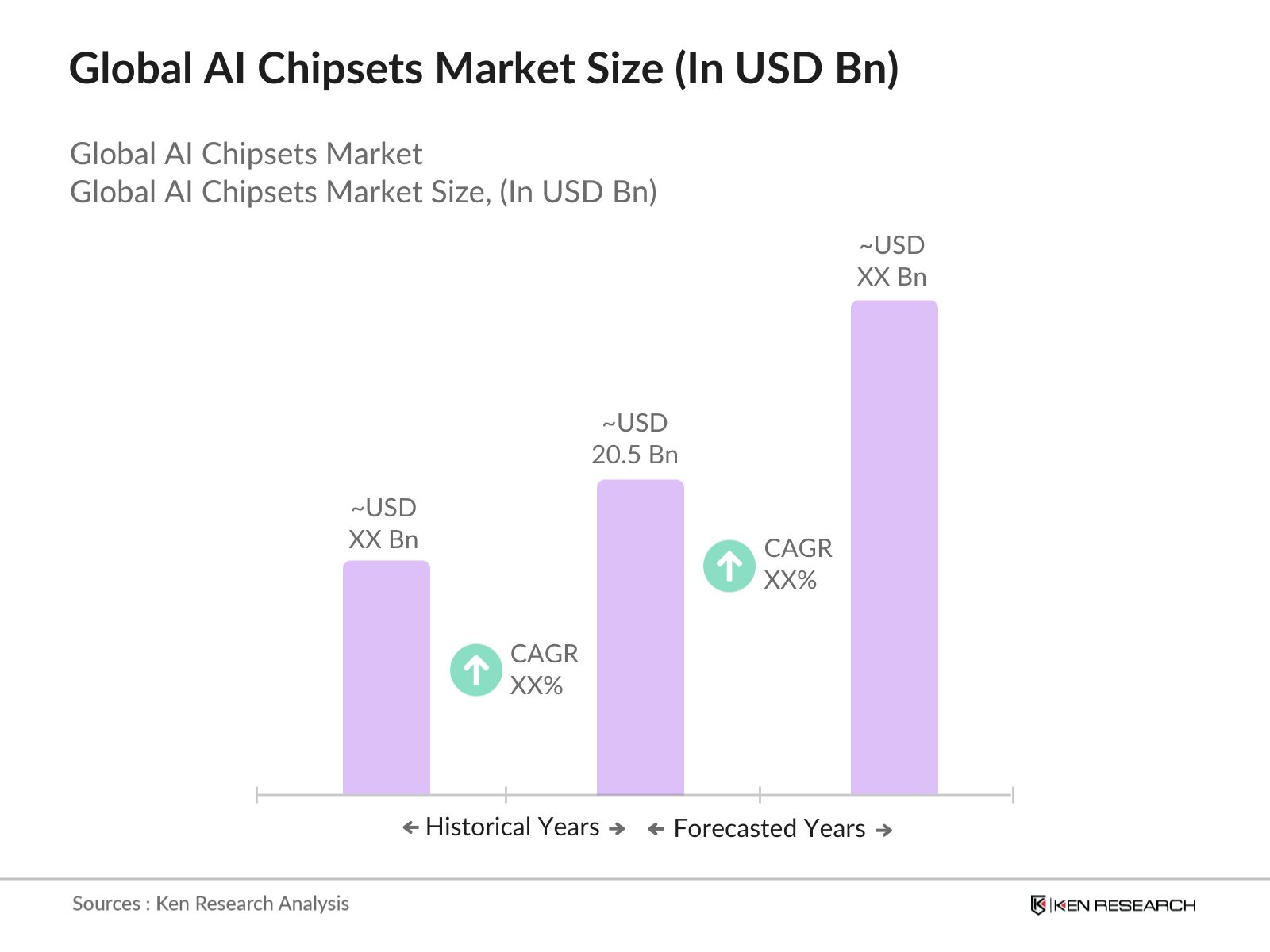
- The Global AI Chipsets Market is valued at USD 20.5 billion, driven primarily by the expanding demand for AI-powered applications in sectors such as healthcare, automotive, and consumer electronics. Key growth factors include the rapid adoption of AI technologies across industries, the growing need for processing massive amounts of data, and technological advancements in chipset manufacturing.
- Countries like the United States, China, and South Korea dominate the AI chipsets market due to their robust semiconductor industries, technological leadership, and government-backed initiatives that encourage AI research and development. These countries have the advantage of well-established manufacturing facilities and leading tech companies that have invested heavily in AI chipset development, enabling them to capture significant portions of the global market.
- AI chipsets process vast amounts of sensitive data, making them a focal point for data privacy regulations. By 2023, more than 80 countries had implemented comprehensive data privacy laws, including the GDPR in Europe and the CCPA in the USA. According to the IMF, global spending on cybersecurity and data protection measures reached $240 billion in 2023, with AI chipsets playing a key role in ensuring compliance with these regulations. The increased focus on data privacy is driving advancements in secure AI chipset designs.
Global AI Chipsets Market Segmentation
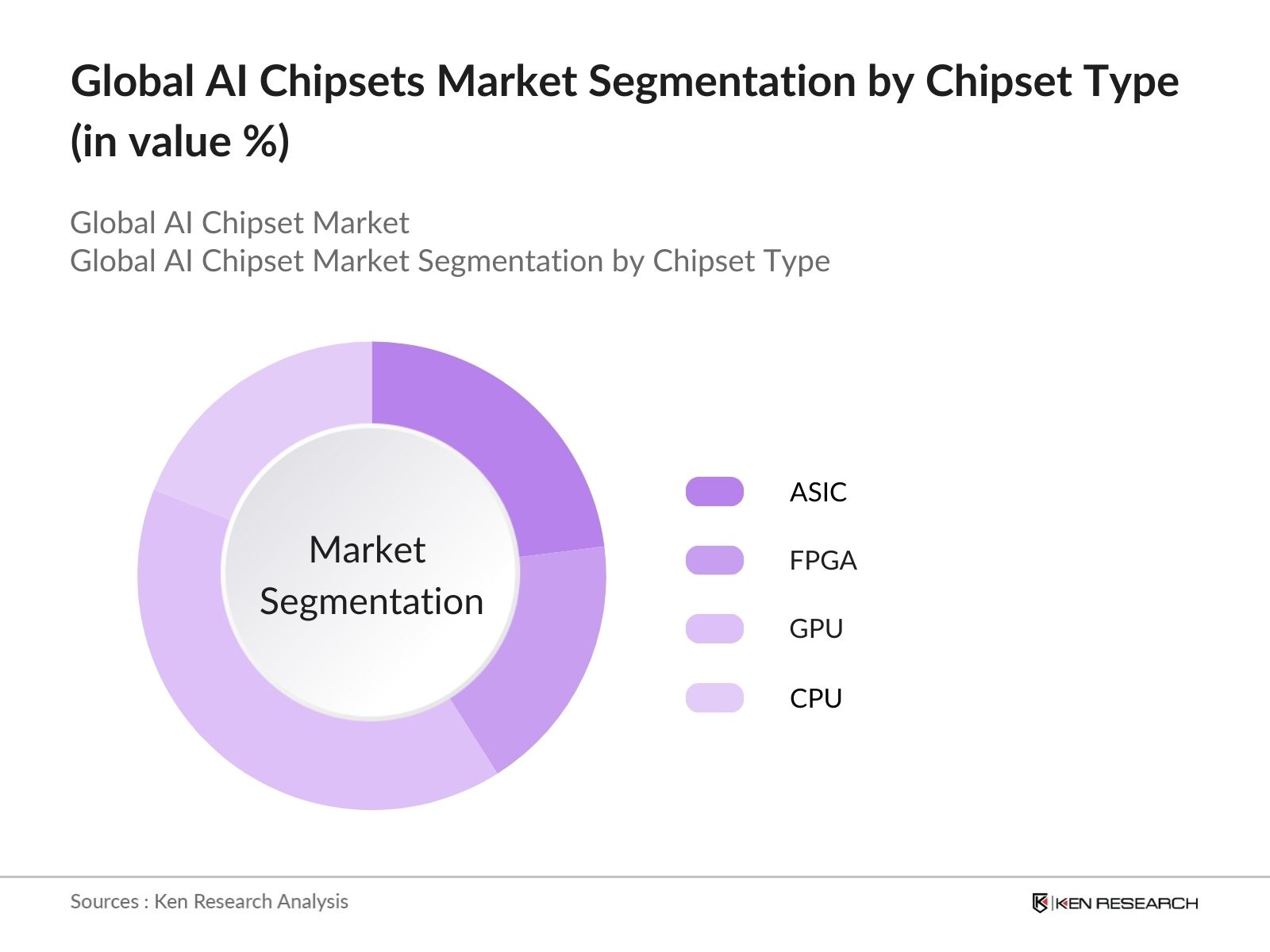
By Chipset Type: The global AI chipsets market is segmented by chipset type into Application-Specific Integrated Circuits (ASIC), Field Programmable Gate Arrays (FPGA), Graphics Processing Units (GPU), and Central Processing Units (CPU). Recently, GPUs have dominated the market due to their parallel processing capabilities, making them ideal for deep learning applications. Companies like Nvidia have played a key role in cementing GPUs as the preferred chipset for AI tasks, given their proven efficiency in handling complex AI computations across multiple industries, especially in autonomous vehicles and cloud computing.
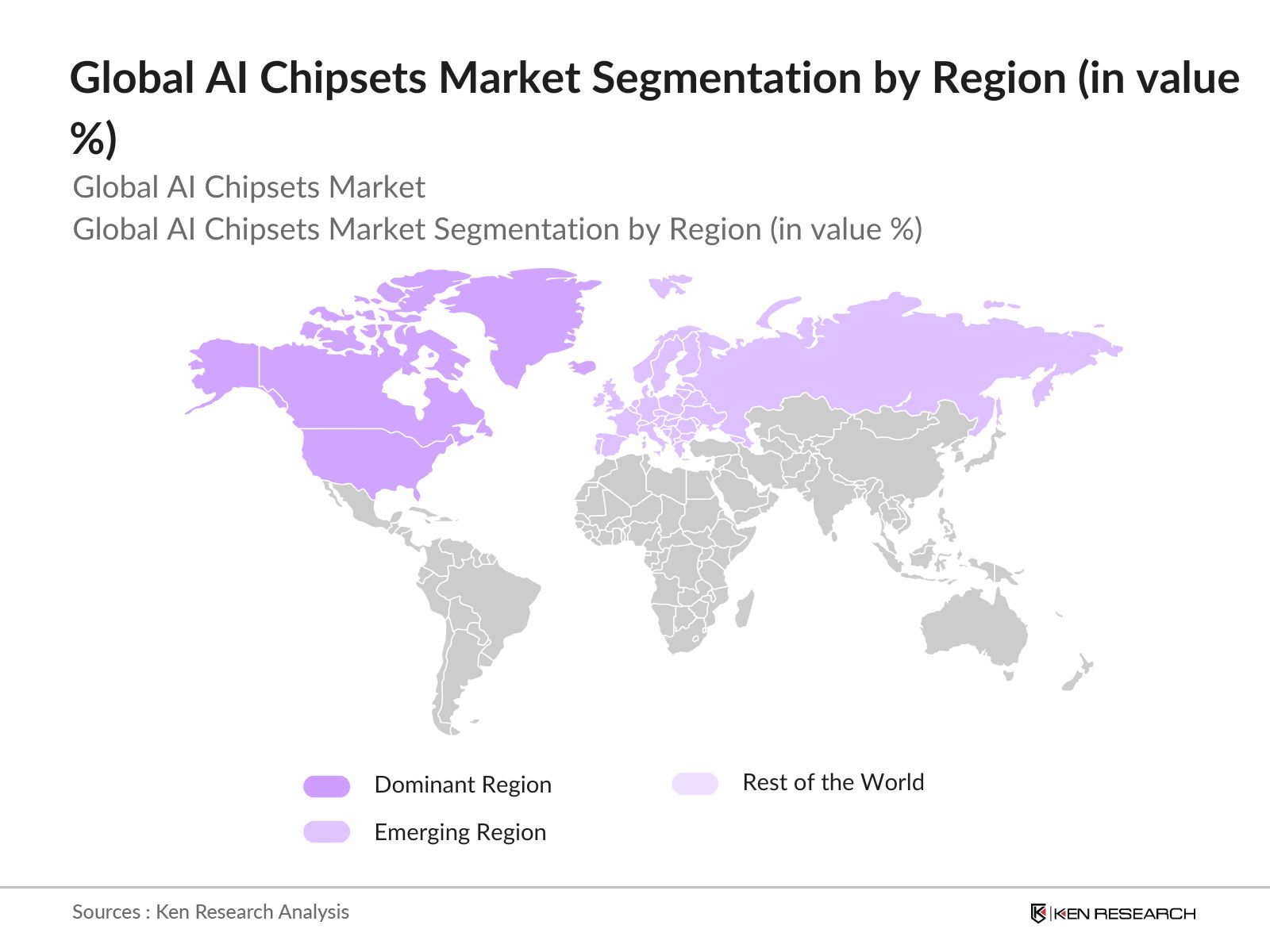
By Region: The global AI chipsets market is segmented by region into North America, Europe, Asia Pacific, Latin America, and the Middle East & Africa. North America dominates the market due to the presence of major AI technology companies like Nvidia, Google, and Intel, coupled with strong government support for AI research. The region's dominance is driven by its advanced infrastructure and significant investment in AI-based innovations across industries such as healthcare, automotive, and defense.
By Application: The global AI chipsets market is segmented by application into autonomous vehicles, healthcare, smart consumer devices, and robotics. Autonomous vehicles hold the largest market share in this category, primarily due to the growing adoption of AI technologies in developing advanced driver assistance systems (ADAS) and fully autonomous driving capabilities. The significant R&D investments from automotive giants like Tesla and traditional automakers have driven the demand for AI chipsets that can process real-time data and enhance vehicle safety, thereby leading this segment's growth.
Global AI Chipsets Market Competitive Landscape
The global AI chipsets market is dominated by a few major players who have established a strong foothold through technological advancements, extensive research, and strategic acquisitions. Key players such as Nvidia, Intel, and Qualcomm lead the market by leveraging their advanced R&D capabilities, robust product portfolios, and global distribution networks. The competitive landscape is marked by continuous innovations, collaborations with cloud service providers, and investments in AI-specific hardware to strengthen their market positions.
|
Company |
Establishment Year |
Headquarters |
Revenue (USD Bn) |
No. of Employees |
R&D Spending |
AI Product Line |
Key Partnerships |
|
Nvidia Corporation |
1993 |
Santa Clara, CA, USA |
- |
- |
- |
- |
- |
|
Intel Corporation |
1968 |
Santa Clara, CA, USA |
- |
- |
- |
- |
- |
|
Qualcomm Technologies Inc. |
1985 |
San Diego, CA, USA |
- |
- |
- |
- |
- |
|
Huawei Technologies Co., Ltd. |
1987 |
Shenzhen, China |
- |
- |
- |
- |
- |
|
Advanced Micro Devices Inc. (AMD) |
1969 |
Santa Clara, CA, USA |
- |
- |
- |
- |
- |
Global AI Chipsets Market Analysis
Growth Drivers
- Increasing Demand for Edge Computing: Edge computing is gaining traction due to the need for real-time processing of data closer to the source. AI chipsets are critical in enabling this shift by offering localized processing power in devices like sensors and cameras. As of 2024, global shipments of edge AI chipsets are projected to surpass 700 million units, driven by demand in sectors such as manufacturing, healthcare, and automotive. The World Bank has reported a 30% increase in investments in smart cities and IoT infrastructure in 2023, which directly boosts the demand for AI chipsets in edge computing.
- Expansion of AI Applications Across Industries: Artificial intelligence is expanding across various sectors, including finance, retail, and healthcare. In 2024, the global adoption of AI applications in manufacturing grew by 18%, with AI chipsets enabling predictive maintenance and automation. According to the IMF, the global manufacturing sector was valued at $35 trillion in 2023, with AI-driven automation being a significant contributor to efficiency gains. AI chipsets are pivotal in processing complex algorithms in industries like healthcare, where diagnostic accuracy is enhanced by 20% due to AI.
- Rise of AI in Consumer Devices: AI chipsets are integral to the growing integration of AI in consumer devices such as smartphones, wearables, and home assistants. As of 2024, more than 2 billion AI-powered consumer devices are in use globally. The IMF highlights a $500 billion increase in global consumer electronics sales in 2023, emphasizing the role of AI chipsets in enhancing device capabilities and user experience.
Challenges
- High Development Costs: The development of AI chipsets involves high research, design, and manufacturing costs. A single AI chip requires significant investment, with companies spending an estimated $3 billion annually on R&D for AI chip development. These high costs can be attributed to the need for advanced fabrication technologies and materials. Despite rising demand, the cost factor poses a challenge for smaller enterprises seeking to integrate AI chipsets into their products.
- Complexity in Design and Fabrication: AI chipsets are becoming increasingly complex due to the demands of deep learning and neural network processing. The number of transistors on AI chips reached 50 billion in 2023, requiring advanced fabrication technologies such as 3nm and 5nm processes. According to the World Bank, the semiconductor industry experienced a 15% increase in fabrication complexities in 2023, which significantly impacts production timelines and yields. These complexities are a challenge for manufacturers, making it difficult to scale production efficiently.
Global AI Chipsets Future Market Outlook
Over the next five years, the Global AI Chipsets Market is expected to witness robust growth driven by technological innovations, increased demand for AI-integrated devices, and expanding AI applications in various industries. The automotive and healthcare sectors are projected to be the major contributors to this growth, as AI continues to play a crucial role in advancements like autonomous driving and AI-assisted diagnostics. Strategic collaborations between AI chip manufacturers and cloud service providers will further fuel market expansion.
Market Opportunities
- Growth in AI-Powered Autonomous Vehicles: The integration of AI chipsets into autonomous vehicles is driving advancements in vehicle safety, navigation, and automation. By 2023, over 3 million autonomous vehicles were operating worldwide, with AI chipsets playing a critical role in processing the vast amounts of sensor data required for navigation. The deployment of AI chipsets in this sector offers substantial opportunities for further innovation and market expansion.
- AI Chipset Integration in Healthcare Applications: AI chipsets are transforming healthcare by enabling faster diagnostics, predictive analytics, and personalized treatments. As of 2023, AI-powered diagnostic tools had improved diagnostic accuracy by 25%, with AI chipsets being integral to processing complex medical data. This creates a lucrative opportunity for chipset manufacturers to expand into the healthcare sector, particularly in the development of AI-driven medical devices.
Scope of the Report
|
Segment |
Sub-segments |
|
By Chipset Type |
Application-Specific Integrated Circuits (ASIC) |
|
Field Programmable Gate Arrays (FPGA) |
|
|
Graphics Processing Units (GPU) |
|
|
Central Processing Units (CPU) |
|
|
By Technology |
Deep Learning |
|
Natural Language Processing (NLP) |
|
|
Computer Vision |
|
|
Reinforcement Learning |
|
|
By Application |
Autonomous Vehicles |
|
Healthcare |
|
|
Smart Consumer Devices |
|
|
Robotics |
|
|
By End-User Industry |
Automotive |
|
IT and Telecom |
|
|
Manufacturing |
|
|
Consumer Electronics |
|
|
By Region |
North America |
|
Europe |
|
|
Asia Pacific |
|
|
Latin America |
|
|
Middle East & Africa |
Products
Key Target Audience
AI Chipset Manufacturers
Autonomous Vehicle Manufacturers
Cloud Service Providers
Healthcare Technology Firms
Consumer Electronics Manufacturers
Telecommunications Service Providers
Investors and Venture Capitalist Firms
Government and Regulatory Bodies (e.g., Federal Trade Commission, NIST)
Companies
Major Players in the Global AI Chipsets Market
Nvidia Corporation
Intel Corporation
Qualcomm Technologies Inc.
Advanced Micro Devices Inc. (AMD)
Huawei Technologies Co., Ltd.
Xilinx Inc.
Apple Inc.
Samsung Electronics Co., Ltd.
Alphabet Inc. (Google)
Graphcore Ltd.
Cambricon Technologies Corporation
MediaTek Inc.
Hailo Technologies Ltd.
Mythic Inc.
Cerebras Systems Inc.
Table of Contents
1. Global AI Chipsets Market Overview
1.1. Definition and Scope
1.2. Market Taxonomy
1.3. Market Growth Rate
1.4. Market Segmentation Overview
2. Global AI Chipsets Market Size (In USD Bn)
2.1. Historical Market Size
2.2. Year-On-Year Growth Analysis
2.3. Key Market Developments and Milestones
3. Global AI Chipsets Market Analysis
3.1. Growth Drivers
3.1.1. Increasing Demand for Edge Computing
3.1.2. Expansion of AI Applications Across Industries
3.1.3. Technological Advancements in AI Accelerators
3.1.4. Rise of AI in Consumer Devices
3.2. Market Challenges
3.2.1. High Development Costs
3.2.2. Complexity in Design and Fabrication
3.2.3. Limited Scalability of AI Hardware
3.3. Opportunities
3.3.1. Integration of AI Chipsets in IoT Devices
3.3.2. Growth in AI-Powered Autonomous Vehicles
3.3.3. AI Chipset Integration in Healthcare Applications
3.4. Trends
3.4.1. Emergence of AI-Specific Hardware for Data Centers
3.4.2. Shift Toward Neuromorphic Computing
3.4.3. AI Chipsets for 5G Technology
3.5. Government Regulation
3.5.1. AI Chipset Standardization (Processing Capabilities, Efficiency Standards)
3.5.2. Data Privacy and Security Regulations (GDPR, CCPA Compliance)
3.5.3. Semiconductor Manufacturing Incentives (Government Subsidies, Grants)
3.6. SWOT Analysis
3.7. Stakeholder Ecosystem (Chipset Manufacturers, System Integrators, OEMs)
3.8. Porters Five Forces Analysis
3.9. Competition Ecosystem
4. Global AI Chipsets Market Segmentation
4.1. By Chipset Type (In Value %)
4.1.1. Application-Specific Integrated Circuits (ASIC)
4.1.2. Field Programmable Gate Arrays (FPGA)
4.1.3. Graphics Processing Units (GPU)
4.1.4. Central Processing Units (CPU)
4.2. By Technology (In Value %)
4.2.1. Deep Learning
4.2.2. Natural Language Processing (NLP)
4.2.3. Computer Vision
4.2.4. Reinforcement Learning
4.3. By Application (In Value %)
4.3.1. Autonomous Vehicles
4.3.2. Healthcare
4.3.3. Smart Consumer Devices
4.3.4. Robotics
4.4. By End-User Industry (In Value %)
4.4.1. Automotive
4.4.2. IT and Telecom
4.4.3. Manufacturing
4.4.4. Consumer Electronics
4.5. By Region (In Value %)
4.5.1. North America
4.5.2. Europe
4.5.3. Asia Pacific
4.5.4. Latin America
4.5.5. Middle East & Africa
5. Global AI Chipsets Market Competitive Analysis
5.1. Detailed Profiles of Major Companies
5.1.1. Nvidia Corporation
5.1.2. Intel Corporation
5.1.3. Qualcomm Technologies Inc.
5.1.4. Advanced Micro Devices Inc. (AMD)
5.1.5. Huawei Technologies Co., Ltd.
5.1.6. Alphabet Inc. (Google)
5.1.7. IBM Corporation
5.1.8. Samsung Electronics Co., Ltd.
5.1.9. Xilinx Inc.
5.1.10. MediaTek Inc.
5.1.11. Apple Inc.
5.1.12. Graphcore Ltd.
5.1.13. Cambricon Technologies Corporation
5.1.14. Mythic Inc.
5.1.15. Hailo Technologies Ltd.
5.2. Cross Comparison Parameters (Chipset Performance, Power Efficiency, Architecture, No. of Transistors, Clock Speed, Processing Capabilities, Inception Year, Revenue)
5.3. Market Share Analysis
5.4. Strategic Initiatives
5.5. Mergers And Acquisitions
5.6. Investment Analysis
5.7. Venture Capital Funding
5.8. Government Grants
5.9. Private Equity Investments
6. Global AI Chipsets Market Regulatory Framework
6.1. Environmental Standards for Semiconductor Manufacturing (Carbon Emissions, Waste Management)
6.2. Data Security and AI Ethics Regulations (Algorithm Transparency, AI Bias Prevention)
6.3. Compliance Requirements (Global Semiconductor Standards, Cross-Border Data Flow)
6.4. Certification Processes (AI Chipset Safety Certifications, Energy Efficiency Standards)
7. Global AI Chipsets Future Market Size (In USD Bn)
7.1. Future Market Size Projections
7.2. Key Factors Driving Future Market Growth
8. Global AI Chipsets Future Market Segmentation
8.1. By Chipset Type (In Value %)
8.2. By Technology (In Value %)
8.3. By Application (In Value %)
8.4. By End-User Industry (In Value %)
8.5. By Region (In Value %)
9. Global AI Chipsets Market Analysts Recommendations
9.1. TAM/SAM/SOM Analysis
9.2. Customer Cohort Analysis
9.3. Marketing Initiatives
9.4. White Space Opportunity Analysis
Disclaimer
Contact Us
Research Methodology
Step 1: Identification of Key Variables
In this phase, an extensive analysis of the AI chipset market ecosystem is conducted to identify the key stakeholders, including manufacturers, application providers, and end-users. This involves primary and secondary research to pinpoint critical variables affecting market trends and dynamics.
Step 2: Market Analysis and Construction
Here, historical data from verified sources is used to assess market penetration, AI chipset adoption rates, and the growth of key application sectors. This also includes data compilation on production and revenue, ensuring a clear understanding of market structure.
Step 3: Hypothesis Validation and Expert Consultation
Through consultations with industry experts and AI professionals, key hypotheses regarding market growth, competitive positioning, and technological advancements are validated. This step ensures that all market data is grounded in real-world insights and experiences.
Step 4: Research Synthesis and Final Output
The final stage synthesizes the collected data, corroborating findings through direct interaction with manufacturers and end-users. This ensures the report reflects both quantitative data and qualitative insights, providing an accurate market analysis.
Frequently Asked Questions
01. How big is the Global AI Chipsets Market?
The global AI chipsets market was valued at USD 20.5 billion in 2023, primarily driven by the growing demand for AI-powered applications across various industries like automotive and healthcare.
02. What are the challenges in the Global AI Chipsets Market?
Key challenges include the high cost of chipset development, complexity in AI hardware design, and issues related to scalability and energy efficiency in large-scale AI applications.
03. Who are the major players in the Global AI Chipsets Market?
Major players include Nvidia Corporation, Intel Corporation, Qualcomm Technologies Inc., Huawei Technologies Co., Ltd., and Advanced Micro Devices Inc. (AMD), all of whom lead the market through technological innovation and strategic partnerships.
04. What are the growth drivers of the Global AI Chipsets Market?
The market is driven by factors such as increased demand for AI in autonomous vehicles, advancements in AI processing technologies, and the rapid integration of AI in consumer electronics.
Why Buy From Us?

What makes us stand out is that our consultants follows Robust, Refine and Result (RRR) methodology. i.e. Robust for clear definitions, approaches and sanity checking, Refine for differentiating respondents facts and opinions and Result for presenting data with story

We have set a benchmark in the industry by offering our clients with syndicated and customized market research reports featuring coverage of entire market as well as meticulous research and analyst insights.

While we don't replace traditional research, we flip the method upside down. Our dual approach of Top Bottom & Bottom Top ensures quality deliverable by not just verifying company fundamentals but also looking at the sector and macroeconomic factors.

With one step in the future, our research team constantly tries to show you the bigger picture. We help with some of the tough questions you may encounter along the way: How is the industry positioned? Best marketing channel? KPI's of competitors? By aligning every element, we help maximize success.

Our report gives you instant access to the answers and sources that other companies might choose to hide. We elaborate each steps of research methodology we have used and showcase you the sample size to earn your trust.

If you need any support, we are here! We pride ourselves on universe strength, data quality, and quick, friendly, and professional service.