
Global AI in Drug Design Market Outlook 2030
Region:Global
Author(s):Shivani Mehra
Product Code:KROD6587
November 2024
82
About the Report
Global AI in Drug Design Market Overview
- The global AI in drug design market is valued at USD 1.5 billion, fueled by the rapid adoption of AI technologies to expedite drug discovery processes. Pharmaceutical companies are integrating AI-driven platforms to streamline and accelerate lead identification, molecular screening, and preclinical testing, reducing both costs and time-to-market for new drugs.
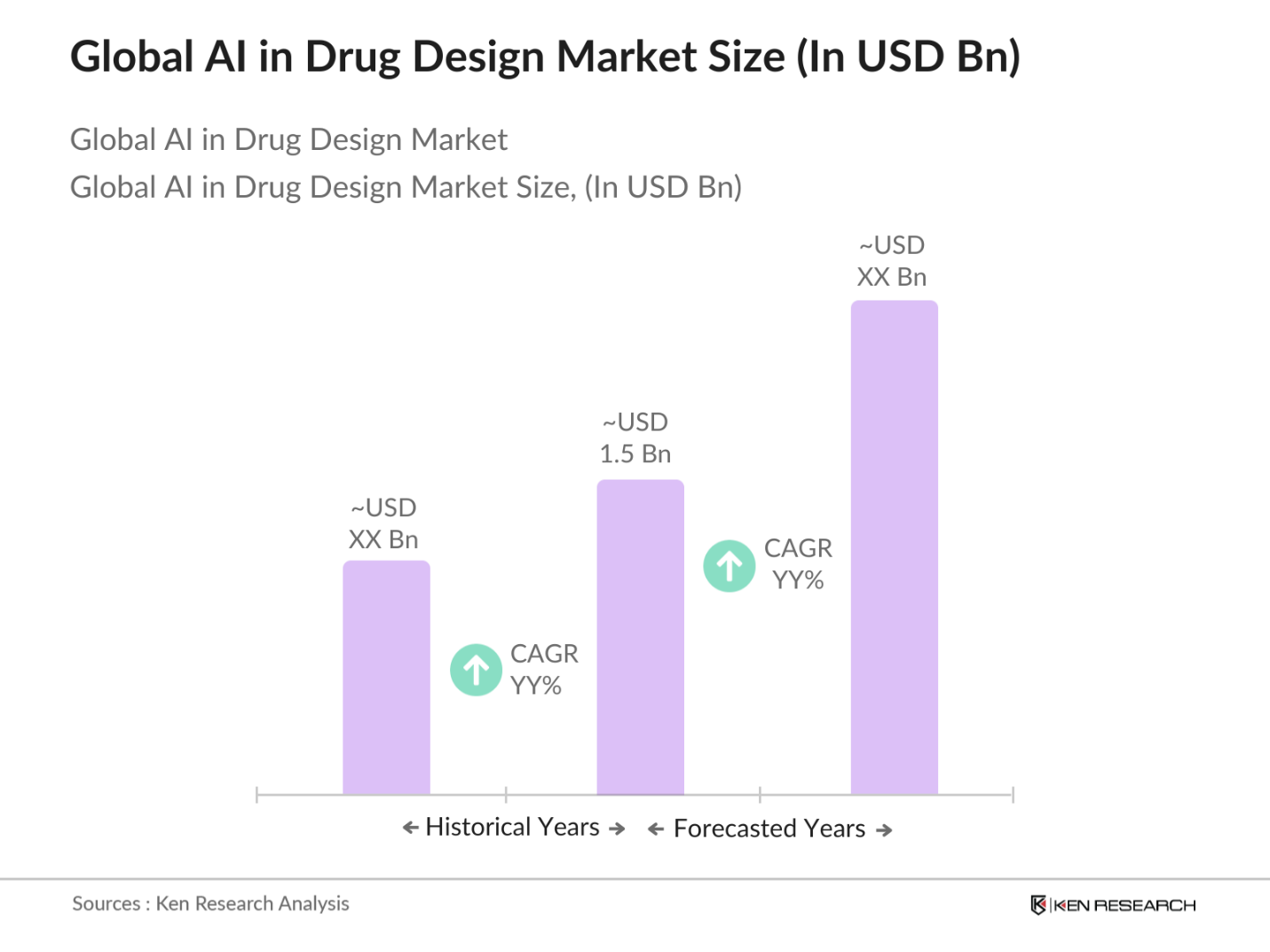
- North America dominates the AI in drug design market due to the presence of major pharmaceutical companies, a strong AI ecosystem, and significant investments in R&D. Cities like Boston and San Francisco lead the charge, thanks to their concentration of biotech firms, AI startups, and proximity to renowned research institutions. Europe, with hubs in London and Zurich, also holds a significant share due to government support for AI in healthcare, while Asia-Pacific's growing prominence is driven by rapid AI adoption in cities like Tokyo and Singapore, where innovation is a priority.
- The U.S. government has significantly increased funding for AI-driven healthcare technologies, including drug discovery, through initiatives like the Artificial Intelligence for the American People program. In 2023, the National Institutes of Health (NIH) allocated over $1 billion towards AI-based healthcare solutions, including AI in drug design. Additionally, the Department of Health and Human Services (HHS) is offering grants to support R&D projects integrating AI into pharmaceutical processes. This funding has spurred the development of AI tools for drug discovery, making the U.S. a leader in this domain.
Global AI in Drug Design Market Segmentation
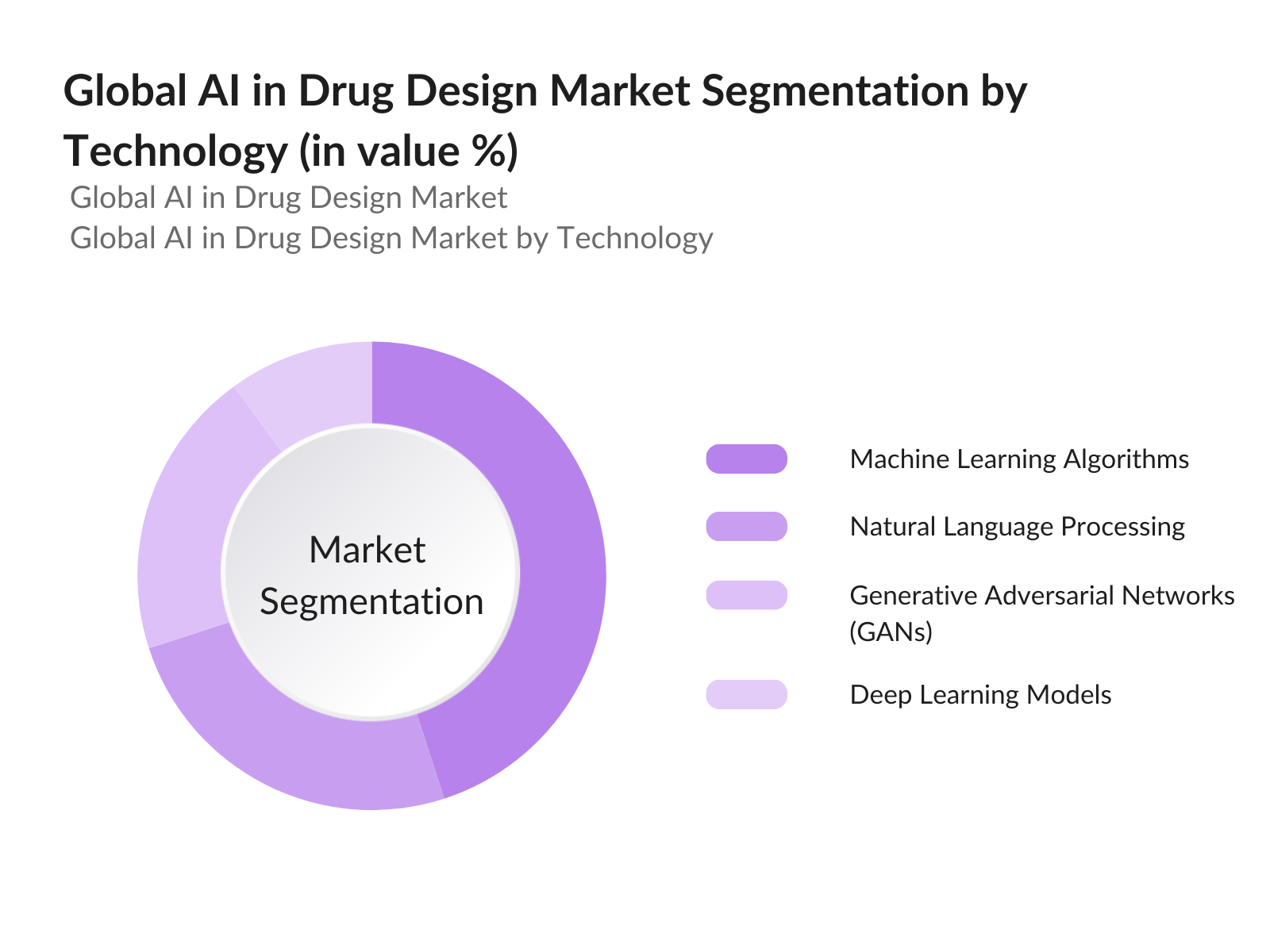
By Technology: The AI in drug design market is segmented by technology into machine learning algorithms, natural language processing (NLP), generative adversarial networks (GANs), and deep learning models. Machine learning algorithms dominate this segment due to their widespread application in pattern recognition and drug-target interaction predictions. Companies are leveraging these algorithms to optimize lead generation and develop targeted therapies faster, making machine learning a key driver in accelerating the drug discovery process.
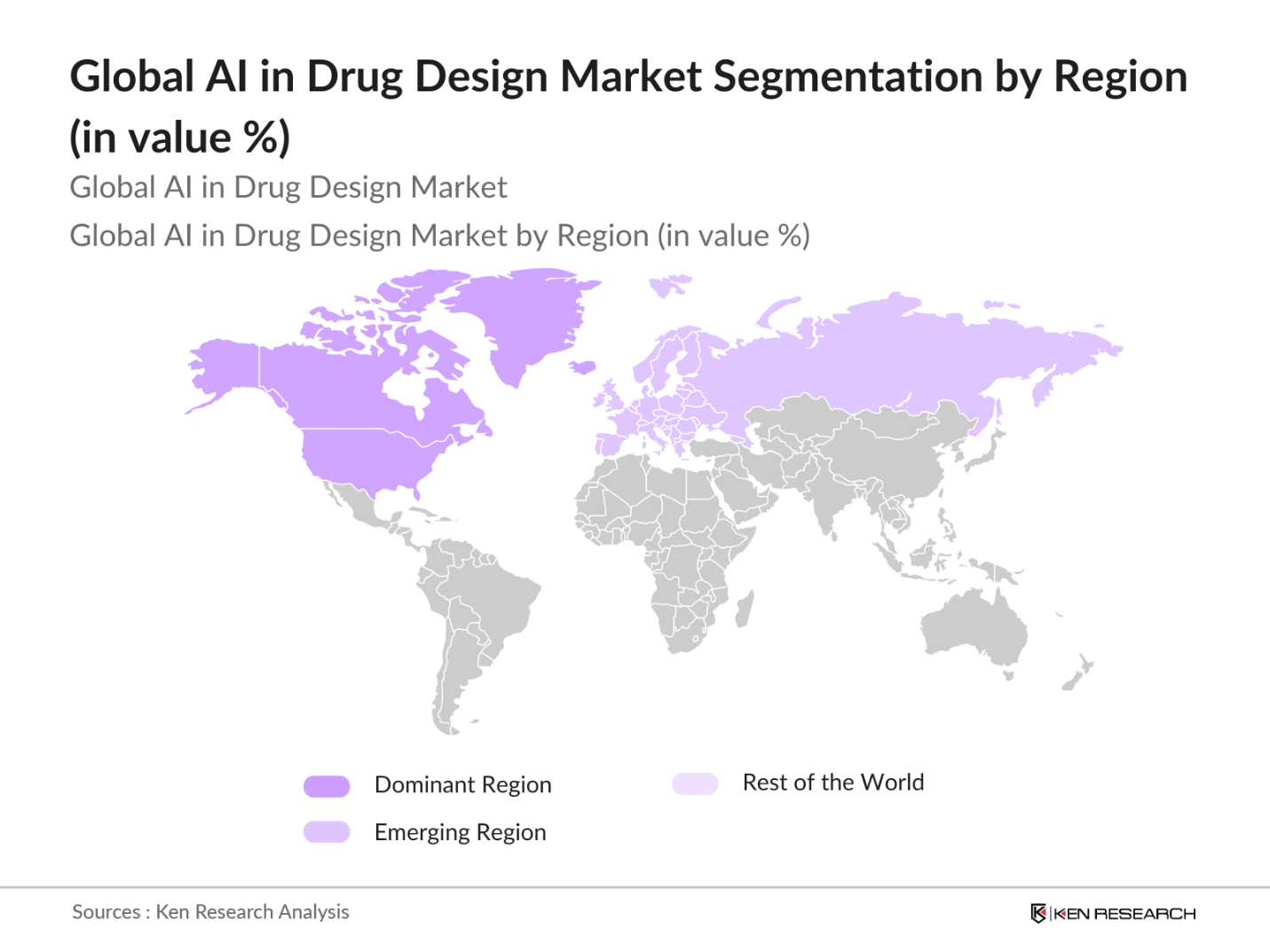
By Region: The AI in drug design market is regionally segmented into North America, Europe, Asia-Pacific, Latin America, and the Middle East & Africa. North America leads the market due to robust infrastructure, favorable regulations, and strong collaboration between AI startups and pharmaceutical giants. Europe follows, with increasing government funding for AI in healthcare initiatives, while Asia-Pacific is rapidly gaining traction as countries like Japan and China intensify their investments in AI research.
Global AI in Drug Design Market Competitive Landscape
The AI in drug design market is characterized by a competitive landscape dominated by both global technology firms and specialized biotech startups. Major players are focusing on strategic collaborations, expanding AI capabilities, and launching proprietary drug discovery platforms to maintain a competitive edge.
|
Company Name |
Established Year |
Headquarters |
Technology Stack |
R&D Investments |
Partnerships |
Drug Development Stages |
AI Algorithm Efficiency |
Market Reach |
Key Therapeutic Areas |
|
IBM Watson Health |
2015 |
USA |
Advanced ML |
||||||
|
BenevolentAI |
2013 |
UK |
AI & NLP |
||||||
|
Insilico Medicine |
2014 |
Hong Kong |
Deep Learning |
||||||
|
Exscientia |
2012 |
UK |
Generative AI |
||||||
|
Atomwise |
2012 |
USA |
ML & NLP |
Global AI in Drug Design Market Analysis
Market Growth Drivers
- Rise in Drug Discovery Automation: AI-enabled automation in drug discovery is significantly reducing the time it takes to bring new drugs to market. The automation of drug screening processes, once taking over a decade, now has the potential to be completed in under five years. According to a 2024 report from the World Bank, investments in digital healthcare infrastructure, including AI automation, grew by more than $500 billion globally in the past three years.
- Shorter Time-to-Market for Drug Development: AI is revolutionizing the pharmaceutical industry by cutting down the time-to-market for drug development. Traditional drug development cycles that took up to 12-15 years are being shortened to 5-7 years with the use of AI models. This shift is crucial as the global health spending in 2024 is projected at $10 trillion, which is helping fuel rapid advancements in AI technologies across the pharma industry.
- Integration of Machine Learning (ML) and Big Data: The integration of ML and big data analytics into drug design is transforming the pharmaceutical industry. Machine learning algorithms are increasingly used to sift through vast datasets, accelerating drug discovery processes by identifying potential compounds in a matter of weeks instead of years. This approach allows pharmaceutical companies to streamline processes in drug discovery, enhancing efficiency and innovation in drug development. The adoption of AI and big data tools is becoming more prevalent as companies seek to optimize research and development pipelines, reduce costs, and improve drug discovery outcomes.
Market Challenges:
- High Initial Investment Costs: While AI presents enormous potential, the high initial capital investment is a significant barrier. For AI implementation in drug design, companies need to spend millions on software, hardware, and skilled labor. The World Bank estimates that global R&D expenditure has surpassed $2.4 trillion in 2024, a substantial portion of which is allocated to developing advanced technologies such as AI in industries like pharmaceuticals.
- Data Privacy and Security Concerns: Handling vast amounts of health-related data for AI models raises serious privacy and security concerns. With the enforcement of General Data Protection Regulation (GDPR) in Europe and the Health Insurance Portability and Accountability Act (HIPAA) in the U.S., companies face challenges in securely managing patient data. Data breaches have affected healthcare organizations, costing them around $7 billion in 2023 according to IMF projections.
Global AI in Drug Design Market Future Outlook
Over the next five years, the AI in drug design market is expected to experience remarkable growth, driven by technological advancements in AI models, increasing demand for personalized medicine, and collaborations between biotech firms and AI developers. The ability of AI to reduce the time and cost associated with drug discovery will likely result in increased adoption across the pharmaceutical industry, particularly as companies seek to enhance efficiency in drug development pipelines.
Market Opportunities:
- Collaboration Between Pharma and AI Companies: Collaborations between pharmaceutical companies and AI-focused firms are set to drive innovation in drug design. In 2023, joint ventures between the two sectors have exceeded $200 billion globally, as pharma companies look to leverage the AI capabilities of tech firms to enhance their R&D processes. According to the World Bank, cross-sector collaborations are expected to further increase investment in AI technologies in the healthcare domain.
- Advancements in Quantum Computing for AI in Drug Design: Quantum computing is emerging as a key enabler for AI in drug design, offering the potential to solve complex molecular structures faster than classical computers. By 2024, countries like the U.S., China, and Germany have invested more than $22 billion in quantum computing research, with a focus on healthcare applications, according to a World Bank technology report. This is expected to boost AI's capabilities in processing large datasets for drug discovery.
Scope of the Report
|
By Technology |
Machine Learning Algorithms Natural Language Processing (NLP) Generative Adversarial Networks (GANs) Deep Learning Models |
|
By Application |
Drug Discovery Lead Optimization Preclinical Testing Clinical Trials |
|
By End-User |
Pharmaceutical Companies Biotechnology Firms Contract Research Organizations (CROs) Research Institutions |
|
By Drug Type |
Small Molecule Drugs Biologics RNA-Based Drugs Gene Therapy Drugs |
|
By Region |
North America Europe Asia-Pacific Latin America Middle East & Africa |
Products
Key Target Audience
Pharmaceutical Companies
Biotechnology Firms
Contract Research Organizations (CROs)
AI Software Developers
Drug Discovery Platforms
Venture Capital and Investment Firms
Government and Regulatory Bodies (FDA, EMA)
Healthcare Data Companies
Companies
Players Mention in the Report
IBM Watson Health
BenevolentAI
Insilico Medicine
Atomwise
Exscientia
Cyclica
Schrdinger
Healx
PathAI
Aria Pharmaceuticals
Deep Genomics
Verge Genomics
Recursion Pharmaceuticals
Berg Health
BioSymetrics
Table of Contents
1. Global AI in Drug Design Market Overview
1.1 Definition and Scope
1.2 Market Taxonomy
1.3 Market Growth Rate
1.4 Key AI Applications in Drug Design
2. Global AI in Drug Design Market Size (In USD Bn)
2.1 Historical Market Size
2.2 Year-On-Year Growth Analysis
2.3 Key Market Developments and Milestones
3. Global AI in Drug Design Market Analysis
3.1 Growth Drivers
3.1.1 Integration of Machine Learning (ML) and Big Data
3.1.2 Increasing Demand for Personalized Medicine
3.1.3 Rise in Drug Discovery Automation
3.1.4 Shorter Time-to-Market for Drug Development
3.2 Market Challenges
3.2.1 High Initial Investment Costs
3.2.2 Regulatory Hurdles for AI-Driven Drug Solutions
3.2.3 Data Privacy and Security Concerns
3.2.4 Limited AI Expertise in Pharma
3.3 Opportunities
3.3.1 Collaboration Between Pharma and AI Companies
3.3.2 Advancements in Quantum Computing for AI in Drug Design
3.3.3 Expanding AI Capabilities in Target Identification
3.3.4 Growth of AI in Generative Chemistry
3.4 Trends
3.4.1 AI in Protein Structure Prediction
3.4.2 Use of AI for Clinical Trial Optimization
3.4.3 AI-Powered Biomarker Discovery
3.5 Regulatory Framework
3.5.1 AI Regulations in Drug Design (FDA, EMA)
3.5.2 Compliance and Certification Processes for AI Drug Solutions
3.6 SWOT Analysis
3.7 Stakeholder Ecosystem
3.8 Porters Five Forces
3.9 Competitive Ecosystem
4. Global AI in Drug Design Market Segmentation
4.1 By Technology (In Value %)
4.1.1 Machine Learning Algorithms
4.1.2 Natural Language Processing (NLP)
4.1.3 Generative Adversarial Networks (GANs)
4.1.4 Deep Learning Models
4.2 By Application (In Value %)
4.2.1 Drug Discovery
4.2.2 Lead Optimization
4.2.3 Preclinical Testing
4.2.4 Clinical Trials
4.3 By End-User (In Value %)
4.3.1 Pharmaceutical Companies
4.3.2 Biotechnology Firms
4.3.3 Contract Research Organizations (CROs)
4.3.4 Research Institutions
4.4 By Drug Type (In Value %)
4.4.1 Small Molecule Drugs
4.4.2 Biologics
4.4.3 RNA-Based Drugs
4.4.4 Gene Therapy Drugs
4.5 By Region (In Value %)
4.5.1 North America
4.5.2 Europe
4.5.3 Asia-Pacific
4.5.4 Latin America
4.5.5 Middle East & Africa
5. Global AI in Drug Design Market Competitive Analysis
5.1 Detailed Profiles of Major Companies
5.1.1 IBM Watson Health
5.1.2 BenevolentAI
5.1.3 Insilico Medicine
5.1.4 Atomwise
5.1.5 Exscientia
5.1.6 Cyclica
5.1.7 Schrdinger
5.1.8 Healx
5.1.9 PathAI
5.1.10 Aria Pharmaceuticals
5.1.11 Deep Genomics
5.1.12 Verge Genomics
5.1.13 Recursion Pharmaceuticals
5.1.14 Berg Health
5.1.15 BioSymetrics
5.2 Cross Comparison Parameters (Technology Stack, R&D Investments, Partnerships, Drug Development Stages, AI Algorithm Efficiency, Market Reach, Revenue, Key Therapeutic Areas)
5.3 Market Share Analysis
5.4 Strategic Initiatives
5.5 Mergers and Acquisitions
5.6 Investment Analysis
5.7 Venture Capital Funding
5.8 Government Grants
5.9 Private Equity Investments
6. Global AI in Drug Design Market Regulatory Framework
6.1 AI in Healthcare Regulations
6.2 Compliance Requirements for AI-Based Drug Discovery
6.3 Certification and Approval Processes
7. Global AI in Drug Design Future Market Size (In USD Bn)
7.1 Future Market Size Projections
7.2 Key Factors Driving Future Market Growth
8. Global AI in Drug Design Future Market Segmentation
8.1 By Technology (In Value %)
8.2 By Application (In Value %)
8.3 By End-User (In Value %)
8.4 By Drug Type (In Value %)
8.5 By Region (In Value %)
9. Global AI in Drug Design Market Analysts Recommendations
9.1 TAM/SAM/SOM Analysis
9.2 Target Market Strategies
9.3 Marketing Initiatives
9.4 White Space Opportunities
Disclaimer
Contact Us
Research Methodology
Step 1: Identification of Key Variables
The initial phase involves mapping out the key stakeholders within the AI in drug design market, including pharmaceutical companies, AI vendors, and research institutions. This step is supported by extensive desk research that gathers industry data from proprietary databases and secondary sources, helping identify the main variables influencing the market.
Step 2: Market Analysis and Construction
In this phase, historical data on AI applications in drug design is compiled, including analysis of market penetration rates and the revenue generated by AI-driven solutions. This process also involves evaluating the quality of the data collected and ensuring accuracy in estimating market growth.
Step 3: Hypothesis Validation and Expert Consultation
Key market hypotheses are validated through direct consultations with industry experts from pharmaceutical firms, AI startups, and research institutes. These discussions provide valuable insights into real-world applications of AI in drug discovery and help refine market predictions.
Step 4: Research Synthesis and Final Output
The final phase includes synthesizing the collected data to deliver a comprehensive, validated analysis of the AI in drug design market. This process incorporates insights from both the top-down and bottom-up approaches to ensure a balanced and accurate market report.
Frequently Asked Questions
01. How big is the global AI in Drug Design market?
The global AI in drug design market is valued at USD 1.5 billion, driven by increasing adoption of AI for drug discovery, lead optimization, and clinical trials.
02. What are the challenges in the global AI in Drug Design market?
Key challenges include the high cost of AI implementation, regulatory hurdles for AI-driven drug solutions, and concerns about data privacy and security.
03. Who are the major players in the AI in Drug Design market?
Major players include IBM Watson Health, BenevolentAI, Insilico Medicine, Atomwise, and Exscientia, all of which leverage AI technologies to accelerate drug discovery processes.
04. What drives the growth of the AI in Drug Design market?
The market is propelled by advancements in AI technologies such as machine learning and deep learning, along with increased demand for personalized medicine and faster drug development cycles.
Why Buy From Us?

What makes us stand out is that our consultants follows Robust, Refine and Result (RRR) methodology. i.e. Robust for clear definitions, approaches and sanity checking, Refine for differentiating respondents facts and opinions and Result for presenting data with story

We have set a benchmark in the industry by offering our clients with syndicated and customized market research reports featuring coverage of entire market as well as meticulous research and analyst insights.

While we don't replace traditional research, we flip the method upside down. Our dual approach of Top Bottom & Bottom Top ensures quality deliverable by not just verifying company fundamentals but also looking at the sector and macroeconomic factors.

With one step in the future, our research team constantly tries to show you the bigger picture. We help with some of the tough questions you may encounter along the way: How is the industry positioned? Best marketing channel? KPI's of competitors? By aligning every element, we help maximize success.

Our report gives you instant access to the answers and sources that other companies might choose to hide. We elaborate each steps of research methodology we have used and showcase you the sample size to earn your trust.

If you need any support, we are here! We pride ourselves on universe strength, data quality, and quick, friendly, and professional service.