
Global AI in Retail Market Outlook to 2030
Region:Global
Author(s):Sanjna Verma
Product Code:KROD3532
October 2024
88
About the Report
Global AI in Retail Market Overview
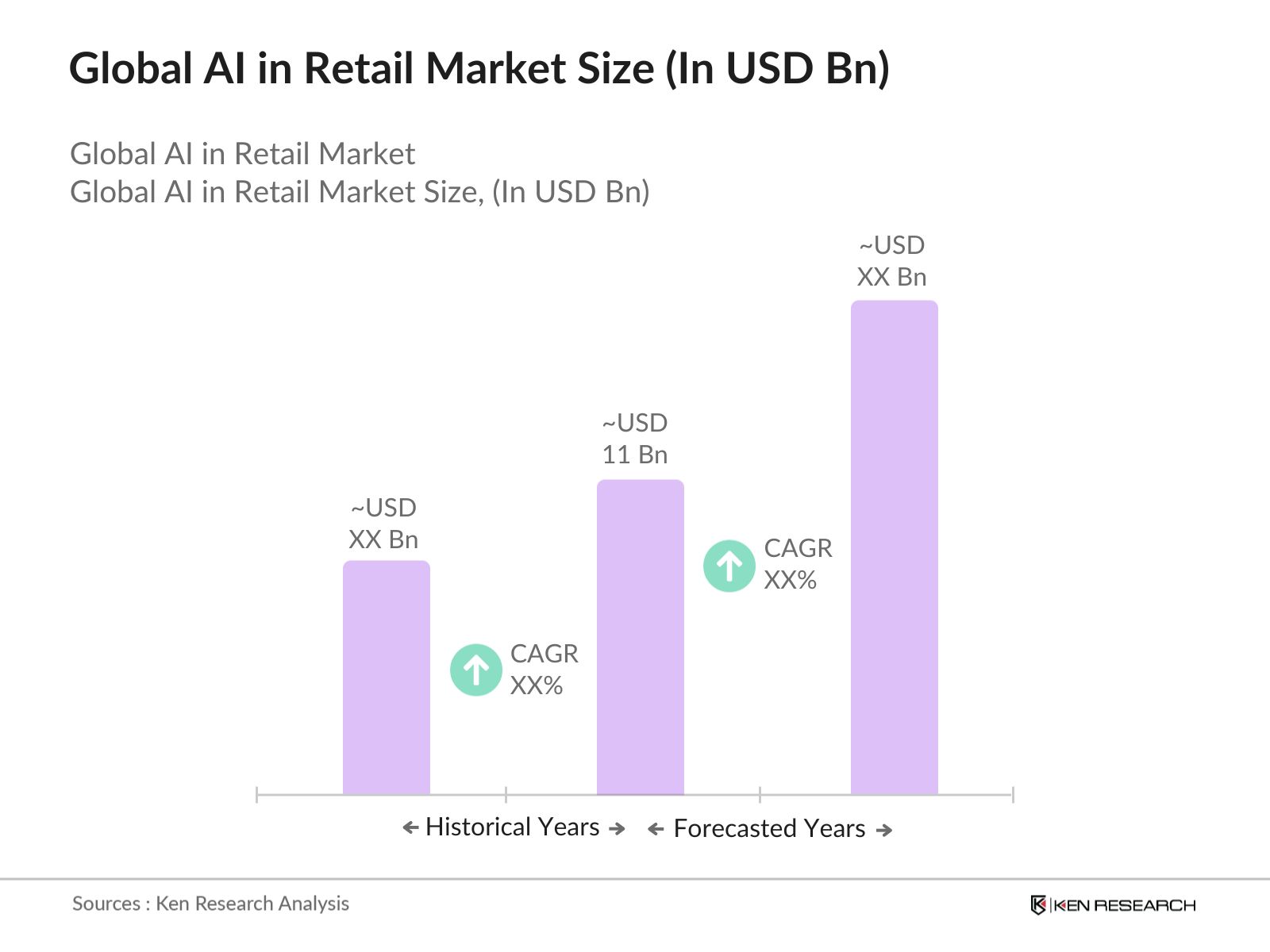
- The Global AI in Retail market is valued at USD 11 billion. The market is driven by the increased adoption of AI across e-commerce platforms, enabling retailers to personalize the shopping experience, automate operational processes, and optimize supply chain management. The proliferation of digital stores and the need for data-driven insights are key drivers, as AI-based solutions become essential for retailers to stay competitive in a tech-savvy consumer environment.
- Countries like the United States and China dominate the global AI in Retail market due to their technological advancements and large retail sectors. The United States has strong innovation ecosystems with established AI leaders, while China’s robust e-commerce market, spearheaded by giants like Alibaba, propels it to the forefront of AI adoption in retail.
- The implementation of data governance regulations such as GDPR in Europe and CCPA in California has had significant impacts on AI adoption in retail. As of 2023, over 25% of retail companies in Europe have implemented AI systems that comply with GDPR. This regulation mandates strict guidelines for data protection, emphasizing consumer rights regarding their personal information. The compliance with GDPR is crucial for companies looking to adopt AI technologies responsibly while ensuring consumer data privacy.
Global AI in Retail Market Segmentation
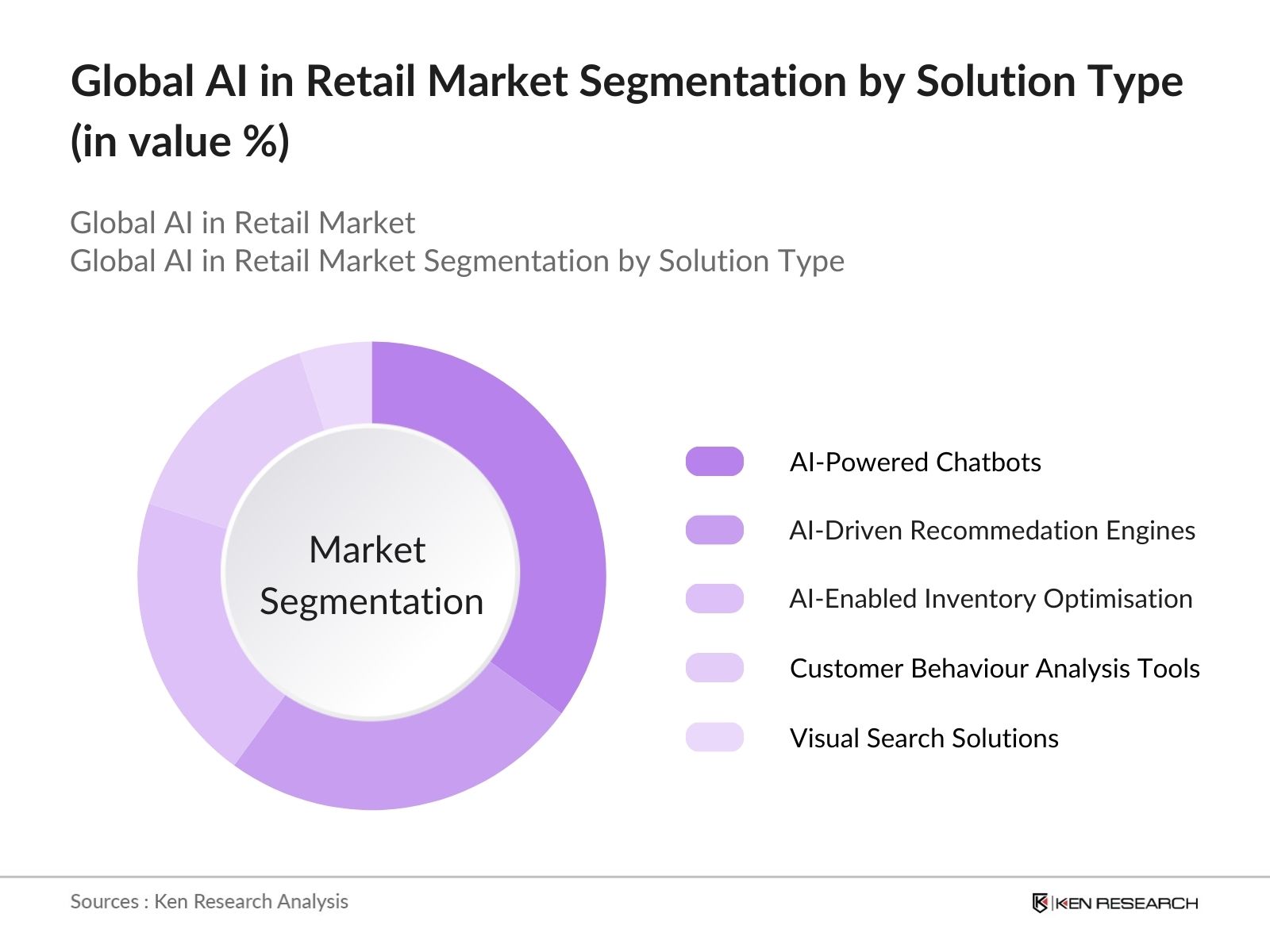
By Solution Type: The Global AI in Retail market is segmented by solution type into AI-powered chatbots, AI-driven recommendation engines, AI-enabled inventory optimization systems, customer behavior analytics tools, and visual search solutions. AI-powered chatbots hold a dominant share within this segment, driven by the increasing need for personalized customer support and engagement across retail channels. Retailers utilize AI chatbots to provide real-time, automated responses, improving customer service efficiency and satisfaction.
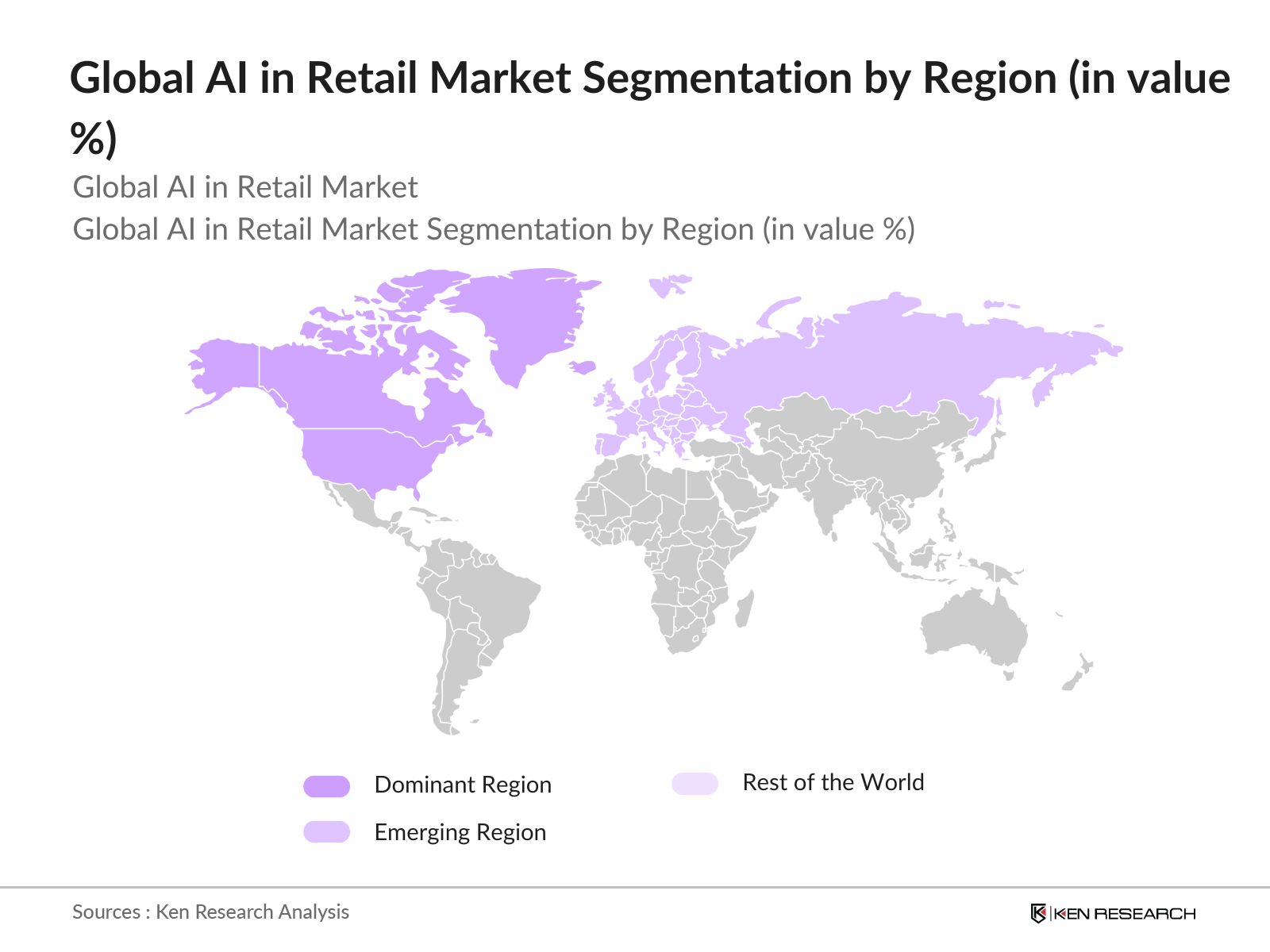
By Region: The AI in Retail market is also segmented by region into North America, Europe, Asia-Pacific, Latin America, and the Middle East & Africa. North America holds a significant market share due to its well-developed retail infrastructure and advanced AI ecosystem. The region's leading retailers, such as Amazon and Walmart, heavily invest in AI technologies to enhance customer experience, improve operational efficiency, and reduce costs, driving the region’s dominance in the market.
By Application: The AI in Retail market is segmented by application into supply chain and logistics, customer relationship management (CRM), pricing and promotion management, in-store AI solutions, and fraud detection and prevention. In this segment, supply chain and logistics dominate due to the increasing need for predictive analytics and AI-driven automation to enhance efficiency and reduce operational costs. AI helps retailers optimize their inventory management and demand forecasting, ensuring product availability and minimizing overstock.
Global AI in Retail Market Competitive Landscape
The Global AI in Retail market is dominated by a few major players, such as Amazon Web Services, Google Cloud, and Microsoft Corporation, as well as AI-specialized firms like Symphony RetailAI and CognitiveScale. These players control significant portions of the market due to their strong technological capabilities and strategic partnerships with retail giants. Their influence shapes the competitive landscape, driving innovation and the adoption of cutting-edge AI solutions across various retail applications.
|
Company |
Establishment Year |
Headquarters |
Revenue (USD Bn) |
No. of Patents |
AI-Specific Revenue |
Investment in AI R&D |
Key AI Retail Products |
Strategic Partnerships in Retail |
|
Amazon Web Services |
2006 |
Seattle, WA, USA |
- |
- |
- |
- |
- |
- |
|
Google Cloud |
2008 |
Mountain View, CA, USA |
- |
- |
- |
- |
- |
- |
|
Microsoft Corporation |
1975 |
Redmond, WA, USA |
- |
- |
- |
- |
- |
- |
|
Symphony RetailAI |
2016 |
Dallas, TX, USA |
- |
- |
- |
- |
- |
- |
|
CognitiveScale |
2013 |
Austin, TX, USA |
- |
- |
- |
- |
- |
- |
Global AI in Retail Market Analysis
Growth Drivers
- Surge in E-commerce Platforms: The global surge in e-commerce platforms has significantly impacted AI adoption in retail, driven by the digital transformation of economies. In 2022, global online retail sales reached nearly $5.7 trillion, with a continuous rise in internet penetration and mobile phone adoption. The total number of digital transactions in India for the financial year 2023 was over 103 billion transactions, with a significant increase in the volume of digital payments compared to previous years, showcasing the growing reliance on e-commerce platforms for AI-powered retail.
- Personalization in Customer Experience: Retailers have integrated AI-powered personalization to enhance customer experiences. The ILO reports that the retail sector employs approximately 420 million people globally, with digitalization creating new job opportunities, particularly in online retail, warehousing, and distribution services. Visual search powered by AI simplifies the online shopping process, allowing users to search for products by uploading images.
- Growing Demand for Automated Retail Operations: Automation in retail operations has drastically increased due to AI adoption. These AI-enabled automated systems handle inventory, customer service, and logistics more efficiently. Germany is the most automated country in Europe, with an industrial robot density of 371 units per 10,000 employees in 2020. Other highly automated European countries include Sweden, Denmark, and Italy. This transformation underscores the critical role AI plays in automating retail operations.
Challenges
- High Implementation Costs: AI implementation in retail comes with significant costs. The average cost for deploying AI solutions for small and medium-sized retail enterprises globally was estimated at $50,000 to $1 million in 2023. These costs, coupled with maintenance and upgrades, limit AI adoption, especially in developing economies. In Latin America alone, only 3% of retail companies have fully integrated AI due to the high financial barriers associated with implementing cutting-edge technologies.
- Data Privacy and Security Concerns: Data privacy concerns have grown significantly with the adoption of AI in retail. ENISA Threat Landscape Report 2023 indicates that there were approximately 2,580 documented cyber incidents from July 2022 to June 2023. AI systems in retail that handle large volumes of customer data, such as credit card details and purchase histories, have made retailers prime targets for cyberattacks, necessitating stronger data protection protocols.
Global AI in Retail Future Market Outlook
Over the next five years, the Global AI in Retail market is expected to experience rapid growth, driven by advancements in AI technology, increasing demand for personalized retail experiences, and expanding e-commerce platforms. The integration of AI into omnichannel retail strategies and the growing use of AI for predictive analytics in inventory and supply chain management are also expected to propel market expansion. Retailers will increasingly leverage AI to improve customer engagement and operational efficiency.
Market Opportunities
- AI-Driven Virtual Assistance in Retail: AI-driven virtual assistants are revolutionizing retail customer service. AI-powered virtual assistants are transforming customer service by providing 24/7 support, addressing inquiries, and assisting with transactions. These AI assistants improved response times by 25% and contributed to reducing customer service costs by up to 30%, benefiting retailers across North America, Europe, and Asia.
- Expansion of AI into Brick-and-Mortar Stores: AI is making inroads into traditional brick-and-mortar stores. Companies like Focal Systems are noted for providing AI-powered solutions that include automated checkouts and shelf monitoring, which are indicative of the types of technologies being adopted by retailers. In Japan, over 10,000 stores now use AI-enabled systems for customer management and store operations, improving operational efficiency by up to 40%. This expansion signals a major shift in how physical retail environments operate.
Scope of the Report
|
Segment |
Sub-segments |
|
By Solution Type |
AI-Powered Chatbots |
|
AI-Driven Recommendation Engines |
|
|
AI-Enabled Inventory Optimization Systems |
|
|
Customer Behavior Analytics Tools |
|
|
Visual Search Solutions |
|
|
By Application |
Supply Chain and Logistics |
|
Customer Relationship Management |
|
|
Pricing and Promotion Management |
|
|
In-Store AI Solutions |
|
|
Fraud Detection and Prevention |
|
|
By Retail Type |
E-commerce |
|
Brick-and-Mortar |
|
|
Omnichannel Retail |
|
|
Pop-up Stores |
|
|
Department Stores |
|
|
By Technology |
Machine Learning |
|
Natural Language Processing (NLP) |
|
|
Computer Vision |
|
|
Robotics |
|
|
Predictive Analytics |
|
|
By Region |
North America |
|
Europe |
|
|
Asia-Pacific |
|
|
Latin America |
|
|
Middle East & Africa |
Products
Key Target Audience
- Retailers and E-commerce Platforms
- AI Solution Providers
- Supply Chain Optimization Companies
- Customer Relationship Management (CRM) Companies
- Fraud Detection and Prevention Companies
- Investors and Venture Capitalist Firms
- Government and Regulatory Bodies (e.g., Federal Trade Commission, European Data Protection Board)
Companies
Major Players
- Amazon Web Services
- Google Cloud
- Microsoft Corporation
- Symphony RetailAI
- CognitiveScale
- IBM Corporation
- SAP SE
- Oracle Corporation
- Baidu, Inc.
- Alibaba Group
- Salesforce Inc.
- Intel Corporation
- ViSenze
- Vue.ai
- Bloomreach
Table of Contents
1. Global AI in Retail Market Overview
1.1. Definition and Scope
1.2. Market Taxonomy
1.3. Market Growth Rate
1.4. Market Segmentation Overview
1.5. AI Adoption Across Retail Segments
2. Global AI in Retail Market Size (In USD Bn)
2.1. Historical Market Size
2.2. Year-On-Year Growth Analysis
2.3. Key Market Developments and Milestones
3. Global AI in Retail Market Analysis
3.1. Growth Drivers
3.1.1. Surge in E-commerce Platforms
3.1.2. Personalization in Customer Experience
3.1.3. Growing Demand for Automated Retail Operations
3.1.4. AI-Powered Supply Chain Optimization
3.2. Market Challenges
3.2.1. High Implementation Costs
3.2.2. Data Privacy and Security Concerns
3.2.3. Limited Skilled Workforce
3.2.4. Integration Challenges with Legacy Systems
3.3. Opportunities
3.3.1. AI-Driven Virtual Assistance in Retail
3.3.2. Expansion of AI into Brick-and-Mortar Stores
3.3.3. Cross-border E-commerce Using AI Solutions
3.3.4. Retail Analytics for Enhanced Decision Making
3.4. Trends
3.4.1. Integration of AI with Augmented Reality (AR)
3.4.2. AI-Powered Chatbots for Customer Engagement
3.4.3. AI-Driven Predictive Analytics in Retail
3.4.4. Expansion of Conversational AI in Retail Marketing
3.5. Regulatory Framework
3.5.1. Data Governance Regulations (GDPR, CCPA)
3.5.2. AI Ethics in Retail Applications
3.5.3. Consumer Protection Guidelines
3.6. SWOT Analysis
3.7. Stake Ecosystem (AI Developers, Retailers, System Integrators)
3.8. Porter’s Five Forces Analysis
3.9. Competition Ecosystem
4. Global AI in Retail Market Segmentation
4.1. By Solution Type (In Value %)
4.1.1. AI-Powered Chatbots
4.1.2. AI-Driven Recommendation Engines
4.1.3. AI-Enabled Inventory Optimization Systems
4.1.4. Customer Behavior Analytics Tools
4.1.5. Visual Search Solutions
4.2. By Application (In Value %)
4.2.1. Supply Chain and Logistics
4.2.2. Customer Relationship Management
4.2.3. Pricing and Promotion Management
4.2.4. In-Store AI Solutions
4.2.5. Fraud Detection and Prevention
4.3. By Retail Type (In Value %)
4.3.1. E-commerce
4.3.2. Brick-and-Mortar
4.3.3. Omnichannel Retail
4.3.4. Pop-up Stores
4.3.5. Department Stores
4.4. By Technology (In Value %)
4.4.1. Machine Learning
4.4.2. Natural Language Processing (NLP)
4.4.3. Computer Vision
4.4.4. Robotics
4.4.5. Predictive Analytics
4.5. By Region (In Value %)
4.5.1. North America
4.5.2. Europe
4.5.3. Asia-Pacific
4.5.4. Latin America
4.5.5. Middle East & Africa
5. Global AI in Retail Market Competitive Analysis
5.1 Detailed Profiles of Major Companies
5.1.1. Amazon Web Services, Inc.
5.1.2. Google Cloud
5.1.3. IBM Corporation
5.1.4. Microsoft Corporation
5.1.5. Salesforce Inc.
5.1.6. SAP SE
5.1.7. Intel Corporation
5.1.8. Oracle Corporation
5.1.9. Baidu, Inc.
5.1.10. Alibaba Group
5.1.11. CognitiveScale
5.1.12. Symphony RetailAI
5.1.13. ViSenze
5.1.14. Bloomreach
5.1.15. Vue.ai
5.2 Cross Comparison Parameters (Revenue, AI-based Revenue Streams, No. of Patents, Investment in AI R&D, AI Workforce Size, Strategic Partnerships in AI, Retail-specific AI Products, M&A in AI)
5.3 Market Share Analysis
5.4 Strategic Initiatives
5.5 Mergers and Acquisitions
5.6 Investment Analysis
5.7 Venture Capital Funding
5.8 Government Grants
5.9 Private Equity Investments
6. Global AI in Retail Market Regulatory Framework
6.1 AI Regulatory Compliance in Retail
6.2 Data Security and Privacy Regulations
6.3 Certification Standards for AI Solutions in Retail
7. Global AI in Retail Market Future Size (In USD Bn)
7.1 Future Market Size Projections
7.2 Key Factors Driving Future Market Growth
8. Global AI in Retail Market Future Segmentation
8.1 By Solution Type (In Value %)
8.2 By Application (In Value %)
8.3 By Retail Type (In Value %)
8.4 By Technology (In Value %)
8.5 By Region (In Value %)
9. Global AI in Retail Market Analysts’ Recommendations
9.1 TAM/SAM/SOM Analysis
9.2 Customer Cohort Analysis
9.3 Marketing Initiatives
9.4 White Space Opportunity Analysis
Disclaimer
Contact Us
Research Methodology
Step 1: Identification of Key Variables
The initial phase involves constructing an ecosystem map encompassing all major stakeholders within the Global AI in Retail Market. This step is underpinned by extensive desk research using secondary databases to gather comprehensive industry-level information. The primary objective is to identify the critical variables that influence market dynamics, such as AI adoption rates, consumer behavior, and retail infrastructure.
Step 2: Market Analysis and Construction
In this phase, we will compile and analyze historical data related to the Global AI in Retail Market. This includes assessing market penetration, adoption of AI-based solutions by major retail players, and resultant revenue generation. Furthermore, an evaluation of AI deployment in supply chain management and customer engagement will be conducted to ensure reliable revenue estimates.
Step 3: Hypothesis Validation and Expert Consultation
Market hypotheses will be developed and validated through expert interviews with retail sector leaders and AI solution providers. These consultations will provide valuable financial and operational insights directly from industry practitioners, refining and corroborating the market data for accurate analysis.
Step 4: Research Synthesis and Final Output
The final phase involves direct engagement with AI solution providers and retail companies to acquire detailed insights into solution adoption rates, key technology challenges, and revenue performance. This interaction will complement the bottom-up approach and ensure comprehensive and validated analysis of the AI in Retail market.
Frequently Asked Questions
01 How big is the Global AI in Retail market?
The Global AI in Retail market is valued at USD 11 billion, driven by the increasing adoption of AI technologies to enhance retail operations and customer engagement.
02 What factors are driving the growth of the Global AI in Retail market?
Key factors of Global AI in Retail Market include growing demand for personalized shopping experiences, automation in retail operations, and AI-powered predictive analytics for inventory management.
03 What are the main challenges in the AI in Retail market?
The main challenges of Global AI in Retail Market include high implementation costs, data privacy and security concerns, and the lack of skilled professionals to manage AI systems in retail environments.
Why Buy From Us?

What makes us stand out is that our consultants follows Robust, Refine and Result (RRR) methodology. i.e. Robust for clear definitions, approaches and sanity checking, Refine for differentiating respondents facts and opinions and Result for presenting data with story

We have set a benchmark in the industry by offering our clients with syndicated and customized market research reports featuring coverage of entire market as well as meticulous research and analyst insights.

While we don't replace traditional research, we flip the method upside down. Our dual approach of Top Bottom & Bottom Top ensures quality deliverable by not just verifying company fundamentals but also looking at the sector and macroeconomic factors.

With one step in the future, our research team constantly tries to show you the bigger picture. We help with some of the tough questions you may encounter along the way: How is the industry positioned? Best marketing channel? KPI's of competitors? By aligning every element, we help maximize success.

Our report gives you instant access to the answers and sources that other companies might choose to hide. We elaborate each steps of research methodology we have used and showcase you the sample size to earn your trust.

If you need any support, we are here! We pride ourselves on universe strength, data quality, and quick, friendly, and professional service.