
Global Amino Resin Market Outlook 2030
Region:Global
Author(s):Shivani Mehra
Product Code:KROD3305
Region:Global
Author(s):Shivani Mehra
Product Code:KROD3305
November 2024
96

By Type: The global amino resin market is segmented by type into Urea Formaldehyde, Melamine Formaldehyde, and Melamine-Urea Formaldehyde. Urea Formaldehyde holds a dominant market share because of its widespread usage in wood-based panels, particularly for particleboards and plywood. Its adhesive properties, combined with cost-effectiveness, make it an ideal choice for large-scale applications. Additionally, the market's shift towards low-formaldehyde products has further enhanced the demand for Urea Formaldehyde in the construction sector.

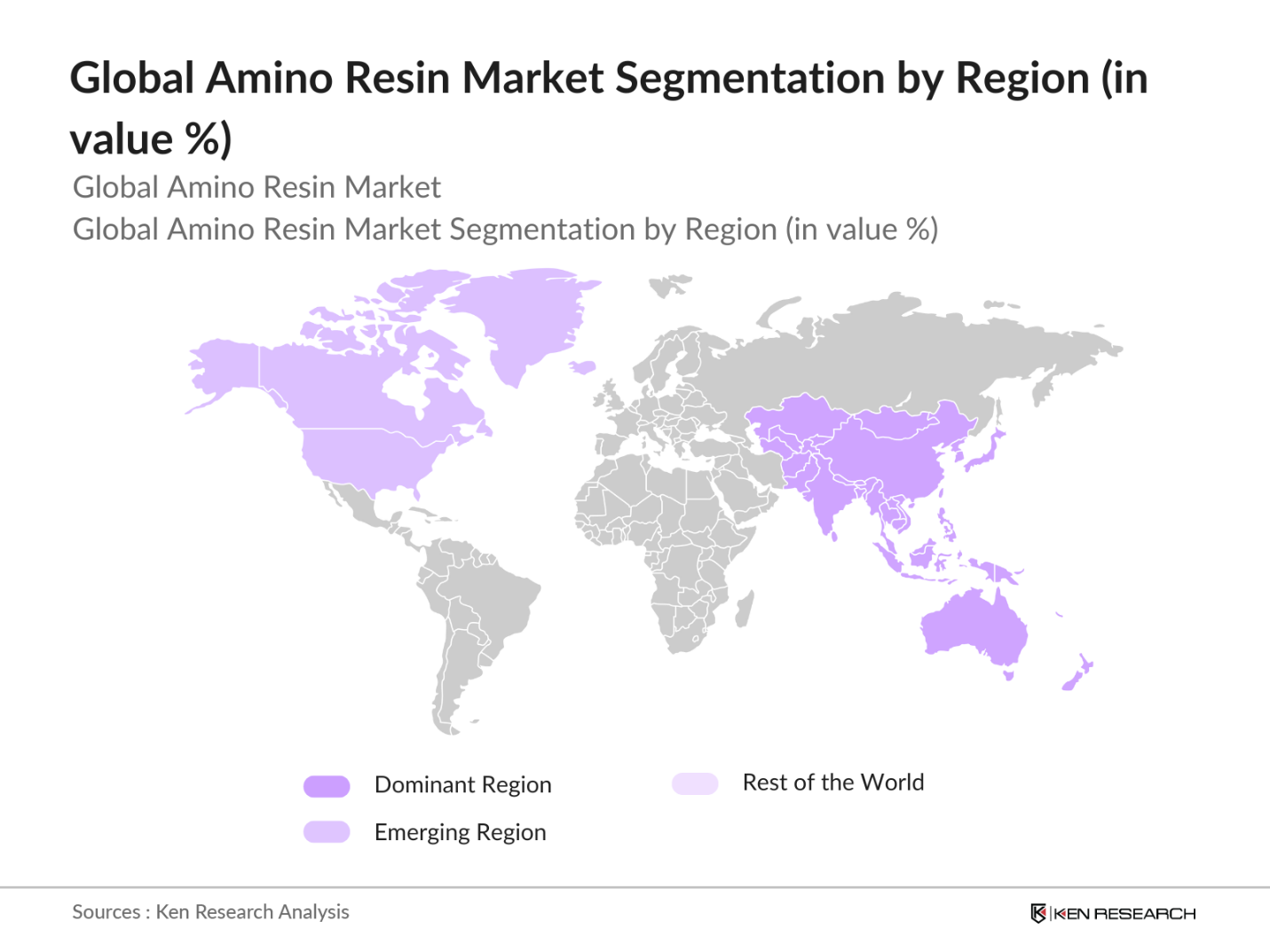
By Region: The global amino resin market is segmented by region into North America, Europe, Asia-Pacific, Latin America, and Middle East & Africa. Asia-Pacific holds the largest market share, led by China and India due to their booming construction and automotive industries. China, in particular, dominates with extensive production capacity and demand for sustainable construction materials. Europe follows closely with Germany spearheading the regions technological advancements in resin formulation and formaldehyde emission reduction.
The global amino resin market is dominated by several key players who hold significant market shares due to their advanced production capabilities, research & development investments, and extensive distribution networks. Companies like BASF SE and Hexion Inc. are prominent in the space, leveraging technological advancements and strong ties to end-user industries such as construction and automotive. The market is also characterized by intense competition, with players focusing on innovations like low-emission formaldehyde products to comply with environmental regulations.
|
Company |
Year Established |
Headquarters |
Revenue (USD Bn) |
Production Capacity |
Market Share (%) |
Product Portfolio |
R&D Expenditure |
Regional Presence |
Technological Advancements |
|
BASF SE |
1865 |
Germany |
87.6 |
||||||
|
Hexion Inc. |
1899 |
USA |
8.5 |
||||||
|
Georgia-Pacific Chemicals |
1927 |
USA |
25.4 |
||||||
|
The Dow Chemical Company |
1897 |
USA |
57.0 |
||||||
|
Mitsui Chemicals, Inc. |
1912 |
Japan |
35.7 |
Market Growth Drivers
Market Challenges
Global Amino Resin Market Future Outlook
Over the next five years, the global amino resin market is expected to grow steadily, driven by increasing demand for low-emission products, advancements in resin technology, and rising consumer demand for sustainable building materials. Government regulations aimed at reducing formaldehyde emissions and promoting green building practices will play a crucial role in shaping the market's future. Expansion into untapped markets such as Latin America and Africa presents significant growth opportunities, especially for companies investing in research & development.
Market Opportunities:
|
By Type |
Urea Formaldehyde Melamine Formaldehyde Melamine-Urea Formaldehyde |
|
By Application |
Wood-based Panels Automotive Construction |
|
By End-Use Industry |
Building & Construction Automotive & Transportation Consumer Goods Electronics |
|
By Resin Form |
Liquid Amino Resins Powder Amino Resins |
|
By Region |
North America Europe Asia-Pacific Latin America Middle East & Africa |
1.1 Definition and Scope
1.2 Market Taxonomy
1.3 Market Growth Rate (In production capacity and consumption trends)
1.4 Market Segmentation Overview
2.1 Historical Market Size
2.2 Year-On-Year Growth Analysis
2.3 Key Market Developments and Milestones (Regulatory changes, new innovations)
3.1 Growth Drivers
3.1.1 Increasing demand in construction materials
3.1.2 Advancements in resin technologies
3.1.3 Environmental regulatory compliance
3.1.4 Rising automotive industry demands
3.2 Market Challenges
3.2.1 Volatility in raw material prices (Urea, Melamine)
3.2.2 Stringent environmental regulations
3.2.3 Shifting consumer preference towards eco-friendly alternatives
3.3 Opportunities
3.3.1 Growth in the wood-based panel industry
3.3.2 Expansion into untapped regions (Africa, Latin America)
3.3.3 Technological advancements in formaldehyde reduction
3.4 Trends
3.4.1 Adoption of low-formaldehyde resins
3.4.2 Rising usage in sustainable building materials
3.4.3 Increased research into bio-based amino resins
3.5 Government Regulations
3.5.1 Formaldehyde Emission Standards
3.5.2 Incentives for eco-friendly resins
3.5.3 Industry-specific emission reduction policies
3.6 SWOT Analysis
3.7 Stake Ecosystem
3.8 Porters Five Forces Analysis
3.9 Competition Ecosystem
4.1 By Type (In Value %)
4.1.1 Urea Formaldehyde
4.1.2 Melamine Formaldehyde
4.1.3 Melamine-Urea Formaldehyde
4.2 By Application (In Value %)
4.2.1 Wood-based Panels
4.2.2 Automotive
4.2.3 Construction
4.2.4 Textile
4.3 By End-Use Industry (In Value %)
4.3.1 Building & Construction
4.3.2 Automotive & Transportation
4.3.3 Consumer Goods
4.3.4 Electronics
4.4 By Resin Form (In Value %)
4.4.1 Liquid Amino Resins
4.4.2 Powder Amino Resins
4.5 By Region (In Value %)
4.5.1 North America
4.5.2 Europe
4.5.3 Asia-Pacific
4.5.4 Latin America
4.5.5 Middle East & Africa
5.1 Detailed Profiles of Major Companies
5.1.1 BASF SE
5.1.2 Hexion Inc.
5.1.3 Georgia-Pacific Chemicals
5.1.4 The Dow Chemical Company
5.1.5 Mitsui Chemicals, Inc.
5.1.6 Allnex Group
5.1.7 Kronospan Holdings Ltd.
5.1.8 Arclin Inc.
5.1.9 Chemiplastica
5.1.10 Prefere Resins Holding GmbH
5.1.11 Momentive Specialty Chemicals
5.1.12 INEOS Melamines
5.1.13 Ercros S.A.
5.1.14 Metadynea
5.1.15 Dynea Oy
5.2 Cross Comparison Parameters (Revenue, Production Capacity, Product Portfolio, Market Presence, Innovation)
5.3 Market Share Analysis
5.4 Strategic Initiatives
5.5 Mergers and Acquisitions
5.6 Investment Analysis
5.7 Venture Capital Funding
5.8 Private Equity Investments
6.1 Emission Standards
6.2 Industry Certifications and Compliance
6.3 International Trade Regulations
7.1 Future Market Size Projections
7.2 Key Factors Driving Future Market Growth
8.1 By Type (In Value %)
8.2 By Application (In Value %)
8.3 By End-Use Industry (In Value %)
8.4 By Resin Form (In Value %)
8.5 By Region (In Value %)
9.1 TAM/SAM/SOM Analysis
9.2 Customer Cohort Analysis
9.3 Market Expansion Strategies
9.4 Innovation and R&D Focus
Disclaimer Contact UsThe initial phase involves constructing an ecosystem map of the global amino resin market. This step is based on extensive desk research, utilizing secondary and proprietary databases to gather comprehensive market information. Key variables like production capacity and market penetration will be identified.
In this phase, historical data will be compiled and analyzed, assessing the ratio of product demand to supply across different regions. Further analysis of resin formulation advancements and their commercial impact will be undertaken.
Market hypotheses will be validated through interviews with industry experts, including manufacturers, distributors, and key stakeholders. These consultations will provide operational insights to refine market forecasts and corroborate data from proprietary databases.
The final phase will involve engaging with major amino resin manufacturers to acquire detailed insights into production trends, product developments, and distribution channels. These interactions will ensure a comprehensive and validated market analysis.
The global amino resin market is valued at USD 7.17 billion, driven by increased demand across construction, automotive, and wood-based panel industries.
Challenges include volatility in raw material prices, stringent environmental regulations on formaldehyde emissions, and competition from eco-friendly resin alternatives.
Key players in the market include BASF SE, Hexion Inc., Georgia-Pacific Chemicals, The Dow Chemical Company, and Mitsui Chemicals, Inc.
The market is propelled by demand in the construction and automotive industries, advancements in low-emission resin technology, and increasing adoption of sustainable building materials.

What makes us stand out is that our consultants follows Robust, Refine and Result (RRR) methodology. i.e. Robust for clear definitions, approaches and sanity checking, Refine for differentiating respondents facts and opinions and Result for presenting data with story

We have set a benchmark in the industry by offering our clients with syndicated and customized market research reports featuring coverage of entire market as well as meticulous research and analyst insights.

While we don't replace traditional research, we flip the method upside down. Our dual approach of Top Bottom & Bottom Top ensures quality deliverable by not just verifying company fundamentals but also looking at the sector and macroeconomic factors.

With one step in the future, our research team constantly tries to show you the bigger picture. We help with some of the tough questions you may encounter along the way: How is the industry positioned? Best marketing channel? KPI's of competitors? By aligning every element, we help maximize success.

Our report gives you instant access to the answers and sources that other companies might choose to hide. We elaborate each steps of research methodology we have used and showcase you the sample size to earn your trust.

If you need any support, we are here! We pride ourselves on universe strength, data quality, and quick, friendly, and professional service.