
Global Ashwagandha Market Outlook to 2030
Region:Global
Author(s):Shivani
Product Code:KROD7916
Region:Global
Author(s):Shivani
Product Code:KROD7916
November 2024
89
Listen to the audio summary
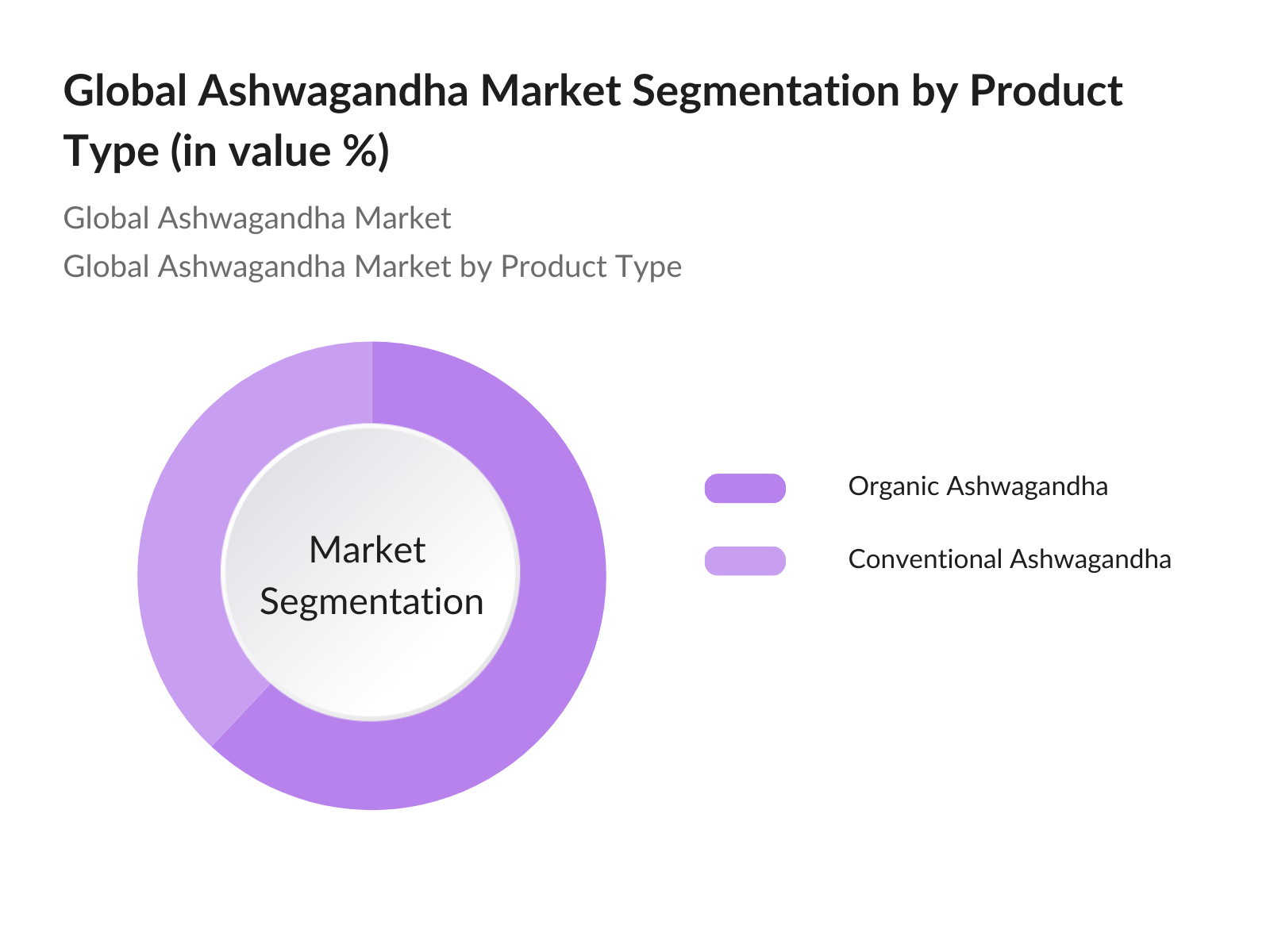
By Product Type: The Ashwagandha market is segmented by product type into organic Ashwagandha and conventional Ashwagandha. Organic Ashwagandha holds a dominant market share due to consumer preferences for organic and non-GMO products. The increasing demand for certified organic supplements, especially in North America and Europe, has driven this segments growth. Furthermore, the higher price premium associated with organic products also adds to its market dominance.
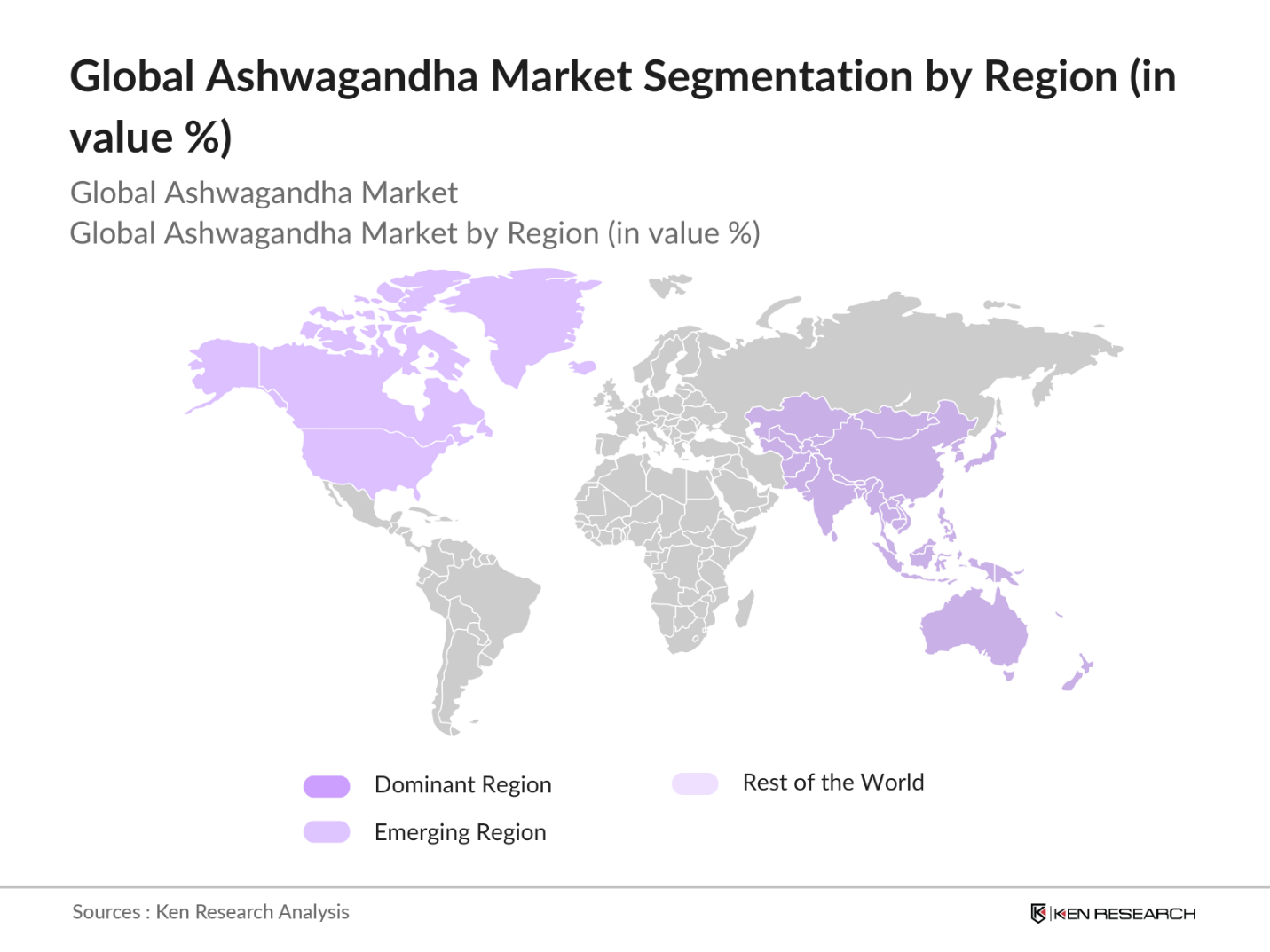
By Region: The Ashwagandha market is segmented into North America, Europe, Asia-Pacific, Latin America, and the Middle East & Africa. Asia-Pacific, led by India, is the leading region in the Ashwagandha market due to the large-scale cultivation and processing of Ashwagandha roots in India. Additionally, the region benefits from government initiatives supporting traditional herbal medicine production and export. The high availability of raw materials in this region also lowers production costs, allowing it to maintain a competitive edge in global markets.
The Ashwagandha market is dominated by both global supplement brands and domestic producers specializing in herbal products. Major players in the market include Natreon Inc. and Ixoreal Biomed, who are known for their proprietary formulations like KSM-66. Several companies are leveraging Ashwagandhas growing popularity by introducing innovative product lines, such as Ashwagandha-based powders, gummies, and tinctures. These companies emphasize quality control and certifications, including GMP and organic certifications, to differentiate themselves in a competitive marketplace.
|
Company |
Establishment Year |
Headquarters |
Product Line Diversity |
Certifications |
Global Reach |
R&D Investment |
Market Share |
Sustainability Initiatives |
|
Natreon Inc. |
1998 |
U.S. |
Herbal Extracts |
- |
- |
- |
- |
- |
|
Ixoreal Biomed Inc. |
2009 |
India |
KSM-66 Ashwagandha |
- |
- |
- |
- |
- |
|
Himalaya Drug Company |
1930 |
India |
Ayurvedic Supplements |
- |
- |
- |
- |
- |
|
Dabur India Ltd. |
1884 |
India |
Ayurvedic Products |
- |
- |
- |
- |
- |
|
Organic India Pvt Ltd. |
1997 |
India |
Organic Wellness Products |
- |
- |
- |
- |
- |
The Ashwagandha market is expected to witness significant growth in the coming years due to increasing consumer demand for plant-based adaptogens and wellness products. The growing awareness regarding Ashwagandhas benefits for mental health and immunity, particularly in developed markets, is expected to drive future demand. Additionally, the expansion of e-commerce platforms and advancements in herbal supplement formulations will open new opportunities for market players.
|
By Product Type |
Organic Ashwagandha Conventional Ashwagandha |
|
By Application |
Dietary Supplements Functional Food and Beverages Cosmetics and Personal Care Pharmaceuticals |
|
By Distribution Channel |
Offline (Retail, Pharmacy) Online |
|
By End-User |
Individual Consumers Commercial Buyers (Pharmaceutical Companies, FMCG) |
|
By Region |
North America Europe Asia Pacific Latin America Middle East and Africa |
1.1 Definition and Scope
1.2 Market Taxonomy
1.3 Market Growth Rate
1.4 Market Segmentation Overview
2.1 Historical Market Size
2.2 Year-on-Year Growth Analysis
2.3 Key Market Developments and Milestones
3.1 Growth Drivers
3.1.1 Rising Consumer Focus on Natural Supplements
3.1.2 Increased Awareness of Health Benefits (Health-Conscious Consumer Segment)
3.1.3 Expanding Herbal Product Demand
3.1.4 Government Promotion of Ayurveda
3.2 Market Challenges
3.2.1 Supply Chain Constraints
3.2.2 Standardization and Quality Control Issues
3.2.3 Price Volatility of Raw Materials
3.3 Opportunities
3.3.1 Rising Demand for Adaptogens
3.3.2 Expanding Online Retail Channels (E-Commerce Growth)
3.3.3 Potential in Functional Food and Beverage Industry
3.4 Trends
3.4.1 Growing Demand for Organic Ashwagandha
3.4.2 Innovations in Supplement Formats (Capsules, Powders, Gummies)
3.4.3 Integration with Mental Health and Wellness Products
3.5 Regulatory Framework
3.5.1 FDA & EU Regulations on Herbal Supplements
3.5.2 Certification Processes (Organic Certifications, GMP)
3.5.3 Regional Government Initiatives in India and Southeast Asia
3.6 SWOT Analysis
3.7 Porters Five Forces
3.8 Competition Ecosystem
4.1 By Product Type (In Value %)
4.1.1 Organic Ashwagandha
4.1.2 Conventional Ashwagandha
4.2 By Application (In Value %)
4.2.1 Dietary Supplements
4.2.2 Functional Food and Beverages
4.2.3 Pharmaceuticals
4.2.4 Cosmetics and Personal Care Products
4.3 By Distribution Channel (In Value %)
4.3.1 Offline (Retail, Pharmacy)
4.3.2 Online
4.4 By End-User (In Value %)
4.4.1 Individual Consumers
4.4.2 Commercial Buyers (Pharmaceutical Companies, FMCG)
4.5 By Region (In Value %)
4.5.1 North America
4.5.2 Europe
4.5.3 Asia Pacific
4.5.4 Latin America
4.5.5 Middle East and Africa
5.1 Detailed Profiles of Major Companies
5.1.1 Natreon Inc.
5.1.2 Ixoreal Biomed Inc. (KSM-66)
5.1.3 Himalaya Drug Company
5.1.4 Organic India Pvt Ltd.
5.1.5 Dabur India Ltd.
5.1.6 Nature's Way Products, LLC
5.1.7 Herbalife International
5.1.8 Gaia Herbs
5.1.9 Jarrow Formulas
5.1.10 Pukka Herbs
5.1.11 Banyan Botanicals
5.1.12 NOW Foods
5.1.13 Swanson Health Products
5.1.14 Life Extension
5.1.15 NutraScience Labs
5.2 Cross Comparison Parameters (Product Portfolio, Global Reach, Revenue, Market Share, R&D Initiatives, Product Innovation, Certifications, Sustainability Practices)
5.3 Market Share Analysis
5.4 Strategic Initiatives
5.5 Mergers and Acquisitions
5.6 Investment Analysis
5.7 Government Grants and Funding
6.1 International Standards for Herbal Supplements
6.2 Organic Certifications and Labeling Guidelines
6.3 Import/Export Regulations
7.1 Future Market Size Projections
7.2 Key Factors Driving Future Market Growth
8.1 By Product Type (In Value %)
8.2 By Application (In Value %)
8.3 By Distribution Channel (In Value %)
8.4 By End-User (In Value %)
8.5 By Region (In Value %)
9.1 TAM/SAM/SOM Analysis
9.2 Customer Cohort Analysis
9.3 Marketing Initiatives
9.4 White Space Opportunity Analysis
In the initial stage, we identified the critical variables influencing the Ashwagandha market. Through desk research, we analyzed market stakeholders, such as manufacturers, suppliers, and retailers, to form an ecosystem map. This allowed us to gain insights into the factors driving the demand for Ashwagandha-based products.
We gathered and analyzed historical data on the global Ashwagandha market, assessing key metrics such as market growth rates, consumer preferences, and distribution channels. Our analysis included identifying the main end-use segments, including dietary supplements and pharmaceuticals, contributing to overall revenue.
Through a combination of interviews with industry experts and CATIs, we validated our hypotheses concerning market trends and growth drivers. Expert consultation provided critical insights on regional market trends and regulatory frameworks, particularly in Asia and North America.
Finally, we synthesized all collected data into a comprehensive report, providing validated market figures and insights. The research process involved engaging with manufacturers and distributors to ensure accuracy in our final projections and market segmentation analysis.
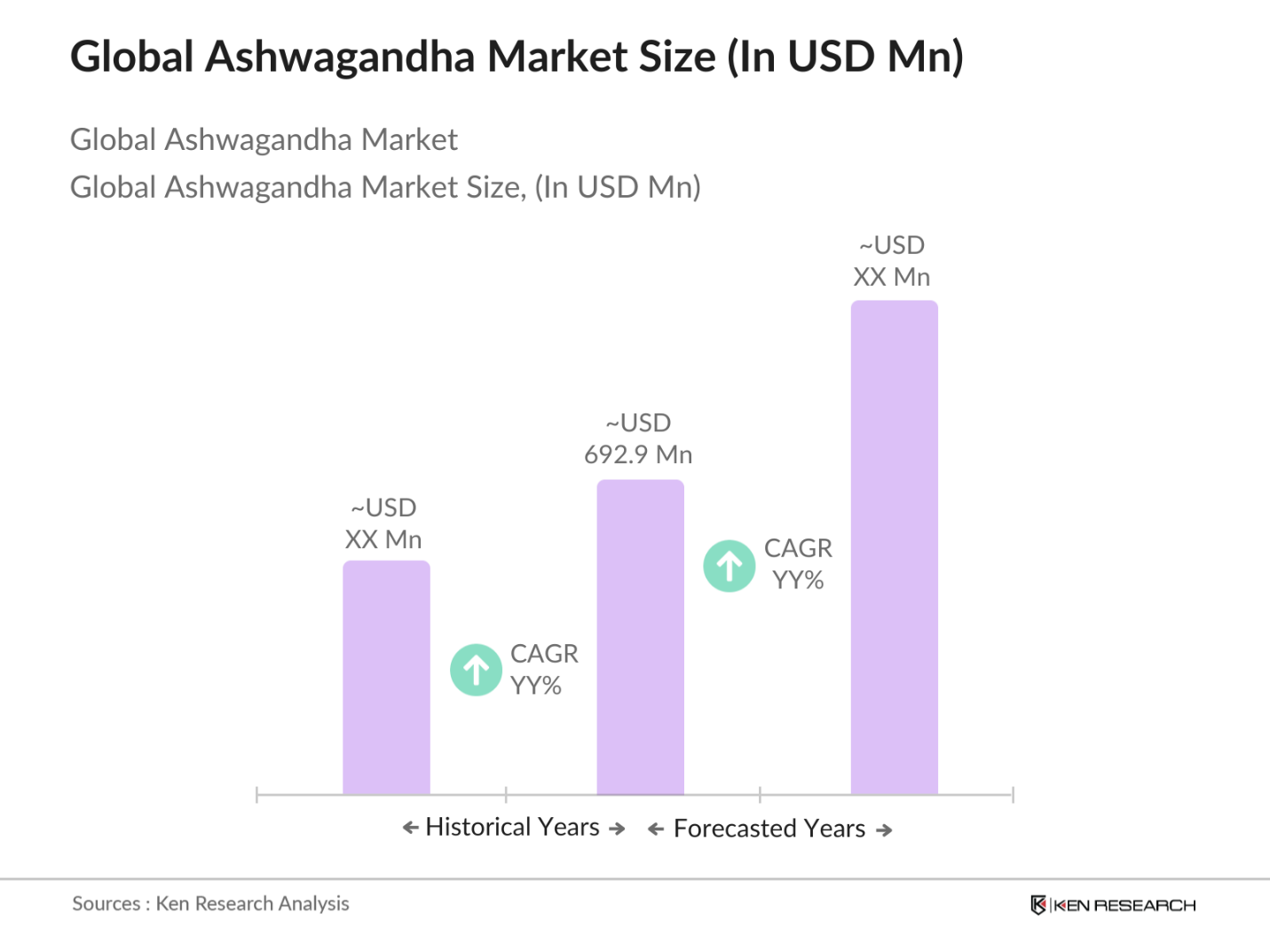
The global Ashwagandha market is valued at USD 692.9 million, driven by rising consumer awareness of its adaptogenic benefits and increased demand in dietary supplements.
Key challenges include supply chain disruptions, particularly in raw material sourcing, and quality control issues. The lack of standardized certification across markets also creates challenges for global distribution.
Major players in the market include Natreon Inc., Ixoreal Biomed Inc., Himalaya Drug Company, Organic India Pvt Ltd., and Dabur India Ltd. These companies dominate due to their strong supply chains and established brand presence.
The market is driven by increasing consumer interest in plant-based adaptogens, rising demand for stress-relief products, and expanding applications in the food, beverage, and cosmetics industries.

What makes us stand out is that our consultants follows Robust, Refine and Result (RRR) methodology. i.e. Robust for clear definitions, approaches and sanity checking, Refine for differentiating respondents facts and opinions and Result for presenting data with story

We have set a benchmark in the industry by offering our clients with syndicated and customized market research reports featuring coverage of entire market as well as meticulous research and analyst insights.

While we don't replace traditional research, we flip the method upside down. Our dual approach of Top Bottom & Bottom Top ensures quality deliverable by not just verifying company fundamentals but also looking at the sector and macroeconomic factors.

With one step in the future, our research team constantly tries to show you the bigger picture. We help with some of the tough questions you may encounter along the way: How is the industry positioned? Best marketing channel? KPI's of competitors? By aligning every element, we help maximize success.

Our report gives you instant access to the answers and sources that other companies might choose to hide. We elaborate each steps of research methodology we have used and showcase you the sample size to earn your trust.

If you need any support, we are here! We pride ourselves on universe strength, data quality, and quick, friendly, and professional service.