
Global Automated Parking System Market Outlook to 2030
Region:Global
Author(s):Shivani Mehra
Product Code:KROD5242
November 2024
94
About the Report
Global Automated Parking System Market Overview
- The global automated parking system market is valued at USD 2.1 billion, driven by rapid urbanization and the rising demand for efficient parking solutions in congested urban areas. The increasing number of vehicles in metropolitan cities, combined with the scarcity of parking spaces, has fueled the adoption of automated parking systems.
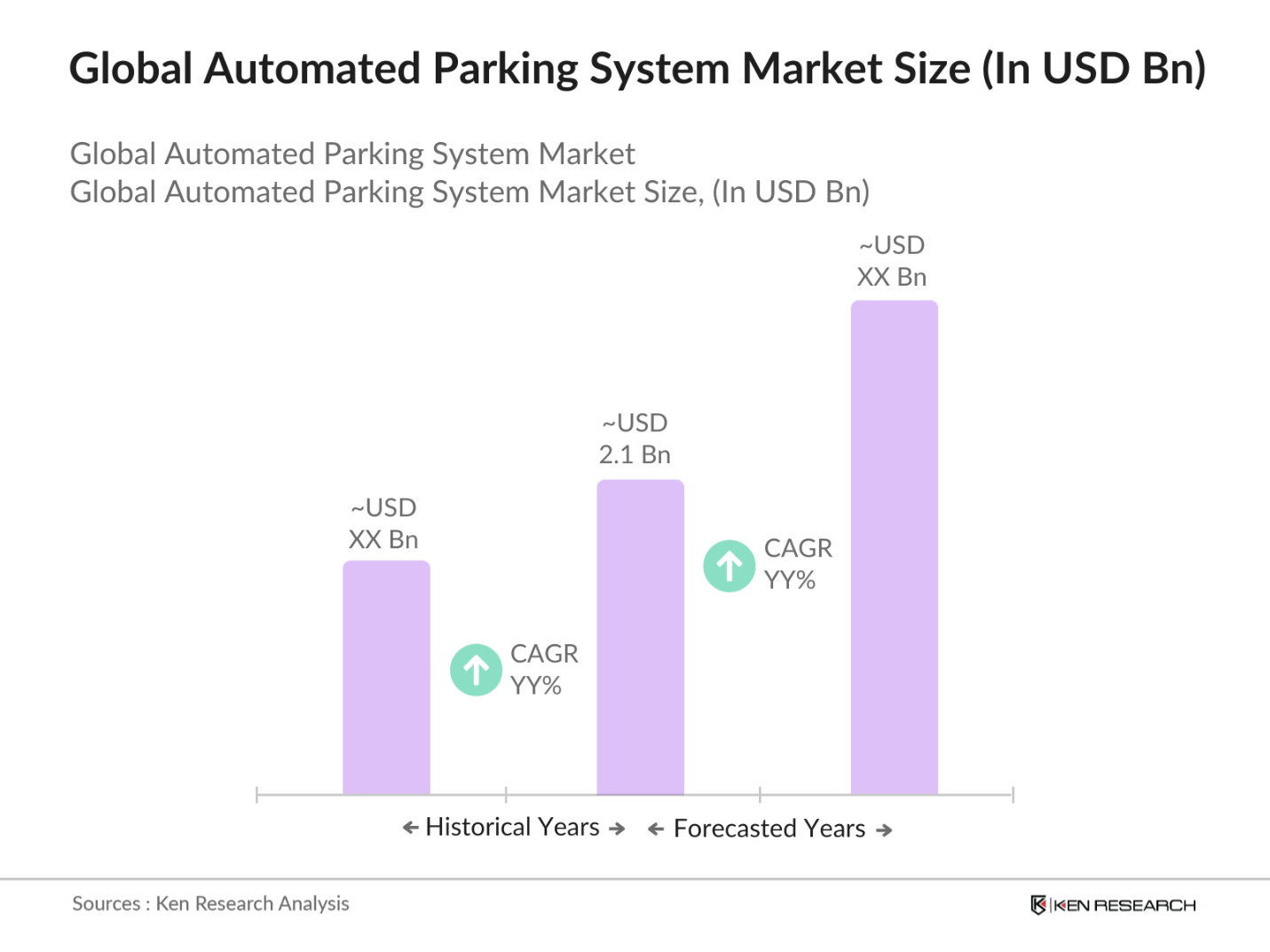
- The automated parking system market is primarily dominated by countries like Germany, Japan, and the United States due to their advanced infrastructure and robust technological adoption. Cities like Berlin and Tokyo are leaders in this space, driven by high urban density, strict regulations on land usage, and the need for innovative parking solutions to combat space limitations. In the US, cities like New York and Los Angeles are at the forefront due to the increasing demand for automated systems in commercial and residential complexes.
- Public-Private Partnerships (PPP) are becoming a popular approach for developing automated parking infrastructure. In 2023, the UK launched a PPP initiative that allocated 100 million to support the development of smart parking solutions in major cities like London and Manchester. These partnerships leverage private sector investment and expertise to build and operate automated parking systems, helping to reduce the financial burden on public entities while improving urban mobility. Other countries, including the US and Australia, are adopting similar PPP models.
Global Automated Parking System Market Segmentation
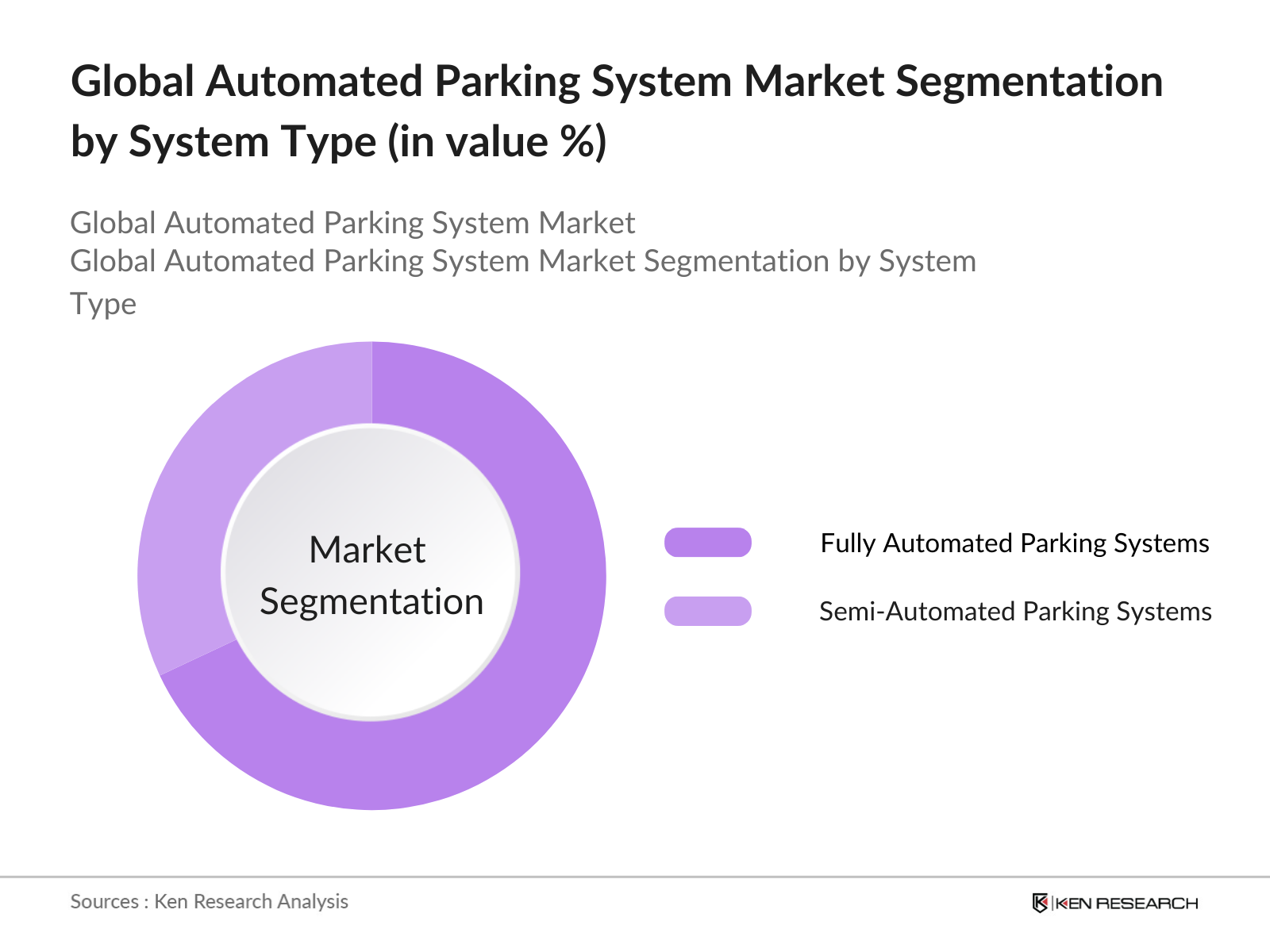
By System Type: The global automated parking system market is segmented by system type into fully automated parking systems and semi-automated parking systems. Fully automated systems dominate this segment due to their efficiency in maximizing space utilization without human intervention. These systems are designed to operate without any human assistance, significantly reducing parking time and enhancing the user experience. They are particularly beneficial in high-density urban areas where space is at a premium. The advanced technologies utilized in these systems, such as robotic vehicle retrieval, enable effective management of parking spaces and improve overall efficiency.
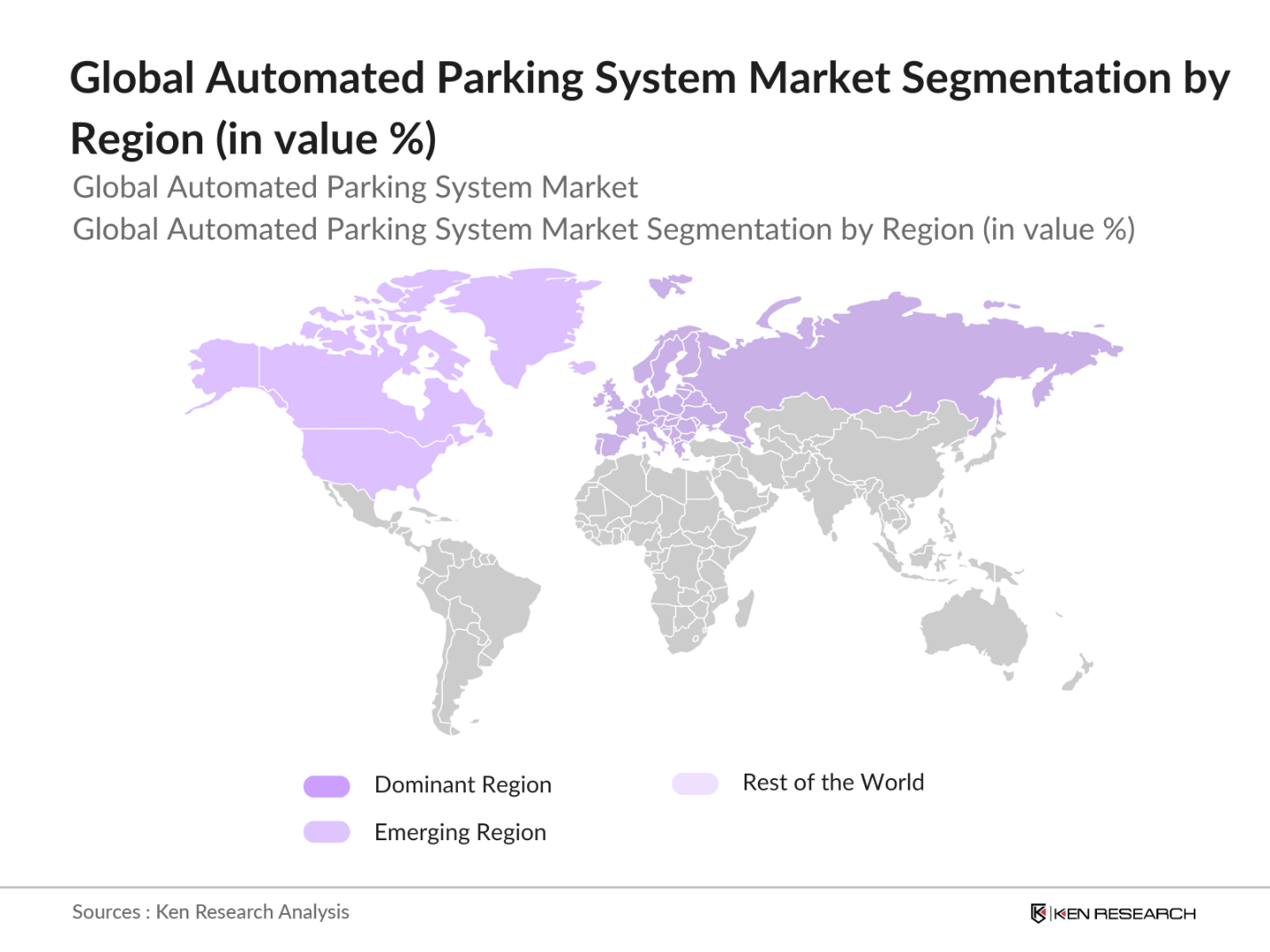
By Region: The automated parking system market is regionally segmented into North America, Europe, Asia Pacific, the Middle East & Africa, and Latin America. Europe leads the market with a significant share, driven by stringent regulations on urban space usage and the need for sustainable parking solutions in densely populated cities like London and Paris. The region's emphasis on smart city development and green building certifications also drives demand for automated parking systems.
Global Automated Parking System Competitive Landscape
The global automated parking system market is dominated by a few key players, with companies such as Whr Autoparksysteme GmbH and Klaus Multiparking GmbH leading the space. These players leverage their expertise in engineering and technology to offer cutting-edge parking solutions, including robotic and tower parking systems. The competitive landscape is characterized by innovation, with players continually upgrading their offerings to meet the growing demand for advanced parking solutions, particularly in urban centers.
|
Company Name |
Year of Establishment |
Headquarters |
Market Presence |
R&D Investment |
No. of Patents |
Technology Innovations |
Strategic Partnerships |
Global Installations |
Aftermarket Services |
|
Whr Autoparksysteme GmbH |
1902 |
Germany |
|||||||
|
Klaus Multiparking GmbH |
1964 |
Germany |
|||||||
|
Robotic Parking Systems, Inc. |
1994 |
USA |
|||||||
|
CityLift Parking |
2009 |
USA |
|||||||
|
ShinMaywa Industries, Ltd. |
1949 |
Japan |
Global Automated Parking System Market Analysis
Global Automated Parking System Market Growth Drivers
- Increasing Urbanization and Smart City Initiatives: Rapid urbanization is putting pressure on existing infrastructure, prompting cities to adopt smart initiatives to manage growing vehicle numbers. Automated parking systems are increasingly being integrated into these initiatives to optimize space usage, reduce congestion, and improve traffic flow, contributing to a more sustainable urban environment. Additionally, these systems help cities meet environmental goals by reducing emissions from vehicles idling while searching for parking spaces.
- Rising Vehicle Ownership and Space Constraints: The global vehicle population surpassed 1.4 billion units in 2023, according to the International Organization of Motor Vehicle Manufacturers (OICA). This rise in vehicle ownership is causing significant space constraints in urban areas, especially in densely populated cities like Tokyo and New York. Space shortages for parking have led to the increased adoption of automated systems that optimize parking in vertical and underground spaces. Cities like London have addressed conventional parking lot shortages by implementing automated systems that significantly reduce parking space requirements.
- Government Regulations Supporting Parking Solutions: Governments worldwide are implementing policies to promote the development of smart parking infrastructure. In the European Union, regulations under the Urban Mobility Package (2024) mandate the inclusion of automated parking systems in new commercial buildings to reduce parking time and congestion. The German government has allocated 100 million for urban parking solutions through public-private partnerships (PPP) aimed at reducing urban congestion in major cities by 2025. Similarly, the US Department of Transportation has introduced grants encouraging cities to incorporate automated parking systems into transit hubs.
- Technological Advancements in Parking Automation: Technological advancements are driving growth in the automated parking market. The integration of AI and IoT in parking systems enables real-time tracking and remote operation, improving traffic flow and operational efficiency. Cities like Singapore have adopted fully autonomous parking systems, minimizing human intervention and enhancing the use of limited parking spaces. These advancements are helping address environmental and logistical challenges in major urban centers.
Global Automated Parking System Market Challenges
- High Initial Installation Costs: Automated parking systems require substantial upfront investment, with installation costs ranging between $15,000 and $25,000 per parking space, depending on the level of automation. This is significantly higher than traditional parking infrastructure, limiting its adoption, particularly in emerging economies. The US Department of Energy (DOE) has reported that a relatively small number of parking facilities in high-density cities have adopted automation, mainly due to financial constraints. Financial incentives and subsidies are needed to bridge this gap, as high installation costs can discourage municipalities and private operators from transitioning to automated systems.
- Complexities in Retrofitting Existing Infrastructure: Retrofitting existing parking infrastructure to accommodate automated systems presents significant technical challenges. Many traditional parking facilities, especially in older urban areas, lack the structural integrity to support robotic and vertical parking systems. A study by the European Parking Association indicated that a limited number of Europes existing parking facilities could be retrofitted without extensive remodeling. This limitation hampers the expansion of automated systems in legacy infrastructure, with retrofitting costs often exceeding $50,000 per space in some cases.
Global Automated Parking System Market Future Outlook
Over the next five years, the global automated parking system market is expected to grow significantly, driven by continuous technological advancements, such as the integration of artificial intelligence and IoT in parking solutions. Increasing demand for sustainable urban mobility solutions and the rising number of smart city initiatives will further propel the market. Furthermore, government regulations on efficient space usage and parking infrastructure development are expected to provide additional momentum for growth in both developed and emerging markets.
Market Opportunities:
- Increasing Adoption of Fully Automated Parking Systems: Fully automated parking systems are gaining popularity, especially in high-density urban areas. These systems enhance parking space efficiency by eliminating the need for driving lanes and reducing human intervention. In 2023, Tokyo introduced fully automated robotic parking systems across multiple commercial hubs, significantly reducing parking search times. The integration of these systems into urban landscapes is becoming a global trend, particularly in cities where space constraints are a critical issue.
- Vertical and Robotic Parking Systems Growth: Vertical and robotic parking systems are rapidly expanding in cities where land availability is limited. These systems stack vehicles in multi-story structures, significantly increasing space utilization. In 2024, cities like Singapore and Hong Kong adopted robotic parking systems in many new commercial developments. These systems are particularly popular in densely populated urban centers where land prices are high, offering considerable space savings compared to traditional parking facilities.
Scope of the Report
|
By System Type |
Fully Automated Parking Systems Semi-Automated Parking Systems |
|
By Automation Level |
Independent Parking Systems Dependent Parking Systems Light Emitting Diode (LED) |
|
By Platform Type |
Robotic Parking Systems Rotary Parking Systems Tower Parking Systems |
|
By Application |
Residential Buildings Commercial Buildings Public Facilities Airports |
|
By Region |
North America Europe Asia Pacific Middle East & Africa Latin America |
Products
Key Target Audience
Urban Development Authorities (Smart City Initiatives)
Real Estate Developers
Property Management Companies
Parking Solution Providers
Investments and Venture Capitalist Firms
Government and Regulatory Bodies (Department of Transportation, Smart City Councils)
Retail and Commercial Space Developers
Municipalities and Urban Planning Agencies
Companies
Players Mention in the Report
Whr Autoparksysteme GmbH
Klaus Multiparking GmbH
Robotic Parking Systems, Inc.
CityLift Parking
Westfalia Technologies, Inc.
Unitronics (1989) (R"G) Ltd.
Boomerang Systems, Inc.
ParkPlus, Inc.
ShinMaywa Industries, Ltd.
FATA Automation, Inc.
IHI Corporation
Ldige Industries
Parkmatic
Eito & Global Inc.
AJ Automated Parking Systems Co.
Table of Contents
01. Global Automated Parking System Market Overview 1.1. Definition and Scope
1.2. Market Taxonomy
1.3. Market Growth Rate
1.4. Market Segmentation Overview
02. Global Automated Parking System Market Size (In USD Bn) 2.1. Historical Market Size
2.2. Year-On-Year Growth Analysis
2.3. Key Market Developments and Milestones
03. Global Automated Parking System Market Analysis
3.1. Growth Drivers
3.1.1. Increasing Urbanization and Smart City Initiatives
3.1.2. Rising Vehicle Ownership and Space Constraints
3.1.3. Government Regulations Supporting Parking Solutions
3.1.4. Technological Advancements in Parking Automation
3.2. Market Challenges
3.2.1. High Initial Installation Costs
3.2.2. Complexities in Retrofitting Existing Infrastructure
3.2.3. Integration Challenges with Legacy Systems
3.3. Opportunities
3.3.1. Integration of IoT and AI in Automated Parking
3.3.2. Expansion in Emerging Economies
3.3.3. Growing Demand for Electric Vehicle Parking Solutions
3.4. Trends
3.4.1. Increasing Adoption of Fully Automated Parking Systems
3.4.2. Vertical and Robotic Parking Systems Growth
3.4.3. Incorporation of Vehicle-to-Infrastructure (V2I) Technologies
3.5. Government Regulations and Policies
3.5.1. Smart Parking Initiatives
3.5.2. Policies to Reduce Urban Congestion
3.5.3. Parking Infrastructure Funding Programs
3.5.4. Public-Private Partnership (PPP) Models
3.6. SWOT Analysis
3.7. Stakeholder Ecosystem
3.8. Porters Five Forces Analysis
3.9. Competition Ecosystem
04. Global Automated Parking System Market Segmentation
4.1. By System Type (In Value %) 4.1.1. Fully Automated Parking Systems
4.1.2. Semi-Automated Parking Systems
4.2. By Automation Level (In Value %) 4.2.1. Independent Parking Systems
4.2.2. Dependent Parking Systems
4.3. By Platform Type (In Value %) 4.3.1. Robotic Parking Systems
4.3.2. Rotary Parking Systems
4.3.3. Tower Parking Systems
4.4. By Application (In Value %) 4.4.1. Residential Buildings
4.4.2. Commercial Buildings
4.4.3. Public Facilities
4.4.4. Airports
4.5. By Region (In Value %) 4.5.1. North America
4.5.2. Europe
4.5.3. Asia Pacific
4.5.4. Middle East & Africa
4.5.5. Latin America
05. Global Automated Parking System Market Competitive Analysis
5.1 Detailed Profiles of Major Companies
5.1.1. Whr Autoparksysteme GmbH
5.1.2. Klaus Multiparking GmbH
5.1.3. Robotic Parking Systems, Inc.
5.1.4. CityLift Parking
5.1.5. Unitronics (1989) (R"G) Ltd.
5.1.6. Parkmatic
5.1.7. Westfalia Technologies, Inc.
5.1.8. Boomerang Systems, Inc.
5.1.9. ParkPlus, Inc.
5.1.10. ShinMaywa Industries, Ltd.
5.1.11. FATA Automation, Inc.
5.1.12. IHI Corporation
5.1.13. Ldige Industries
5.1.14. Eito & Global Inc.
5.1.15. AJ Automated Parking Systems Co.
5.2 Cross Comparison Parameters (No. of Patents, Annual R&D Investment, Technological Innovations, Market Presence, Product Portfolio, Strategic Partnerships, Global Installations, Aftermarket Services)
5.3 Market Share Analysis
5.4 Strategic Initiatives
5.5 Mergers and Acquisitions
5.6 Investment Analysis
5.7 Venture Capital Funding
5.8 Government Grants
5.9 Private Equity Investments
06 .Global Automated Parking System Market Regulatory Framework
6.1. Environmental and Building Standards
6.2. Compliance Requirements for Automation Systems
6.3. Certification Processes for Automated Parking Solutions
07. Global Automated Parking System Future Market Size (In USD Bn)
7.1. Future Market Size Projections
7.2. Key Factors Driving Future Market Growth
08. Global Automated Parking System Future Market Segmentation
8.1. By System Type (In Value %)
8.2. By Automation Level (In Value %)
8.3. By Platform Type (In Value %)
8.4. By Application (In Value %)
8.5. By Region (In Value %)
09. Global Automated Parking System Market Analysts Recommendations
9.1. TAM/SAM/SOM Analysis
9.2. Customer Cohort Analysis
9.3. Marketing Initiatives
9.4. White Space Opportunity Analysis
Disclaimer
Contact Us
Research Methodology
Step 1: Identification of Key Variables
The first step involves mapping the global automated parking system market by analyzing the major stakeholders, including manufacturers, integrators, and end-users. Desk research is conducted using secondary data and proprietary databases to identify the critical factors influencing the market, including technology adoption, space constraints, and regulatory support.
Step 2: Market Analysis and Construction
In this phase, historical data is compiled to assess the market's growth trajectory, including the penetration rate of automated parking systems, market share by application, and revenue generation patterns. Additionally, a detailed analysis of infrastructure development and urbanization trends is undertaken to refine market estimates.
Step 3: Hypothesis Validation and Expert Consultation
The hypotheses developed during market analysis are validated through expert consultations with industry professionals, including interviews with key market players, regulatory bodies, and urban planners. These consultations provide valuable insights into the operational and financial aspects of the automated parking system market.
Step 4: Research Synthesis and Final Output
The final step includes synthesizing the data gathered from primary and secondary sources. A comprehensive analysis is conducted to verify market size, segmentation, and competitive landscape. This final output ensures a holistic view of the global automated parking system market, providing accurate and validated insights.
Frequently Asked Questions
01. How big is the global automated parking system market?
The global automated parking system market is valued at USD 2.1 billion, driven by urbanization, space constraints, and the demand for efficient parking solutions in smart cities.
02. What are the challenges in the global automated parking system market?
Challenges include the high cost of installation, retrofitting issues in existing infrastructure, and integration challenges with older systems, limiting widespread adoption in certain regions.
03. Who are the major players in the global automated parking system market?
Key players include Whr Autoparksysteme GmbH, Klaus Multiparking GmbH, Robotic Parking Systems, Inc., CityLift Parking, and ShinMaywa Industries, Ltd., which dominate due to their advanced technologies and robust infrastructure.
04. What are the growth drivers of the global automated parking system market?
Growth is propelled by increasing vehicle ownership, urbanization, technological advancements like IoT integration, and government policies promoting smart city initiatives, ensuring space-efficient solutions.
Why Buy From Us?

What makes us stand out is that our consultants follows Robust, Refine and Result (RRR) methodology. i.e. Robust for clear definitions, approaches and sanity checking, Refine for differentiating respondents facts and opinions and Result for presenting data with story

We have set a benchmark in the industry by offering our clients with syndicated and customized market research reports featuring coverage of entire market as well as meticulous research and analyst insights.

While we don't replace traditional research, we flip the method upside down. Our dual approach of Top Bottom & Bottom Top ensures quality deliverable by not just verifying company fundamentals but also looking at the sector and macroeconomic factors.

With one step in the future, our research team constantly tries to show you the bigger picture. We help with some of the tough questions you may encounter along the way: How is the industry positioned? Best marketing channel? KPI's of competitors? By aligning every element, we help maximize success.

Our report gives you instant access to the answers and sources that other companies might choose to hide. We elaborate each steps of research methodology we have used and showcase you the sample size to earn your trust.

If you need any support, we are here! We pride ourselves on universe strength, data quality, and quick, friendly, and professional service.