















Global Automotive Exhaust Systems Market Outlook to 2030
Region:Global
Author(s):Vijay Kumar
Product Code:KROD9593
December 2024
89
About the Report
Global Automotive Exhaust Systems Market Overview
- The Global Automotive Exhaust Systems market is valued at USD 31.8 billion based on a five-year historical analysis. The market is driven primarily by the increasing production of vehicles across key regions and the implementation of stricter emissions regulations in countries like the United States, China, and European nations. As governments globally emphasize lowering greenhouse gas emissions, automotive manufacturers have invested heavily in advanced exhaust systems to meet regulatory standards, driving market growth.
- Countries such as China, the United States, and Germany dominate the market due to their massive automotive production capabilities and stringent emissions regulations. China leads with its large-scale vehicle manufacturing industry, while Germanys advanced automotive engineering capabilities contribute to the production of high-efficiency exhaust systems. The United States follows closely, driven by federal emissions standards and the presence of key manufacturers.
- EPAs Tier 3 standards, fully implemented in 2022, target reductions in NOx and particulate matter emissions for light-duty and heavy-duty vehicles. These regulations require the adoption of advanced exhaust technologies, including catalytic converters and SCR systems, in commercial and passenger vehicles. The EPA estimates that these measures will reduce NOx emissions by 35% in new vehicles.

Global Automotive Exhaust Systems Market Segmentation
By Product Type: The global automotive exhaust systems market is segmented by product type into catalytic converters, mufflers, manifolds, exhaust pipes, and other components. Catalytic converters hold a dominant market share due to their vital role in reducing harmful emissions. This segment has been at the forefront of the market owing to the global push for reducing CO2 and NOx emissions, especially in countries with stringent emission standards like the U.S. and European nations.

By Region: The market is segmented by region into North America, Europe, Asia-Pacific, Latin America, and the Middle East & Africa. Asia-Pacific, specifically China, holds the largest market share due to the regions dominant automotive production and rapid industrial growth. Europe follows closely, driven by the presence of leading automotive manufacturers and stringent EU emissions standards.

By Vehicle Type: The market is segmented by vehicle type into passenger cars, light commercial vehicles (LCV), heavy commercial vehicles (HCV), and two-wheelers. Passenger cars dominate this segment due to the high volume of production and consumer demand for personal vehicles globally. The shift toward hybrid and electric vehicles is also influencing exhaust system designs, with manufacturers focusing on developing lightweight systems that complement these technologies.
Global Automotive Exhaust Systems Market Competitive Landscape
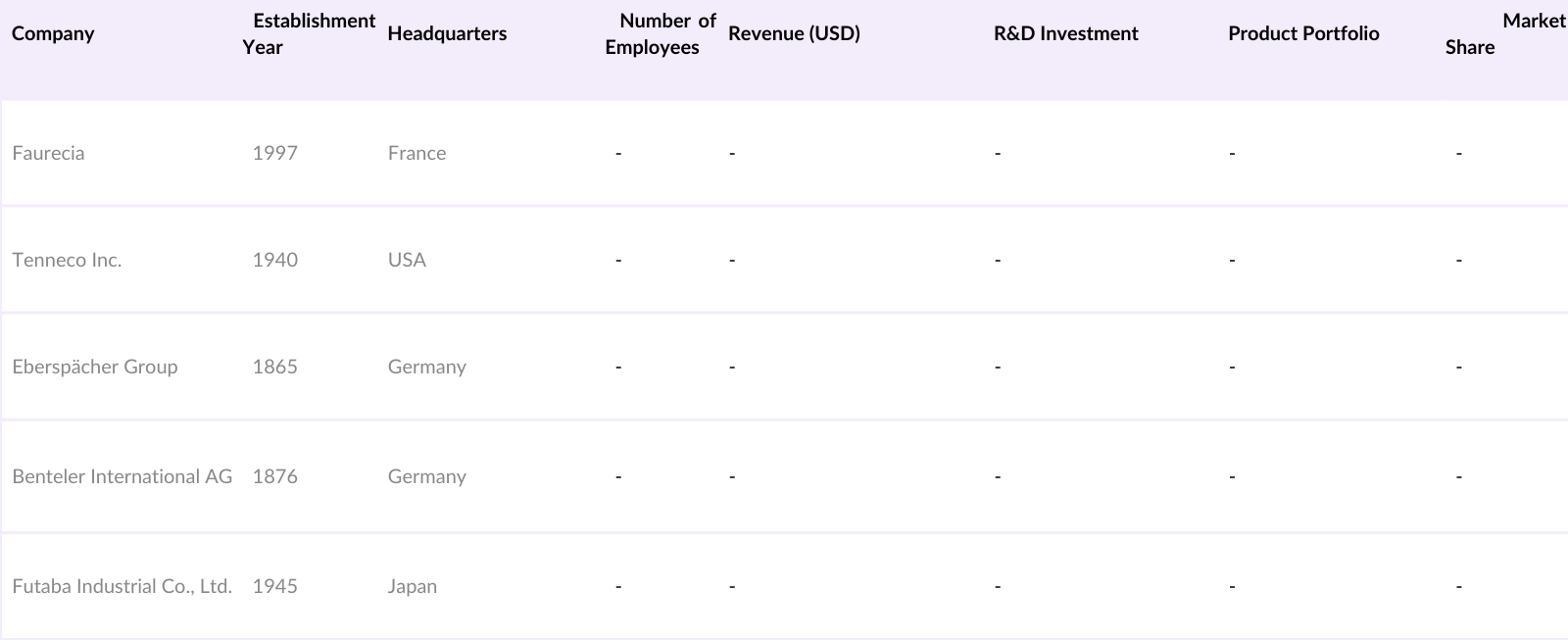
The global automotive exhaust systems market is dominated by key players that control a significant portion of the market through technological innovations, strategic partnerships, and extensive distribution networks. Companies are increasingly focusing on R&D investments to develop systems that comply with evolving emission standards.
Global Automotive Exhaust Systems Industry Analysis
- Rising Environmental Regulations: Environmental regulations, particularly emission standards, are major drivers in the automotive exhaust systems market. In 2023, the European Union introduced the Euro 7 standard, targeting reduced NOx and particulate matter emissions. The Euro 7 regulations enforce stricter limits on nitrogen oxides (NOx) emissions, targeting a maximum of 60 mg/km for gasoline vehicles and 40 mg/km for diesel. These regulatory measures are pushing automakers to adopt advanced exhaust systems, including catalytic converters and particulate filters, to meet these new thresholds. Similar regulations are being enforced globally, such as the U.S. EPA Tier 3 regulations and Chinas National VI standards.
- Increase in Vehicle Production (Passenger and Commercial): Global vehicle production has seen a recovery post-pandemic, with 79 million passenger cars produced globally in 2022, according to the International Organization of Motor Vehicle Manufacturers (OICA). Rising consumer demand, particularly in emerging markets like India and Brazil, coupled with increasing production of commercial vehicles (approximately 24 million units globally), is driving the demand for automotive exhaust systems. As vehicle output grows, manufacturers are focusing on upgrading exhaust systems to meet both production needs and regulatory standards, boosting the market for advanced exhaust technologies.
- Advancements in Exhaust Technologies: Technological advancements in automotive exhaust systems, such as selective catalytic reduction (SCR) and heat recovery systems, have significantly evolved. The SCR system, widely used in diesel engines, helps in reducing NOx emissions by up to 90%, according to a 2023 report by the European Automobile Manufacturers Association (ACEA). The incorporation of heat recovery systems in exhausts also helps improve fuel efficiency, a critical factor as governments push for energy-efficient solutions. For instance, BMW has developed heat-recovery technologies that capture up to 30% of the waste heat generated by exhausts, enhancing overall vehicle efficiency.
Market Restraints
- High Cost of Advanced Systems (Particulate Filters, SCR) The cost of implementing advanced exhaust systems such as diesel particulate filters (DPF) and SCR technology remains a significant challenge. According to industry estimates, the average cost of an SCR system in commercial vehicles is between USD 2,500 and USD 4,000. These costs, particularly for high-volume manufacturing, create barriers for automakers, especially in developing markets. The added financial burden is driven by the complexity and material costs of integrating these technologies into existing vehicle architectures.
- Regulatory Compliance Costs (Emission Regulations, Testing) Complying with stringent emission regulations increases operational costs for automotive manufacturers. In the U.S., compliance with the EPAs Tier 3 standards, which came into full effect in 2022, costs automakers an estimated USD 1,200 per vehicle due to the required changes in exhaust and engine management systems. Similar costs are incurred globally, with automakers needing to constantly upgrade systems to meet evolving regulatory requirements. The financial burden of testing and certification processes further adds to the overall cost structure.
Global Automotive Exhaust Systems Market Future Outlook
Over the next five years, the global automotive exhaust systems market is expected to show significant growth driven by continuous advancements in emission control technologies, rising vehicle production, and the growing trend of electrification in the automotive sector. Hybrid and electric vehicles are expected to play a major role in transforming exhaust systems, pushing manufacturers to innovate and optimize their offerings.
Market Opportunities
- Development of Lightweight Exhaust Systems (Material Innovations, Weight Reduction): With global automakers increasingly focused on reducing vehicle weight to improve fuel efficiency, the demand for lightweight exhaust systems is growing. Aluminum and titanium, known for their high strength-to-weight ratios, are increasingly being adopted. For instance, aluminum exhausts can reduce system weight by up to 50%, leading to substantial improvements in fuel efficiency and emissions reductions. According to a 2023 report by the World Bank, lightweight material adoption is set to rise as fuel efficiency standards continue to tighten across global markets.
- Expansion into Developing Economies (Asia-Pacific, Latin America) Emerging markets in Asia-Pacific and Latin America present significant growth opportunities for the automotive exhaust systems industry. Countries such as India and Brazil are experiencing rapid vehicle sales growth, with India producing 4.7 million vehicles in 2023, according to the World Bank. The rising urbanization and increasing disposable income in these regions are propelling vehicle sales, and consequently, the demand for efficient exhaust systems. Furthermore, governments in these regions are gradually adopting stricter emission norms, further supporting market growth.
Scope of the Report
|
Product Type |
Catalytic Converters, Mufflers, Manifolds, Exhaust Pipes, Other Components |
|
Vehicle Type |
Passenger Cars, Light Commercial Vehicles (LCV), Heavy Commercial Vehicles (HCV), Two-Wheelers |
|
Fuel Type |
Gasoline, Diesel, Hybrid (HEV, PHEV), CNG & LPG |
|
Material |
Stainless Steel, Aluminum, Titanium, Other Alloys |
|
Region |
North America, Europe, Asia-Pacific, Latin America, Middle East & Africa |
Products
Key Target Audience
Automotive OEMs
Exhaust System Manufacturers
Suppliers and Component Manufacturers
Environmental and Regulatory Bodies (EPA, European Commission)
Investors and Venture Capitalist Firms
Government Agencies (Department of Transportation, Ministry of Environment)
Aftermarket Suppliers
Technology Providers
Companies
Players Mentioned in the Report:
Faurecia
Tenneco Inc.
Eberspcher Group
Futaba Industrial Co., Ltd.
Benteler International AG
Bosal International
Sango Co., Ltd.
Friedrich Boysen GmbH & Co. KG
Magneti Marelli S.p.A.
Yutaka Giken Co., Ltd.
Table of Contents
1. Global Automotive Exhaust Systems Market Overview
1.1. Definition and Scope
1.2. Market Taxonomy
1.3. Market Growth Rate (CAGR, Market Expansion Trends)
1.4. Market Segmentation Overview (Product Type, Vehicle Type, Fuel Type, Material, Region)
2. Global Automotive Exhaust Systems Market Size (In USD Bn)
2.1. Historical Market Size
2.2. Year-On-Year Growth Analysis
2.3. Key Market Developments and Milestones (Emissions Standards, Technological Innovations, Electrification Impact)
3. Global Automotive Exhaust Systems Market Analysis
3.1. Growth Drivers
3.1.1. Rising Environmental Regulations (Emission Norms, Government Policies)
3.1.2. Increase in Vehicle Production (Passenger and Commercial)
3.1.3. Advancements in Exhaust Technologies (After-treatment, Heat Recovery, Catalytic Systems)
3.1.4. Growth of Hybrid and Electric Vehicles (Impact on Exhaust Systems)
3.2. Market Challenges
3.2.1. High Cost of Advanced Systems (Particulate Filters, SCR)
3.2.2. Regulatory Compliance Costs (Emission Regulations, Testing)
3.2.3. Competition from Electric Vehicles (Market Disruption, Demand Shift)
3.3. Opportunities
3.3.1. Development of Lightweight Exhaust Systems (Material Innovations, Weight Reduction)
3.3.2. Expansion into Developing Economies (Asia-Pacific, Latin America)
3.3.3. Integration with Advanced Powertrains (Hybrid, Plug-In Hybrid)
3.3.4. Aftermarket Segment Growth (Replacement Demand, Upgradation Needs)
3.4. Trends
3.4.1. Adoption of Lightweight Materials (Aluminum, Titanium, Composites)
3.4.2. Electrification Impact on Exhaust Design (Reduced Exhausts, Sound Design)
3.4.3. Integrated Exhaust and Thermal Management Systems (Efficiency Improvement)
3.4.4. Increasing Use of Selective Catalytic Reduction (SCR) Systems
3.5. Government Regulations
3.5.1. European Emission Standards (Euro 6, Euro 7)
3.5.2. U.S. Environmental Protection Agency (EPA) Regulations
3.5.3. China National VI Standards (China 6 Emissions Standard)
3.5.4. Bharat Stage (BS) Emission Standards in India
3.6. SWOT Analysis
3.7. Stakeholder Ecosystem (Manufacturers, Suppliers, OEMs, Aftermarket Players)
3.8. Porters Five Forces (Supplier Power, Buyer Power, Substitution Risk, Market Entry Barriers, Competitive Rivalry)
3.9. Competition Ecosystem
4. Global Automotive Exhaust Systems Market Segmentation
4.1. By Product Type (In Value %)
4.1.1. Catalytic Converters
4.1.2. Mufflers
4.1.3. Manifolds
4.1.4. Exhaust Pipes
4.1.5. Other Components
4.2. By Vehicle Type (In Value %)
4.2.1. Passenger Cars
4.2.2. Light Commercial Vehicles (LCV)
4.2.3. Heavy Commercial Vehicles (HCV)
4.2.4. Two-Wheelers
4.3. By Fuel Type (In Value %)
4.3.1. Gasoline
4.3.2. Diesel
4.3.3. Hybrid (HEV, PHEV)
4.3.4. CNG & LPG
4.4. By Material (In Value %)
4.4.1. Stainless Steel
4.4.2. Aluminum
4.4.3. Titanium
4.4.4. Other Alloys
4.5. By Region (In Value %)
4.5.1. North America
4.5.2. Europe
4.5.3. Asia-Pacific
4.5.4. Latin America
4.5.5. Middle East & Africa
5. Global Automotive Exhaust Systems Market Competitive Analysis
5.1. Detailed Profiles of Major Companies
5.1.1. Faurecia
5.1.2. Tenneco Inc.
5.1.3. Eberspcher Group
5.1.4. Futaba Industrial Co., Ltd.
5.1.5. Bosal International
5.1.6. Benteler International AG
5.1.7. Sango Co., Ltd.
5.1.8. Sejong Industrial Co., Ltd.
5.1.9. Friedrich Boysen GmbH & Co. KG
5.1.10. Yutaka Giken Co., Ltd.
5.1.11. Magneti Marelli S.p.A.
5.1.12. Harbin Airui Automotive Exhaust System Co., Ltd.
5.1.13. Katcon Global
5.1.14. Calsonic Kansei Corporation
5.1.15. SMR Automotive
5.2. Cross Comparison Parameters (Number of Employees, Headquarters, Inception Year, Revenue, R&D Investment, Market Share, Product Range, Market Reach)
5.3. Market Share Analysis
5.4. Strategic Initiatives (Product Launches, Collaborations, Partnerships)
5.5. Mergers and Acquisitions
5.6. Investment Analysis
5.7. Venture Capital Funding
5.8. Government Grants
5.9. Private Equity Investments
6. Global Automotive Exhaust Systems Market Regulatory Framework
6.1. Emission Standards (Euro, BS, EPA)
6.2. Compliance Requirements
6.3. Certification Processes (Environmental, Automotive Quality)
7. Global Automotive Exhaust Systems Future Market Size (In USD Bn)
7.1. Future Market Size Projections
7.2. Key Factors Driving Future Market Growth (Regulations, Vehicle Production, Technological Innovations)
8. Global Automotive Exhaust Systems Future Market Segmentation
8.1. By Product Type (In Value %)
8.2. By Vehicle Type (In Value %)
8.3. By Fuel Type (In Value %)
8.4. By Material (In Value %)
8.5. By Region (In Value %)
8. Global Automotive Exhaust Systems Market Analysts Recommendations
9.1. TAM/SAM/SOM Analysis
9.2. Customer Cohort Analysis
9.3. Marketing Initiatives
9.4. White Space Opportunity Analysis
Disclaimer Contact UsResearch Methodology
Step 1: Identification of Key Variables
The initial phase involves mapping all major stakeholders within the global automotive exhaust systems market. This includes conducting extensive desk research using both secondary and proprietary databases to gather crucial industry-level information.
Step 2: Market Analysis and Construction
In this phase, historical market data is compiled and analyzed, assessing market penetration, exhaust system developments, and revenue generation trends. An evaluation of key regulatory standards and technological innovations is also conducted to ensure data accuracy.
Step 3: Hypothesis Validation and Expert Consultation
Market hypotheses will be developed and validated through expert consultations, including interviews with leading automotive exhaust manufacturers and industry professionals. These discussions will provide insights into industry dynamics and further validate the data collected.
Step 4: Research Synthesis and Final Output
In the final phase, direct engagement with major manufacturers will be undertaken to verify insights on exhaust systems, sales performance, and evolving consumer demands. This step ensures a well-rounded and accurate analysis of the market.
Frequently Asked Questions
01. How big is the Global Automotive Exhaust Systems Market?
The global automotive exhaust systems market is valued at USD 31.8 billion, driven by stringent emission regulations and rising vehicle production, especially in key markets like China, the U.S., and Germany.
02. What are the challenges in the Global Automotive Exhaust Systems Market?
Challenges include the high cost of advanced exhaust systems, compliance with strict environmental regulations, and the rise of electric vehicles, which reduce the need for traditional exhaust systems.
03. Who are the major players in the Global Automotive Exhaust Systems Market?
Key players include Faurecia, Tenneco Inc., Eberspcher Group, Futaba Industrial Co., Ltd., and Benteler International AG. These companies dominate due to their strong market presence and innovative exhaust system technologies.
04. What are the growth drivers of the Global Automotive Exhaust Systems Market?
Growth is driven by the increasing production of vehicles globally, advancements in emission control technologies, and stringent emission regulations enforced by various governments worldwide.
Why Buy From Us?

What makes us stand out is that our consultants follows Robust, Refine and Result (RRR) methodology. i.e. Robust for clear definitions, approaches and sanity checking, Refine for differentiating respondents facts and opinions and Result for presenting data with story

We have set a benchmark in the industry by offering our clients with syndicated and customized market research reports featuring coverage of entire market as well as meticulous research and analyst insights.

While we don't replace traditional research, we flip the method upside down. Our dual approach of Top Bottom & Bottom Top ensures quality deliverable by not just verifying company fundamentals but also looking at the sector and macroeconomic factors.

With one step in the future, our research team constantly tries to show you the bigger picture. We help with some of the tough questions you may encounter along the way: How is the industry positioned? Best marketing channel? KPI's of competitors? By aligning every element, we help maximize success.

Our report gives you instant access to the answers and sources that other companies might choose to hide. We elaborate each steps of research methodology we have used and showcase you the sample size to earn your trust.

If you need any support, we are here! We pride ourselves on universe strength, data quality, and quick, friendly, and professional service.