
Global Automotive Glass Market Outlook 2030
Region:Global
Author(s):Shivani Mehra
Product Code:KROD2175
Region:Global
Author(s):Shivani Mehra
Product Code:KROD2175
December 2024
91
Listen to the audio summary
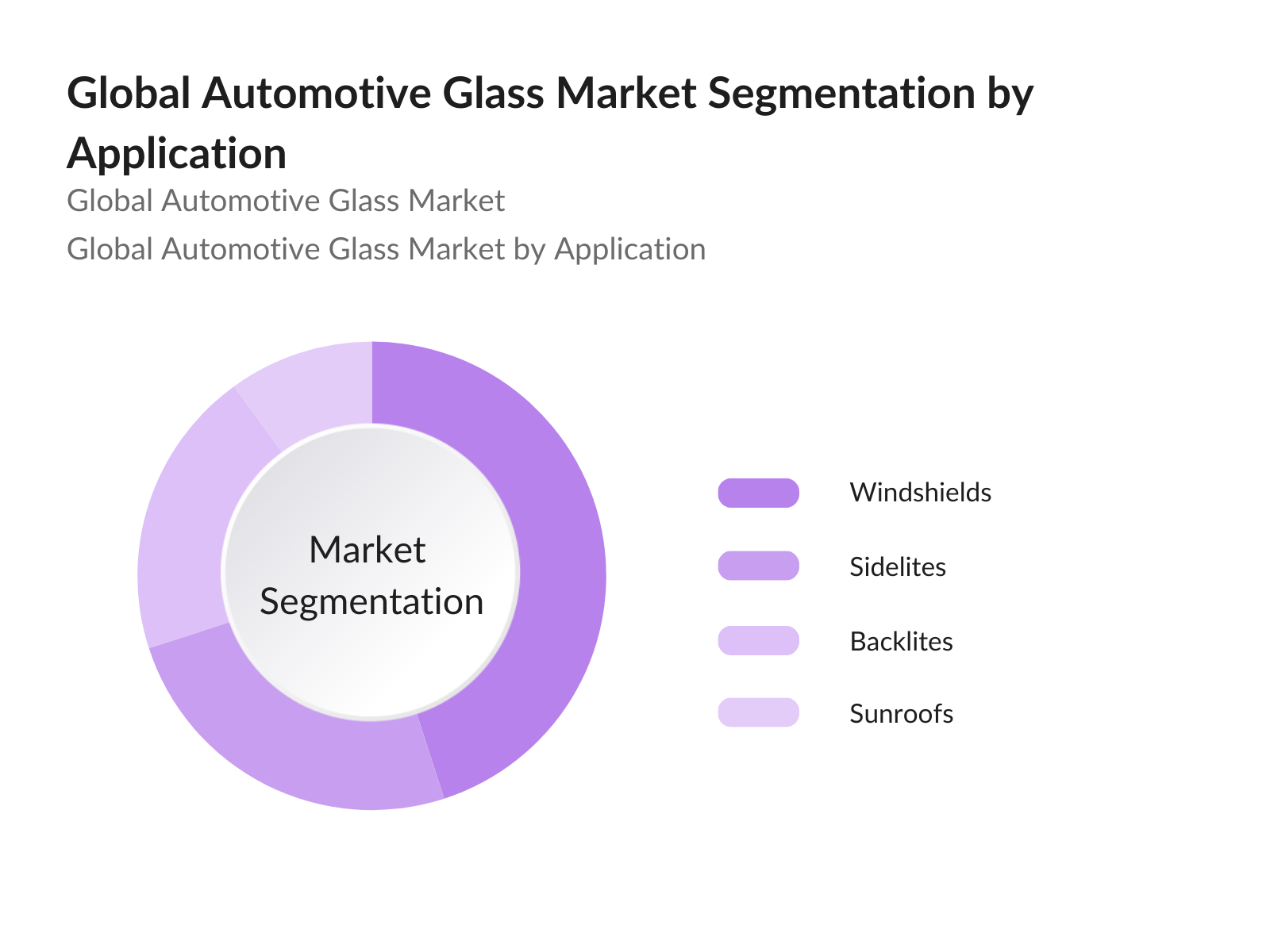
By Application: The global automotive glass market is segmented by application into windshields, sidelites, backlites, and sunroofs. Windshields are the leading application segment due to the need for high durability and clarity, as they directly impact driver visibility and vehicle safety. As regulations evolve and focus more on advanced safety and durability, manufacturers are increasingly investing in advanced windshield materials with added features like head-up display (HUD) compatibility.
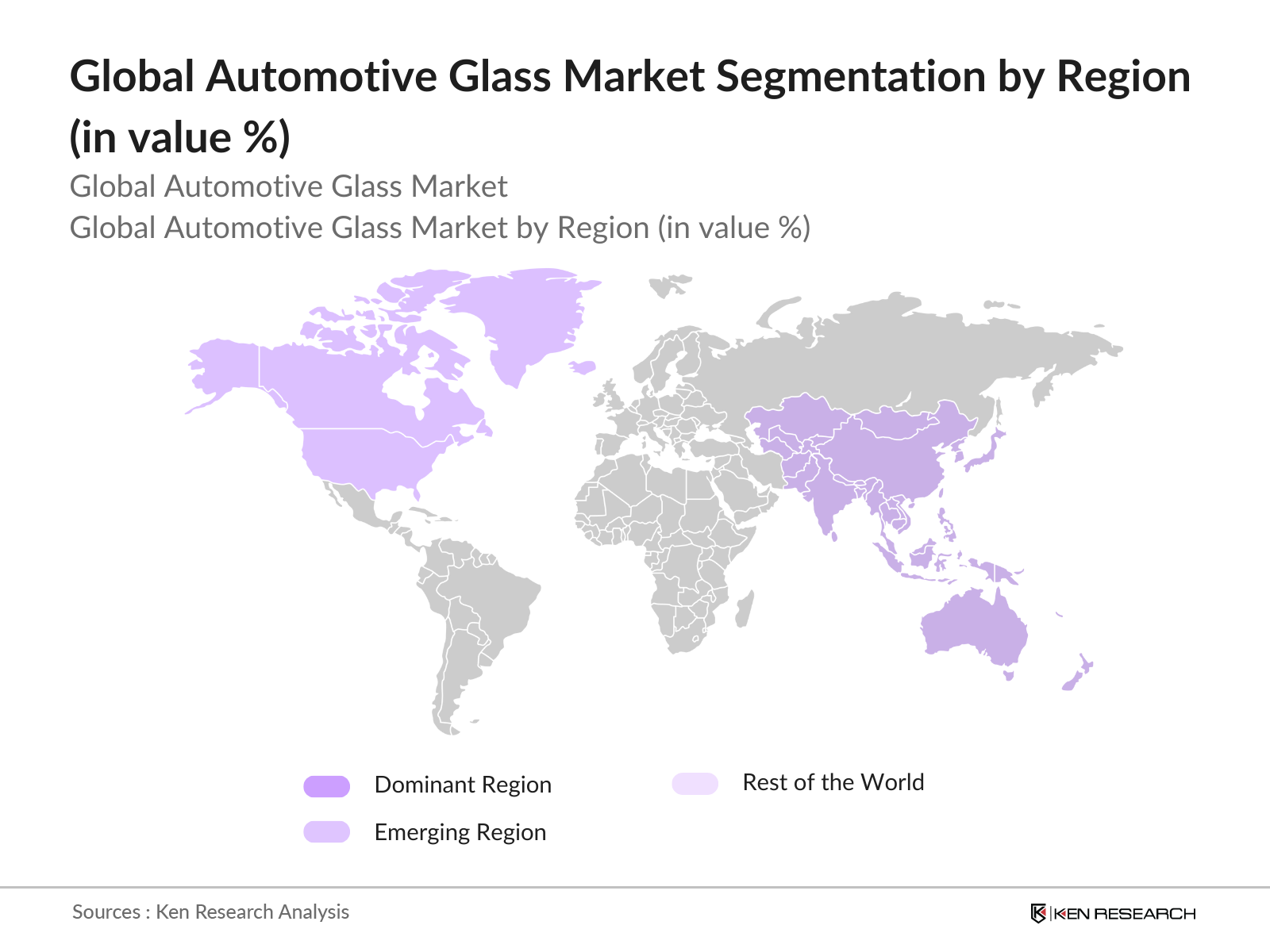
 By Region: The global automotive glass market is segmented by region into North America, Europe, Asia-Pacific, Middle East & Africa, and Latin America. Asia-Pacific leads the market due to its rapidly expanding automotive sector, especially in China and India, where automotive production and sales are on the rise. Government initiatives promoting electric vehicles in the region further stimulate demand for advanced automotive glass materials, bolstering the dominance of Asia-Pacific in this market.
 Global Automotive Glass Market Competitive Landscape
The global automotive glass market is characterized by a concentration of major players, including AGC Inc., Saint-Gobain S.A., and Fuyao Group, which lead in innovation, production capabilities, and geographic presence. This concentration highlights the influence of these key companies on the global supply chain and their ongoing contributions to advancing automotive glass technologies.
|
Company Name |
Establishment Year |
Headquarters |
R&D Investment |
Production Capacity |
Global Reach |
Product Innovation |
Market Presence |
Employee Strength |
|
AGC Inc. |
1907 |
Tokyo, Japan |
||||||
|
Saint-Gobain S.A. |
1665 |
La Dfense, France |
||||||
|
Fuyao Group |
1987 |
Fuqing, China |
||||||
|
Guardian Industries |
1932 |
Auburn Hills, USA |
||||||
|
Nippon Sheet Glass |
1918 |
Tokyo, Japan |
Over the next five years, the global automotive glass market is expected to experience significant growth, propelled by increased investments in electric vehicles and a growing focus on lightweight materials for fuel efficiency. Continuous advancements in smart glass technology, coupled with regulatory pressures for vehicle safety and environmental compliance, will further drive the demand for advanced automotive glass solutions.
|
By Product Type |
B2C Platforms C2C Platforms B2B Platforms |
|
By Product Category |
Electronics & Gadgets Fashion & Apparel Health & Beauty Home & Living Groceries |
|
By Payment Method |
Digital Wallets Bank Transfers Cash on Delivery Credit/Debit Cards |
|
By Device Type |
Mobile Desktop Tablets |
|
By Region |
North America Europe Asia Pacific Latin America Middle East & Africa |
1.1. Definition and Scope
1.2. Market Taxonomy
1.3. Market Growth Rate
1.4. Market Segmentation Overview
2.1. Historical Market Size
2.2. Year-On-Year Growth Analysis
2.3. Key Market Developments and Milestones
3.1. Growth Drivers
3.1.1. Increasing Vehicle Production
3.1.2. Advancements in Automotive Glass Technology
3.1.3. Growth in Automotive Aftermarket Demand
3.2. Market Challenges
3.2.1. High Production Costs
3.2.2. Stringent Environmental Regulations
3.3. Opportunities
3.3.1. Demand from Electric Vehicle (EV) Adoption
3.3.2. Expansion in Emerging Markets
3.4. Trends
3.4.1. Use of Lightweight Glass Materials
3.4.2. Rise in Smart Glass Applications
3.4.3. Growth in Acoustic Glass for Enhanced Comfort
3.5. Government Regulations
3.5.1. Safety Standards and Compliance Requirements
3.5.2. Environmental Impact Regulations
3.6. SWOT Analysis
3.7. Stakeholder Ecosystem
3.8. Porters Five Forces Analysis
3.9. Competitive Landscape
4.1. By Application (Market Share %)
4.1.1. Windshields
4.1.2. Sidelites
4.1.3. Backlites
4.1.4. Sunroofs
4.2. By Region (Market Share %)
4.2.1. North America
4.2.2. Europe
4.2.3. Asia-Pacific
4.2.4. Middle East & Africa
4.2.5. Latin America
5.1. Detailed Profiles of Major Companies
5.1.1. AGC Inc.
5.1.2. Saint-Gobain S.A.
5.1.3. Fuyao Group
5.1.4. Guardian Industries
5.1.5. Nippon Sheet Glass
5.1.6. Central Glass Co., Ltd.
5.1.7. Xinyi Glass Holdings Ltd.
5.1.8. Vitro S.A.B. de C.V.
5.1.9. Sisecam Group
5.1.10. Magna International Inc.
5.1.11. Gentex Corporation
5.1.12. PGW Auto Glass LLC
5.1.13. Asahi India Glass Ltd.
5.1.14. Schott AG
5.1.15. Guardian Automotive
5.2. Cross Comparison Parameters (Employees, Headquarters, Inception Year, Revenue, Market Share, Product Portfolio, Recent Developments, Strategic Initiatives)
5.3. Market Share Analysis
5.4. Strategic Initiatives
5.5. Mergers and Acquisitions
5.6. Investment Analysis
5.6.1. Venture Capital Funding
5.6.2. Government Grants
5.6.3. Private Equity Investments
6.1. Safety Compliance Requirements
6.2. Environmental Standards and Regulations
6.3. Certification Processes
7.1. Future Market Size Projections
7.2. Key Factors Driving Future Market Growth
8.1. By Application (Market Share %)
8.2. By Region (Market Share %)
9.1. Total Addressable Market (TAM), Serviceable Available Market (SAM), and Serviceable Obtainable Market (SOM) Analysis
9.2. Consumer Cohort Analysis
9.3. Marketing Initiatives
9.4. White Space Opportunity Analysis
The initial phase involves mapping out key stakeholders within the automotive glass market. This mapping is supported by in-depth secondary research from proprietary databases, aimed at identifying critical market-driving variables.
This phase includes a detailed analysis of historical data, assessing production volumes, automotive sales, and key technological advancements. This analysis helps in validating market trends and building reliable projections.
Hypotheses based on market insights are validated through interviews with industry experts. These consultations provide insights into production processes, consumer preferences, and R&D priorities.
The final phase synthesizes primary and secondary research to create an accurate and validated market analysis. Interactions with key manufacturers refine the reports content, ensuring it meets industry standards and accurately represents market dynamics.
The global automotive glass market is valued at USD 18,598.6 million, driven by the demand for lightweight, durable, and advanced glass solutions that cater to modern vehicle design and safety requirements.
Key challenges include high production costs and stringent environmental regulations that increase manufacturing complexity. Fluctuating raw material prices also add cost volatility.
Key players include AGC Inc., Saint-Gobain S.A., and Fuyao Group, with extensive global reach, advanced R&D capabilities, and a focus on automotive glass innovation.
The shift to electric vehicles drives demand for lightweight glass solutions to improve energy efficiency. Advanced glass technologies, like smart and solar control glass, are increasingly used in EVs for added performance.

What makes us stand out is that our consultants follows Robust, Refine and Result (RRR) methodology. i.e. Robust for clear definitions, approaches and sanity checking, Refine for differentiating respondents facts and opinions and Result for presenting data with story

We have set a benchmark in the industry by offering our clients with syndicated and customized market research reports featuring coverage of entire market as well as meticulous research and analyst insights.

While we don't replace traditional research, we flip the method upside down. Our dual approach of Top Bottom & Bottom Top ensures quality deliverable by not just verifying company fundamentals but also looking at the sector and macroeconomic factors.

With one step in the future, our research team constantly tries to show you the bigger picture. We help with some of the tough questions you may encounter along the way: How is the industry positioned? Best marketing channel? KPI's of competitors? By aligning every element, we help maximize success.

Our report gives you instant access to the answers and sources that other companies might choose to hide. We elaborate each steps of research methodology we have used and showcase you the sample size to earn your trust.

If you need any support, we are here! We pride ourselves on universe strength, data quality, and quick, friendly, and professional service.