















Global Autonomous AI Market Outlook to 2030
Region:Asia
Author(s):Sanjna Verma
Product Code:KROD7929
December 2024
97
About the Report
Global Autonomous AI Market Overview
- The Global Autonomous AI Market is valued at USD 5 billion, driven by the widespread adoption of artificial intelligence technologies across industries such as automotive, healthcare, and manufacturing. The increasing demand for automated solutions, combined with advancements in machine learning, robotics, and deep learning, has led to significant growth in this market. Government initiatives focused on AI development and the push for digitization are major factors fueling the demand for autonomous AI systems.
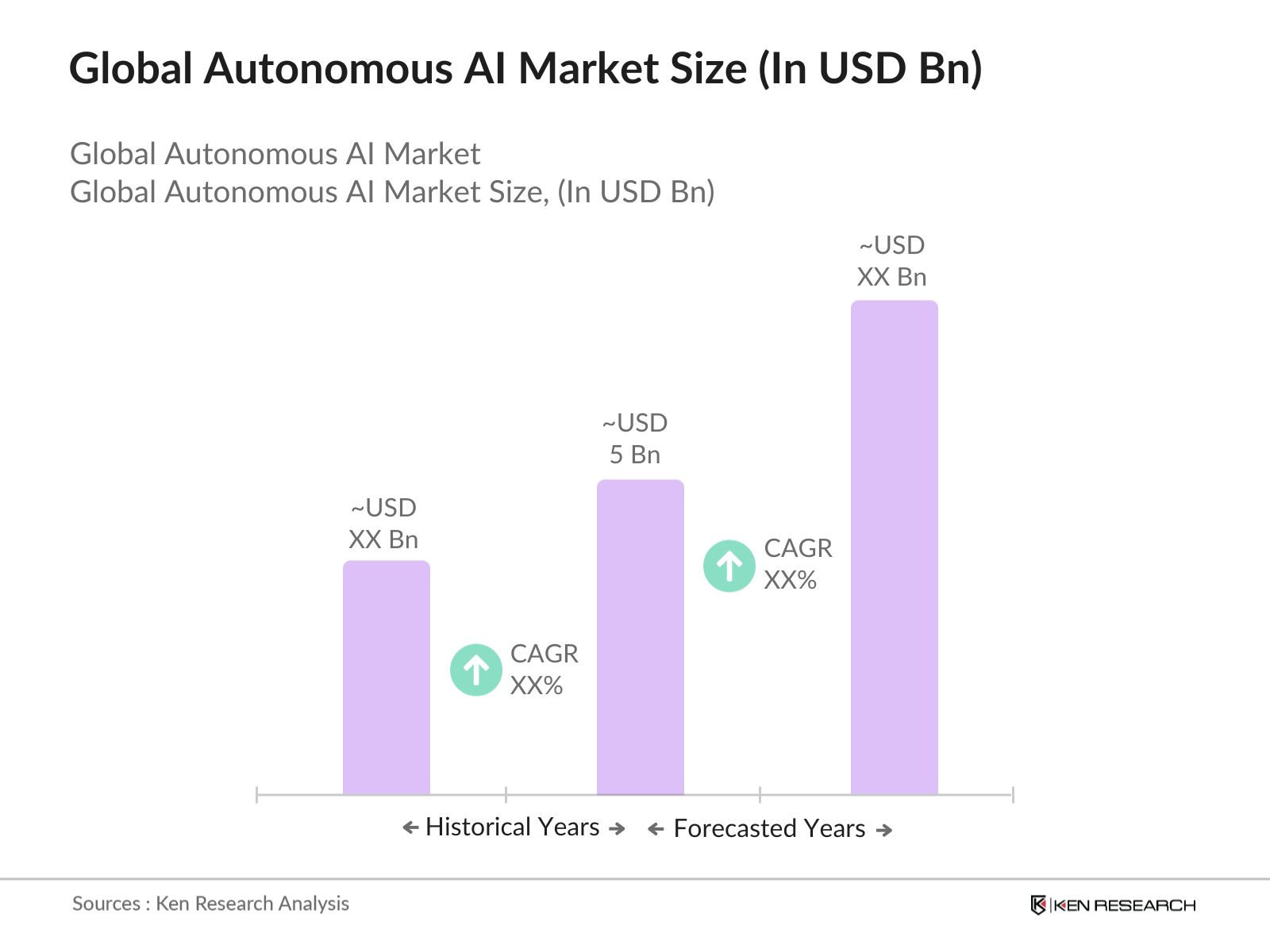
- Countries such as the United States and China dominate the autonomous AI market due to their robust technological ecosystems and heavy investments in AI research and development. The United States benefits from its innovation hubs like Silicon Valley, where major players such as Google and Tesla operate. Chinas government-backed AI initiatives, coupled with its rapid digital transformation and a high level of AI patent filings, have cemented its leadership in the global market.
- Governments around the world are creating regulatory frameworks to govern AI technologies. By 2023, over 80% of G20 countries had enacted or proposed AI-related regulations, according to the International Telecommunication Union (ITU). For instance, the European Union and the U.S. have both introduced extensive legal frameworks that focus on high-risk AI applications, data protection, and ethical standards. The U.S. government allocated $12 billion in 2023 to fund initiatives aimed at ensuring compliance with these new AI regulations, especially in sectors like healthcare and finance.
Global Autonomous AI Market Segmentation
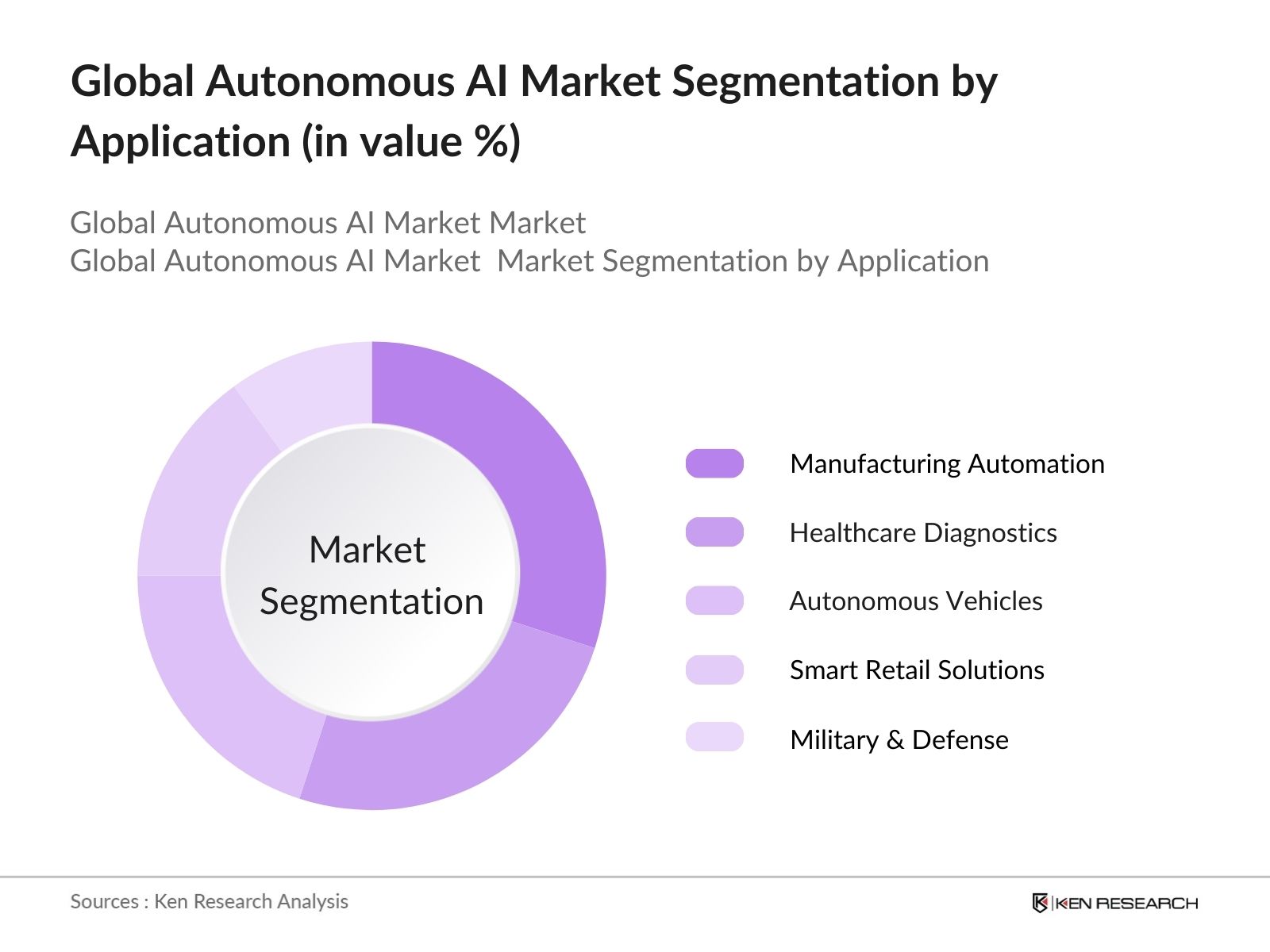
By Application: The global autonomous AI market is segmented by application into manufacturing automation, healthcare diagnostics, autonomous vehicles, smart retail solutions, and military & defense. Among these, manufacturing automation holds the dominant market share. The increasing demand for automation in production processes, including predictive maintenance and quality control, has propelled this segment forward. Major industrial players are leveraging AI-powered robotics to enhance efficiency and reduce operational costs.
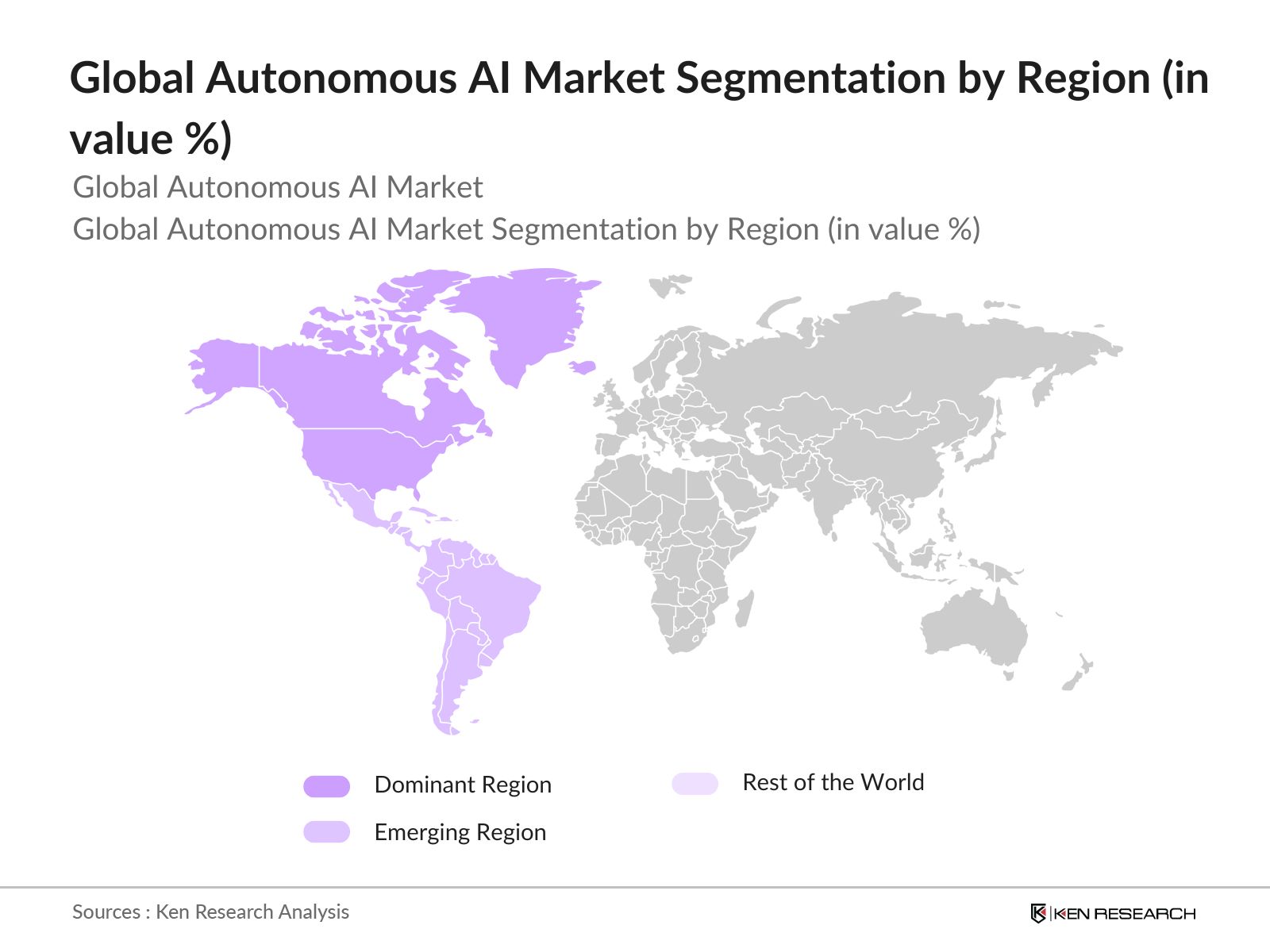
By Region: The regional segmentation includes North America, Europe, Asia-Pacific, the Middle East & Africa, and Latin America. North America continues to dominate the market with the largest share, mainly due to the presence of key players like Google, Microsoft, and NVIDIA, as well as significant investments in AI infrastructure. The regions leadership in technological innovation and its early adoption of AI across industries like healthcare and autonomous vehicles have ensured its continued dominance. The United States, in particular, leads the market, benefiting from an established ecosystem of research institutions and private sector investment.
By Technology: The technology segment includes machine learning, natural language processing, robotic process automation, neural networks, and computer vision. Machine learning dominates this segment with a significant market share due to its wide application across various industries. The capability of machine learning algorithms to analyze vast amounts of data, generate predictive insights, and drive autonomous decision-making makes it indispensable, especially in areas like autonomous vehicles and healthcare diagnostics.
Global Autonomous AI Market Competitive Landscape
The global autonomous AI market is dominated by key players with substantial R&D capabilities and expansive AI-driven product portfolios. Companies like Alphabet (Google) and Microsoft have made significant strides in developing AI systems, from cloud-based machine learning platforms to advanced AI research initiatives. These firms are bolstered by extensive global networks and partnerships with leading enterprises across various industries. Additionally, automotive companies like Tesla are pivotal in pushing forward the adoption of autonomous AI technologies in the transportation sector.
|
Company |
Establishment Year |
Headquarters |
R&D Spending |
AI Patents Held |
Product Portfolio |
Global Partnerships |
Annual Revenue |
AI-Specific Revenue |
|
Alphabet Inc. (Google) |
1998 |
Mountain View, USA |
- |
- |
- |
- |
- |
- |
|
Microsoft Corporation |
1975 |
Redmond, USA |
- |
- |
- |
- |
- |
- |
|
IBM Corporation |
1911 |
Armonk, USA |
- |
- |
- |
- |
- |
- |
|
Tesla Inc. |
2003 |
Palo Alto, USA |
- |
- |
- |
- |
- |
- |
|
NVIDIA Corporation |
1993 |
Santa Clara, USA |
- |
- |
- |
- |
- |
- |
Global Autonomous AI Market Analysis
Growth Drivers
- Increased Demand for Autonomous Systems in Manufacturing: According to the World Bank, industrial automation accounted for an estimated increase in manufacturing output by 20% across developed economies in 2023, driven by AI integration. Countries like the U.S. have invested heavily in smart manufacturing, with over $150 billion allocated by the U.S. Department of Commerce to support automation technology deployment in 2022. This increased demand reflects a shift towards higher efficiency and precision in production lines.
- AI Integration in Healthcare Diagnostics: AI technologies in healthcare diagnostics are revolutionizing patient care by enabling faster, more accurate diagnoses. By 2024, the integration of AI diagnostic tools in hospitals in the U.S. is expected to grow, with over 2,000 hospitals adopting AI-based radiology and pathology systems. The National Institutes of Health (NIH) reported that AI tools helped reduce diagnostic errors by 15% in cancer screenings in 2023. This trend is backed by increased government funding for AI in healthcare, amounting to $10 billion across the U.S. and European healthcare systems.
- Government Investments in AI Technology Development: Governments worldwide have amplified their investment in AI technology development, recognizing its potential to drive innovation and economic growth. In 2023, the U.S. government allocated $50 billion for AI research and development, focusing on sectors such as defense, healthcare, and infrastructure. Similarly, China invested over $15 billion in AI initiatives, creating AI hubs and research centers, highlighting governments' commitment to accelerating AI-driven transformation.
Challenges
- Lack of Regulatory Standards: Despite rapid advancements in AI, there remains a lack of consistent global regulatory standards. The European Union's proposed AI Act, introduced in 2024, highlights the challenges in regulating AI applications. The lack of unified global regulations hinders cross-border AI collaborations and commercialization. As of 2024, only 20% of countries have comprehensive AI governance frameworks in place, according to data from the OECD, creating a fragmented legal environment that poses challenges for multinational companies.
- Ethical Dilemmas and Public Resistance: AI technology continues to face ethical concerns, particularly regarding bias, accountability, and job displacement. A 2023 survey conducted by the U.S. Department of Labor revealed that 40% of workers expressed concerns about AI replacing human jobs. Furthermore, ethical dilemmas regarding data use and transparency in AI decision-making have led to growing public resistance, particularly in Europe and North America.
Global Autonomous AI Market Future Outlook
Global Autonomous AI market is expected to witness significant growth, driven by rapid advancements in AI technologies and increasing adoption across various industries. Autonomous AI solutions will continue to revolutionize sectors like healthcare, manufacturing, and transportation, where automation and machine learning are becoming integral to operations. As governments worldwide invest in AI development and regulatory frameworks evolve, the market will see increased participation from new players, along with rising consumer awareness about the benefits of AI-driven systems.
Future Market Opportunities
- AI-Driven Retail Automation: AI-powered automation in retail is creating new opportunities for enhanced customer experience and operational efficiency. In 2023, Amazon reported that its AI-driven checkout systems helped reduce checkout times by 30%, increasing customer satisfaction across its global stores. The U.S. retail sector saw a 10% increase in AI technology investment in 2023, totaling $5 billion, driven by demand for AI-powered inventory management and personalized marketing tools.
- Integration with Edge Computing: The integration of AI with edge computing is transforming industries by enabling real-time decision-making closer to data sources. In 2023, the U.S. Federal Communications Commission (FCC) reported that AI edge computing applications were responsible for a 25% improvement in network latency across manufacturing and logistics sectors. These advancements are facilitating real-time data processing, improving efficiency in critical operations, and reducing reliance on centralized cloud infrastructures.
Scope of the Report
|
By Application |
Manufacturing Automation Healthcare Diagnostics Autonomous Vehicles Smart Retail Military & Defense |
|
By Technology |
Machine Learning Natural Language Processing Robotic Process Automation Neural Networks, Computer Vision |
|
By Deployment Type |
Cloud-Based On-Premise |
|
By End-User |
Large Enterprises SMEs Government Public Sector |
|
By Region |
North America Europe Asia-Pacific Middle East & Africa Latin America |
Products
Key Target Audience
Autonomous Vehicle Manufacturers
AI Software and Hardware Providers
Healthcare Providers and AI Diagnostic Firms
Cloud and Data Management Companies
Military and Defense Contractors
Large Enterprises and SMEs implementing AI Solutions
Investors and Venture Capitalist Firms
Government and Regulatory Bodies (European Commission, US Federal Trade Commission)
Companies
Players Mentioned in the Report
Alphabet Inc. (Google)
Microsoft Corporation
IBM Corporation
Tesla Inc.
NVIDIA Corporation
Intel Corporation
Amazon Web Services (AWS)
Baidu Inc.
Qualcomm Technologies Inc.
OpenAI
Table of Contents
Global Autonomous AI Market Overview
1.1. Definition and Scope
1.2. Market Taxonomy
1.3. Market Ecosystem
1.4. Market Segmentation Overview
Global Autonomous AI Market Size (In USD Bn)
2.1. Historical Market Size
2.2. Year-on-Year Growth Analysis
2.3. Key Market Developments and Milestones
Global Autonomous AI Market Analysis
3.1. Growth Drivers (AI Adoption, Automation, Technological Evolution)
3.1.1. Increased Demand for Autonomous Systems in Manufacturing
3.1.2. AI Integration in Healthcare Diagnostics
3.1.3. Government Investments in AI Technology Development
3.1.4. Adoption of AI for Autonomous Vehicles
3.2. Market Challenges (Regulatory Landscape, Ethical Concerns, Data Privacy)
3.2.1. Lack of Regulatory Standards
3.2.2. Ethical Dilemmas and Public Resistance
3.2.3. Cybersecurity Threats and Data Breaches
3.2.4. High Initial Implementation Costs
3.3. Opportunities (AI in Retail, Edge Computing, Robotics, Military)
3.3.1. AI-Driven Retail Automation
3.3.2. Integration with Edge Computing
3.3.3. Expansion of AI in Robotics
3.3.4. Autonomous AI in Military Operations
3.4. Trends (Deep Learning, AI Governance, Explainable AI)
3.4.1. Rise of Deep Learning in AI Models
3.4.2. Evolution of AI Governance and Regulation Frameworks
3.4.3. Adoption of Explainable AI
3.4.4. Expansion of AI for Predictive Maintenance in Industries
3.5. Government Regulations (Data Protection Laws, AI Ethics, International Standards)
3.5.1. Global AI Regulatory Frameworks
3.5.2. AI Ethics and Public Policy Initiatives
3.5.3. Standardization of AI Systems Across Regions
3.5.4. Government Incentives for AI Research and Development
3.6. Stake Ecosystem
3.7. Porters Five Forces (AI Market Power Dynamics)
3.8. Competition Ecosystem
Global Autonomous AI Market Segmentation
4.1. By Application (In Value %)
4.1.1. Manufacturing Automation
4.1.2. Healthcare Diagnostics and Treatment
4.1.3. Autonomous Vehicles and Transport Systems
4.1.4. Smart Retail Solutions
4.1.5. Military and Defense
4.2. By Technology (In Value %)
4.2.1. Machine Learning
4.2.2. Natural Language Processing
4.2.3. Robotic Process Automation
4.2.4. Neural Networks
4.2.5. Computer Vision
4.3. By Deployment Type (In Value %)
4.3.1. Cloud-Based AI Systems
4.3.2. On-Premise AI Solutions
4.4. By End-User (In Value %)
4.4.1. Large Enterprises
4.4.2. SMEs
4.4.3. Government and Public Sector
4.5. By Region (In Value %)
4.5.1. North America
4.5.2. Europe
4.5.3. Asia-Pacific
4.5.4. Middle East & Africa
4.5.5. Latin America
Global Autonomous AI Market Competitive Analysis
5.1. Detailed Profiles of Major Competitors
5.1.1. Alphabet Inc.
5.1.2. Microsoft Corporation
5.1.3. IBM Corporation
5.1.4. NVIDIA Corporation
5.1.5. Tesla Inc.
5.1.6. Intel Corporation
5.1.7. Baidu Inc.
5.1.8. Amazon Web Services (AWS)
5.1.9. Qualcomm Technologies Inc.
5.1.10. OpenAI
5.2. Cross Comparison Parameters (R&D Expenditure, Patent Holdings, No. of Employees, Headquarters, Market Penetration, Global Partnerships, AI-Specific Revenue, AI Investments)
5.3. Market Share Analysis
5.4. Strategic Initiatives (Partnerships, AI Startups Acquisitions, Product Innovations)
5.5. Mergers and Acquisitions
5.6. Investment Analysis
5.7. Venture Capital Funding
5.8. Government Grants and Support
5.9. Private Equity Investments
Global Autonomous AI Market Regulatory Framework
6.1. AI Regulation Policies by Region
6.2. Data Privacy and Protection Laws (GDPR, CCPA)
6.3. AI Algorithm Transparency and Accountability
6.4. Ethical Compliance Guidelines
Global Autonomous AI Future Market Size (In USD Bn)
7.1. Future Market Size Projections
7.2. Key Factors Driving Future Market Growth
Global Autonomous AI Future Market Segmentation
8.1. By Application (In Value %)
8.2. By Technology (In Value %)
8.3. By Deployment Type (In Value %)
8.4. By End-User (In Value %)
8.5. By Region (In Value %)
Global Autonomous AI Market Analysts Recommendations
9.1. TAM/SAM/SOM Analysis
9.2. Customer Cohort Analysis
9.3. Marketing Initiatives
9.4. White Space Opportunity Analysis
Research Methodology
Step 1: Identification of Key Variables
The initial phase involves constructing an ecosystem map of key stakeholders in the Global Autonomous AI Market. We conducted extensive desk research, utilizing secondary and proprietary databases to gather comprehensive industry data. The objective was to identify and define critical variables that influence market dynamics, such as AI adoption rates and technology advancements.
Step 2: Market Analysis and Construction
We compiled and analyzed historical data for the market, including market penetration, technological adoption, and revenue generation. This analysis included an in-depth assessment of AI deployment across industries and regions, providing an accurate understanding of current market conditions.
Step 3: Hypothesis Validation and Expert Consultation
To validate market data, we conducted interviews with industry experts through computer-assisted telephone interviews (CATIs). These consultations provided valuable operational and financial insights, which helped refine the market hypotheses and align the research with on-ground realities.
Step 4: Research Synthesis and Final Output
In the final phase, we engaged directly with AI solution providers and manufacturers to acquire detailed insights into their product segments, market strategies, and sales performance. This interaction validated our bottom-up market approach and ensured the accuracy of the research report.
Frequently Asked Questions
01. How big is the Global Autonomous AI Market?
The global autonomous AI market is valued at USD 5 billion, driven by the increasing demand for automated systems and AI integration across various industries, such as manufacturing and healthcare.
02. What are the challenges in the Global Autonomous AI Market?
Key challenges in Global Autonomous AI Market include the lack of regulatory standards, high initial implementation costs, and growing ethical concerns related to AI decision-making processes. Data privacy and security risks also pose significant barriers to market growth.
03. Who are the major players in the Global Autonomous AI Market?
Major players in Global Autonomous AI Market include Alphabet Inc. (Google), Microsoft Corporation, IBM Corporation, Tesla Inc., and NVIDIA Corporation, all of which lead in innovation, AI development, and deployment.
04. What are the growth drivers of the Global Autonomous AI Market?
Global Autonomous AI Market is driven by the widespread adoption of AI technologies, advancements in deep learning and machine learning, and growing demand for autonomous solutions across various industries like manufacturing, healthcare, and transportation.
Why Buy From Us?

What makes us stand out is that our consultants follows Robust, Refine and Result (RRR) methodology. i.e. Robust for clear definitions, approaches and sanity checking, Refine for differentiating respondents facts and opinions and Result for presenting data with story

We have set a benchmark in the industry by offering our clients with syndicated and customized market research reports featuring coverage of entire market as well as meticulous research and analyst insights.

While we don't replace traditional research, we flip the method upside down. Our dual approach of Top Bottom & Bottom Top ensures quality deliverable by not just verifying company fundamentals but also looking at the sector and macroeconomic factors.

With one step in the future, our research team constantly tries to show you the bigger picture. We help with some of the tough questions you may encounter along the way: How is the industry positioned? Best marketing channel? KPI's of competitors? By aligning every element, we help maximize success.

Our report gives you instant access to the answers and sources that other companies might choose to hide. We elaborate each steps of research methodology we have used and showcase you the sample size to earn your trust.

If you need any support, we are here! We pride ourselves on universe strength, data quality, and quick, friendly, and professional service.