
Global Aviation & Technology Market Outlook 2030
Region:Global
Author(s):Shivani Mehra
Product Code:KROD11348
December 2024
83
About the Report
Global Aviation & Technology Market Overview
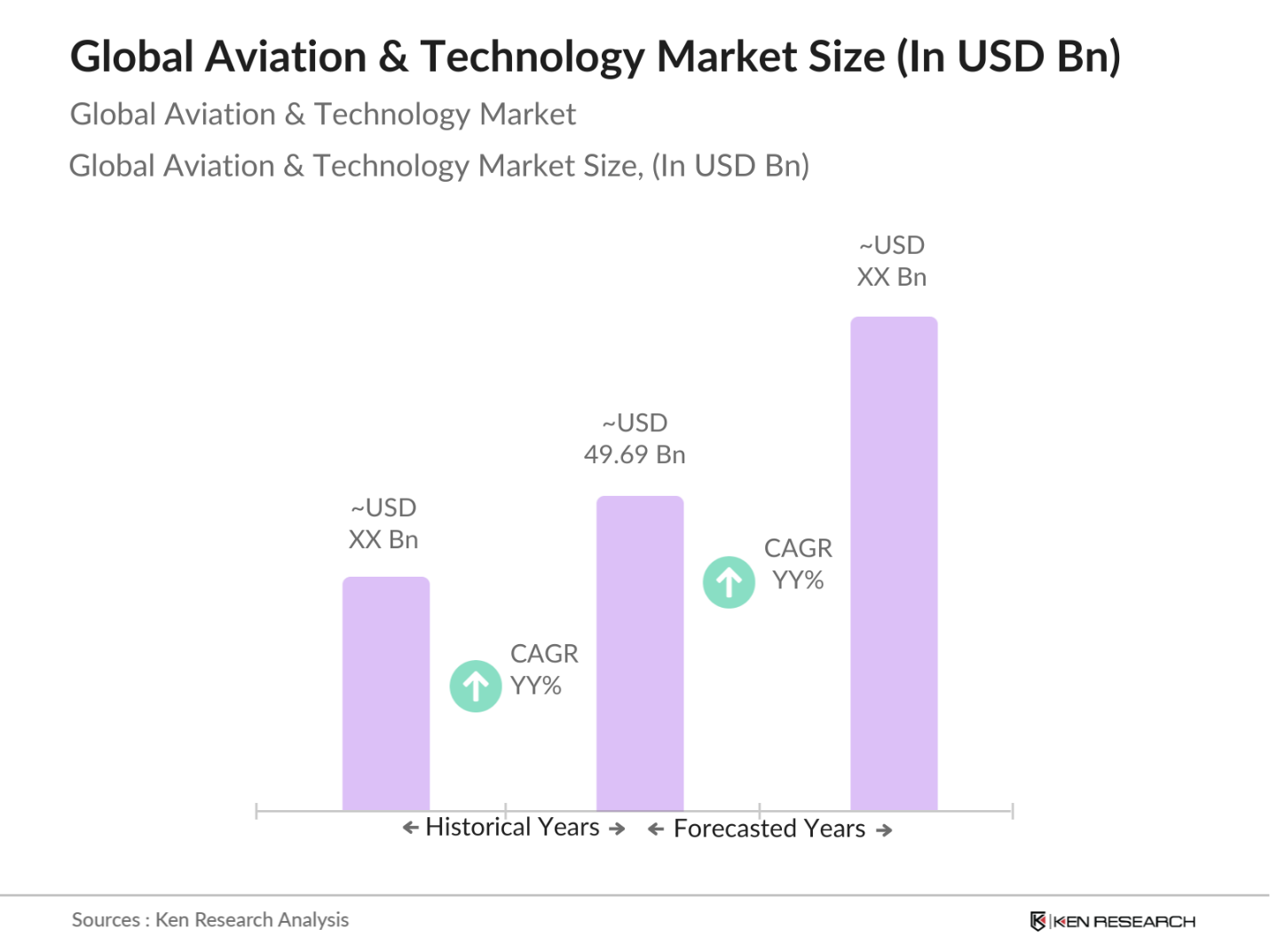
- The Global Aviation & Technology Market has witnessed strong growth driven by increased air travel demand, technological advancements in aircraft systems, and the focus on sustainability. Valued at approximately USD 49.69 billion, this market covers various aviation technologies, from AI and IoT integration to advanced navigation and security solutions. The adoption of digital transformation in aviation, along with the push for fuel efficiency and environmental compliance, has bolstered the market, especially within commercial and defense aviation sectors.
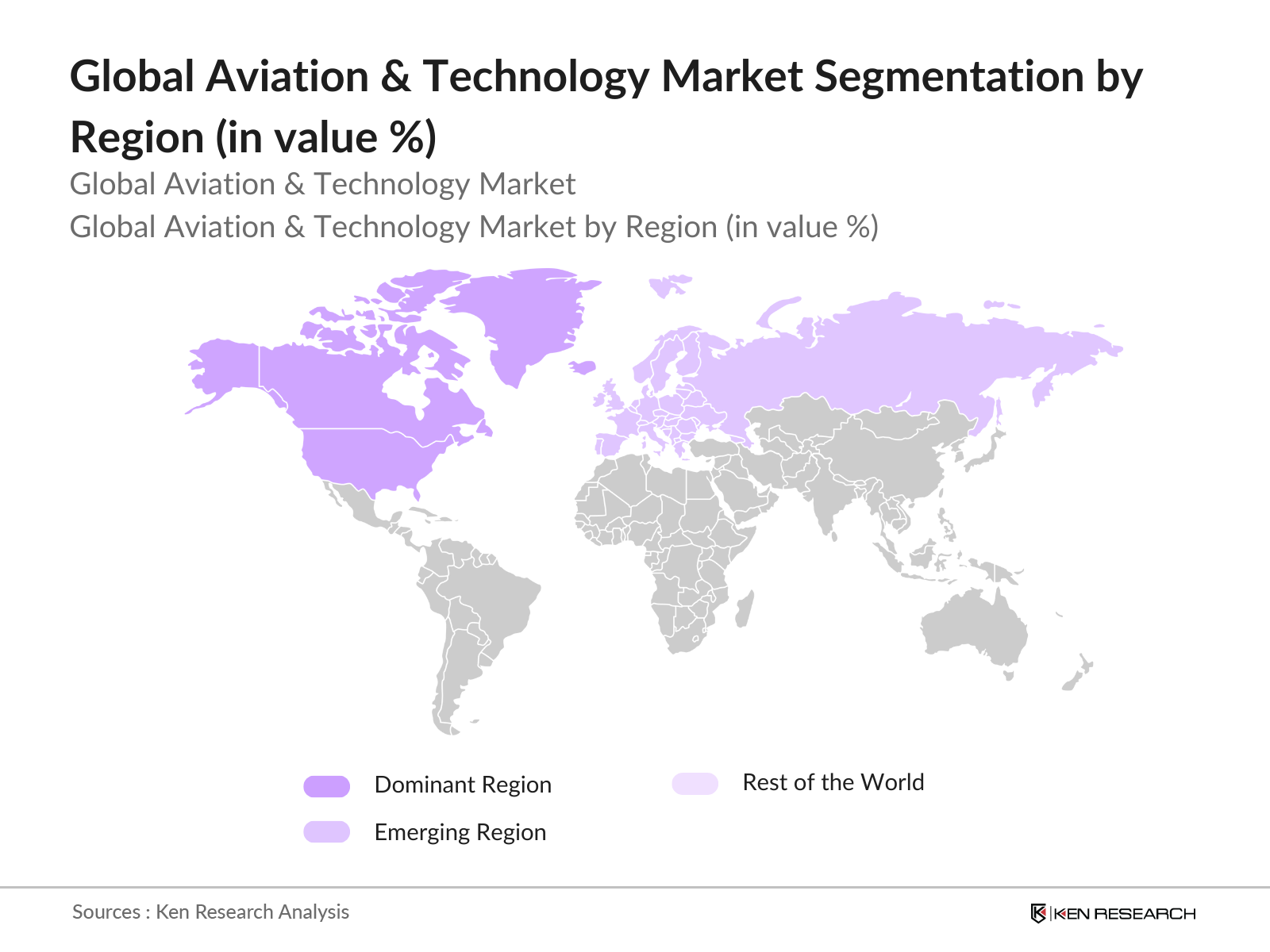
- North America holds the largest market share due to strong defense investments, technological innovation, and a robust aviation infrastructure. Europe follows, driven by stringent emission regulations and leading aerospace firms. The Asia-Pacific region is emerging as a high-growth market, supported by increasing air travel demand, investments in new airports, and digitalization initiatives across the aviation sector.
- Governments worldwide have implemented emission standards to reduce aviation's carbon footprint. The International Civil Aviation Organization (ICAO) mandates that all new aircraft models meet emissions standards targeting fuel efficiency and lower CO2 emissions. Compliance with these standards is essential for manufacturers, as governments impose penalties on non-compliant operations. These regulations are driving the development of fuel-efficient engines, sustainable aviation fuels, and other technologies aimed at reducing aviations environmental impact.
Global Aviation & Technology Market Segmentation
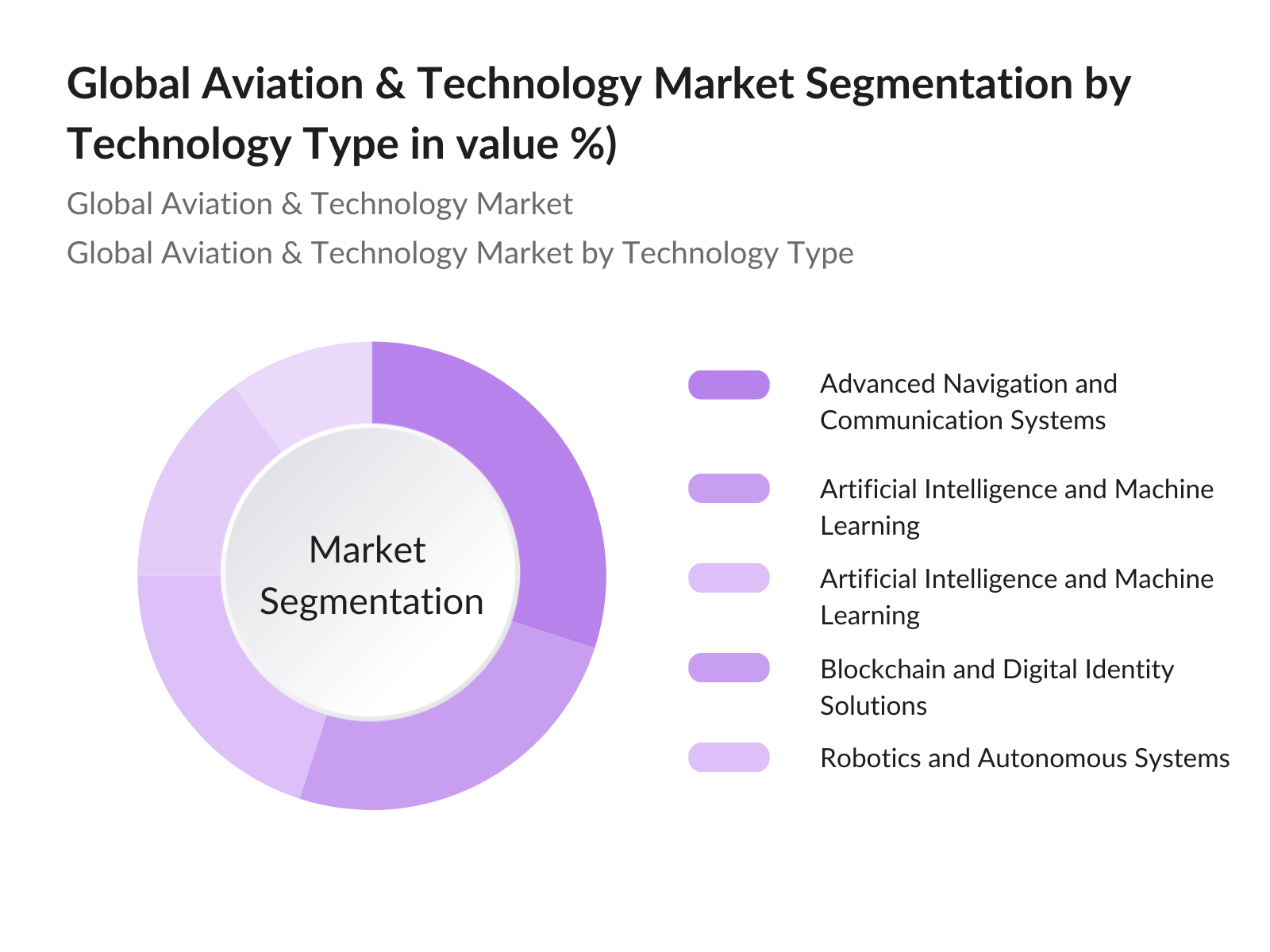
- By Technology Type: The Aviation & Technology Market is segmented by technology type into artificial intelligence and machine learning, IoT and connectivity solutions, blockchain and digital identity solutions, advanced navigation and communication systems, and robotics and autonomous systems. Advanced navigation and communication systems hold the largest market share, due to increasing air traffic and the need for efficient and safe air navigation.
- By Region: The Aviation & Technology Market is segmented by region into North America, Europe, Asia-Pacific, Latin America, and the Middle East & Africa. North America leads due to sstrong aerospace and defense industries, followed by Europe with a focus on environmental compliance and sustainable aviation solutions. Asia-Pacific is a rapidly growing region, driven by increasing air travel and investment in airport infrastructure.
Global Aviation & Technology Market Competitive Landscape
The Global Aviation & Technology Market is highly competitive, with major players focusing on developing advanced aviation technologies, including AI-driven maintenance solutions, connectivity, and fuel-efficient engines. Leading companies such as Boeing, Airbus SE, and Lockheed Martin dominate with extensive R&D capabilities and strong government and commercial partnerships. The competitive landscape is marked by strategic alliances, investments in autonomous and hybrid systems, and a focus on environmental sustainability.
|
Company |
Establishment Year |
Headquarters |
Revenue |
Key Product Offerings |
Technology Focus |
Customer Satisfaction Ratings |
Global Presence |
|
Boeing |
1916 |
Chicago, USA |
- |
- |
- |
- |
- |
|
Airbus SE |
1970 |
Toulouse, France |
- |
- |
- |
- |
- |
|
Lockheed Martin Corporation |
1995 |
Bethesda, USA |
- |
- |
- |
- |
- |
|
Honeywell International Inc. |
1906 |
Charlotte, USA |
- |
- |
- |
- |
- |
|
Raytheon Technologies Corporation |
2020 |
Waltham, USA |
- |
- |
- |
- |
- |
Global Aviation & Technology Market Analysis
Market Growth Drivers
- Growing Demand for Air Travel and Fleet Expansion: The global demand for air travel has steadily increased, with the number of air passengers exceeding 4.5 billion in 2023. This growth is driven by expanding middle classes, particularly in Asia-Pacific and the Middle East, where air travel is increasingly affordable and accessible. To accommodate this demand, airlines are expanding fleets, with more than 2,000 aircraft orders projected for delivery between 2024 and 2025. This surge in demand supports the need for advanced aviation technology to enhance fleet capacity and operational efficiency.
- Technological Advancements in Aircraft and Navigation Systems: Technological advancements in aviation, including improvements in navigation, communication, and cockpit automation, are transforming the industry. Modern aircraft systems now utilize advanced avionics for precision navigation and automated flight control, which enhance safety and reduce pilot workload. In 2023, more than of new commercial aircraft deliveries are expected to include next-generation navigation technology, reflecting the industrys commitment to enhancing efficiency and safety through innovation.
- Increasing Focus on Fuel Efficiency and Sustainability: Fuel efficiency and sustainability have become central to the aviation industry, as airlines seek to reduce fuel consumption and lower carbon emissions. In 2023, the average fuel efficiency of commercial jets improved by 15% compared to a decade earlier due to advancements in engine technology and aerodynamics. This focus on fuel efficiency not only reduces operating costs but also aligns with global sustainability goals, as the industry works toward reducing its carbon footprint to meet regulatory and environmental standards.
Market Challenges:
- High R&D Costs for New Aircraft and Technology Development: The development of new aircraft and aviation technology requires significant investment, with R&D costs often exceeding billions of dollars per project. For example, developing a new commercial jet model can take 5-7 years and involve costs upwards of $10 billion. These high costs create financial risks for manufacturers and can slow innovation as companies balance R&D expenses with profitability. Smaller firms and emerging markets may find it challenging to compete due to the capital-intensive nature of aviation technology development.
- Stringent Regulatory Compliance Requirements for Safety and Emissions: Aviation operates within a highly regulated environment, with strict requirements for safety, emissions, and operational standards. Compliance with these regulations requires rigorous testing, certification, and adherence to international standards like those from the FAA and EASA. Regulatory compliance can increase operational costs and extend time-to-market for new aircraft and technologies. Meeting these stringent requirements is essential to maintaining safety and environmental compliance but presents challenges for innovation due to complex approval processes.
Global Aviation & Technology Market Future Outlook
Over the next five years, the Aviation & Technology Market is expected to experience steady growth due to advancements in autonomous aviation, digital twin technology, and the adoption of renewable aviation fuels. Investment in AI and predictive maintenance solutions is anticipated to enhance operational efficiency and safety. Asia-Pacific is likely to be the fastest-growing region, supported by increasing air travel, government investments in infrastructure, and advancements in aviation technology.
Market Opportunities:
- Development and Demand for Autonomous and Unmanned Aerial Systems: The demand for autonomous and unmanned aerial systems (UAS), including drones, is increasing across sectors such as logistics, agriculture, and defense. In 2023, over 1.5 million drones were in use globally, with applications expanding rapidly. Autonomous flight technology is also being explored for commercial aviation, with trials underway for pilot-assist and semi-autonomous systems. This demand for UAS and autonomous technology presents growth opportunities in commercial aviation and adjacent industries that leverage aerial systems for various applications.
- Growing Interest in Renewable Aviation Fuel and Electric Aircraft: The aviation industry is investing in renewable fuels and electric aircraft to meet emissions reduction targets and sustainability goals. Sustainable aviation fuel (SAF) production reached over 300 million liters globally in 2023, and initiatives to expand its use are underway in regions like the EU and North America. Additionally, electric and hybrid-electric aircraft are in development to reduce reliance on fossil fuels. These renewable technologies present a significant growth opportunity as airlines and manufacturers prioritize eco-friendly innovations.
Scope of the Report
|
By Technology Type |
Artificial Intelligence and Machine Learning Internet of Things (IoT) and Connectivity Solutions Blockchain and Digital Identity Solutions Advanced Navigation and Communication Systems Robotics and Autonomous Systems |
|
By Application |
Commercial Aviation |
|
By Component |
Hardware (Navigation Systems, Sensors, Avionics) |
|
By End-User |
Airlines |
|
By Region |
North America |
Products
Key Target Audience
Airlines and Aviation Operators
Airport Authorities and Management
Government and Defense Organizations
Investments and Venture Capitalist Firms
Aircraft and Avionics Manufacturers
Technology Providers in IoT, AI, and Big Data
Maintenance, Repair, and Overhaul (MRO) Providers
Cybersecurity Firms Specializing in Aviation
Companies
Players Mentioned in the report
Boeing
Airbus SE
Lockheed Martin Corporation
Honeywell International Inc.
Raytheon Technologies Corporation
General Electric Aviation
Thales Group
Safran S.A.
Rolls-Royce Holdings PLC
L3Harris Technologies, Inc.
Embraer S.A.
Northrop Grumman Corporation
Collins Aerospace
Dassault Aviation
Bombardier Inc.
Table of Contents
1. Global Aviation & Technology Market Overview
1.1 Definition and Scope
1.2 Market Taxonomy
1.3 Market Growth Rate
1.4 Market Segmentation Overview
2. Global Aviation & Technology Market Size (In USD Billion)
2.1 Historical Market Size
2.2 Year-On-Year Growth Analysis
2.3 Key Market Developments and Milestones
3. Global Aviation & Technology Market Analysis
3.1 Growth Drivers
3.1.1 Rise in Air Travel Demand
3.1.2 Technological Advancements
3.1.3 Demand for Fuel Efficiency
3.1.4 Growing Demand for Air Travel and Fleet Expansion
3.1.5 Technological Advancements in Aircraft and Navigation Systems
3.1.6 Increasing Focus on Fuel Efficiency and Sustainability
3.1.7 Investment in AI and Big Data Analytics for Operational Efficiency
3.2 Market Challenges
3.2.1 High R&D Costs for New Aircraft and Technology Development
3.2.2 Stringent Regulatory Compliance Requirements for Safety and Emissions
3.2.3 Increasing Cybersecurity Threats to Aviation Systems
3.3 Opportunities
3.3.1 Expansion Opportunities in Emerging Markets with Rising Air Travel Demand
3.3.2 Development and Demand for Autonomous and Unmanned Aerial Systems
3.3.3 Growing Interest in Renewable Aviation Fuel and Electric Aircraft
3.4 Trends
3.4.1 Integration of AI and IoT for Predictive Maintenance and Enhanced Passenger Experience
3.4.2 Use of Digital Twin Technology for Simulation and Maintenance
3.4.3 Adoption of 5G for Real-Time Data and Faster Communication in Airports and Aircraft
3.5 Government Regulations
3.5.1 Emission Standards and Environmental Compliance in Aviation
3.5.2 Stringent Safety and Operational Regulations for Aircraft
3.5.3 Data Privacy and Cybersecurity Compliance for Passenger Information
3.6 SWOT Analysis
3.7 Stakeholder Ecosystem
3.8 Porter's Five Forces Analysis
3.9 Competition Ecosystem
4. Global Aviation & Technology Market Segmentation
4.1 By Technology Type (In Value %)
4.1.1 Artificial Intelligence and Machine Learning
4.1.2 Internet of Things (IoT) and Connectivity Solutions
4.1.3 Blockchain and Digital Identity Solutions
4.1.4 Advanced Navigation and Communication Systems
4.1.5 Robotics and Autonomous Systems
4.2 By Application (In Value %)
4.2.1 Commercial Aviation
4.2.2 Military and Defense Aviation
4.2.3 Business and Private Aviation
4.2.4 Unmanned Aerial Vehicles (UAVs)
4.2.5 Airport Operations and Ground Handling
4.3 By Component (In Value %)
4.3.1 Hardware (Navigation Systems, Sensors, Avionics)
4.3.2 Software (Flight Management Systems, Predictive Analytics)
4.3.3 Services (Maintenance, Consulting, Training)
4.4 By End-User (In Value %)
4.4.1 Airlines
4.4.2 Airports
4.4.3 Maintenance, Repair, and Overhaul (MRO) Providers
4.4.4 Government and Defense Organizations
4.5 By Region (In Value %)
4.5.1 North America
4.5.2 Europe
4.5.3 Asia-Pacific
4.5.4 Latin America
4.5.5 Middle East & Africa
5. Global Aviation & Technology Market Competitive Analysis
5.1 Detailed Profiles of Major Companies
5.1.1 Boeing
5.1.2 Airbus SE
5.1.3 Lockheed Martin Corporation
5.1.4 Honeywell International Inc.
5.1.5 Raytheon Technologies Corporation
5.1.6 General Electric Aviation
5.1.7 Thales Group
5.1.8 Safran S.A.
5.1.9 Rolls-Royce Holdings PLC
5.1.10 L3Harris Technologies, Inc.
5.1.11 Embraer S.A.
5.1.12 Northrop Grumman Corporation
5.1.13 Collins Aerospace
5.1.14 Dassault Aviation
5.1.15 Bombardier Inc.
5.2 Cross Comparison Parameters
5.2.1 Headquarters
5.2.2 Inception Year
5.2.3 Revenue
5.2.4 Key Product Offerings
5.2.5 Technology Focus
5.2.6 Global Reach
5.2.7 Customer Satisfaction Ratings
5.3 Market Share Analysis
5.4 Strategic Initiatives
5.4.1 Mergers and Acquisitions
5.4.2 Investment Analysis
5.4.2.1 Government Funding in Aviation Technology Development
5.4.2.2 Venture Capital in Aviation Startups
5.4.2.3 Private Equity in Next-Gen Aerospace Technology
6. Global Aviation & Technology Market Regulatory Framework
6.1 Emission and Environmental Standards
6.2 Air Traffic Management Regulations
6.3 Data Privacy and Cybersecurity Compliance
7. Global Aviation & Technology Market Future Size (In USD Billion)
7.1 Future Market Size Projections
7.2 Key Factors Driving Future Market Growth
8. Global Aviation & Technology Market Future Segmentation
8.1 By Technology Type (In Value %)
8.2 By Application (In Value %)
8.3 By Component (In Value %)
8.4 By End-User (In Value %)
8.5 By Region (In Value %)
9. Global Aviation & Technology Market Analysts Recommendations
9.1 TAM/SAM/SOM Analysis
9.2 Customer Cohort Analysis
9.3 Marketing Initiatives
9.4 White Space Opportunity Analysis
Disclaimer Contact UsResearch Methodology
Step 1: Identification of Key Variables
The research began with identifying key factors such as rising air traffic, technological advancements, and environmental regulations. Data was collected from proprietary databases, government publications, and industry reports.
Step 2: Market Analysis and Construction
This phase involved analyzing historical data on aviation technology investments, segmentation by application, and trends in digital transformation and sustainability. Key trends like 5G implementation in aviation and digital twin technology were examined.
Step 3: Hypothesis Validation and Expert Consultation
Hypotheses were validated through consultations with industry experts, aviation technology providers, and regulatory agencies. These insights ensured accurate market projections aligned with industry trends.
Step 4: Research Synthesis and Final Output
The final synthesis included quantitative and qualitative insights, presenting a comprehensive analysis of the Aviation & Technology Market, covering growth drivers, challenges, and future opportunities.
Frequently Asked Questions
01. How big is the Global Aviation & Technology Market?
The global aviation and technology market is valued at approximately USD 49.69 billion, driven by air travel demand, technological advancements, and sustainability initiatives.
02. What are the challenges in the Global Aviation & Technology Market?
Challenges include high R&D costs, stringent regulatory compliance, and the rising need for cybersecurity in aviation technology.
03. Who are the major players in the Global Aviation & Technology Market?
Key players include Boeing, Airbus SE, Lockheed Martin, Honeywell International, and Raytheon Technologies, known for their technological innovation and strong presence in aerospace.
04.What are the growth drivers of the Global Aviation & Technology Market?
Growth drivers include increasing air travel, demand for fuel-efficient technologies, and investments in AI, IoT, and digital transformation in aviation.
Why Buy From Us?

What makes us stand out is that our consultants follows Robust, Refine and Result (RRR) methodology. i.e. Robust for clear definitions, approaches and sanity checking, Refine for differentiating respondents facts and opinions and Result for presenting data with story

We have set a benchmark in the industry by offering our clients with syndicated and customized market research reports featuring coverage of entire market as well as meticulous research and analyst insights.

While we don't replace traditional research, we flip the method upside down. Our dual approach of Top Bottom & Bottom Top ensures quality deliverable by not just verifying company fundamentals but also looking at the sector and macroeconomic factors.

With one step in the future, our research team constantly tries to show you the bigger picture. We help with some of the tough questions you may encounter along the way: How is the industry positioned? Best marketing channel? KPI's of competitors? By aligning every element, we help maximize success.

Our report gives you instant access to the answers and sources that other companies might choose to hide. We elaborate each steps of research methodology we have used and showcase you the sample size to earn your trust.

If you need any support, we are here! We pride ourselves on universe strength, data quality, and quick, friendly, and professional service.