
Global Ayurvedic Herbs Market Outlook to 2030
Region:Global
Author(s):Yogita Sahu
Product Code:KROD7932
Region:Global
Author(s):Yogita Sahu
Product Code:KROD7932
December 2024
97
Listen to the audio summary
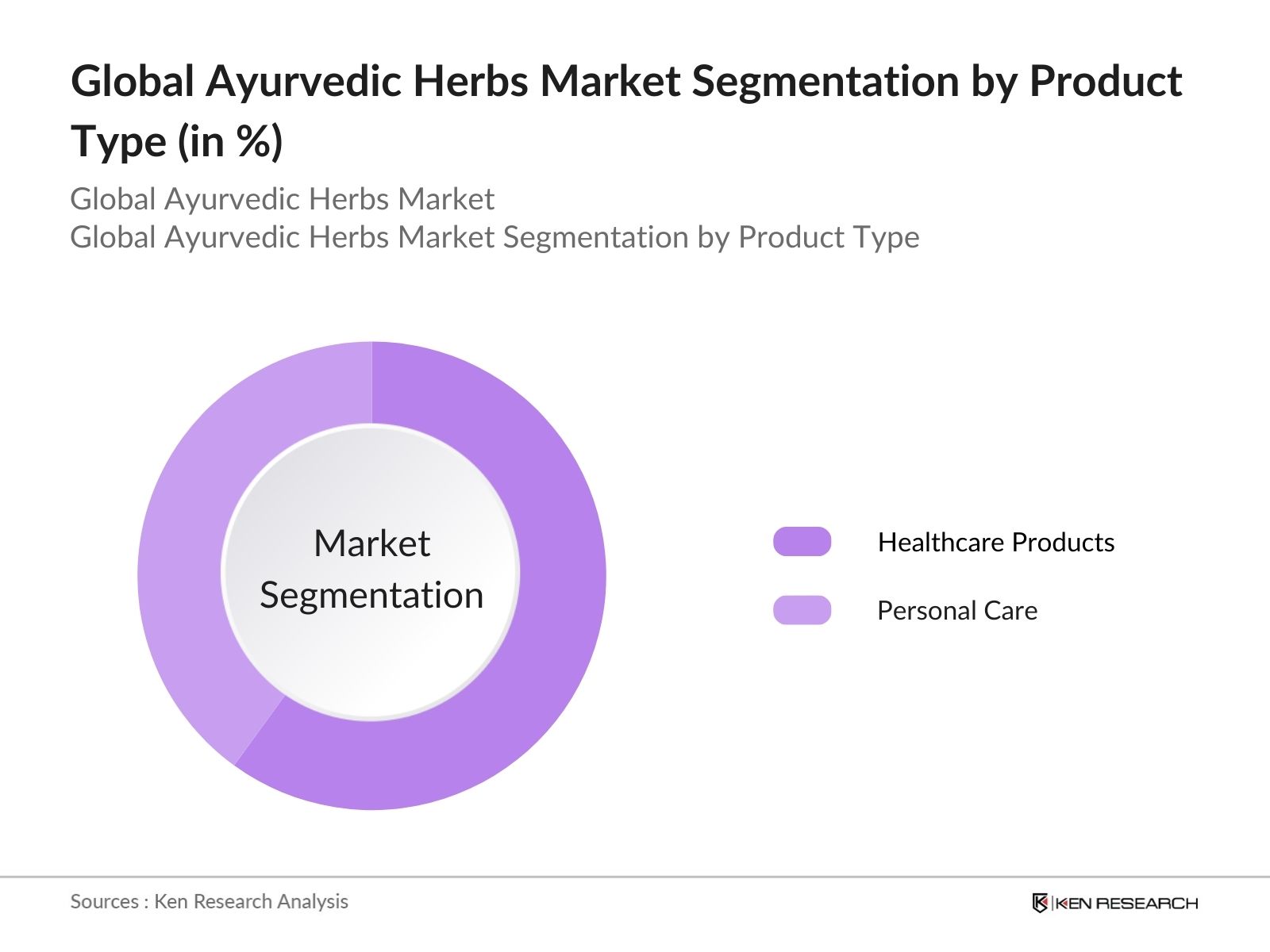
By Product Type: The market is segmented into healthcare products and personal care products. Healthcare products, including dietary supplements, Ayurvedic medicines, and nutraceuticals, hold a dominant market share. This is attributed to the increasing consumer demand for preventive healthcare and natural remedies. Ayurvedic nutraceuticals, which include products like Ashwagandha and Amla, are widely consumed for their health benefits, including immune support, stress relief, and energy enhancement.
By Application: In terms of application, Ayurvedic herbs are used for a variety of health concerns, with skin diseases and cardiovascular disorders being prominent sub-segments. The application of Ayurvedic herbs in skin diseases dominates due to their efficacy in treating conditions like eczema, psoriasis, and acne without harmful side effects. Similarly, Ayurvedic products for cardiovascular health are gaining traction as consumers seek natural alternatives to manage chronic diseases like hypertension and heart disease.
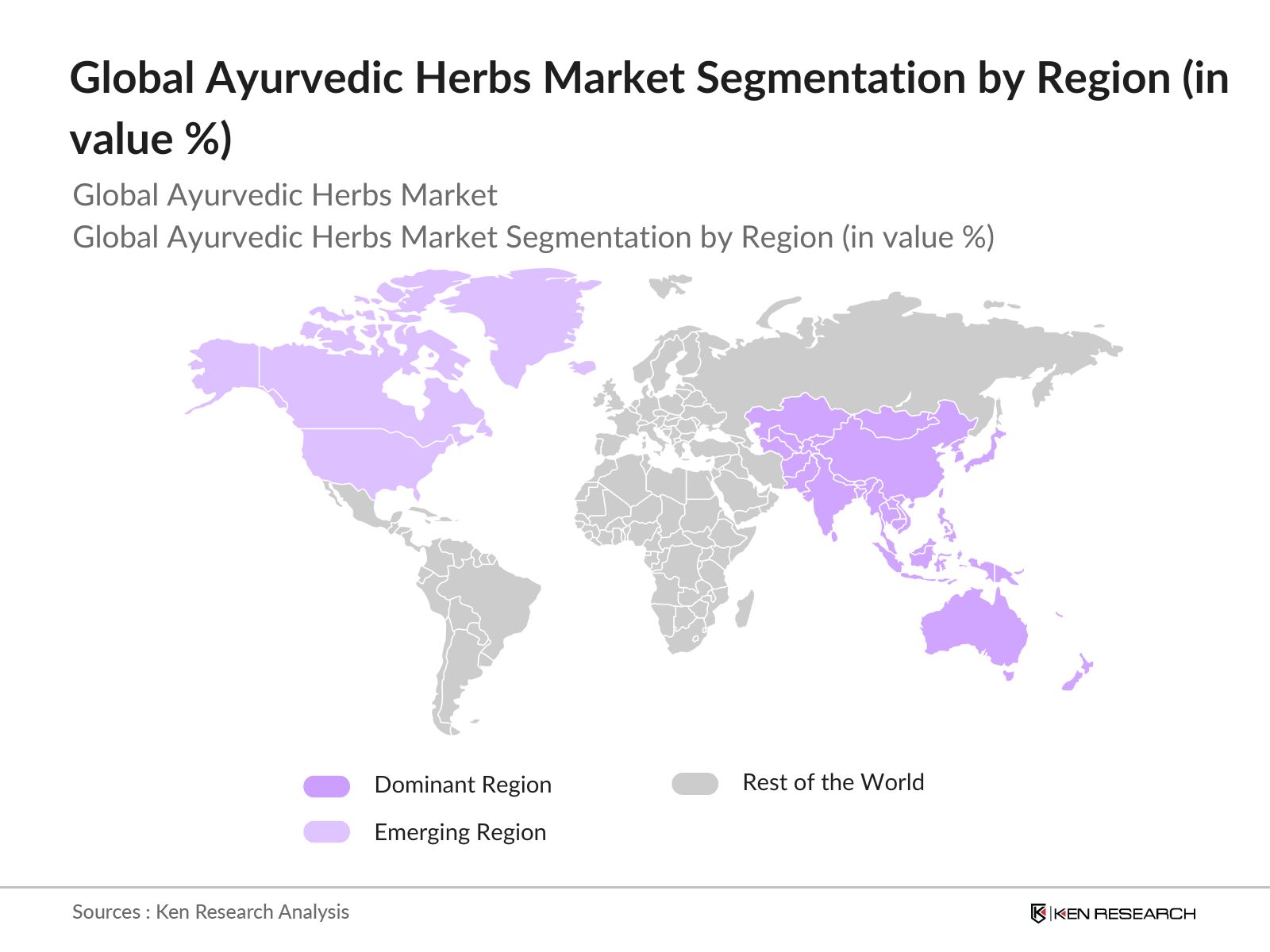
By Region: Regionally, the market is segmented into North America, Europe, Asia-Pacific, the Middle East & Africa, and South America. The Asia-Pacific region leads the market, with India being a major player due to its well-established Ayurvedic traditions, growing middle-class population, and government initiatives promoting Ayurveda as a form of primary healthcare. North America follows, where increasing consumer preference for natural products and greater awareness about Ayurveda are driving demand.
The market is competitive, with several players involved in product innovation, strategic collaborations, and global expansion. Major companies are focusing on new product launches and expanding their presence across various geographies.
|
Company |
Year Established |
Headquarters |
Product Focus |
R&D Investment |
Global Reach |
Collaborations |
Sustainability Practices |
Distribution Channels |
|
Dabur India Ltd. |
1884 |
Ghaziabad, India |
||||||
|
Patanjali Ayurved |
2006 |
Haridwar, India |
||||||
|
Emami Limited |
1974 |
Kolkata, India |
||||||
|
Colgate-Palmolive |
1806 |
New York, United States |
||||||
|
Unilever |
1929 |
London, United Kingdom |
Over the next five years, the global Ayurvedic herbs industry is expected to exhibit strong growth driven by increasing consumer preference for natural products, advancements in herbal formulations, and government support for traditional medicine.
|
By Product Type |
Healthcare Products Personal Care Products |
|
By Application |
Skin Diseases Respiratory Disorders Cancer Treatment Cardiovascular Diseases Other Applications |
|
By Distribution Channel |
Retail Pharmacy E-Pharmacy Specialty Stores |
|
By Region |
North America Europe Asia-Pacific Middle East & Africa South America |
1.1 Definition and Scope
1.2 Market Taxonomy
1.3 Market Growth Rate
1.4 Market Segmentation Overview
2.1 Historical Market Size
2.2 Year-On-Year Growth Analysis
2.3 Key Market Developments and Milestones
3.1 Growth Drivers
3.1.1 Increasing Demand for Natural and Organic Products
3.1.2 Rise in Preventive Healthcare Awareness
3.1.3 Expansion of Ayurvedic Products in Global Markets
3.1.4 Government Support for Ayurveda Integration
3.2 Market Challenges
3.2.1 Regulatory Differences Across Regions
3.2.2 Limited Scientific Validation
3.2.3 High Competition from Alternative Medicine
3.3 Opportunities
3.3.1 Growing Interest in Holistic Health Solutions
3.3.2 Evolving E-commerce Distribution Channels
3.3.3 Innovation in Ayurvedic Formulations
3.4 Trends
3.4.1 Incorporation of Ayurveda in Modern Wellness Practices
3.4.2 Increasing Focus on Eco-friendly Packaging and Ethical Sourcing
3.4.3 Growth of Ayurvedic Cosmetic and Personal Care Products
4.1 By Product Type (In Value %)
4.1.1 Healthcare Products
4.1.2 Personal Care Products
4.2 By Application (In Value %)
4.2.1 Skin Diseases
4.2.2 Respiratory Disorders
4.2.3 Cancer Treatment
4.2.4 Cardiovascular Diseases
4.2.5 Other Applications
4.3 By Distribution Channel (In Value %)
4.3.1 Retail Pharmacy
4.3.2 E-Pharmacy
4.3.3 Specialty Stores
4.4 By Geography (In Value %)
4.4.1 North America
4.4.2 Europe
4.4.3 Asia-Pacific
4.4.4 Middle East & Africa
4.4.5 South America
5.1 Detailed Profiles of Major Companies
5.1.1 Dabur India Ltd.
5.1.2 Himalaya Wellness
5.1.3 Patanjali Ayurved
5.1.4 Emami Limited
5.1.5 Kairali Ayurvedic Group
5.1.6 Colgate-Palmolive Company
5.1.7 Unilever
5.1.8 Procter & Gamble (P&G)
5.1.9 Charak Pharma Pvt. Ltd.
5.1.10 Shree Baidyanath Ayurved Bhawan Pvt. Ltd.
5.1.11 Forest Essentials
5.1.12 Sandu Pharmaceuticals Ltd.
5.1.13 Vicco Laboratories
5.1.14 Kerala Ayurveda Ltd.
5.1.15 Hamdard Laboratories
5.2 Cross Comparison Parameters (Product Portfolio, Regional Presence, Market Share, R&D Investment)
5.3 Market Share Analysis
5.4 Strategic Initiatives
5.5 Mergers and Acquisitions
6.1 Country-Specific Regulatory Bodies and Standards
6.2 Ayurvedic Medicine Classification and Approval Process
6.3 Global Harmonization and Compliance
7.1 By Product
7.2 By Application
7.3 By Distribution Channel
7.4 By Region
8.1 Future Market Size Projections
8.2 Key Factors Driving Future Growth
9.1 Target Market Opportunities (By Region and Application)
9.2 White Space Opportunity Analysis
9.3 Potential Market Barriers
Disclaimer Contact UsIn this initial phase, we map the Ayurvedic herbs market ecosystem, identifying stakeholders such as manufacturers, distributors, and end-users. Extensive desk research is performed to define critical market variables, including product demand, pricing trends, and regulatory frameworks.
We gather and analyze historical data on market size, product penetration, and geographical distribution to create accurate revenue estimates. This step includes evaluating consumer preferences and growth trends to construct the market framework.
To validate market hypotheses, we engage industry experts from major Ayurvedic companies through telephone interviews. Their insights into operational challenges, market opportunities, and consumer behavior are instrumental in refining our analysis.
In the final step, we compile data from multiple sources to generate a comprehensive and validated report. This includes bottom-up and top-down analyses to ensure robust and accurate market projections.
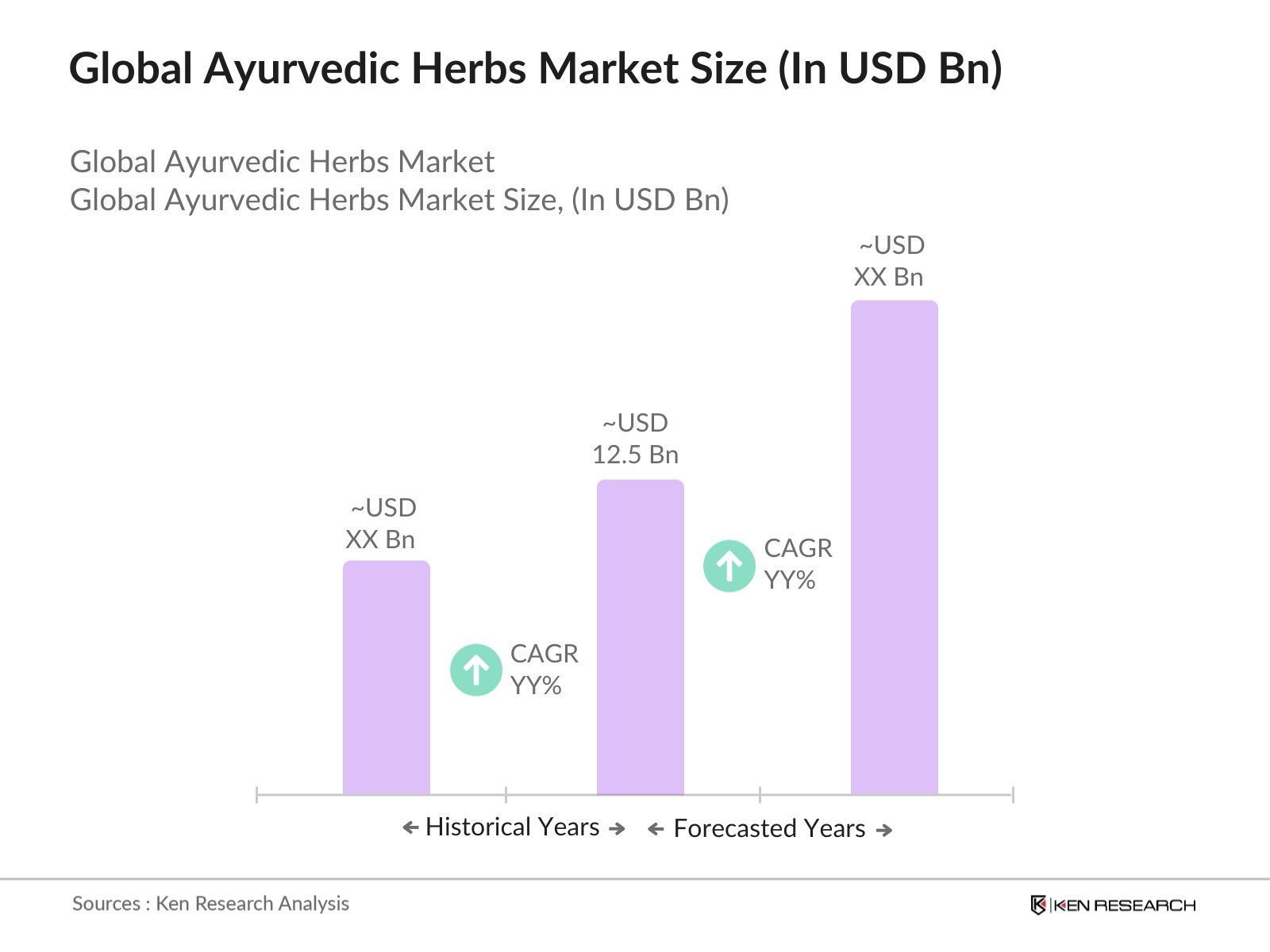
The global Ayurvedic herbs market was valued at USD 12.5 billion, driven by rising consumer demand for natural products and preventive healthcare solutions.
Key challenges in the global Ayurvedic herbs market include regulatory inconsistencies across regions, limited scientific validation of some Ayurvedic products, and high competition from other herbal and natural medicine markets.
Major players in the global Ayurvedic herbs market include Dabur India Ltd., Patanjali Ayurved, Emami Limited, Himalaya Wellness, and Unilever, each of which has strong brand presence and extensive distribution networks.
The global Ayurvedic herbs market is driven by increasing consumer awareness about natural remedies, government support for traditional medicine, and growing demand for holistic healthcare products.
The Asia-Pacific region, led by India, dominates the global Ayurvedic herbs market due to the strong cultural integration of Ayurveda into healthcare practices and government initiatives promoting its global adoption.

What makes us stand out is that our consultants follows Robust, Refine and Result (RRR) methodology. i.e. Robust for clear definitions, approaches and sanity checking, Refine for differentiating respondents facts and opinions and Result for presenting data with story

We have set a benchmark in the industry by offering our clients with syndicated and customized market research reports featuring coverage of entire market as well as meticulous research and analyst insights.

While we don't replace traditional research, we flip the method upside down. Our dual approach of Top Bottom & Bottom Top ensures quality deliverable by not just verifying company fundamentals but also looking at the sector and macroeconomic factors.

With one step in the future, our research team constantly tries to show you the bigger picture. We help with some of the tough questions you may encounter along the way: How is the industry positioned? Best marketing channel? KPI's of competitors? By aligning every element, we help maximize success.

Our report gives you instant access to the answers and sources that other companies might choose to hide. We elaborate each steps of research methodology we have used and showcase you the sample size to earn your trust.

If you need any support, we are here! We pride ourselves on universe strength, data quality, and quick, friendly, and professional service.