
Global Basic Chemicals Market Outlook to 2030
Region:Global
Author(s):Shambhavi
Product Code:KROD9624
December 2024
81
About the Report
Global Basic Chemicals Market Overview
- The global basic chemicals market is valued at USD 650 billion, with a steady expansion driven by rising demand across industrial sectors such as construction, automotive, and agriculture. This market growth is fueled by a stable supply-demand balance, bolstered by manufacturing capabilities and a rise in consumer products dependent on chemicals. Increased urbanization in major economies has further driven the demand for basic chemicals used in construction and manufacturing, underpinned by advancements in production technology to meet industrial demands efficiently.
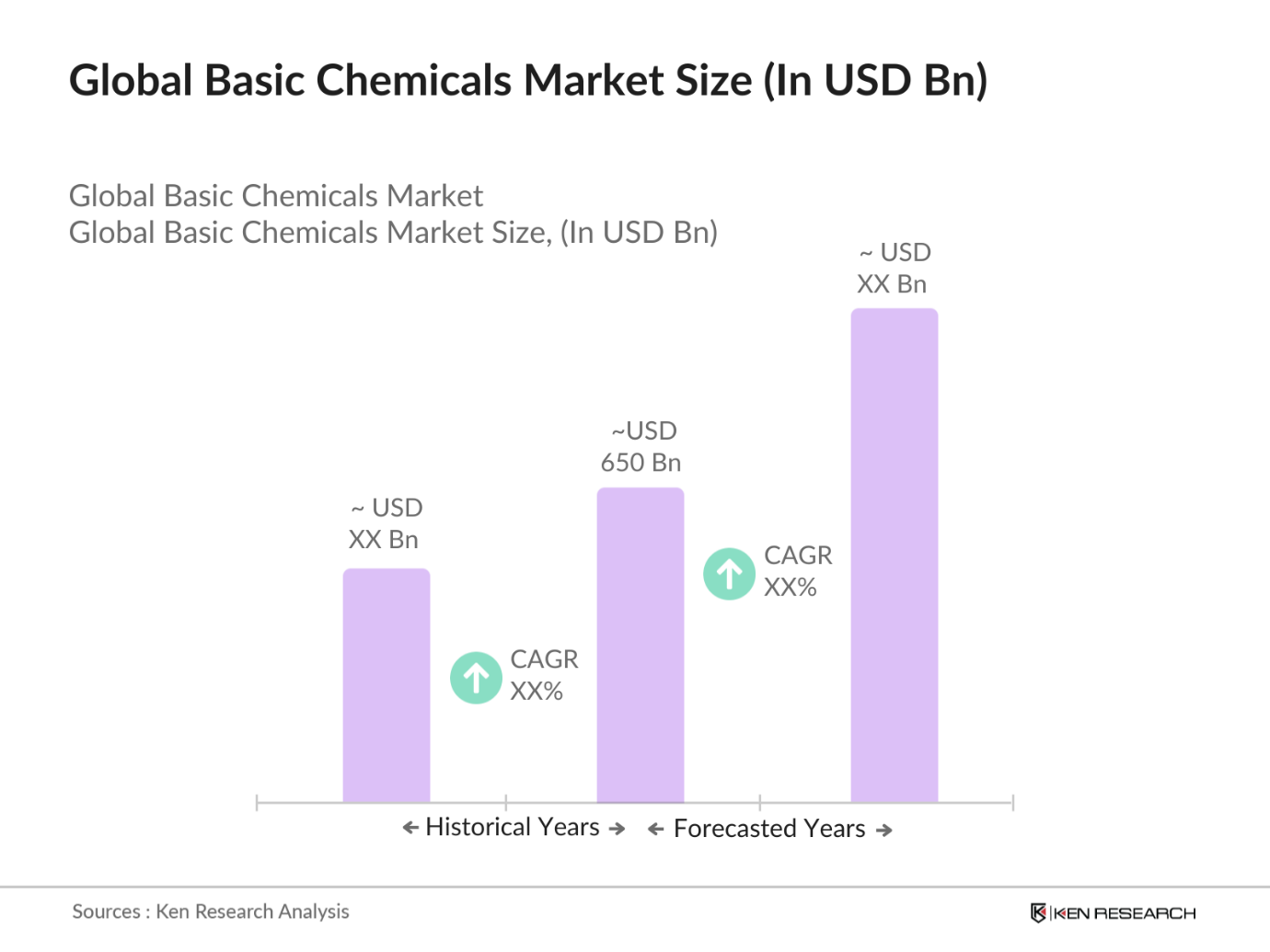
- China and the United States dominate the global basic chemicals market, owing to strong industrial and manufacturing infrastructure and high investment in chemical research. Chinas leadership is supported by government-backed industrialization programs and robust manufacturing output, while the U.S. benefits from advanced production techniques and a wide distribution network. Additionally, India's growing market presence is driven by increasing demand for chemicals across various industries and favorable governmental policies promoting chemical production.
- The chemicals sector is governed by stringent environmental protection standards to control emissions and hazardous waste. For example, the European Green Deal mandates a 55% reduction in emissions from chemical manufacturing by 2030. Compliance with these standards requires companies to adopt advanced emission control technologies, directly influencing production processes and costs. Meeting these requirements remains essential for maintaining market access, particularly within environmentally conscious regions such as the EU, where adherence to these standards is critical for ongoing market participation.
Global Basic Chemicals Market Segmentation
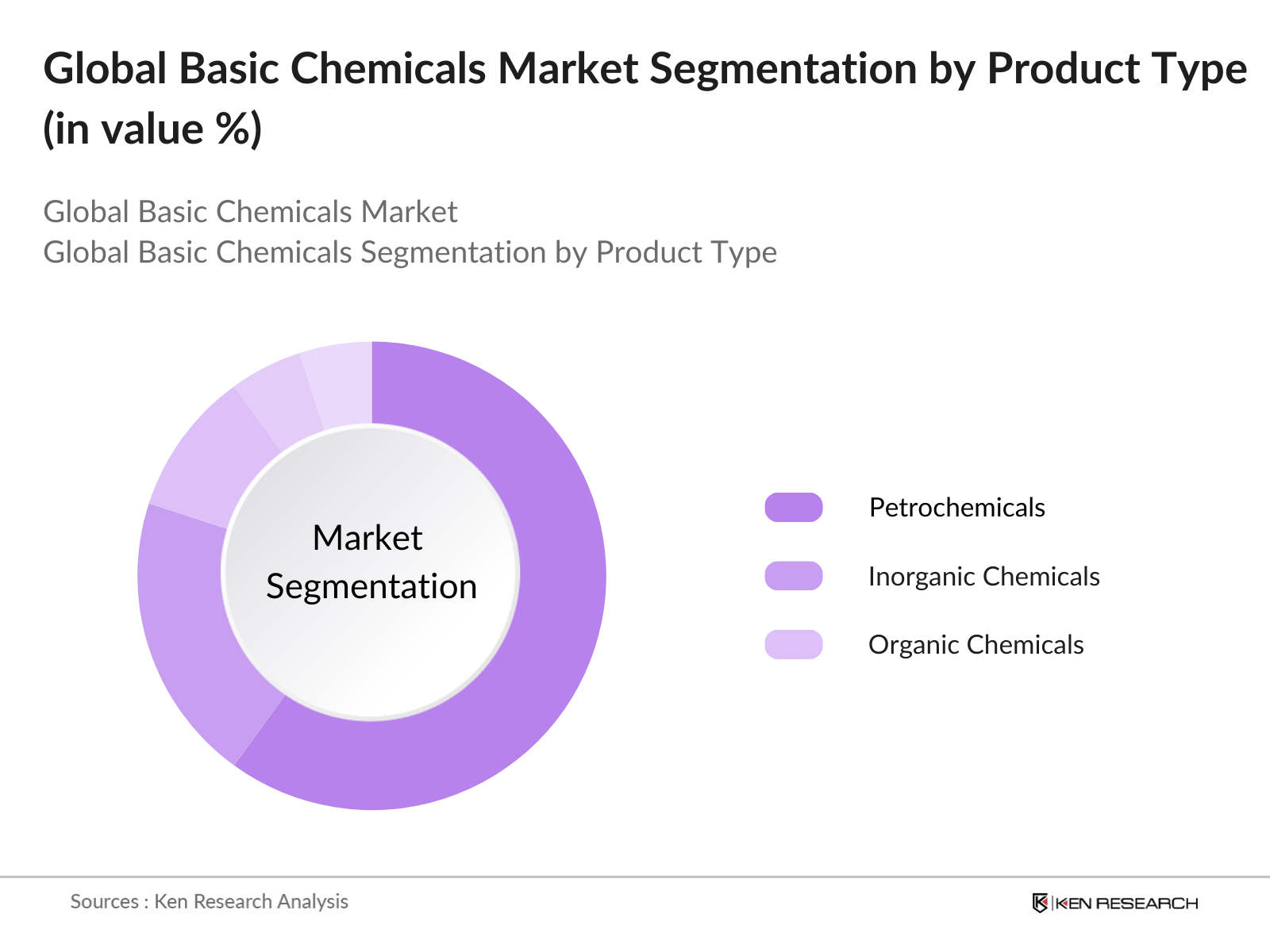
By Product Type: The global basic chemicals market is segmented by product type into Petrochemicals, Inorganic Chemicals, and Organic Chemicals. Petrochemicals dominate the product type segment due to their extensive use in plastic production, which is widely applied in various industries like packaging, automotive, and electronics. The prevalence of petrochemical derivatives such as ethylene, propylene, and benzene in essential products underpins their dominance. Companies have heavily invested in this sub-segment due to the demand for petroleum-based chemicals, which continue to be essential in both domestic and industrial products.
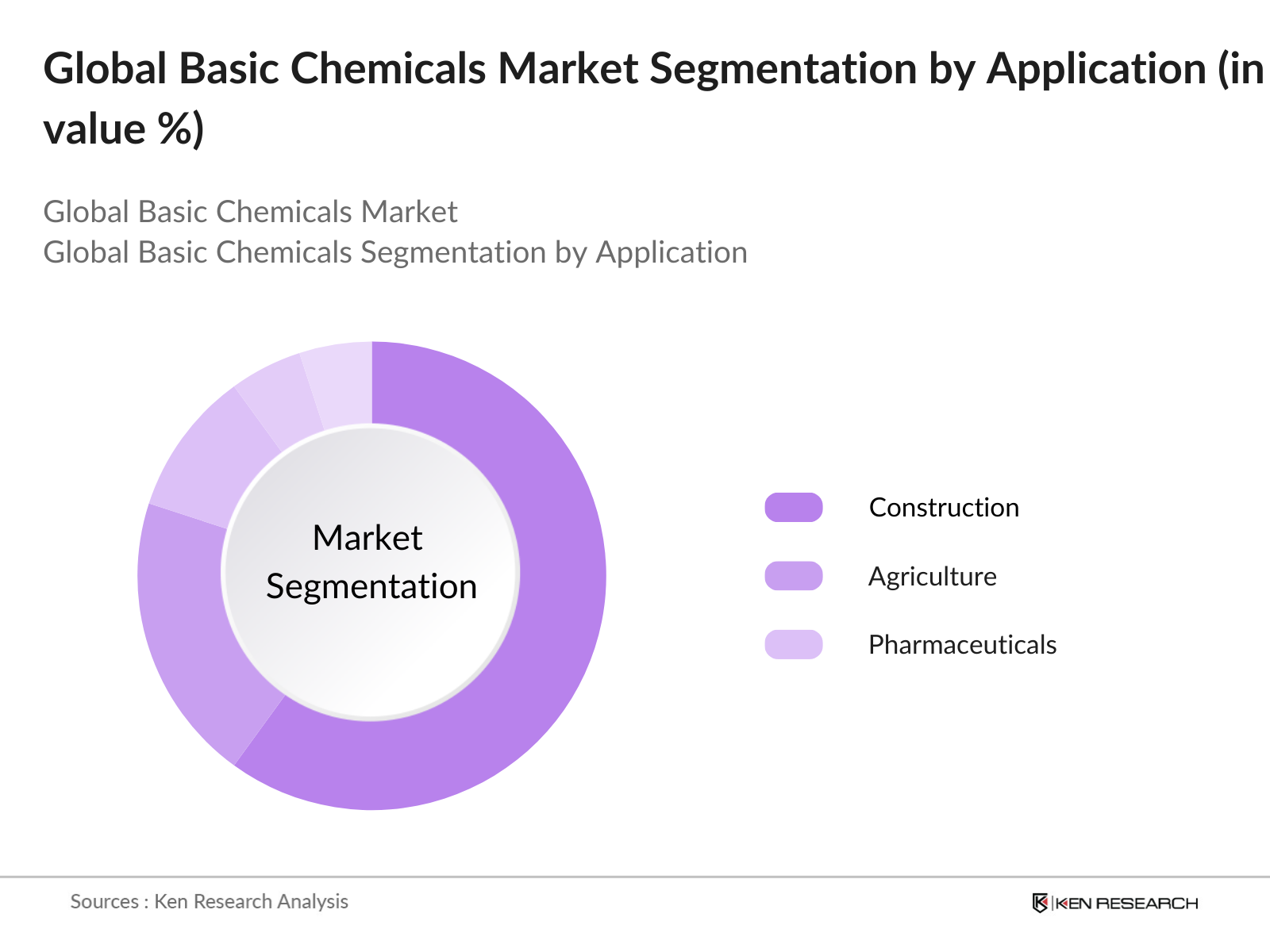
By Application: The global basic chemicals market is also segmented by application into Construction, Agriculture, and Pharmaceuticals. Construction applications hold a substantial market share, driven by high demand for materials such as adhesives, sealants, and coatings in the growing urban infrastructure. Urbanization and industrialization in developing countries create strong demand for construction chemicals. Additionally, the rapid development of housing projects has increased the consumption of basic chemicals within this segment, promoting significant investment from manufacturers in research to improve product durability and safety.
Global Basic Chemicals Competitive Landscape
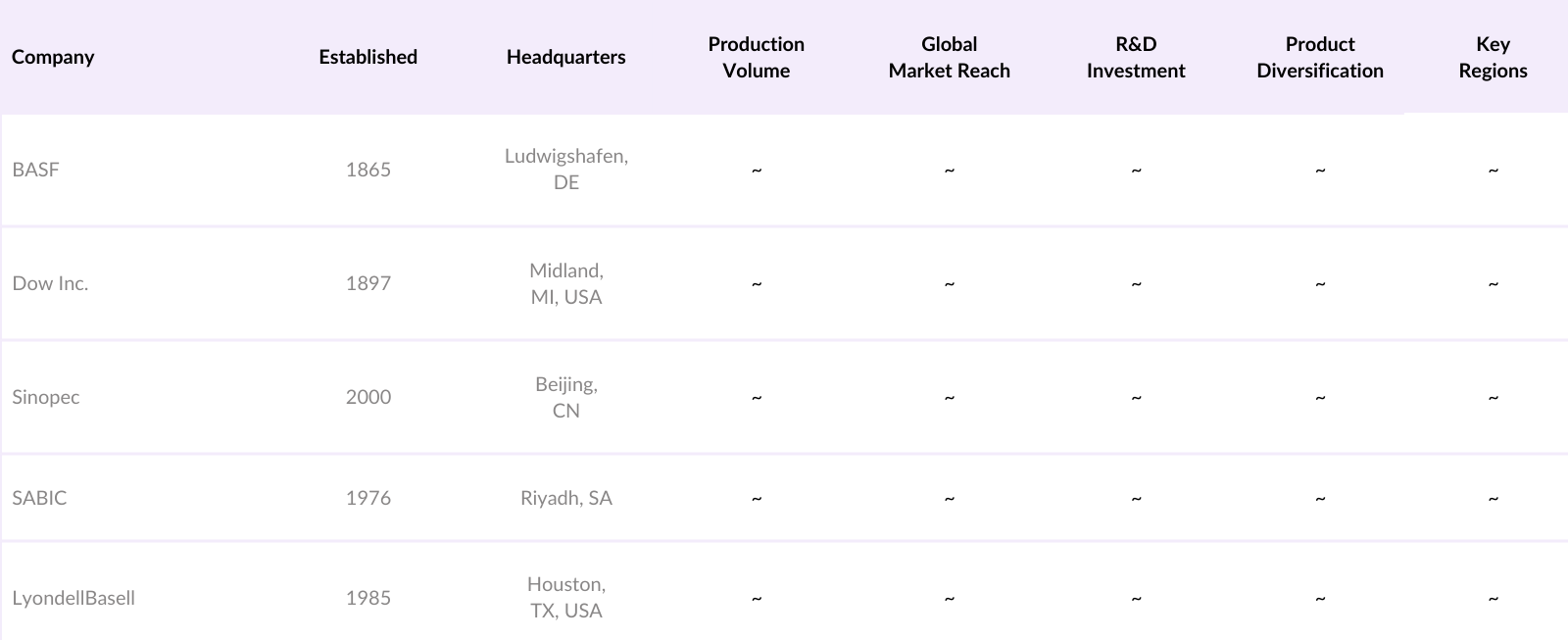
The global basic chemicals market is characterized by a few key players with substantial market share, benefitting from extensive distribution networks and a wide portfolio of products. The global market is dominated by companies such as BASF, Dow Inc., and Sinopec. This dominance is driven by their strong investment in R&D, advanced manufacturing capabilities, and well-established market positions.
Global Basic Chemicals
Growth Drivers
- Demand from Petrochemicals Industry
The petrochemical sector is a significant consumer of basic chemicals, driven by industrial expansion in countries like China and India, where manufacturing output rose by $2.2 trillion and $600 billion, respectively, from 2022 to 2023. This increase correlates with higher demand for basic chemicals essential for plastics, adhesives, and synthetic fibers. According to the World Bank, industrial growth in these regions is expected to remain robust, maintaining a steady consumption pattern for foundational chemicals. This demand highlights the interdependence between basic chemicals and petrochemical-derived products, making the petrochemical industry a key driver for this market. - Expansion in Emerging Economies
Emerging economies, including Brazil, Indonesia, and Vietnam, are witnessing increased chemical imports as their manufacturing sectors expand. In 2023, Brazils industrial output rose by approximately $180 billion, with a significant proportion involving chemicals as raw materials. Vietnam and Indonesia have also experienced similar upticks in their industrial production, with the IMF estimating over $300 billion in combined growth across these regions. This economic expansion underpins a sustained demand for basic chemicals, aligning with industrialization efforts and infrastructural development policies that directly involve chemical-intensive sectors. - Technological Advancements in Production
Technological improvements, especially in cost-effective and environmentally sustainable production methods, are propelling growth in the basic chemicals sector. In 2023, innovations in catalytic processes reduced energy consumption by approximately 25% in chemical manufacturing facilities in the United States, according to the Energy Information Administration. With advancements like these, production output can be optimized, while environmental impacts are minimized, aligning with global sustainability goals. These improvements support increased production efficiency and profitability, directly benefiting manufacturers and enhancing the market's scalability. - Investment in Research and Development
The global investment in R&D within the chemicals industry reached approximately $150 billion in 2023, with basic chemicals receiving a notable share of this allocation. European companies contributed over $50 billion to R&D efforts, according to recent European Commission reports, particularly in green chemistry and alternative raw materials. This substantial financial commitment underscores the market's focus on innovation, aligning with industry-wide sustainability and efficiency goals. By prioritizing R&D, basic chemical producers are well-positioned to introduce enhanced products and processes, supporting competitive advantages and long-term market stability.
Market Analysis: Challenges
- Regulatory Compliance Costs
The rising costs associated with regulatory compliance in the chemicals sector present a substantial challenge. For instance, manufacturers in the European Union face an average compliance cost of $25 million annually per facility due to stringent environmental regulations under REACH (Registration, Evaluation, Authorisation, and Restriction of Chemicals). The need to meet specific waste management, emissions, and workplace safety standards often requires financial investments in technology and labor. These increased operational costs place financial pressure on manufacturers, particularly smaller entities, limiting their capacity to scale and impacting profitability. - Volatile Raw Material Prices
Fluctuations in raw material prices significantly impact production costs in the basic chemicals industry. For instance, natural gas prices surged by 45% in the U.S. during 2022-2023, as per the U.S. Energy Information Administration, directly affecting feedstock costs for various chemicals. Additionally, price volatility in crude oil impacts several downstream products and derivative chemicals. These price variations disrupt production budgets, leading to higher operational costs and uncertainties in planning and pricing, making it challenging for companies to maintain stable profit margins.
Future Outlook
Over the next five years, the global basic chemicals market is expected to show steady growth. Key drivers include the expansion of urban infrastructure, innovations in chemical manufacturing processes, and increasing demand for environmentally sustainable products. Growth in emerging economies such as India and Brazil, coupled with a surge in research activities focused on sustainable chemicals, will play a pivotal role in driving the market forward.
Opportunities
- Green Chemistry Initiatives: Green chemistry is gaining traction within the basic chemicals market as industries aim to reduce environmental impact. The U.S. Department of Energy reported a $2 billion investment in research on sustainable chemical production methods in 2023, driving innovation in non-toxic, biodegradable alternatives. This trend toward green chemistry presents a significant growth opportunity for the sector, as consumer and regulatory pressures encourage sustainable products. Adopting green chemistry principles aligns companies with evolving market expectations, allowing them to access new markets focused on eco-friendly solutions.
- Digital Transformation in Production: The integration of digital technologies in chemical manufacturing is reshaping operational efficiency. In 2023, approximately 60% of large-scale chemical producers adopted predictive analytics and IoT-enabled sensors for real-time monitoring, according to the World Bank. These technologies enable companies to optimize processes, minimize downtime, and reduce waste. Digital transformation offers the industry an opportunity to enhance productivity and sustainability simultaneously, enabling companies to meet market demands for efficient, scalable, and environmentally conscious operations.
Scope Table
|
Segment |
Sub-Segments |
|
Product Type |
Petrochemicals, Inorganic Chemicals, Organic Chemicals, Specialty Chemicals, Commodity Chemicals |
|
Application |
Plastics, Agriculture, Construction Materials, Pharmaceuticals, Automotive |
|
End-User |
Industrial Manufacturing, Healthcare, Agriculture, Consumer Goods, Food and Beverage |
|
Distribution Channel |
Direct Sales, Distributors, E-commerce Platforms, Regional Sales Offices |
|
Region |
North America, Europe, Asia-Pacific, Latin America, Middle East & Africa |
Products
Key Target Audience
Chemical Manufacturers
Investors and Venture Capitalist Firms
Government and Regulatory Bodies (e.g., Environmental Protection Agency)
Industrial Manufacturers
Research and Development Institutions
End-Use Industries (e.g., Agriculture, Automotive)
Export and Import Traders
Environmental Organizations
Companies
Players mentioned in the report
BASF SE
Dow Inc.
Sinopec Limited
SABIC
LyondellBasell Industries
INEOS Group
LG Chem
Mitsubishi Chemical
Braskem
PPG Industries
Asahi Kasei Corporation
Evonik Industries
Sumitomo Chemical
Huntsman Corporation
Akzo Nobel N.V.
Table of Contents
1. Global Basic Chemicals Market Overview
1.1 Definition and Scope
1.2 Market Taxonomy
1.3 Key Market Attributes
1.4 Market Segmentation Overview
2. Global Basic Chemicals Market Size (In USD Bn)
2.1 Historical Market Size
2.2 Year-On-Year Growth Analysis
2.3 Key Developments and Market Milestones
3. Global Basic Chemicals Market Analysis
3.1 Growth Drivers (Macroeconomic Indicators)
3.1.1 Demand from Petrochemicals Industry
3.1.2 Expansion in Emerging Economies
3.1.3 Technological Advancements in Production
3.1.4 Investment in Research and Development
3.2 Market Challenges (Market-Specific Hurdles)
3.2.1 Regulatory Compliance Costs
3.2.2 Volatile Raw Material Prices
3.2.3 Environmental and Safety Concerns
3.2.4 Trade Tariffs and Global Supply Chain Disruptions
3.3 Opportunities (Emerging Market Potentials)
3.3.1 Green Chemistry Initiatives
3.3.2 Digital Transformation in Production
3.3.3 Increasing Applications in Pharmaceuticals
3.3.4 Strategic Collaborations and Partnerships
3.4 Trends (Current Market Dynamics)
3.4.1 Shift to Sustainable Practices
3.4.2 Expansion of E-commerce in Chemical Sales
3.4.3 Rising Investments in Specialty Chemicals
3.4.4 Integration of Advanced Analytics in Manufacturing
3.5 Government Regulations (Regulatory Frameworks)
3.5.1 Environmental Protection Standards
3.5.2 Safety Protocols and Compliance
3.5.3 Emission Reduction Initiatives
3.5.4 Trade Policies and Import-Export Duties
3.6 SWOT Analysis
3.7 Stakeholder Ecosystem
3.8 Porters Five Forces
3.9 Competition Ecosystem
4. Global Basic Chemicals Market Segmentation
4.1 By Product Type (In Value)
4.1.1 Petrochemicals
4.1.2 Inorganic Chemicals
4.1.3 Organic Chemicals
4.1.4 Specialty Chemicals
4.1.5 Commodity Chemicals
4.2 By Application (In Value)
4.2.1 Plastics
4.2.2 Agriculture
4.2.3 Construction Materials
4.2.4 Pharmaceuticals
4.2.5 Automotive
4.3 By End-User (In Value)
4.3.1 Industrial Manufacturing
4.3.2 Healthcare
4.3.3 Agriculture
4.3.4 Consumer Goods
4.3.5 Food and Beverage
4.4 By Distribution Channel (In Value)
4.4.1 Direct Sales
4.4.2 Distributors
4.4.3 E-commerce Platforms
4.4.4 Regional Sales Offices
4.5 By Region (In Value)
4.5.1 North America
4.5.2 Europe
4.5.3 Asia-Pacific
4.5.4 Latin America
4.5.5 Middle East & Africa
5. Global Basic Chemicals Market Competitive Analysis
5.1 Detailed Profiles of Major Companies
5.1.1 BASF SE
5.1.2 Dow Chemical Company
5.1.3 Sinopec
5.1.4 SABIC
5.1.5 LyondellBasell Industries
5.1.6 DuPont
5.1.7 ExxonMobil Chemical
5.1.8 INEOS Group
5.1.9 LG Chem
5.1.10 Mitsubishi Chemical Holdings
5.1.11 Formosa Plastics Corporation
5.1.12 Reliance Industries
5.1.13 PPG Industries
5.1.14 Akzo Nobel
5.1.15 Honeywell International
5.2 Cross Comparison Parameters (Revenue, Market Cap, Employees, Production Sites, Innovation Index, Partnerships, Geographical Presence, Product Portfolio Depth)
5.3 Market Share Analysis
5.4 Strategic Initiatives
5.5 Mergers and Acquisitions
5.6 Investment Analysis
5.7 Venture Capital and Private Equity Influx
5.8 Government Incentives
6. Global Basic Chemicals Market Regulatory Framework
6.1 Environmental Standards
6.2 Safety and Compliance Guidelines
6.3 Import and Export Policies
6.4 Certification Requirements
7. Global Basic Chemicals Future Market Size (In USD Bn)
7.1 Future Market Projections
7.2 Key Factors Driving Future Growth
8. Global Basic Chemicals Future Market Segmentation
8.1 By Product Type
8.2 By Application
8.3 By End-User
8.4 By Distribution Channel
8.5 By Region
9. Global Basic Chemicals Market Analysts Recommendations
9.1 TAM/SAM/SOM Analysis
9.2 Customer Segment Analysis
9.3 Market Entry Strategies
9.4 White Space Opportunity Analysis
Disclaimer Contact Us
Research Methodology
Step 1: Identification of Key Variables
The initial phase of research involves developing a comprehensive ecosystem map covering the major stakeholders within the global basic chemicals market. Extensive desk research, using proprietary databases, provides essential information on the factors that drive market dynamics.
Step 2: Market Analysis and Construction
Historical data for market penetration, product usage across end industries, and revenue generation form the basis of this stage. The analysis includes assessing growth trends, economic drivers, and sector-specific developments.
Step 3: Hypothesis Validation and Expert Consultation
Through expert interviews and consultations, key hypotheses about market trends and industry challenges are validated. Industry insights from company leaders and market analysts provide actionable insights, ensuring data reliability.
Step 4: Research Synthesis and Final Output
The research synthesis phase involves consolidating findings, with extensive verification processes to produce a final, accurate report on the global basic chemicals market, providing a reliable source of data and insights.
Frequently Asked Questions
01. How big is the Global Basic Chemicals Market?
The global basic chemicals market is valued at USD 650 billion, supported by high demand across industries such as construction, automotive, and pharmaceuticals.
02. What are the main challenges in the Global Basic Chemicals Market?
The main challenges include environmental regulations, rising raw material costs, and market fragmentation, which impacts pricing and competitive dynamics.
03. Who are the major players in the Global Basic Chemicals Market?
Key players include BASF SE, Dow Inc., Sinopec, SABIC, and LyondellBasell, all of which have a strong global presence and extensive R&D investments.
04. What factors drive the Global Basic Chemicals Market?
The market is driven by growth in industrialization, demand for eco-friendly chemicals, and investments in sustainable technology across major economies.
05. What regions dominate the Global Basic Chemicals Market?
China and the United States dominate due to advanced industrial bases, high production capacities, and government support for the chemical industry.
Why Buy From Us?

What makes us stand out is that our consultants follows Robust, Refine and Result (RRR) methodology. i.e. Robust for clear definitions, approaches and sanity checking, Refine for differentiating respondents facts and opinions and Result for presenting data with story

We have set a benchmark in the industry by offering our clients with syndicated and customized market research reports featuring coverage of entire market as well as meticulous research and analyst insights.

While we don't replace traditional research, we flip the method upside down. Our dual approach of Top Bottom & Bottom Top ensures quality deliverable by not just verifying company fundamentals but also looking at the sector and macroeconomic factors.

With one step in the future, our research team constantly tries to show you the bigger picture. We help with some of the tough questions you may encounter along the way: How is the industry positioned? Best marketing channel? KPI's of competitors? By aligning every element, we help maximize success.

Our report gives you instant access to the answers and sources that other companies might choose to hide. We elaborate each steps of research methodology we have used and showcase you the sample size to earn your trust.

If you need any support, we are here! We pride ourselves on universe strength, data quality, and quick, friendly, and professional service.