
Global Bike Airbag Jacket Market Outlook to 2030
Region:Global
Author(s):Sanjna
Product Code:KROD8783
Region:Global
Author(s):Sanjna
Product Code:KROD8783
November 2024
91
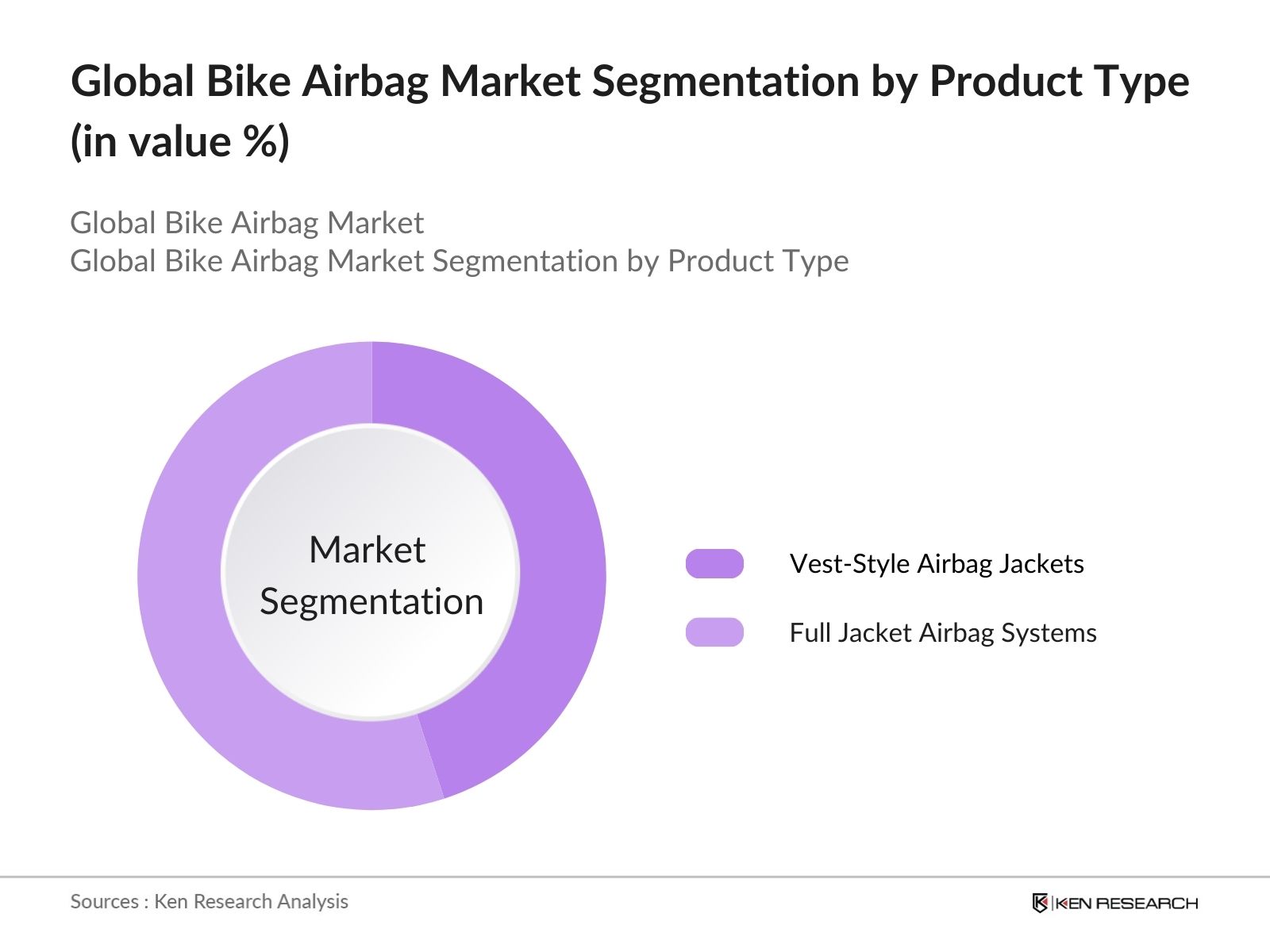
By Product Type: The global bike airbag jacket market is segmented by product type into vest-style airbag jackets and full jacket airbag systems. Full jacket airbag systems hold a dominant market share under this segmentation. This is largely due to their comprehensive protection, which covers the torso, shoulders, and back, offering riders a higher sense of safety. The integration of full-body airbag systems with advanced crash detection technology makes these products particularly popular among professional motorcyclists and safety-conscious consumers.
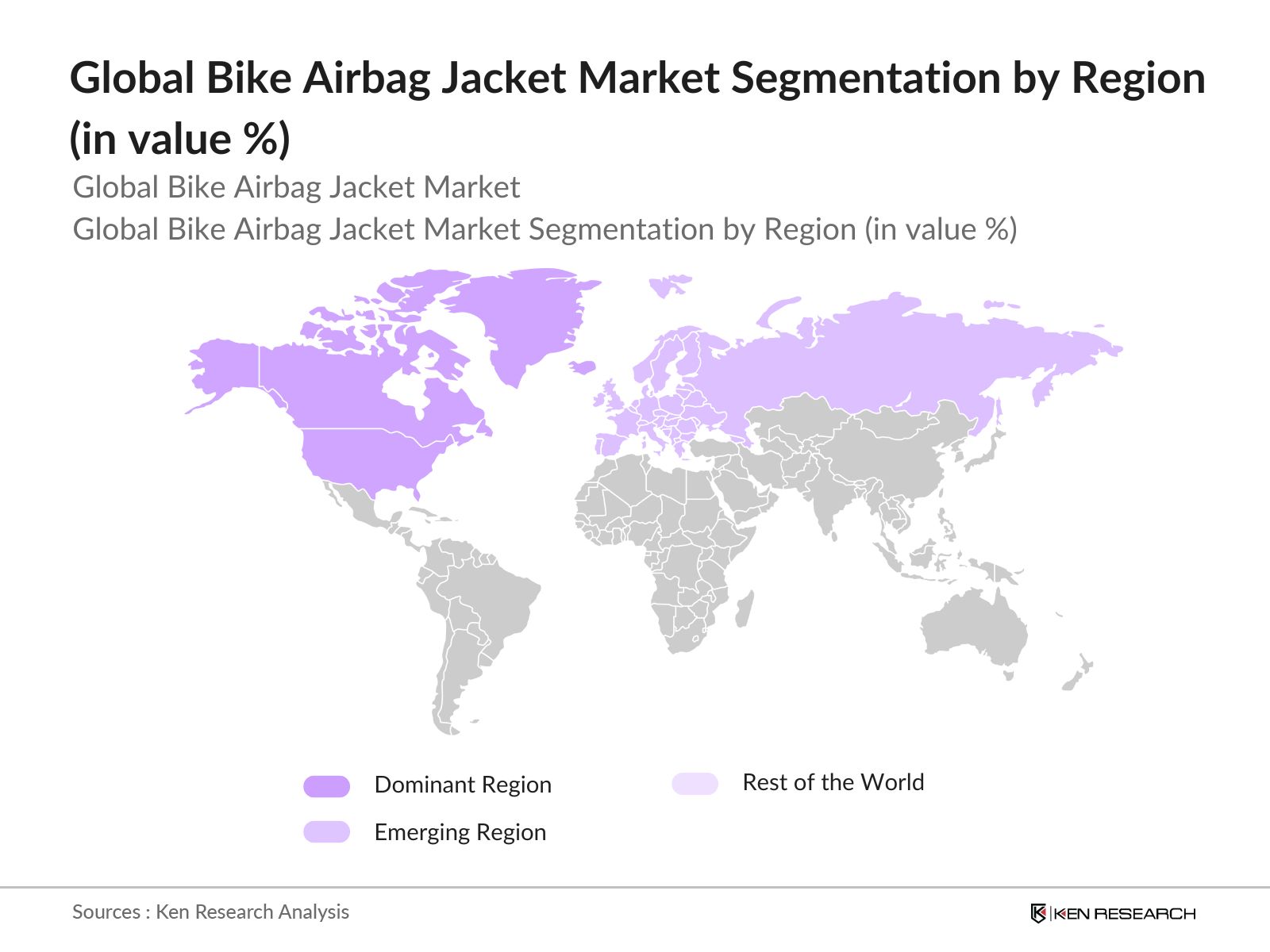
By Region: The global bike airbag jacket market is regionally segmented into North America, Europe, Asia-Pacific, Latin America, and the Middle East & Africa. North America leads the market due to the high awareness of road safety, a robust motorcycle culture, and supportive government regulations. The regions advanced manufacturing capabilities and the presence of leading market players further cement its dominant position. Europe follows closely, driven by stringent safety standards and increasing adoption of protective gear among professional and casual riders alike.
By Technology Type: The bike airbag jacket market is also segmented by technology type into electronic airbag systems and mechanical airbag systems. Electronic airbag systems dominate the market due to their ability to integrate advanced sensors and smart technology, which can automatically detect accidents and deploy airbags in milliseconds. These systems are more accurate and reliable than mechanical systems, which require manual activation, making them a preferred choice among safety-conscious consumers. The growing demand for smart wearables has further boosted the adoption of electronic airbag systems.
The global bike airbag jacket market is highly competitive, with key players focusing on product innovation, strategic collaborations, and expanding their geographical reach to strengthen their market presence. Major companies like Alpinestars and Dainese have established strong brand recognition, leveraging cutting-edge technology to offer superior products. The competitive landscape is characterized by a mix of established global brands and emerging companies.
|
Company |
Establishment Year |
Headquarters |
No. of Employees |
Revenue (USD Mn) |
Product Range |
Market Share (%) |
Regional Presence |
R&D Investments |
Partnerships/Collaborations |
|
Alpinestars |
1963 |
Italy |
- |
- |
- |
- |
- |
- |
- |
|
Dainese |
1972 |
Italy |
- |
- |
- |
- |
- |
- |
- |
|
Helite |
2002 |
France |
- |
- |
- |
- |
- |
- |
- |
|
MotoAir |
1997 |
Taiwan |
- |
- |
- |
- |
- |
- |
- |
|
Klim |
1999 |
USA |
- |
- |
- |
- |
- |
- |
- |
Growth Drivers
Challenges
Global Bike Airbag Jacket Market is expected to witness significant growth, driven by increasing consumer awareness of safety, advancements in airbag technology, and the expansion of product offerings into emerging markets. The adoption of smart technology and the integration of sensors into airbag jackets will be key drivers, providing real-time crash detection and enhanced protection. Additionally, rising disposable incomes in developing regions like Asia-Pacific and Latin America will open new opportunities for market expansion, further supported by favorable government regulations promoting the use of safety gear.
Market Opportunities
|
Segment |
Sub-Segment |
|
By Product Type |
Vest-Style Airbag Jackets |
|
Full Jacket Airbag Systems |
|
|
By Distribution Channel |
Online Retail |
|
Offline Retail |
|
|
By Technology Type |
Electronic Airbag Systems |
|
Mechanical Airbag Systems |
|
|
By End-User |
Commuters |
|
Professional Motorcyclists |
|
|
Casual Riders |
|
|
By Region |
North America |
|
Europe |
|
|
Asia-Pacific |
|
|
Latin America |
|
|
Middle East & Africa |
1.1 Definition and Scope
1.2 Market Taxonomy
1.3 Market Growth Rate
1.4 Market Segmentation Overview
2.1 Historical Market Size
2.2 Year-On-Year Growth Analysis
2.3 Key Market Developments and Milestones
3.1 Growth Drivers (Unit Sales, Demand for Safety Gear, Government Regulations, Consumer Awareness)
3.1.1 Increasing Motorcycle Sales in Emerging Markets
3.1.2 Rising Awareness of Road Safety Initiatives
3.1.3 Government Mandates for Protective Gear
3.1.4 Technological Innovations in Airbag Jackets
3.2 Market Challenges (Manufacturing Costs, Consumer Perception, Supply Chain Issues, Cost of R&D)
3.2.1 High Costs of Advanced Materials
3.2.2 Consumer Reluctance Due to High Prices
3.2.3 Regulatory Hurdles in Emerging Markets
3.2.4 Lack of Standardization in Design
3.3 Opportunities (Technological Advancements, New Market Entries, Mergers & Acquisitions, Regional Expansions)
3.3.1 Integration of Smart Technology (IoT)
3.3.2 Expansion into Asia-Pacific Region
3.3.3 Collaborations with Motorcycle Manufacturers
3.3.4 Growth in Urban Commuter Segment
3.4 Trends (Material Innovation, Design Customization, Sustainability Focus, Brand Collaborations)
3.4.1 Lightweight and Breathable Fabrics
3.4.2 Custom Fit and Design Options
3.4.3 Eco-Friendly Production Processes
3.4.4 Partnerships with Premium Motorcycle Brands
3.5 Government Regulation (Safety Certifications, Trade Policies, Regional Safety Mandates, Protective Gear Laws)
3.5.1 European CE Certification Requirements
3.5.2 North American Motorcycle Safety Standards
3.5.3 Asian Road Safety Initiatives
3.5.4 Global Trade Policies for Protective Gear
3.6 Porters Five Forces (Buyer Power, Supplier Power, Industry Rivalry, Threat of New Entrants, Threat of Substitutes)
3.7 Competitive Landscape (Market Share Analysis, Strategic Partnerships, Product Innovations, Mergers & Acquisitions)
3.8 SWOT Analysis (Strengths, Weaknesses, Opportunities, Threats)
3.9 Stakeholder Ecosystem (Suppliers, Manufacturers, Distributors, End Users)
4.1 By Product Type (In Value %)
4.1.1 Vest-Style Airbag Jackets
4.1.2 Full Jacket Airbag Systems
4.2 By Distribution Channel (In Value %)
4.2.1 Online Retail
4.2.2 Offline Retail
4.3 By Technology Type (In Value %)
4.3.1 Electronic Airbag Systems
4.3.2 Mechanical Airbag Systems
4.4 By End-User (In Value %)
4.4.1 Commuters
4.4.2 Professional Motorcyclists
4.4.3 Casual Riders
4.5 By Region (In Value %)
4.5.1 North America
4.5.2 Europe
4.5.3 Asia-Pacific
4.5.4 Latin America
4.5.5 Middle East & Africa
5.1 Detailed Profiles of Major Companies (No. of Employees, Headquarters, Inception Year, Revenue)
5.1.1 Alpinestars
5.1.2 Dainese
5.1.3 Helite
5.1.4 MotoAir
5.1.5 Spidi Sport
5.1.6 Klim
5.1.7 Furygan
5.1.8 RST
5.1.9 Hit-Air
5.1.10 REV'IT!
5.2 Cross Comparison Parameters (Revenue, Market Penetration, Product Portfolio, Patents, Partnerships, Regional Presence, Technology Innovations, Distribution Channels)
5.3 Market Share Analysis
5.4 Strategic Initiatives
5.5 Mergers and Acquisitions
5.6 Investment Analysis
5.7 Government Grants
5.8 Private Equity and Venture Capital Funding
6.1 Safety Certification Requirements
6.2 Compliance with Regional Safety Standards
6.3 Global and Regional Trade Policies
6.4 Certification Processes for Protective Gear
7.1 Market Size Projections
7.2 Key Factors Driving Future Market Growth
8.1 By Product Type (In Value %)
8.2 By Distribution Channel (In Value %)
8.3 By Technology Type (In Value %)
8.4 By End-User (In Value %)
8.5 By Region (In Value %)
9.1 TAM/SAM/SOM Analysis
9.2 Product Launch Strategies
9.3 Strategic Marketing Initiatives
9.4 White Space Opportunity Analysis
In this phase, an ecosystem map was created to include all the key stakeholders of the global bike airbag jacket market. Extensive desk research was conducted using secondary and proprietary databases to gather industry information. The main objective was to define the critical variables driving market growth, such as safety regulations, technology advancements, and consumer demand.
Historical data was compiled and analyzed, focusing on market penetration, sales performance, and revenue generation. This step involved assessing the product portfolios of major manufacturers and analyzing consumer purchasing patterns to ensure the accuracy of market estimates and forecasts.
Industry experts from key companies were consulted via CATIs (computer-assisted telephone interviews) to validate the market hypotheses. These consultations provided critical insights into operational challenges, technological developments, and consumer preferences, thereby refining the market estimates.
In this final phase, detailed interviews with airbag jacket manufacturers were conducted to obtain insights on sales trends, production volumes, and innovation strategies. The gathered data was synthesized to create a comprehensive and validated analysis of the global bike airbag jacket market.
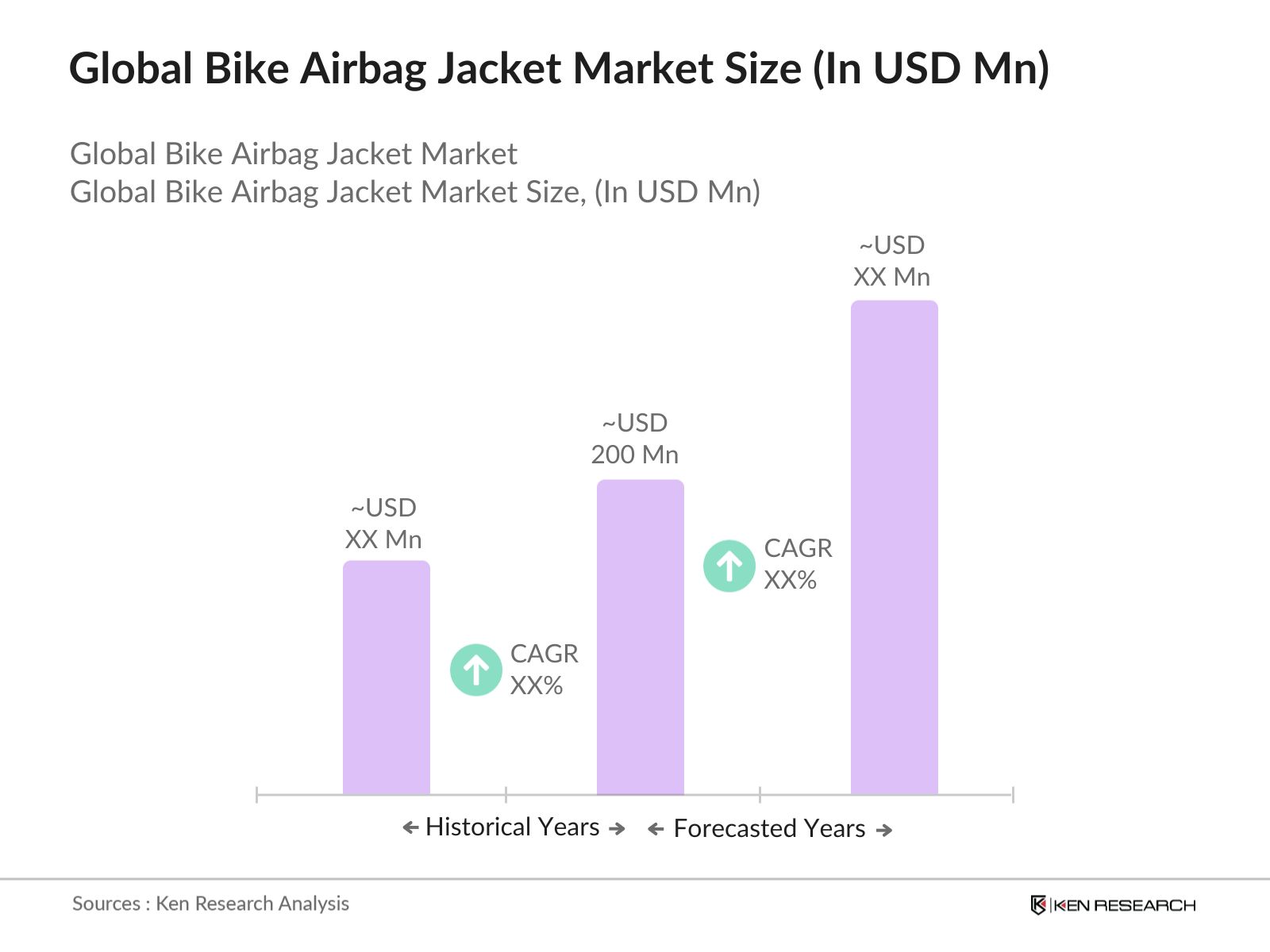
The Global Bike Airbag Jacket Market is valued at USD 200 million, driven by rising safety concerns and technological advancements in protective gear.
Challenges in Global Bike Airbag Jacket Market include high manufacturing costs, consumer reluctance due to the high price of products, and regulatory hurdles in emerging markets that lack standardization for airbag jackets.
Key players in Global Bike Airbag Jacket Market include Alpinestars, Dainese, Helite, MotoAir, and Klim, with a strong presence in regions such as North America and Europe, where safety regulations are stringent.
Global Bike Airbag Jacket Market is propelled by increasing motorcycle sales, heightened awareness of road safety, technological innovations in airbag systems, and government regulations mandating the use of protective gear.

What makes us stand out is that our consultants follows Robust, Refine and Result (RRR) methodology. i.e. Robust for clear definitions, approaches and sanity checking, Refine for differentiating respondents facts and opinions and Result for presenting data with story

We have set a benchmark in the industry by offering our clients with syndicated and customized market research reports featuring coverage of entire market as well as meticulous research and analyst insights.

While we don't replace traditional research, we flip the method upside down. Our dual approach of Top Bottom & Bottom Top ensures quality deliverable by not just verifying company fundamentals but also looking at the sector and macroeconomic factors.

With one step in the future, our research team constantly tries to show you the bigger picture. We help with some of the tough questions you may encounter along the way: How is the industry positioned? Best marketing channel? KPI's of competitors? By aligning every element, we help maximize success.

Our report gives you instant access to the answers and sources that other companies might choose to hide. We elaborate each steps of research methodology we have used and showcase you the sample size to earn your trust.

If you need any support, we are here! We pride ourselves on universe strength, data quality, and quick, friendly, and professional service.