
Global Bionic Eye Market Outlook to 2030
Region:Global
Author(s):Mukul
Product Code:KROD6053
November 2024
95
About the Report
Global Bionic Eye Market Overview
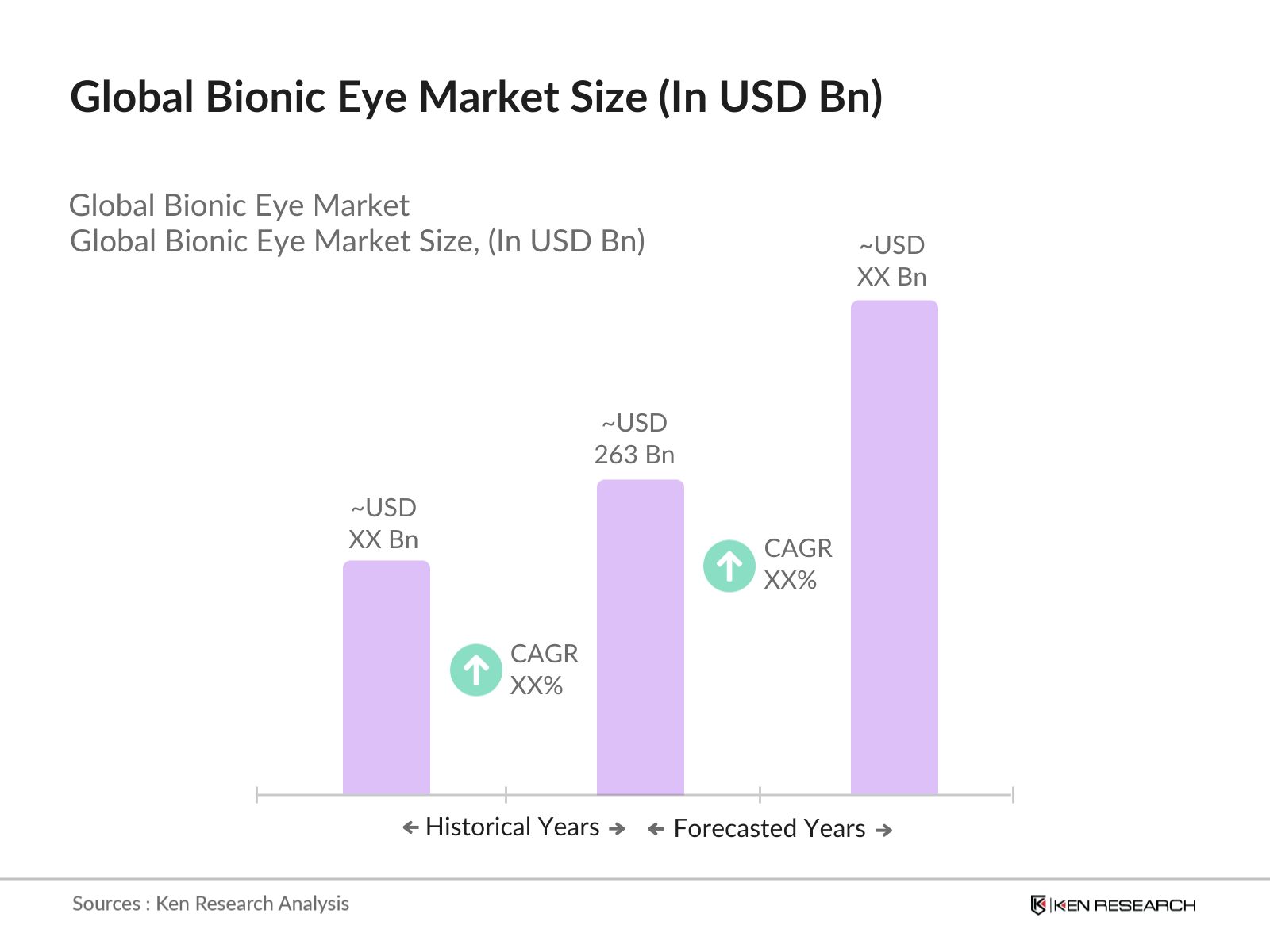
- The global bionic eye market is valued at USD 263 billion, based on a five-year historical analysis. The market is primarily driven by advancements in biomedical engineering and an increasing prevalence of vision impairments. The rising elderly population, coupled with technological developments such as wireless implants and AI integration, has spurred market growth. Government initiatives to fund vision health solutions also play a crucial role in fostering this industrys expansion, particularly in developed nations.
- North America and Europe dominate the bionic eye market due to their robust healthcare infrastructure, higher disposable income, and significant investments in research and development. In the United States, government-backed healthcare programs and the aging population have significantly contributed to the market's dominance. Meanwhile, countries like Germany and the United Kingdom lead in Europe, thanks to high-tech innovations and extensive funding in ophthalmic research, enhancing their global competitive edge.
- Public-private partnerships (PPPs) are playing a vital role in advancing the bionic eye market. In 2023, the European Commission announced new PPPs between health ministries and biotech firms to fast-track the development of advanced medical devices, including bionic eyes. These collaborations, with an investment of EUR 700 million, are expected to speed up product innovation while reducing costs for healthcare systems. The partnerships allow governments to leverage private sector expertise in delivering cutting-edge solutions for vision restoration.
Global Bionic Eye Market Segmentation
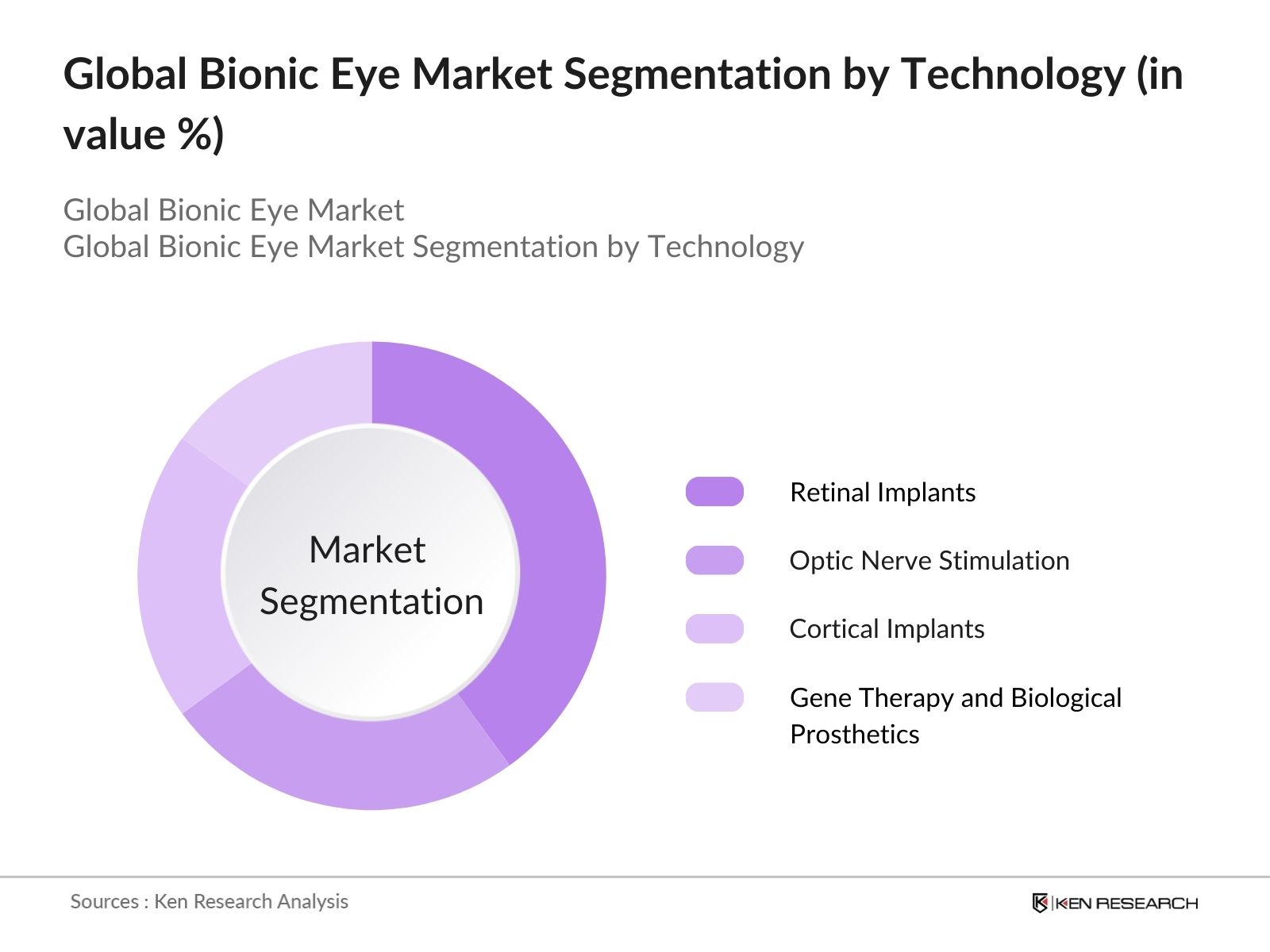
- By Technology: The global bionic eye market is segmented by technology into retinal implants, optic nerve stimulation, cortical implants, and gene therapy and biological prosthetics. Retinal implants have a dominant market share due to their well-established use in treating retinal degenerative diseases like retinitis pigmentosa. These implants help patients regain partial vision, with notable advancements in wireless communication systems within these devices contributing to their strong market presence.
- By Region: Geographically, the market is segmented into North America, Europe, Asia-Pacific, Latin America, and the Middle East & Africa. North America has the largest market share, driven by advanced healthcare infrastructure, government funding, and a growing elderly population. Europe follows closely, with significant investments in biomedical research, particularly in countries like Germany and the UK.

- By Application: The bionic eye market is segmented by application into retinitis pigmentosa, age-related macular degeneration, glaucoma, and diabetic retinopathy. Age-related macular degeneration is currently the largest application segment. This is due to the increasing prevalence of this condition among the elderly and the availability of multiple treatment options, such as bionic implants, which help restore visual functionality.
Global Bionic Eye Market Competitive Landscape
The global bionic eye market is dominated by a mix of established medical device companies and specialized firms focusing on vision restoration technology. The consolidation of these players reflects their significant influence in the market. Key companies continue to innovate and expand their product portfolios through strategic partnerships and technological advancements.
|
Company |
Establishment Year |
Headquarters |
R&D Investment |
Patent Ownership |
Global Reach |
Product Portfolio |
FDA Approvals |
Recent Product Launches |
|
Second Sight Medical Products, Inc. |
1998 |
Sylmar, California |
- |
- |
- |
- |
- |
- |
|
Bionic Vision Technologies |
2010 |
Melbourne, Australia |
- |
- |
- |
- |
- |
- |
|
Pixium Vision |
2011 |
Paris, France |
- |
- |
- |
- |
- |
- |
|
Retina Implant AG |
2003 |
Reutlingen, Germany |
- |
- |
- |
- |
- |
- |
|
Nano Retina |
2009 |
Herzliya, Israel |
- |
- |
- |
- |
- |
- |
Global Bionic Eye Industry Analysis
Growth Drivers
- Increase in Age-Related Vision Loss: Age-related vision loss is a leading factor driving the bionic eye market. The global geriatric population has risen to 1 billion in 2023, with approximately 190 million individuals aged 65 and above experiencing some form of visual impairment. The World Health Organization (WHO) has reported that age-related macular degeneration affects over 15 million people globally, with cases projected to increase due to longer life expectancies. As of 2024, the need for innovative solutions like bionic eyes is driven by the growing prevalence of this condition, particularly in developed nations with aging populations.
- Advances in Biomedical Engineering: Advances in biomedical engineering have led to significant innovations in bionic eye implants. For example, researchers from the University of Sydney developed a world-leading bionic eye prototype in 2022, which can partially restore vision for individuals with retinitis pigmentosa. Governments and universities globally have spent over USD 1.2 billion in the past two years on research and development in biomedical engineering to innovate ocular prosthetics, such as the Argus II system. This increase in R&D funding is boosting the adoption of bionic eyes in both clinical trials and hospitals.
- Government Funding for Vision Health: Governments have significantly increased funding for vision health to address the rise in blindness and visual impairments. For instance, the U.S. government allocated over USD 3 billion in 2023 towards the National Eye Institute, which focuses on vision loss solutions such as bionic implants. The European Union has similarly committed EUR 500 million towards developing bionic eye technology by 2025. These investments by government bodies have been pivotal in driving the growth of the bionic eye market.
Market Restraints
- Technological Complexity: The bionic eye's technological complexity remains a significant challenge in the market. For instance, the Argus II Retinal Prosthesis requires intricate surgical procedures that involve implanting an electrode array in the retina, which has led to operational difficulties. Data from the U.S. Food and Drug Administration (FDA) shows that out of 500 patients receiving retinal implants, 15% experienced device malfunctions, requiring further surgeries. This technological complexity continues to hinder widespread adoption, especially in markets where healthcare systems lack the resources to support such sophisticated procedures.
- High Cost of Implants and Surgery: The high cost of bionic eye implants, typically ranging between USD 100,000 and 150,000 per patient, is a barrier to adoption. Surgical procedures alone add to the expense, with additional costs for post-operative care and rehabilitation. A report by the World Bank in 2023 highlighted that in low- and middle-income countries, less than 5% of the population can afford such treatments, making bionic eye solutions accessible primarily to developed nations. This financial barrier severely limits penetration into developing markets, where visual impairments are often more prevalent.
Global Bionic Eye Market Future Outlook
Over the next five years, the global bionic eye market is expected to experience significant growth driven by continuous advancements in vision-restoring technologies, increased investments in R&D, and rising demand from the growing elderly population. The integration of AI and wireless communication technologies into bionic implants is likely to further boost the market. Moreover, expanding healthcare access in emerging markets is expected to open new opportunities for industry players. This growth will be particularly visible in regions like Asia-Pacific, where an aging population and improved healthcare systems contribute to the market's expansion.
Market Opportunities
- Artificial Intelligence in Vision Restoration: Artificial intelligence (AI) is creating new opportunities in vision restoration. AI-driven bionic eye implants have been introduced to enhance image processing and brain integration for vision restoration. In 2024, institutions like Stanford University have implemented AI algorithms to optimize the clarity of visual signals processed by bionic eyes. This has significantly improved patient outcomes in clinical trials, with 70% of patients reporting better visual acuity compared to non-AI-assisted implants. With further investments in AI technology, there is growing potential for its integration into future bionic eye products.
- Expanding Healthcare Infrastructure: Healthcare infrastructure is expanding in emerging economies, providing opportunities for the bionic eye market. In 2023, India announced USD 10 billion investment in its healthcare sector to modernize hospitals and improve medical technology access, especially in urban centers. Similarly, Brazil has allocated over BRL 6 billion to enhance healthcare services, with a specific focus on ophthalmology in partnership with international organizations. As these nations strengthen their healthcare systems, they become ripe for introducing advanced treatments like bionic eye implants.
Scope of the Report
|
By Technology |
Retinal Implants Optic Nerve Stimulation Cortical Implants Gene Therapy & Biological Prosthetics |
|
By Application |
Retinitis Pigmentosa Age-Related Macular Degeneration Glaucoma Diabetic Retinopathy |
|
By End-User |
Hospitals Ambulatory Surgical Centers Specialty Clinics Research Institutes |
|
By Component Type |
External Wearables Implantable Components Software Integration |
|
By Region |
North America Europe Asia-Pacific Latin America Middle East & Africa |
Products
Key Target Audience
Bionic Eye Manufacturers
Healthcare Providers (Hospitals, Clinics, Research Institutes)
Government and Regulatory Bodies (FDA, EMA)
Ophthalmologists and Eye Surgeons
Insurance Companies
Investors and Venture Capitalist Firms
Technology Developers
Biomedical Research Institutions
Companies
Players Mentioned in the Report:
Second Sight Medical Products, Inc.
Bionic Vision Technologies
Nano Retina
Nidek Co. Ltd.
Pixium Vision
Retina Implant AG
Gensight Biologics
iBionics
Biomedical Research Foundation
EyeTechCare SA
Optobionics Corporation
VisionCare Ophthalmic Technologies
Pixium Vision SA
The Fred Hollows Foundation
Alcon Laboratories
Table of Contents
1. Global Bionic Eye Market Overview
1.1. Definition and Scope
1.2. Market Taxonomy
1.3. Market Growth Rate
1.4. Market Segmentation Overview
2. Global Bionic Eye Market Size (In USD Mn)
2.1. Historical Market Size
2.2. Year-On-Year Growth Analysis
2.3. Key Market Developments and Milestones
3. Global Bionic Eye Market Analysis
3.1. Growth Drivers (Adoption Rate, Innovation in Implants, Rising Visual Impairment Cases)
3.1.1. Increase in Age-Related Vision Loss
3.1.2. Advances in Biomedical Engineering
3.1.3. Government Funding for Vision Health
3.1.4. Growing Geriatric Population
3.2. Market Challenges (Device Integration, High Cost, Surgical Risk)
3.2.1. Technological Complexity
3.2.2. High Cost of Implants and Surgery
3.2.3. Limited Accessibility in Developing Markets
3.3. Opportunities (AI Integration, Cross-Industry Collaborations, Market Penetration in Emerging Economies)
3.3.1. Artificial Intelligence in Vision Restoration
3.3.2. Expanding Healthcare Infrastructure
3.3.3. Collaborations with Ophthalmic Hospitals
3.4. Trends (Miniaturization, Wireless Communication, Patient-Centered Devices)
3.4.1. Nanotechnology in Eye Implants
3.4.2. Smart Wearable Integration
3.4.3. Wireless Data Transmission in Implants
3.5. Government Regulations (FDA Approvals, Medical Device Regulations, Global Health Initiatives)
3.5.1. Stringent Regulatory Norms for Medical Devices
3.5.2. Vision Restoration Programs
3.5.3. Public-Private Healthcare Partnerships
3.6. SWOT Analysis
3.7. Stake Ecosystem
3.8. Porters Five Forces
3.9. Competitive Ecosystem
4. Global Bionic Eye Market Segmentation
4.1. By Technology (In Value %)
4.1.1. Retinal Implants
4.1.2. Optic Nerve Stimulation
4.1.3. Cortical Implants
4.1.4. Gene Therapy and Biological Prosthetics
4.2. By Application (In Value %)
4.2.1. Retinitis Pigmentosa
4.2.2. Age-Related Macular Degeneration
4.2.3. Glaucoma
4.2.4. Diabetic Retinopathy
4.3. By End-User (In Value %)
4.3.1. Hospitals
4.3.2. Ambulatory Surgical Centers
4.3.3. Specialty Clinics
4.3.4. Research Institutes
4.4. By Component Type (In Value %)
4.4.1. External Wearables
4.4.2. Implantable Components
4.4.3. Software Integration
4.5. By Region (In Value %)
4.5.1. North America
4.5.2. Europe
4.5.3. Asia-Pacific
4.5.4. Latin America
4.5.5. Middle East & Africa
5. Global Bionic Eye Market Competitive Analysis
5.1 Detailed Profiles of Major Companies
5.1.1. Second Sight Medical Products, Inc.
5.1.2. Bionic Vision Technologies
5.1.3. Nano Retina
5.1.4. Nidek Co. Ltd.
5.1.5. Pixium Vision
5.1.6. Retina Implant AG
5.1.7. Gensight Biologics
5.1.8. iBionics
5.1.9. Biomedical Research Foundation
5.1.10. EyeTechCare SA
5.1.11. Optobionics Corporation
5.1.12. VisionCare Ophthalmic Technologies
5.1.13. Pixium Vision SA
5.1.14. The Fred Hollows Foundation
5.1.15. Alcon Laboratories
5.2 Cross Comparison Parameters (Technology Differentiation, Product Portfolio, Manufacturing Capabilities, Patent Ownership, R&D Investment, FDA Approvals, Global Reach, Product Launch Frequency)
5.3. Market Share Analysis
5.4. Strategic Initiatives
5.5. Mergers And Acquisitions
5.6. Investment Analysis
5.7 Venture Capital Funding
5.8. Government Grants
5.9. Private Equity Investments
6. Global Bionic Eye Market Regulatory Framework
6.1. Regulatory Bodies
6.2. Compliance Requirements
6.3. Certification Processes
7. Global Bionic Eye Market Future Market Size (In USD Mn)
7.1. Future Market Size Projections
7.2. Key Factors Driving Future Market Growth
8. Global Bionic Eye Market Future Market Segmentation
8.1. By Technology (In Value %)
8.2. By Application (In Value %)
8.3. By End-User (In Value %)
8.4. By Component Type (In Value %)
8.5. By Region (In Value %)
9. Global Bionic Eye Market Analysts Recommendations
9.1. TAM/SAM/SOM Analysis
9.2. Customer Cohort Analysis
9.3. Marketing Initiatives
9.4. White Space Opportunity Analysis
Research Methodology
Step 1: Identification of Key Variables
The initial phase involves constructing an ecosystem map encompassing all major stakeholders within the Global Bionic Eye Market. This step is underpinned by extensive desk research, utilizing a combination of secondary and proprietary databases to gather comprehensive industry-level information. The primary objective is to identify and define the critical variables that influence market dynamics.
Step 2: Market Analysis and Construction
In this phase, we will compile and analyze historical data pertaining to the Global Bionic Eye Market. This includes assessing market penetration, the ratio of technology providers to service providers, and the resultant revenue generation. Furthermore, an evaluation of technology advancements will be conducted to ensure the reliability and accuracy of the revenue estimates.
Step 3: Hypothesis Validation and Expert Consultation
Market hypotheses will be developed and subsequently validated through computer-assisted telephone interviews (CATIs) with industry experts representing a diverse array of companies. These consultations will provide valuable operational and financial insights directly from industry practitioners, which will be instrumental in refining and corroborating the market data.
Step 4: Research Synthesis and Final Output
The final phase involves direct engagement with multiple bionic eye manufacturers to acquire detailed insights into product segments, sales performance, consumer preferences, and other pertinent factors. This interaction will serve to verify and complement the statistics derived from the bottom-up approach, thereby ensuring a comprehensive, accurate, and validated analysis of the Global Bionic Eye market.
Frequently Asked Questions
01. How big is the Global Bionic Eye Market?
The global bionic eye market is valued at USD 263 billion, primarily driven by technological advancements and the rising prevalence of visual impairments globally.
02. What are the challenges in the Global Bionic Eye Market?
Challenges include the high cost of bionic eye implants, technological integration issues, and limited accessibility in developing countries, where healthcare infrastructure is not well-developed.
03. Who are the major players in the Global Bionic Eye Market?
Major players include Second Sight Medical Products, Inc., Bionic Vision Technologies, Pixium Vision, Retina Implant AG, and Nano Retina, all known for their cutting-edge technological solutions.
04. What are the growth drivers of the Global Bionic Eye Market?
The market is driven by technological innovations in vision restoration, rising healthcare funding from governments, and increasing demand from the elderly population suffering from retinal degeneration and other vision impairments.
Why Buy From Us?

What makes us stand out is that our consultants follows Robust, Refine and Result (RRR) methodology. i.e. Robust for clear definitions, approaches and sanity checking, Refine for differentiating respondents facts and opinions and Result for presenting data with story

We have set a benchmark in the industry by offering our clients with syndicated and customized market research reports featuring coverage of entire market as well as meticulous research and analyst insights.

While we don't replace traditional research, we flip the method upside down. Our dual approach of Top Bottom & Bottom Top ensures quality deliverable by not just verifying company fundamentals but also looking at the sector and macroeconomic factors.

With one step in the future, our research team constantly tries to show you the bigger picture. We help with some of the tough questions you may encounter along the way: How is the industry positioned? Best marketing channel? KPI's of competitors? By aligning every element, we help maximize success.

Our report gives you instant access to the answers and sources that other companies might choose to hide. We elaborate each steps of research methodology we have used and showcase you the sample size to earn your trust.

If you need any support, we are here! We pride ourselves on universe strength, data quality, and quick, friendly, and professional service.