
Global Car Manufacturing Market Outlook to 2030
Region:Global
Author(s):Paribhasha Tiwari
Product Code:KROD1925
Region:Global
Author(s):Paribhasha Tiwari
Product Code:KROD1925
October 2024
94
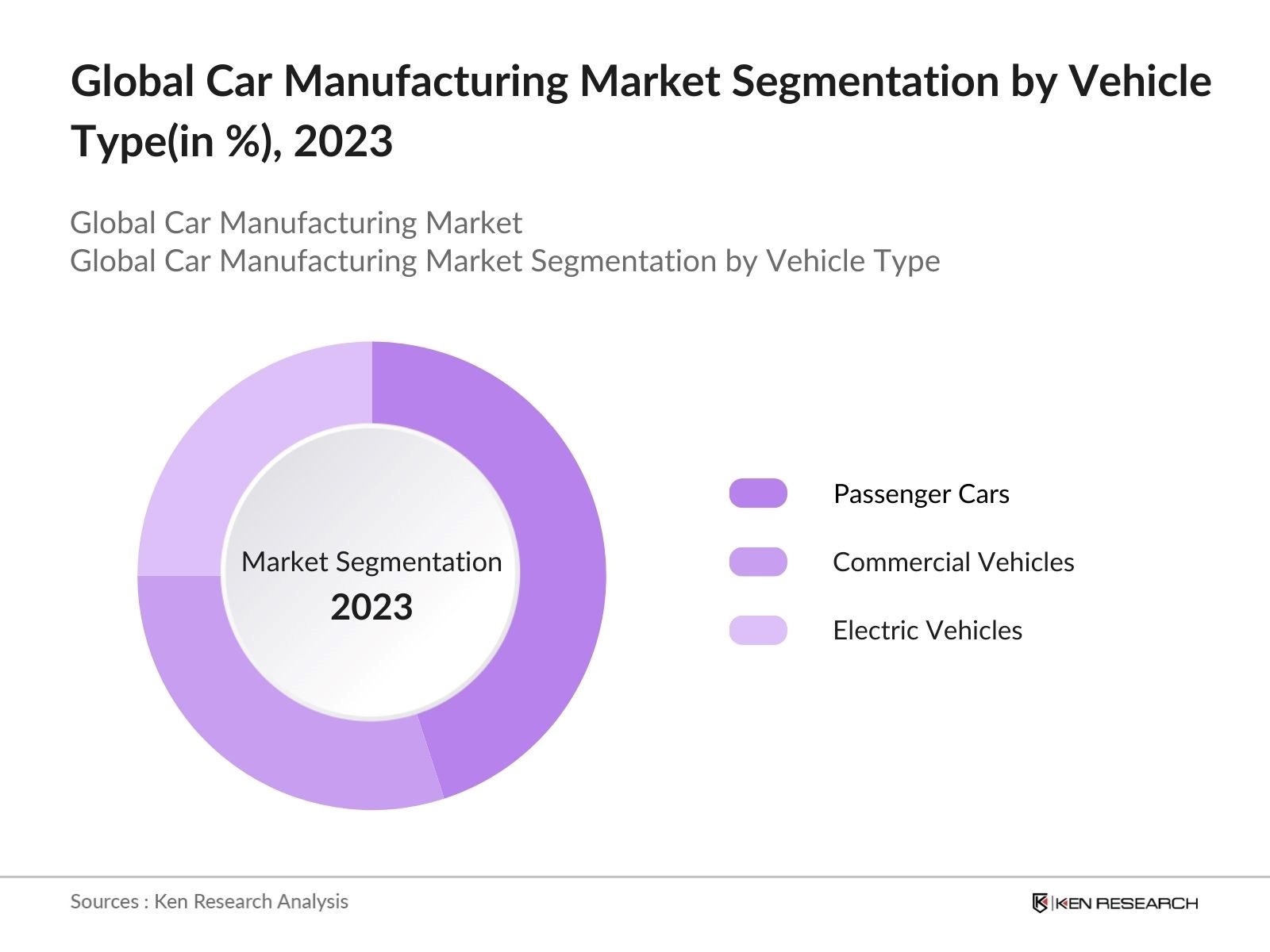
By Vehicle Type: The global car manufacturing market is segmented by vehicle type into passenger cars, commercial vehicles, and electric vehicles (EVs). In 2023, passenger cars held the dominant market share, driven by rising demand in both developed and emerging markets. This dominance is attributed to the affordability, wide range, and continued popularity of passenger cars, which cater to diverse consumer preferences. Brands like Toyota, Volkswagen, and Ford continue to lead this segment, capitalizing on their extensive product portfolios and strong market presence.
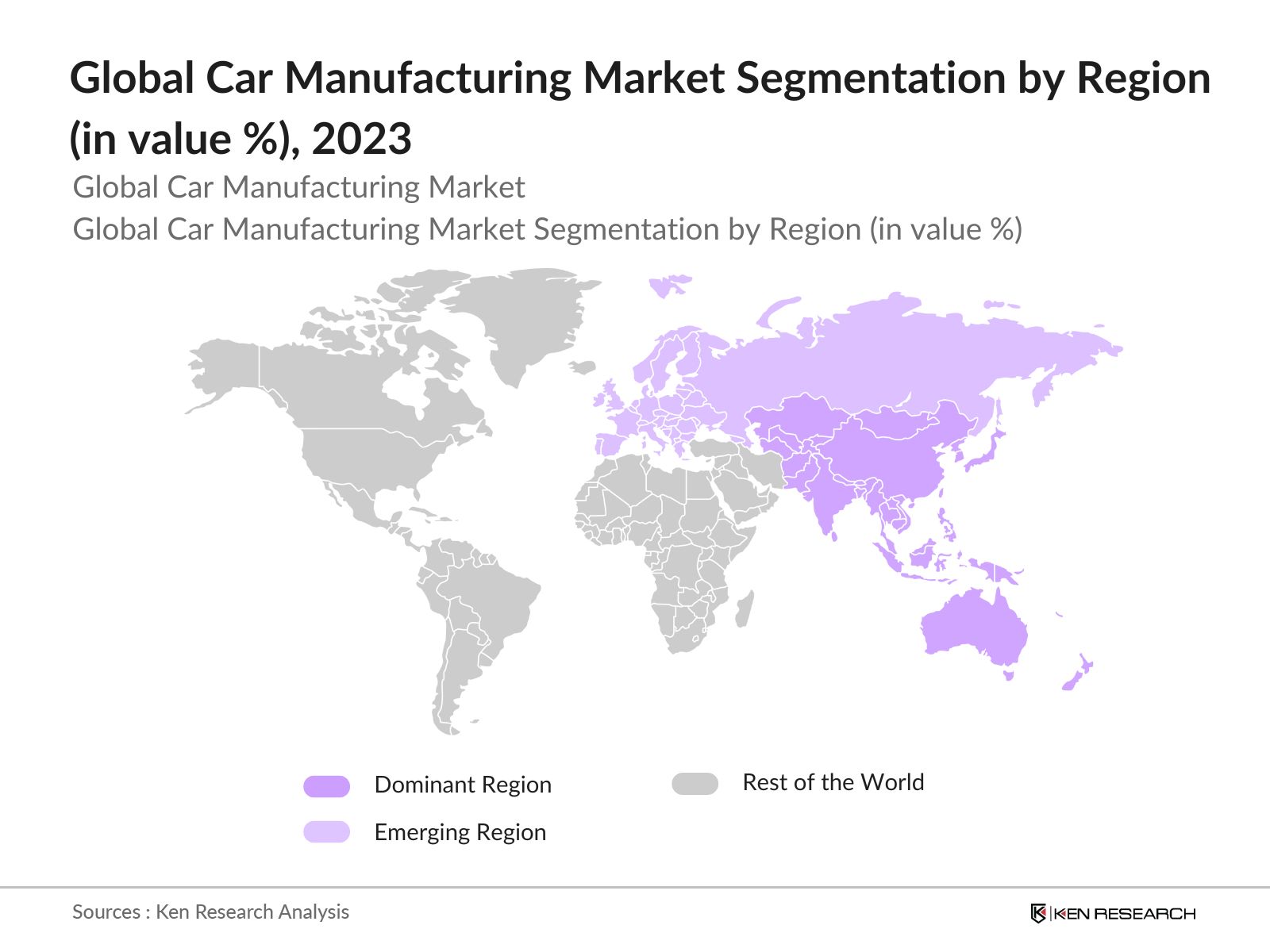
By Region: The global car manufacturing market is segmented by region into North America, Europe, APAC, MEA and Latin America. The Asia-Pacific (APAC) region dominates the global car manufacturing market in 2023. This is largely driven by the presence of major automotive hubs in countries like China, Japan, and South Korea. China, in particular, leads in both production and consumption of vehicles, supported by a robust supply chain, large consumer base, and government policies favoring automotive growth.
By Fuel Type: The car manufacturing market is segmented by fuel type into petrol, diesel, and electric/hybrid vehicles. In 2023, petrol vehicles retained the largest market share due to their widespread availability and established refueling infrastructure. However, the electric/hybrid segment is rapidly growing, driven by environmental regulations and consumer preference for sustainable options. Companies such as Tesla and BYD have been instrumental in expanding the electric vehicle market, offering competitive pricing and innovative features.
|
Company Name |
Establishment Year |
Headquarters |
|---|---|---|
|
Toyota Motor Corporation |
1937 |
Toyota City, Japan |
|
Volkswagen Group |
1937 |
Wolfsburg, Germany |
|
General Motors |
1908 |
Detroit, USA |
|
Ford Motor Company |
1903 |
Dearborn, USA |
|
Honda Motor Co., Ltd. |
1948 |
Tokyo, Japan |
The Global car manufacturing market is projected to grow exponentially in coming years. This growth will be driven by the increasing EV sales, policy support and investment and expansion of car manufacturing facilities in emerging markets.
|
By Vehicle Type |
passenger car commercial vehicles electric vehicles (EVs) |
|
By Region |
North America Europe APAC MEA Latin America |
|
By Fuel Type |
Petrol Diesel electric/hybrid vehicles |
1.1. Market Definition and Scope
1.2. Market Size and Growth (2023)
1.3. Key Market Drivers
1.4. Key Players in the Market
1.5. Recent Developments and Market Trends
1.6. Overview of Market Segmentation
2.1. Historical Market Size
2.2. Year-on-Year Growth Analysis
2.3. Key Market Developments and Milestones
3.1. Growth Drivers
3.1.1. Increase in Electric Vehicle (EV) Adoption
3.1.2. Technological Advancements in Autonomous Vehicles
3.1.3. Expansion of Car Manufacturing Facilities in Emerging Markets
3.2. Market Challenges
3.2.1. Supply Chain Disruptions
3.2.2. Rising Raw Material Costs
3.2.3. Stringent Environmental Regulations
3.3. Market Opportunities
3.3.1. Growing Demand for Sustainable Mobility Solutions
3.3.2. Expansion of Car Markets in Emerging Economies
3.4. Current Market Trends
3.4.1. Growth in Hybrid Vehicle Sales
3.4.2. Increased Investment in Battery Technology
3.4.3. Collaborations for Autonomous Driving Technology
4.1. By Vehicle Type (Market Share %)
4.1.1. Passenger Cars
4.1.2. Commercial Vehicles
4.1.3. Electric Vehicles (EVs)
4.2. By Region (Market Share %)
4.2.1. North America
4.2.2. Europe
4.2.3. APAC
4.2.4. MEA
4.2.5 Latin America
4.3. By Fuel Type (Market Share %)
4.3.1. Petrol
4.3.2. Diesel
4.3.3. Electric/Hybrid
5.1. Key Players and Market Share Analysis
5.2. Strategic Initiatives and Developments
5.3. Mergers, Acquisitions, and Investments
5.4. Company Profiles
5.4.1. Toyota Motor Corporation
5.4.2. Volkswagen Group
5.4.3. General Motors
5.4.4. Ford Motor Company
5.4.5. Honda Motor Co., Ltd.
6.1. Emission Standards and Compliance
6.2. Government Incentives and Subsidies for Electric Vehicles
6.3. Regulations Impacting Autonomous and Connected Vehicles
7.1. Future Market Size Projections
7.2. Factors Influencing Future Market Growth
7.3. Projected Trends and Market Dynamics
8.1. By Vehicle Type (Projected Market Share %)
8.2. By Fuel Type (Projected Market Share %)
8.3. By Technology (Autonomous, Connected)
8.4. By Region (Projected Market Share %)
9.1. Total Addressable Market (TAM) Analysis
9.2. Strategic Initiatives for Market Penetration and Expansion
9.3. Key Recommendations for Industry Stakeholders
10.1. Future Market Trends and Innovations
10.2. Anticipated Regulatory Changes
10.3. Key Challenges for Future Growth
Ecosystem creation for all the major entities and referring to multiple secondary and proprietary databases to perform desk research around market to collate industry level information.
Collating statistics on Global Car Manufacturing Market over the years, penetration of marketplaces and service providers ratio to compute revenue generated for Global Car Mnaufacturing Industry. We will also review service quality statistics to understand revenue generated which can ensure accuracy behind the data points shared.
Building market hypothesis and conducting CATIs with industry experts belonging to different companies to validate statistics and seek operational and financial information from company representatives.
Our team will approach multiple car manufacturing companies and understand nature of product segments and sales, consumer preference and other parameters, which will support us validate statistics derived through bottom to top approach from car manufacturing companies.
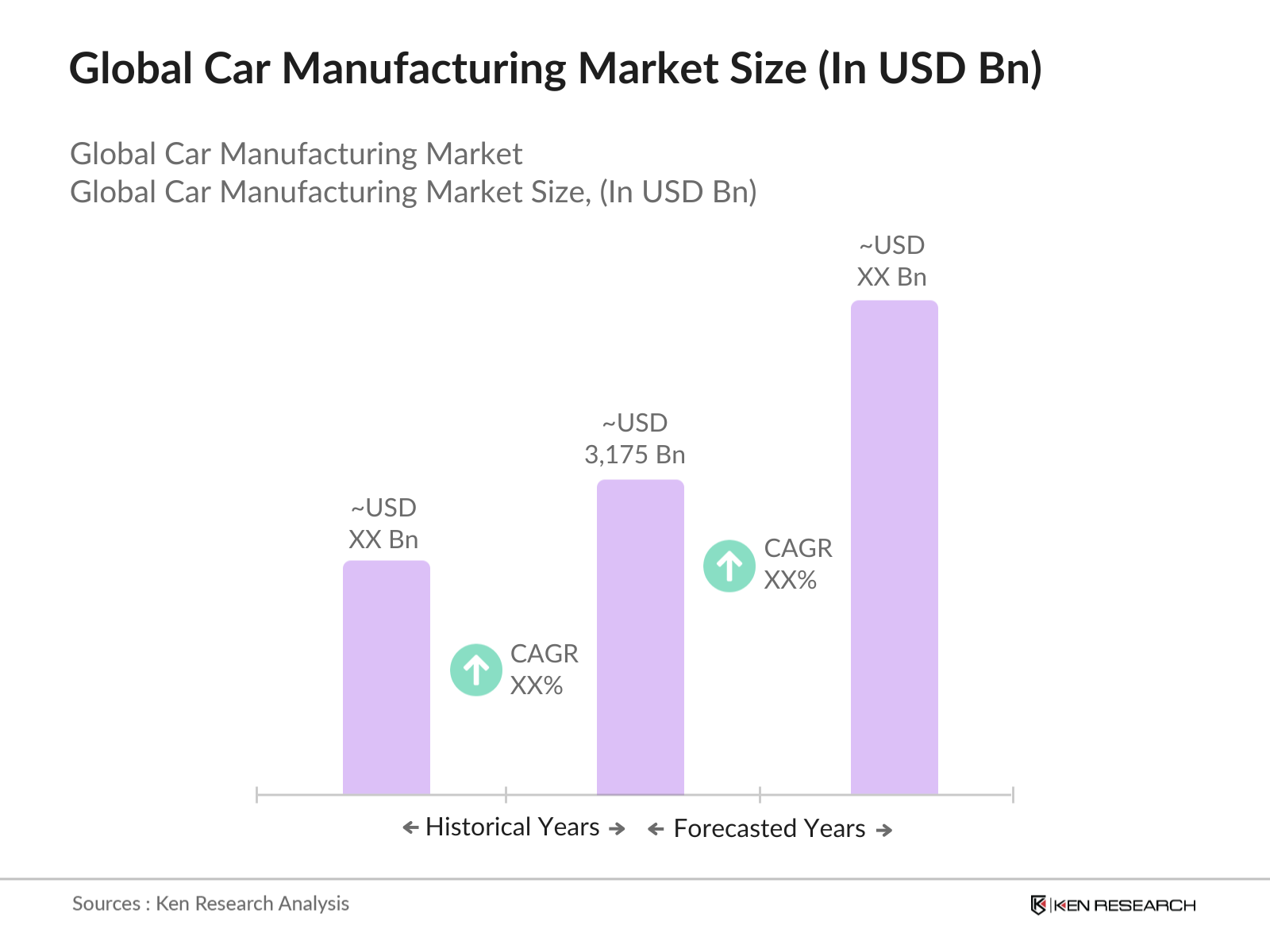
The global car manufacturing market was valued at USD 3,175 billion in 2023, driven by the growing demand for passenger vehicles, technological advancements in electric vehicles, and the expansion of manufacturing facilities in emerging markets.
Key challenges in the global car manufacturing market include supply chain disruptions, especially the semiconductor shortage, rising raw material costs such as steel and lithium, and stringent environmental regulations that require significant investment to comply with new emission standards.
Major players in the global car manufacturing market include Toyota Motor Corporation, Volkswagen Group, General Motors, Ford Motor Company, and Honda Motor Co., Ltd. These companies dominate the market due to their extensive production capacities, strong R&D capabilities, and global distribution networks.
The market is driven by increasing adoption of electric vehicles (EVs), advancements in autonomous vehicle technology, and expansion into emerging markets such as India and Brazil. Government incentives and regulations promoting sustainable mobility further boost market growth.

What makes us stand out is that our consultants follows Robust, Refine and Result (RRR) methodology. i.e. Robust for clear definitions, approaches and sanity checking, Refine for differentiating respondents facts and opinions and Result for presenting data with story

We have set a benchmark in the industry by offering our clients with syndicated and customized market research reports featuring coverage of entire market as well as meticulous research and analyst insights.

While we don't replace traditional research, we flip the method upside down. Our dual approach of Top Bottom & Bottom Top ensures quality deliverable by not just verifying company fundamentals but also looking at the sector and macroeconomic factors.

With one step in the future, our research team constantly tries to show you the bigger picture. We help with some of the tough questions you may encounter along the way: How is the industry positioned? Best marketing channel? KPI's of competitors? By aligning every element, we help maximize success.

Our report gives you instant access to the answers and sources that other companies might choose to hide. We elaborate each steps of research methodology we have used and showcase you the sample size to earn your trust.

If you need any support, we are here! We pride ourselves on universe strength, data quality, and quick, friendly, and professional service.