















Global Carmines Market Outlook to 2030
Region:Global
Author(s):Shreya Garg
Product Code:KROD9820
December 2024
90
About the Report
Global Carmines Market Overview
- The Global Carmines Market, valued at USD 48 billion, is driven primarily by the rising demand for natural colorants across food, beverage, cosmetics, and pharmaceutical industries. With increasing consumer awareness regarding the benefits of clean-label products, manufacturers are focusing on natural alternatives like carmines. Additionally, technological advancements in extraction methods are enhancing the efficiency and quality of carmine production, further driving the market forward.
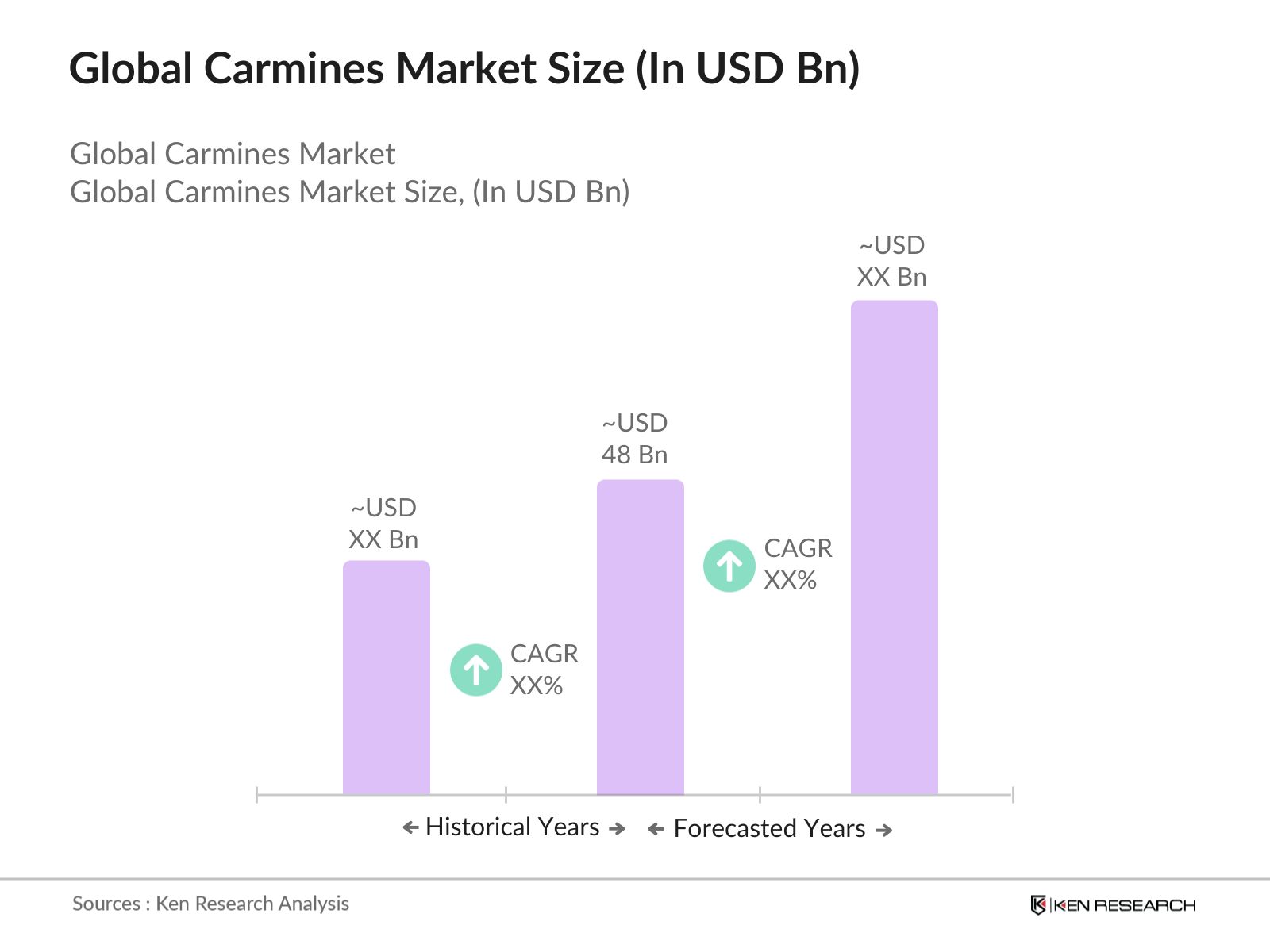
- The market is dominated by regions like North America, Europe, and parts of Asia-Pacific, particularly countries like the United States, France, and China. These countries are home to several prominent manufacturers and have favorable regulatory environments that support natural additives. Additionally, increasing demand for organic cosmetics and food products has solidified the dominance of these countries in the global market.
- The U.S. FDA and European EFSA set strict standards for the use of food colorants like carmine. As of 2023, both agencies require clear labeling of carmine in food products due to potential allergic reactions. In the EU, food products containing carmine must also meet specific purity criteria, and these regulations are periodically reviewed to ensure consumer safety. The regulatory environment in these regions plays a critical role in shaping the market for natural food colorants
Global Carmines Market Segmentation
By Source: The market is segmented by source into cochineal insects and plant-based alternatives. Cochineal insects have a dominant market share due to their historical usage and well-established extraction processes. The ability to produce high-quality carmine from cochineal insects with minimal resource investment makes this source particularly attractive to manufacturers in the food and cosmetics industry. On the other hand, plant-based alternatives are gradually gaining traction, especially in regions with strict regulations regarding animal-derived ingredients. 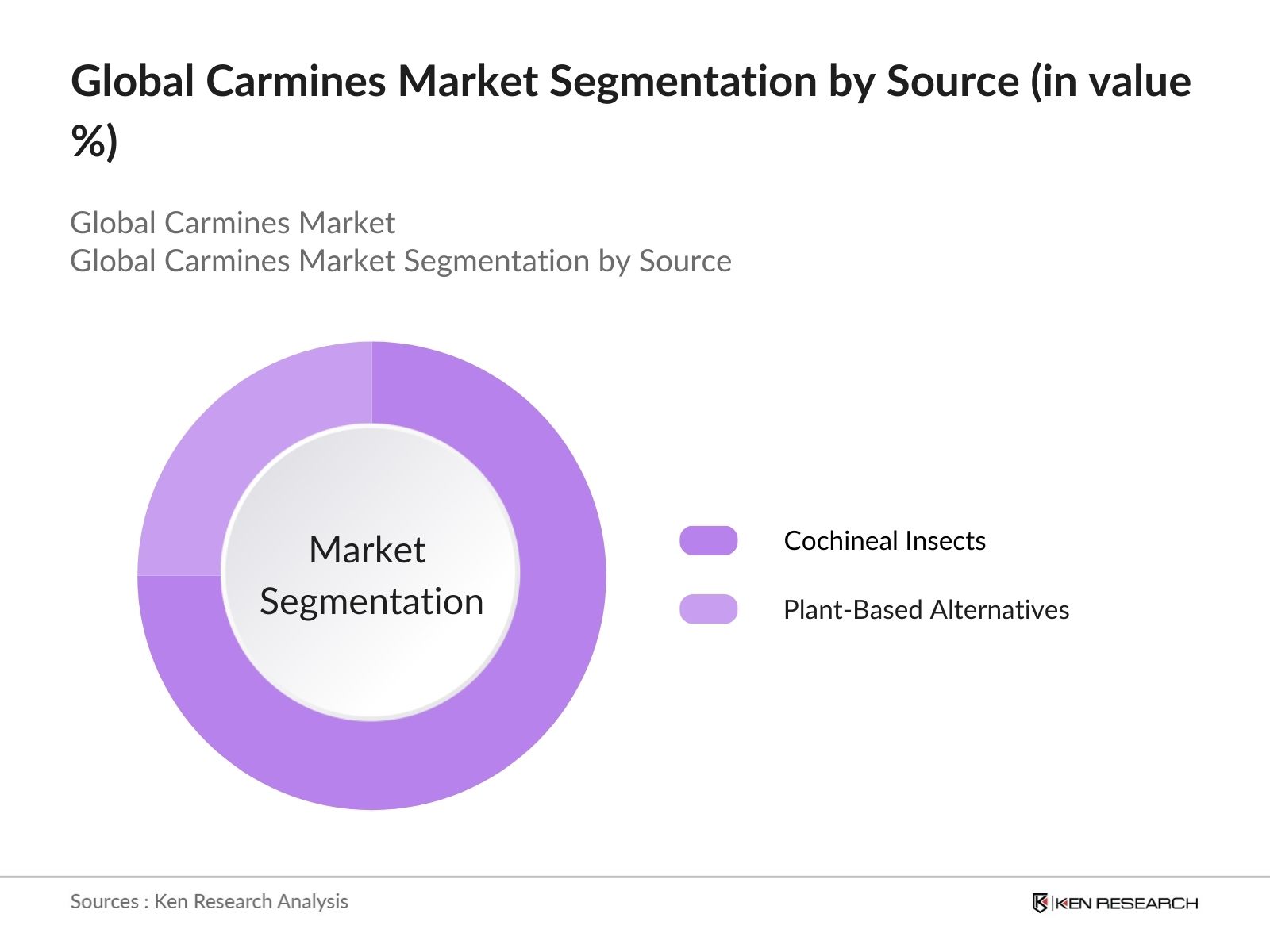
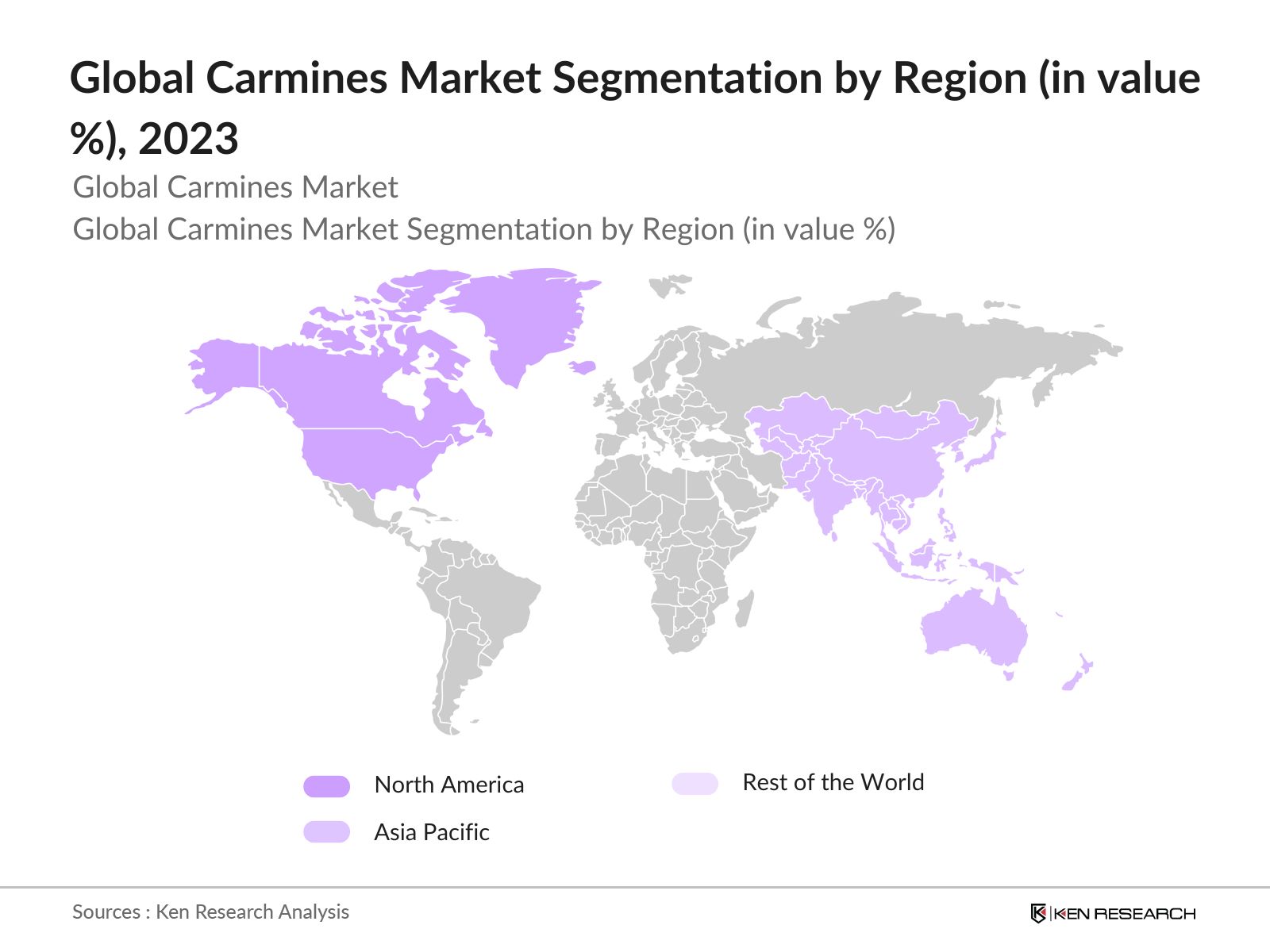
By Region: The market is geographically segmented into North America, Europe, Asia-Pacific, Latin America, and the Middle East & Africa. North America leads the market, driven by stringent food safety regulations and a well-developed cosmetics industry. Europe follows closely, with countries like France and Spain benefiting from a robust demand for natural colorants in food and luxury cosmetics. Asia-Pacific, especially China, is experiencing rapid growth due to increasing urbanization and consumer preferences for natural additives.
By Form: Carmines are available in both powder and liquid forms. Powdered carmine holds a significant share of the market due to its ease of storage, transportation, and extended shelf life, making it popular among food manufacturers. Liquid carmine is favored in applications like beverages and cosmetics, where it is directly incorporated without further processing.
Global Carmines Market Competitive Landscape
The Global Carmines Market is dominated by a few key players who control a significant portion of the market through strategic partnerships, technological innovation, and geographical reach. These companies also benefit from strong brand recognition and customer loyalty, allowing them to sustain their market positions.
|
Company |
Establishment Year |
Headquarters |
No. of Employees |
Production Capacity (Tons) |
Revenue (USD Mn) |
Global Presence (No. of Countries) |
Key Clients (Industry) |
|
DDW The Color House |
1865 |
Kentucky, USA |
|||||
|
Chr. Hansen Holding A/S |
1874 |
Copenhagen, DEN |
|||||
|
Sensient Technologies Corporation |
1882 |
Wisconsin, USA |
|||||
|
Naturex (Givaudan) |
1992 |
Avignon, FRA |
|||||
|
Roha Dyechem Pvt. Ltd. |
1972 |
Mumbai, IND |
Global Carmines Industry Analysis
Growth Drivers
- Rising Demand for Natural Food Colorants: The demand for natural food colorants, such as carmine, has surged as the global food and beverage industry increasingly shifts toward using sustainable and clean ingredients. In 2023, the global consumption of natural food colorants was recorded at approximately 67,000 metric tons, with carmine accounting for a substantial portion due to its vibrant red hue and stability under various conditions. Countries like the U.S. and those in the European Union are seeing an uptick in consumer demand for naturally colored products, which aligns with the growing health-conscious movement and clean-label requirements in these regions.
- Increasing Consumer Preference for Clean-Label Products: Clean-label products, which contain fewer and more natural ingredients, have gained significant traction, particularly in developed markets. In 2023, around 60% of consumers in the U.S. reported they actively seek out clean-label products, preferring food and beverages without artificial additives. Carmines status as a natural colorant supports this trend, making it a popular choice among manufacturers. Furthermore, emerging markets such as China and India have begun to adopt clean-label standards, with their consumer base becoming increasingly aware of ingredient transparency.
- Technological Advancements in Extraction Processes: Advancements in carmine extraction technologies have contributed to the growth of the market, making production more efficient and sustainable. New methods, such as enzyme-assisted extraction, have improved yield rates by up to 15%, while reducing waste and water usage by 10% to 20%, as reported in studies conducted in 2022. These improvements make carmine more accessible and environmentally friendly, which is particularly important in regions like the EU, where sustainability regulations are stringent.
Market Challenges
- High Production Costs: Despite its growing demand, the high production costs associated with carmine pose significant challenges to market expansion. In 2023, production costs averaged $150 to $200 per kilogram, largely due to the labor-intensive harvesting and processing of cochineal insects, the primary source of carmine. Additionally, supply chain inefficiencies, such as fluctuating raw material availability, further escalate production costs, making carmine less competitive against synthetic alternatives.
- Limited Sources of Cochineal Insects: Cochineal insects, which are native to South America, remain the primary source of carmine, but their limited geographical distribution affects the global supply. In 2023, Peru and Mexico together accounted for over 85% of the global cochineal production. However, climate change and habitat destruction have started to threaten the availability of these insects, potentially disrupting the supply chain in the coming years if sustainable farming practices are not expanded.
Global Carmines Market Future Outlook
Over the next few years, the global carmines market is expected to witness steady growth driven by several factors. These include the increasing consumer demand for natural colorants in food and cosmetics, ongoing research into more sustainable production methods, and the expansion of carmine applications into emerging sectors such as pharmaceuticals. Additionally, growth in the Asia-Pacific region, especially in countries like China and India, will provide new opportunities for market players to expand their operations and capture larger market shares.
Future Market Opportunities
- Expanding Demand in the Cosmetics Industry: Carmines application in the cosmetics industry has shown notable growth, particularly in lipsticks, blushes, and eyeshadows. In 2023, the global cosmetics market was valued at over $500 billion, with carmine-based products gaining popularity due to their vibrant and long-lasting red pigmentation. The Middle East and Africa are emerging as significant growth regions for carmine in cosmetics, with their cosmetics markets expanding rapidly thanks to rising disposable incomes and an increasing preference for premium, natural products.
- Growing Applications in Pharmaceuticals: Carmines usage is extending beyond food and cosmetics into pharmaceuticals, where it is used as a coloring agent in pills and syrups. In 2023, over 12% of pharmaceutical formulations included natural colorants like carmine. This expansion is driven by stringent health regulations that favor natural additives over synthetic ones, particularly in markets like the U.S. and EU, where natural products are perceived as safer. Carmines non-toxic nature and stability under various conditions make it an attractive option for pharmaceutical companies looking to enhance product appeal.
Scope of the Report
|
Source |
Cochineal Insects Plant-Based Alternatives |
|
Form |
Powder Liquid |
|
Application |
Food & Beverage Cosmetics & Personal Care Pharmaceuticals Textiles |
|
Distribution Channel |
Direct Sales Distributors Online Channels |
|
Region |
North America Europe Asia-Pacific Latin America Middle East & Africa |
Products
Key Target Audience
Natural Colorant Manufacturers
Food & Beverage Manufacturers
Cosmetics and Personal Care Product Manufacturers
Pharmaceutical Companies
Government & Regulatory Bodies (FDA, EFSA)
Investor and Venture Capitalist Firms
Organic & Natural Product Retailers
Trade Associations (International Association of Color Manufacturers)
Companies
Major Players
DDW The Color House
Chr. Hansen Holding A/S
Sensient Technologies Corporation
Naturex (Givaudan)
Roha Dyechem Pvt. Ltd.
ColorMaker Inc.
BioconColors
Proquimac
Clariant International Ltd.
Vinayak Ingredients India Pvt. Ltd.
Kalsec Inc.
Diana Naturals (Symrise)
IFC Solutions
Chrystal Cochineal, S.A.
Univar Solutions
Table of Contents
Global Carmines Market Overview
1.1. Definition and Scope
1.2. Market Taxonomy
1.3. Market Growth Rate
1.4. Market Segmentation Overview
Global Carmines Market Size (In USD Bn)
2.1. Historical Market Size
2.2. Year-On-Year Growth Analysis
2.3. Key Market Developments and Milestones
Global Carmines Market Analysis
3.1. Growth Drivers
- Rising demand for natural food colorants (Growth Drivers: Food & Beverage Industry)
- Increasing consumer preference for clean-label products (Clean Labeling Trend)
- Technological advancements in extraction processes (Extraction Technologies)
3.2. Market Challenges
- High production costs (Production Costs and Supply Chain Efficiency)
- Limited sources of cochineal insects (Raw Material Supply Constraints)
- Regulatory restrictions on carmine usage in specific regions (Regulatory Barriers)
3.3. Opportunities
- Expanding demand in the cosmetics industry (Cosmetics & Personal Care)
- Growing applications in pharmaceuticals (Pharmaceutical Industry)
- Market penetration in emerging economies (Emerging Market Potential)
3.4. Trends
- Adoption of sustainable and organic carmine production (Sustainability in Manufacturing)
- Use of carmine in niche food products (Gourmet & Specialty Foods)
- Increasing research in alternative natural colorants (Research & Innovation)
3.5. Government Regulations
- FDA & EFSA standards on food colorants (Food Safety & Compliance)
- Guidelines for carmine usage in cosmetics (Cosmetic Ingredient Safety)
- Import-export regulations (Trade and Tariff Policies)
3.6. SWOT Analysis
3.7. Stakeholder Ecosystem
3.8. Porters Five Forces Analysis
3.9. Competitive Ecosystem
Global Carmines Market Segmentation
4.1. By Source (In Value %)
- Cochineal Insects
- Plant-Based Alternatives
4.2. By Form (In Value %)
- Powder
- Liquid
4.3. By Application (In Value %)
- Food & Beverage
- Cosmetics & Personal Care
- Pharmaceuticals
- Textiles
4.4. By Distribution Channel (In Value %)
- Direct Sales
- Distributors
- Online Channels
4.5. By Region (In Value %)
- North America
- Europe
- Asia-Pacific
- Latin America
- Middle East & Africa
Global Carmines Market Competitive Analysis
5.1. Detailed Profiles of Major Companies
- DDW The Color House
- Chr. Hansen Holding A/S
- Naturex (Givaudan)
- Sensient Technologies Corporation
- Diana Naturals (Symrise)
- ColorMaker Inc.
- Proquimac
- BioconColors
- Clariant International Ltd.
- Roha Dyechem Pvt. Ltd.
- Vinayak Ingredients India Pvt. Ltd.
- Chrystal Cochineal, S.A.
- Univar Solutions
- IFC Solutions
- Kalsec Inc.
5.2. Cross Comparison Parameters (No. of Employees, Production Capacity, Revenue, Headquarters, Global Presence, R&D Investment, Certification Standards, Key Clients)
5.3. Market Share Analysis
5.4. Strategic Initiatives
5.5. Mergers and Acquisitions
5.6. Investment Analysis
5.7. Venture Capital Funding
5.8. Private Equity Investments
Global Carmines Market Regulatory Framework
6.1. Environmental Standards
6.2. Compliance Requirements
6.3. Certification Processes
Global Carmines Future Market Size (In USD Bn)
7.1. Future Market Size Projections
7.2. Key Factors Driving Future Market Growth
Global Carmines Future Market Segmentation
8.1. By Source (In Value %)
8.2. By Form (In Value %)
8.3. By Application (In Value %)
8.4. By Distribution Channel (In Value %)
8.5. By Region (In Value %)
Global Carmines Market Analysts Recommendations
9.1. TAM/SAM/SOM Analysis
9.2. Customer Cohort Analysis
9.3. Marketing Initiatives
9.4. White Space Opportunity Analysis
Research Methodology
Step 1: Identification of Key Variables
This phase involves creating a comprehensive map of the global carmines market, identifying key stakeholders, market trends, and dynamics. Extensive desk research was conducted to gather data from industry reports, regulatory bodies, and company financials. The main objective was to define the factors driving the market.
Step 2: Market Analysis and Construction
Historical data was analyzed to assess market penetration, consumer preferences, and revenue generation across various segments. The data was validated through secondary sources to ensure consistency with industry trends. Key market drivers, challenges, and opportunities were identified.
Step 3: Hypothesis Validation and Expert Consultation
Market hypotheses were tested by conducting interviews with industry experts and stakeholders, including carmine manufacturers, distributors, and major clients. These insights provided operational and financial perspectives that were crucial in finalizing the market analysis.
Step 4: Research Synthesis and Final Output
The final step synthesized the data into a detailed report, focusing on the key variables, market trends, and growth drivers. The findings were cross-referenced with the primary data collected to ensure a comprehensive and accurate market analysis.
Frequently Asked Questions
01. How big is the Global Carmines Market?
The global carmines market was valued at USD 48 billion, driven by the growing demand for natural colorants in food, beverages, cosmetics, and pharmaceuticals.
02. What are the challenges in the Global Carmines Market?
Challenges in the global carmines market include high production costs, limited supply of cochineal insects, and regulatory barriers in certain regions. Sustainability and ethical concerns related to sourcing are also impacting market growth.
03. Who are the major players in the Global Carmines Market?
Key players in the global carmines market include DDW The Color House, Chr. Hansen Holding A/S, Sensient Technologies Corporation, Naturex (Givaudan), and Roha Dyechem Pvt. Ltd.
04. What are the growth drivers of the Global Carmines Market?
The global carmines market is driven by increased demand for natural food and cosmetic products, advancements in extraction technology, and consumer preference for clean-label ingredients.
05. What regions are leading the Global Carmines Market?
North America and Europe are leading regions in the global carmines market due to the well-established demand for natural colorants and favorable regulatory frameworks that promote the use of carmines in various industries.
Why Buy From Us?

What makes us stand out is that our consultants follows Robust, Refine and Result (RRR) methodology. i.e. Robust for clear definitions, approaches and sanity checking, Refine for differentiating respondents facts and opinions and Result for presenting data with story

We have set a benchmark in the industry by offering our clients with syndicated and customized market research reports featuring coverage of entire market as well as meticulous research and analyst insights.

While we don't replace traditional research, we flip the method upside down. Our dual approach of Top Bottom & Bottom Top ensures quality deliverable by not just verifying company fundamentals but also looking at the sector and macroeconomic factors.

With one step in the future, our research team constantly tries to show you the bigger picture. We help with some of the tough questions you may encounter along the way: How is the industry positioned? Best marketing channel? KPI's of competitors? By aligning every element, we help maximize success.

Our report gives you instant access to the answers and sources that other companies might choose to hide. We elaborate each steps of research methodology we have used and showcase you the sample size to earn your trust.

If you need any support, we are here! We pride ourselves on universe strength, data quality, and quick, friendly, and professional service.