















Global Catalytic Converter Price Market Outlook 2030
Region:Global
Author(s):Shivani Mehra
Product Code:KROD4108
November 2024
95
About the Report
Global Catalytic Converter Price Market Overview
- The global catalytic converter market is valued at USD 100.8 billion, driven by a combination of stringent emission regulations, rising automotive production, and an increasing focus on sustainable technologies. This market has seen consistent growth over the past few years, particularly as automotive manufacturers are pushed to adopt more eco-friendly technologies to meet international environmental standards.
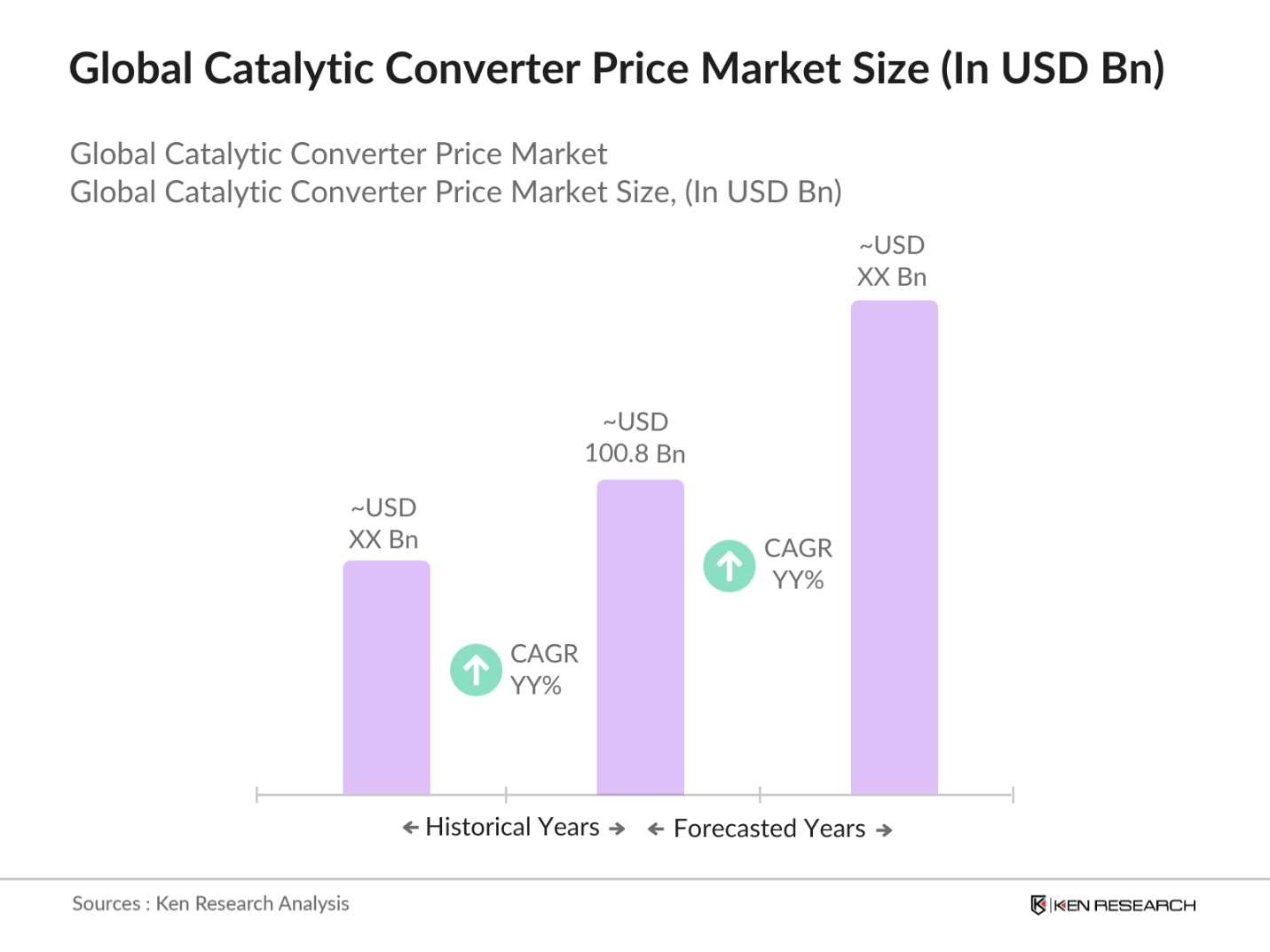
- Regions such as North America, Europe, and Asia-Pacific dominate the market for catalytic converters due to their established automotive industries and progressive environmental regulations. Countries like Germany, China, and the United States lead in production and demand due to their large-scale automotive manufacturing sectors and proactive governmental policies toward emission reduction. In particular, China has emerged as a key player owing to its high vehicle production and implementation of stringent environmental standards.
- Governments are introducing environmental policies focused on recycling to promote sustainability in catalytic converter manufacturing. In 2022, the European Union enacted regulations requiring end-of-life vehicle components, including catalytic converters, to be recycled. Japan also introduced a program in 2023 that mandates the recycling of key materials like platinum, palladium, and rhodium from scrapped converters. These policies aim to reduce the demand for newly mined precious metals, promoting sustainability and reducing the environmental impact of mining and resource extraction.
Global Catalytic Converter Price Market Segmentation
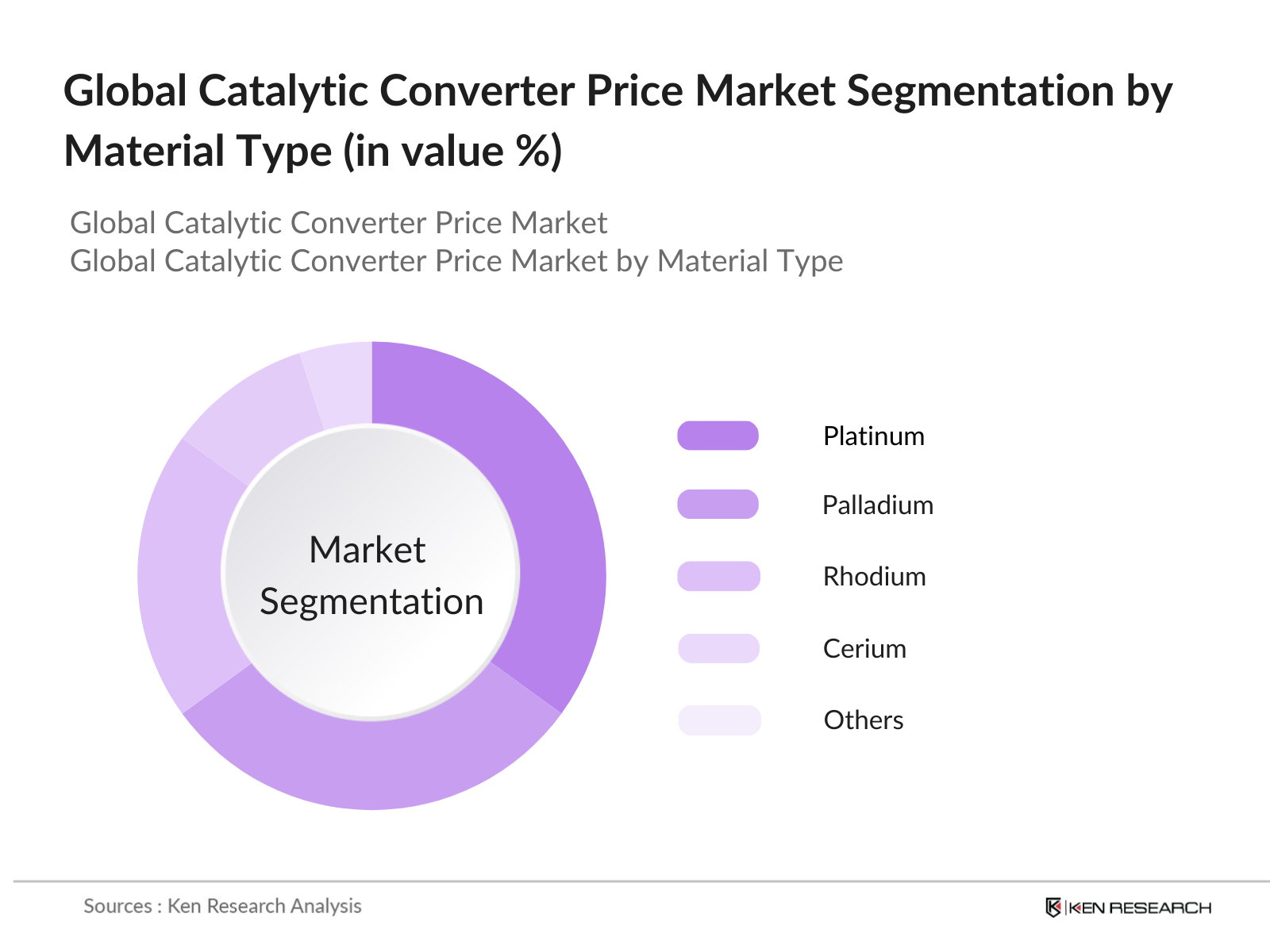
By Material Type: The global catalytic converter market is segmented by material type into platinum, palladium, rhodium, cerium, and others (nickel, copper). Recently, platinum has dominated the market share under the material type segmentation due to its high efficiency in reducing harmful emissions. Platinum-based converters are preferred because of their ability to operate efficiently at lower temperatures, thus making them essential in controlling emissions in vehicles that operate under varied conditions.
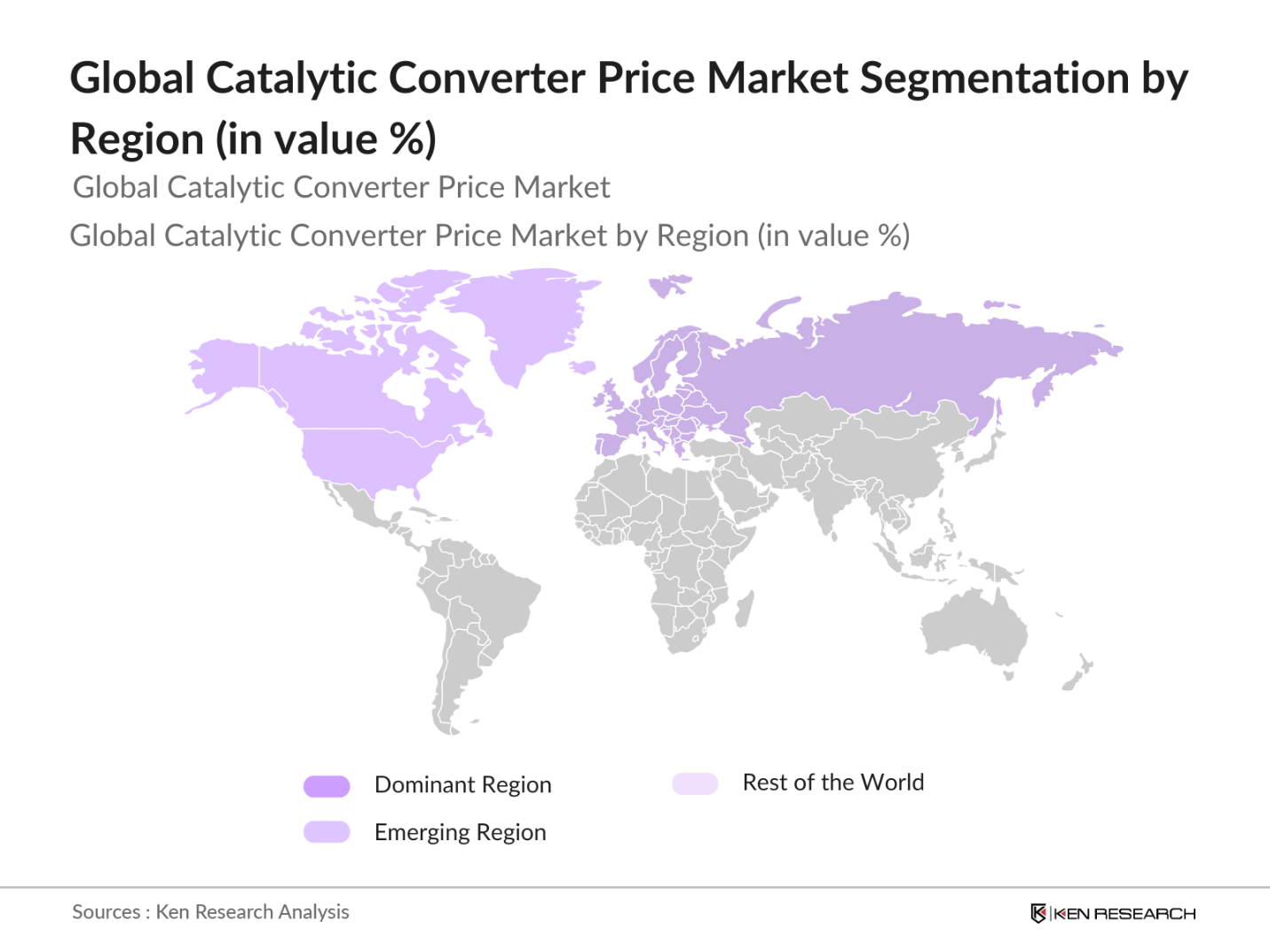
By Region: The global catalytic converter market is segmented by region into North America, Europe, Asia-Pacific, Latin America, and the Middle East & Africa. Recently, Europe has dominated the market share under the regional segmentation, driven by its strict emission regulations, such as the Euro 6 standards, which require automakers to implement advanced catalytic converter technologies. The presence of major automotive manufacturers in countries like Germany, France, and Italy has further strengthened Europe's leadership in this segment, as these nations continue to push for greater automotive innovation and environmental sustainability.
Global Catalytic Converter Price Market Competitive Landscape
The global catalytic converter market is characterized by a few major players, who have substantial influence over pricing, production, and innovation. Companies such as BASF Catalysts LLC, Faurecia SA, and Tenneco Inc. dominate the landscape, owing to their strong market presence, advanced technologies, and extensive distribution networks. These firms have consistently invested in R&D to develop catalytic converters that meet evolving environmental standards, giving them a competitive edge.
|
Company |
Year Established |
Headquarters |
Raw Material Sourcing |
Global Sales Volume |
Patented Technologies |
Market Penetration |
R&D Investment |
Sustainability Initiatives |
|
BASF Catalysts LLC |
1865 |
Germany |
||||||
|
Faurecia SA |
1997 |
France |
||||||
|
Tenneco Inc. |
1940 |
USA |
||||||
|
Johnson Matthey PLC |
1817 |
UK |
||||||
|
Umicore SA |
1805 |
Belgium |
Global Catalytic Converter Price Market Analysis
Market Growth Drivers
- Increasing Automotive Production (Impact on Global Supply Chain): The global automotive industry produced over 82 million vehicles in 2022, led by China with 26 million units, followed by the U.S. and Europe. The rise in vehicle production requires more catalytic converters, driving demand for materials like platinum and palladium. In China, production growth correlates with high domestic demand, and with nearly 20 million vehicles sold in 2022, automotive production impacts global supply chains, increasing the requirement for exhaust emission control systems. Countries like Japan and India also saw production growth, affecting demand for converters and related supply chain logistics.
- Adoption of Advanced Materials (Metals Used: Platinum, Palladium, Rhodium): Catalytic converters rely on rare metals such as platinum, palladium, and rhodium, each critical for reducing vehicle emissions. In 2023, the price of platinum hovered around $900 per ounce, while palladium was priced at $1,300 per ounce. Rhodium, used in small quantities but vital for NOx reduction, remains the most expensive, trading at $8,000 per ounce. This reliance on high-value metals increases the overall cost and technological innovation in the converter manufacturing process, as companies strive to use materials more efficiently. These metals are essential for meeting global emission standards.
- Industrial Shifts (Electrification Trends, Metal Recovery Technologies): As the global automotive industry transitions toward electric vehicles (EVs), hybrid vehicles continue to rely on catalytic converters. In 2022, the global EV market reached 10 million units sold, but hybrids remain important due to their lower emissions compared to traditional combustion engines. Concurrently, advancements in metal recovery technologies have become crucial. For example, in 2023, innovations allowed significant recovery of critical metals like platinum from scrapped converters.
Market Challenges
- High Raw Material Costs (Precious Metals Pricing): The reliance on precious metals like platinum, palladium, and rhodium poses significant cost challenges for catalytic converter manufacturers. In 2023, rhodium prices fluctuated from $8,000 to $10,000 per ounce due to supply chain disruptions in South Africa, a major producer. Palladium, primarily sourced from Russia, also saw price volatility amidst geopolitical tensions, rising to $1,500 per ounce. These fluctuations directly impact the cost structure for manufacturers, leading to higher end-product prices and reduced profit margins. The automotive industrys dependence on these metals makes cost control difficult.
- Trade Tariffs Impacting Global Price (Global Trade Restrictions): In 2022, trade tariffs and sanctions heavily impacted the supply of metals crucial for catalytic converters. The U.S. imposed tariffs on steel and aluminum imports, which increased the cost of automotive parts, including catalytic converters. The Russia-Ukraine conflict further disrupted the palladium supply chain, as Russia is a major producer of palladium. Sanctions on Russian exports caused palladium prices to rise significantly, leading to higher production costs for converter manufacturers globally.
Global Catalytic Converter Price Market Future Outlook
Over the next few years, the global catalytic converter market is expected to continue its steady growth, driven by continuous advancements in automotive technology and increasingly stringent environmental regulations. The adoption of electric vehicles is also expected to impact the market, with hybrid vehicles continuing to require catalytic converters, albeit in different forms than traditional combustion engines. Furthermore, with governments around the world pushing for sustainability and pollution control, the demand for more efficient and recyclable catalytic converters will likely rise.
Market Opportunities:
- Metal Recycling Initiatives (Government-Initiated Recycling Programs): Governments are increasingly promoting metal recycling initiatives to reduce reliance on newly mined resources. In 2022, the European Union introduced a program aimed at increasing the recycling of materials from end-of-life catalytic converters. This initiative supports sustainability goals by minimizing the environmental impact of mining operations while ensuring a stable supply of critical metals like platinum and rhodium.
- Price Fluctuations Based on Market Demand (Global Supply Chain Disruptions): Global supply chain disruptions, particularly in 2022, led to significant price fluctuations for catalytic converters. The automotive industry faced shortages of essential materials like platinum, causing price spikes. In March 2023, the price of platinum rose to $1,050 per ounce due to mining disruptions in South Africa. Supply chain delays exacerbated these fluctuations, as manufacturers struggled to secure timely raw material supplies. As global demand for vehicles remains high, these price swings continue to affect converter manufacturers, increasing the cost of production and impacting the final product price.
Scope of the Report
|
By Material Type |
Platinum Palladium Rhodium Cerium Others (Nickel, Copper) |
|
By Application |
Passenger Cars Heavy-Duty Vehicles Off-Road Vehicles |
|
By Vehicle Type |
Gasoline Vehicles Diesel Vehicles Hybrid and Electric Vehicles |
|
By Sales Channel |
OEMs Aftermarket |
|
By Region |
North America Europe Asia-Pacific Latin America Middle East & Africa |
Products
Key Target Audience
Automotive Manufacturers
Raw Material Suppliers (Precious Metals)
Emission Control Solution Providers
Government and Regulatory Bodies (e.g., Environmental Protection Agency, European Commission)
Investments and Venture Capitalist Firms
Exhaust System Manufacturers
Recycling Companies
OEM and Aftermarket Suppliers
Companies
Players Mention in the Report
BASF Catalysts LLC
Faurecia SA
Tenneco Inc.
Eberspaecher GmbH
Johnson Matthey PLC
Magneti Marelli SpA
Umicore SA
DCL International Inc.
Continental AG
Katcon Global
Walker Exhaust Systems
Bosal International NV
Clean Diesel Technologies, Inc.
Eastern Manufacturing Inc.
Cataler Corporation
Table of Contents
Global Catalytic Converter Price Market Overview
1.1 Definition and Scope
1.2 Market Taxonomy
1.3 Market Growth Rate (Global Supply Chain Metrics, Manufacturer Pricing)
1.4 Market Segmentation Overview (By Material, By Application, By Vehicle Type)
Global Catalytic Converter Price Market Size (in USD Bn)
2.1 Historical Market Size
2.2 Year-On-Year Growth Analysis (Price Volatility, Raw Material Cost Trends)
2.3 Key Market Developments and Milestones
Global Catalytic Converter Price Market Analysis
3.1 Growth Drivers
3.1.1 Emission Norms & Regulations (Government Policies, Emission Standards Compliance)
3.1.2 Increasing Automotive Production (Impact on Global Supply Chain)
3.1.3 Adoption of Advanced Materials (Metals Used: Platinum, Palladium, Rhodium)
3.1.4 Industrial Shifts (Electrification Trends, Metal Recovery Technologies)
3.2 Market Challenges
3.2.1 High Raw Material Costs (Precious Metals Pricing)
3.2.2 Trade Tariffs Impacting Global Price (Global Trade Restrictions)
3.2.3 Sustainability Challenges (Recycling Regulations)
3.3 Opportunities
3.3.1 Technological Advancements (Catalyst Coating Innovations, Improved Recycling Methods)
3.3.2 Market Expansion in Emerging Markets (Growth in Asia-Pacific, Latin America)
3.3.3 Expansion of Electric Vehicle Segment (Shift in Catalytic Converter Requirements)
3.4 Trends
3.4.1 Use of Hybrid Technology (Reduction in Rare Metal Usage)
3.4.2 Price Fluctuations Based on Market Demand (Global Supply Chain Disruptions)
3.4.3 Metal Recycling Initiatives (Government-Initiated Recycling Programs)
3.5 Government Regulations
3.5.1 Emission Control Programs (Euro 6, Tier 3, Bharat Stage VI)
3.5.2 Environmental Policies on Recycling (Material Recycling and Recovery Laws)
3.5.3 Import-Export Restrictions (Metal Import Restrictions, Trade Agreements)
3.6 SWOT Analysis
3.7 Stake Ecosystem (Catalyst Manufacturers, OEMs, Raw Material Suppliers)
3.8 Porters Five Forces
3.8.1 Bargaining Power of Suppliers (Precious Metal Providers)
3.8.2 Bargaining Power of Buyers (Automotive Industry, Industrial Sector)
3.9 Competition Ecosystem
Global Catalytic Converter Price Market Segmentation
4.1 By Material Type (In Value %)
4.1.1 Platinum
4.1.2 Palladium
4.1.3 Rhodium
4.1.4 Cerium
4.1.5 Others (Nickel, Copper)
4.2 By Application (In Value %)
4.2.1 Passenger Cars
4.2.2 Heavy-Duty Vehicles
4.2.3 Off-Road Vehicles
4.3 By Vehicle Type (In Value %)
4.3.1 Gasoline Vehicles
4.3.2 Diesel Vehicles
4.3.3 Hybrid and Electric Vehicles
4.4 By Sales Channel (In Value %)
4.4.1 OEMs
4.4.2 Aftermarket
4.5 By Region (In Value %)
4.5.1 North America
4.5.2 Europe
4.5.3 Asia-Pacific
4.5.4 Latin America
4.5.5 Middle East & Africa
Global Catalytic Converter Price Market Competitive Analysis
5.1 Detailed Profiles of Major Competitors
5.1.1 BASF Catalysts LLC
5.1.2 Faurecia SA
5.1.3 Tenneco Inc.
5.1.4 Eberspaecher GmbH
5.1.5 Johnson Matthey PLC
5.1.6 Magneti Marelli SpA
5.1.7 Umicore SA
5.1.8 DCL International Inc.
5.1.9 Continental AG
5.1.10 Katcon Global
5.1.11 Walker Exhaust Systems
5.1.12 Bosal International NV
5.1.13 Clean Diesel Technologies, Inc.
5.1.14 Eastern Manufacturing Inc.
5.1.15 Cataler Corporation
5.2 Cross Comparison Parameters (Raw Material Sourcing, Technology Innovations, Global Sales Volume, Patented Technologies, Market Penetration, Strategic Partnerships, Environmental Impact, Investment in R&D)
5.3 Market Share Analysis
5.4 Strategic Initiatives (Collaborations, Technological Integration)
5.5 Mergers and Acquisitions
5.6 Investment Analysis
5.7 Government Grants (Subsidies for Recycling Technologies)
5.8 Private Equity Investments
Global Catalytic Converter Price Market Regulatory Framework
6.1 Environmental Compliance Standards
6.2 Certification Processes (ISO, Regional Certifications)
6.3 Compliance Requirements by Region
Global Catalytic Converter Price Future Market Size (In USD Bn)
7.1 Future Market Size Projections
7.2 Key Factors Driving Future Market Growth
Global Catalytic Converter Price Future Market Segmentation
8.1 By Material Type (In Value %)
8.2 By Application (In Value %)
8.3 By Vehicle Type (In Value %)
8.4 By Sales Channel (In Value %)
8.5 By Region (In Value %)
Global Catalytic Converter Price Market Analysts Recommendations
9.1 TAM/SAM/SOM Analysis
9.2 Market Penetration Strategy
9.3 White Space Opportunity Identification
9.4 Marketing Initiatives
Disclaimer Contact UsResearch Methodology
Step 1: Identification of Key Variables
The initial step in our research involved mapping the catalytic converter market ecosystem. This entailed analyzing the key stakeholders including automotive manufacturers, raw material suppliers, and regulatory bodies. A combination of primary and secondary research was conducted to gather critical variables such as market size, pricing trends, and environmental regulations impacting the market.
Step 2: Market Analysis and Construction
In this phase, historical data related to the production and sale of catalytic converters was compiled. By analyzing these statistics, we assessed the market's evolution in terms of technological advancements and regulatory impact. Additionally, we examined the cost structure and raw material usage to determine market profitability.
Step 3: Hypothesis Validation and Expert Consultation
To validate our market hypotheses, interviews with industry experts were conducted, providing first-hand insights into market trends, material sourcing challenges, and the competitive landscape. These consultations enabled us to refine our projections and ensure the accuracy of market data.
Step 4: Research Synthesis and Final Output
The final phase involved synthesizing the collected data and producing a comprehensive analysis of the global catalytic converter market. This included verifying market statistics and producing a detailed report with clear insights into current trends, competitive dynamics, and future opportunities.
Frequently Asked Questions
01. How big is the Global Catalytic Converter Price Market?
The global catalytic converter price market is valued at USD 100.8 billion, driven by increasing automotive production and stringent emission standards imposed by governments globally.
02. What are the challenges in the Global Catalytic Converter Price Market?
Challenges include the high cost of raw materials such as platinum, palladium, and rhodium, as well as fluctuating precious metal prices. Trade tariffs and recycling inefficiencies also present hurdles to market growth.
03. Who are the major players in the Global Catalytic Converter Price Market?
Key players in the market include BASF Catalysts LLC, Faurecia SA, Tenneco Inc., Johnson Matthey PLC, and Umicore SA. These companies dominate due to their extensive product portfolios, technological expertise, and strong distribution networks.
04. What are the growth drivers of the Global Catalytic Converter Price Market?
The market is propelled by the growing automotive industry, increasing demand for fuel-efficient vehicles, and strict emission regulations globally, which compel manufacturers to adopt advanced catalytic converter technologies.
Why Buy From Us?

What makes us stand out is that our consultants follows Robust, Refine and Result (RRR) methodology. i.e. Robust for clear definitions, approaches and sanity checking, Refine for differentiating respondents facts and opinions and Result for presenting data with story

We have set a benchmark in the industry by offering our clients with syndicated and customized market research reports featuring coverage of entire market as well as meticulous research and analyst insights.

While we don't replace traditional research, we flip the method upside down. Our dual approach of Top Bottom & Bottom Top ensures quality deliverable by not just verifying company fundamentals but also looking at the sector and macroeconomic factors.

With one step in the future, our research team constantly tries to show you the bigger picture. We help with some of the tough questions you may encounter along the way: How is the industry positioned? Best marketing channel? KPI's of competitors? By aligning every element, we help maximize success.

Our report gives you instant access to the answers and sources that other companies might choose to hide. We elaborate each steps of research methodology we have used and showcase you the sample size to earn your trust.

If you need any support, we are here! We pride ourselves on universe strength, data quality, and quick, friendly, and professional service.