















Global Ceramic Fiber Market Outlook 2030
Region:Global
Author(s):Shivani Mehra
Product Code:KROD1571
November 2024
91
About the Report
Global Ceramic Fiber Market Overview
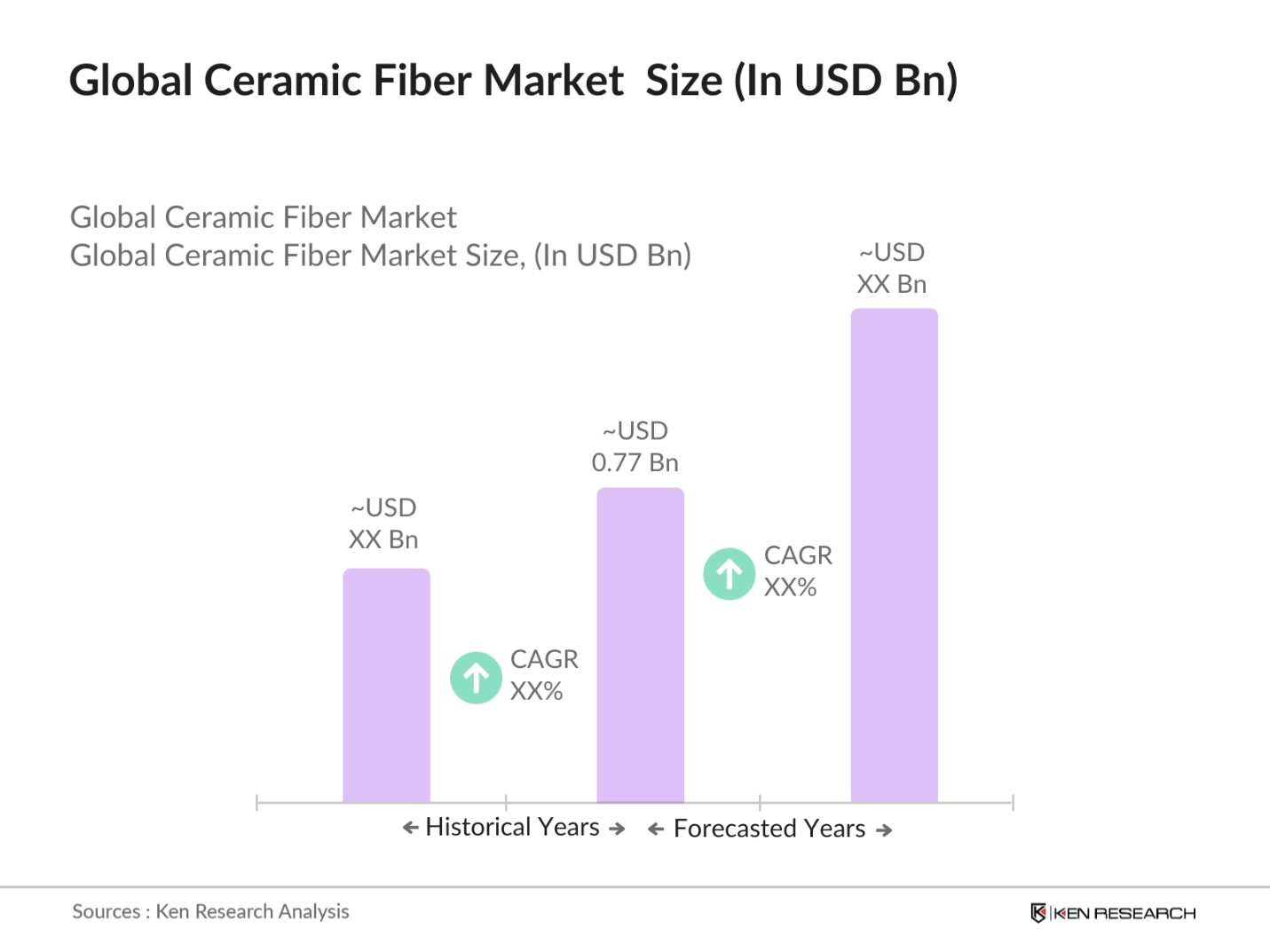
- The global ceramic fiber market is valued at USD 0.77 billion, driven by the increasing demand for high-temperature insulation solutions across various industries. The growth is attributed to the rising energy efficiency standards and the shift towards sustainable manufacturing practices. Companies are investing in advanced technologies to produce eco-friendly ceramic fibers, which enhances their performance and reduces environmental impact. This transition is critical as industries seek to comply with stricter regulations on emissions and energy use.
- The market is dominated by key regions including North America, Europe, and Asia-Pacific. North America benefits from its well-established industrial sector and significant investments in aerospace and defense. Europe leads due to stringent environmental regulations and a strong emphasis on energy efficiency. Asia-Pacific is witnessing rapid industrialization, particularly in countries like China and India, where increasing manufacturing activities drive the demand for ceramic fibers.
- In 2023, the DOE launched new energy efficiency programs aimed at industrial sectors, providing funding for technologies that improve thermal insulation. These programs support the adoption of high-temperature insulation materials, including ceramic fibers, by offering grants and incentives to manufacturers who implement energy-saving technologies. This initiative is part of a broader effort to reduce industrial energy consumption by 5.1 quadrillion BTUs by 2025.
Global Ceramic Fiber Market Segmentation
By Product Type: The global ceramic fiber market is segmented by product type into blankets, modules, boards, paper, and other forms. In 2023, ceramic fiber blankets hold a dominant market share, primarily due to their versatile applications in high-temperature environments. They are widely used in industries such as aerospace, automotive, and petrochemicals for insulation purposes. Their lightweight and excellent thermal resistance make them a preferred choice for manufacturers, further fueling market growth.

By Region: The global ceramic fiber market is segmented by region into North America, Europe, Asia-Pacific, Middle East & Africa, and Latin America. North America dominates the market, driven by advanced manufacturing sectors and significant investments in aerospace and automotive industries. The region's focus on innovation and quality further supports the use of high-performance ceramic fibers, maintaining its leadership position.

Global Ceramic Fiber Market Competitive Landscape
The global ceramic fiber market is characterized by a few major players, including Unifrax, Morgan Advanced Materials, and Nutec Group. These companies are leaders in the market due to their extensive product portfolios and global presence. Their strong focus on R&D allows them to innovate and meet the diverse needs of customers, further solidifying their competitive positions.
|
Company Name |
Establishment Year |
Headquarters |
Product Portfolio |
Market Reach |
R&D Investment |
Sustainability Initiatives |
Customer Base |
|
Unifrax |
1996 |
New York, USA |
- |
- |
- |
- |
- |
|
Morgan Advanced Materials |
1856 |
London, UK |
- |
- |
- |
- |
- |
|
Nutec Group |
1982 |
Quertaro, Mexico |
- |
- |
- |
- |
- |
|
Rath Group |
1880 |
Vienna, Austria |
- |
- |
- |
- |
- |
|
Ibiden Co. Ltd. |
1912 |
Gifu, Japan |
- |
- |
- |
- |
- |
Global Ceramic Fiber Market Analysis
Global Ceramic Fiber Market Growth Drivers
- Demand for High-Temperature Insulation: The demand for high-temperature insulation in industrial processes is driven by the increasing focus on energy conservation. In 2023, the global industrial energy consumption reached approximately 303 exajoules, with significant portions attributed to high-temperature processes. Industries such as steel and cement manufacturing are major consumers, utilizing ceramic fibers for their thermal properties, which help to reduce energy losses during production. The implementation of energy-efficient practices is expected to enhance the reliance on high-temperature insulation materials.
- Rising Energy Efficiency Standards: Regulatory frameworks are tightening around energy efficiency, with the U.S. Department of Energy reporting that new regulations could save around 5.1 quadrillion British thermal units (BTUs) by 2025. This shift mandates industries to adopt insulation materials that minimize heat loss, pushing ceramic fibers to the forefront due to their thermal resistance capabilities. The increased emphasis on carbon emission reduction has led to widespread adoption of these materials, aligning with global climate commitments.
- Increased Demand from Aerospace and Defense: The aerospace sector is projected to require lightweight insulation solutions, with the industry spending approximately $80 billion on new aircraft in 2023. Ceramic fibers are critical for their high-temperature resistance, essential in engine and airframe applications. The U.S. military's investment in advanced materials for defense applications also contributes to this demand, as these materials provide thermal protection in extreme conditions.
Global Ceramic Fiber Market Challenges
- Health Concerns Related to Ceramic Fiber Dust: Health concerns regarding ceramic fiber dust are significant, as studies indicate that prolonged exposure can lead to respiratory issues. The Occupational Safety and Health Administration (OSHA) has established a permissible exposure limit (PEL) of 0.5 fibers per cubic centimeter (f/cc) for airborne fibers. This regulatory pressure is prompting manufacturers to develop safer alternatives or invest in dust control technologies, complicating the market landscape.
- Limited Raw Material Availability: Raw material availability poses a challenge, with disruptions in supply chains affecting the procurement of critical components like alumina and silica. The Global Trade Alert noted that over 1,200 export restrictions were imposed on raw materials in 2022, significantly affecting access. These constraints can limit production capacities for manufacturers, driving the need for strategic sourcing and local supply chains.
Global Ceramic Fiber Market Future Outlook
The global ceramic fiber market is expected to experience significant growth over the next five years, propelled by the increasing demand for energy-efficient solutions across various sectors. Key drivers include government regulations promoting sustainability, technological advancements in manufacturing processes, and a growing emphasis on high-performance materials. The trend towards lightweight and durable insulation materials is also anticipated to drive innovations and new product development in the ceramic fiber space.
Market Opportunities:
- Shift Toward Bio-Soluble Ceramic Fibers: The trend towards bio-soluble ceramic fibers is accelerating, driven by stringent environmental compliance and the desire to mitigate health risks. In 2022, the global market for bio-soluble fibers was valued at approximately $600 million, with expectations of continued growth as industries seek safer alternatives to traditional ceramic fibers. This shift aligns with increasing regulatory scrutiny regarding material safety and environmental impact.
- Growth of Ceramic Fiber in Furnace Linings: The demand for ceramic fibers in furnace linings is rising, particularly in industrial furnaces and kiln applications. In 2023, the global production of ceramics reached around 1.5 billion tons, and the requirement for high-performance insulation materials has become critical. The growth is attributed to the need for improved thermal efficiency and reduced operational costs in manufacturing processes.
Scope of the Report
|
By Product Type |
Ceramic Fiber Blankets Ceramic Fiber Modules Ceramic Fiber Boards Ceramic Fiber Paper Other Forms |
|
By Application |
Aerospace Automotive Construction Energy Sector General Industry |
|
By Technology |
Vacuum Forming Spun Fiber Technology |
|
By End-User Industry |
Aerospace and Defense Automotive Petrochemical Steel Manufacturing Power Generation |
|
By Region |
North America Europe Asia-Pacific Latin America Middle East & Africa |
Products
Key Target Audience
Manufacturers of industrial equipment
Aerospace and defense contractors
Automotive industry stakeholders
Energy efficiency consultants
Government and regulatory bodies (EPA, OSHA)
Investments and venture capital firms
Construction and building material suppliers
End-users in the petrochemical industry
Companies
Players Mention in the Report
Unifrax
Morgan Advanced Materials
Nutec Group
Rath Group
Ibiden Co. Ltd.
Luyang Energy-Saving Materials Co., Ltd.
Isolite Insulating Products Co., Ltd.
Yeso Insulating Products Co., Ltd.
FibreCast Inc.
Pyrotek Inc.
Thermal Ceramics
Shandong Minye Refractory Fibre Co., Ltd.
3M Company
Lewco Specialty Products
Lanexis Enterprises
Table of Contents
01. Global Ceramic Fiber Market Overview
1.1. Definition and Scope
1.2. Market Valuation and Historical Analysis
1.3. Key Market Developments and Milestones
02. Global Ceramic Fiber Market Size (In USD Billion)
2.1. Historical Market Size
2.2. Year-On-Year Growth Analysis
2.3. Major Trends Impacting Market Growth
03. Global Ceramic Fiber Market Analysis
3.1. Growth Drivers
3.1.1. Demand for High-Temperature Insulation
3.1.2. Rising Energy Efficiency Standards
3.1.3. Increased Demand from Aerospace and Defense
3.2. Market Challenges
3.2.1. Health Concerns Related to Ceramic Fiber Dust
3.2.2. Limited Raw Material Availability
3.3. Market Opportunities
3.3.1. Shift Toward Bio-Soluble Ceramic Fibers
3.3.2. Growth of Ceramic Fiber in Furnace Linings
3.4. Future Trends
3.4.1. Technological Advancements in Manufacturing
3.4.2. Increased Adoption in Emerging Economies
04. Global Ceramic Fiber Market Segmentation
4.1. By Product Type (In Value %)
4.1.1. Blankets
4.1.2. Modules
4.1.3. Boards
4.1.4. Paper
4.1.5. Other Forms
4.2. By Application (In Value %)
4.2.1. Aerospace
4.2.2. Automotive
4.2.3. Construction
4.2.4. Energy Sector
4.2.5. General Industry
4.3. By Region (In Value %)
4.3.1. North America
4.3.2. Europe
4.3.3. Asia-Pacific
4.3.4. Middle East & Africa
4.3.5. Latin America
05. Global Ceramic Fiber Market Competitive Analysis
5.1. Detailed Profiles of Major Companies
5.1.1. Unifrax
5.1.2. Morgan Advanced Materials
5.1.3. Nutec Group
5.1.4. Rath Group
5.1.5. Ibiden Co. Ltd.
5.1.6. Luyang Energy-Saving Materials Co., Ltd.
5.1.7. Isolite Insulating Products Co., Ltd.
5.1.8. Yeso Insulating Products Co., Ltd.
5.1.9. FibreCast Inc.
5.1.10. Pyrotek Inc.
5.1.11. Thermal Ceramics
5.1.12. Shandong Minye Refractory Fibre Co., Ltd.
5.1.13. 3M Company
5.1.14. Lewco Specialty Products
5.1.15. Lanexis Enterprises
5.2. Cross Comparison Parameters (R&D Investment, Market Reach, Product Portfolio)
5.3. Market Share Analysis
5.4. Strategic Initiatives
5.5. Mergers and Acquisitions
06. Global Ceramic Fiber Market Regulatory Framework
6.1. Compliance Standards and Environmental Regulations
6.2. Health and Safety Standards
07. Global Ceramic Fiber Market Future Outlook
7.1. Future Market Size Projections (In USD Billion)
7.2. Key Factors Driving Future Market Growth
08. Global Ceramic Fiber Market Future Segmentation
8.1. By Product Type (In Value %)
8.2. By Application (In Value %)
8.3. By Sales Channel (In Value %)
8.4. By Technology (In Value %)
8.5. By Region (In Value %)
09. Global Ceramic Fiber Market Analysts Recommendations
9.1. TAM/SAM/SOM Analysis
9.2. Market Entry Strategies
9.3. Key Marketing Initiatives
9.4. White Space Opportunity Analysis
Disclaimer
Contact Us
Research Methodology
Step 1: Identification of Key Variables
This initial phase involves mapping the ecosystem to include all major stakeholders in the global ceramic fiber market. Extensive desk research is conducted, utilizing secondary databases to gather comprehensive industry-level information, thereby identifying critical variables influencing market dynamics.
Step 2: Market Analysis and Construction
In this phase, historical data pertaining to the ceramic fiber market is compiled and analyzed. This includes evaluating market penetration, service provider ratios, and revenue generation metrics, ensuring the reliability of the revenue estimates.
Step 3: Hypothesis Validation and Expert Consultation
Market hypotheses are developed and validated through consultations with industry experts across diverse companies. These insights provide operational and financial data that refine and corroborate the market analysis.
Step 4: Research Synthesis and Final Output
The final phase involves engaging with manufacturers to acquire detailed insights on product segments, sales performance, and consumer preferences. This interaction complements the statistics derived from previous phases, ensuring a comprehensive and validated market analysis.
Frequently Asked Questions
01. How big is the global ceramic fiber market?
The global ceramic fiber market is valued at USD 0.77 billion, driven by increasing demand for energy-efficient insulation solutions across various industries.
02. What are the challenges in the global ceramic fiber market?
Challenges include health concerns related to ceramic fiber dust, high initial manufacturing costs, and limited raw material availability, impacting overall market growth.
03. Who are the major players in the global ceramic fiber market?
Key players include Unifrax, Morgan Advanced Materials, Nutec Group, and Rath Group, which dominate due to their extensive product offerings and strong brand presence.
04. What are the growth drivers of the global ceramic fiber market?
The market is propelled by factors such as rising energy efficiency standards, technological advancements in manufacturing, and increasing industrial applications for high-temperature insulation.
Why Buy From Us?

What makes us stand out is that our consultants follows Robust, Refine and Result (RRR) methodology. i.e. Robust for clear definitions, approaches and sanity checking, Refine for differentiating respondents facts and opinions and Result for presenting data with story

We have set a benchmark in the industry by offering our clients with syndicated and customized market research reports featuring coverage of entire market as well as meticulous research and analyst insights.

While we don't replace traditional research, we flip the method upside down. Our dual approach of Top Bottom & Bottom Top ensures quality deliverable by not just verifying company fundamentals but also looking at the sector and macroeconomic factors.

With one step in the future, our research team constantly tries to show you the bigger picture. We help with some of the tough questions you may encounter along the way: How is the industry positioned? Best marketing channel? KPI's of competitors? By aligning every element, we help maximize success.

Our report gives you instant access to the answers and sources that other companies might choose to hide. We elaborate each steps of research methodology we have used and showcase you the sample size to earn your trust.

If you need any support, we are here! We pride ourselves on universe strength, data quality, and quick, friendly, and professional service.