
Global Cloud AI Market Outlook to 2030
Region:Global
Author(s):Sanjna Verma
Product Code:KROD4632
December 2024
99
About the Report
Global Cloud AI Market Overview
- The Global Cloud AI market is valued at USD 61 billion, based on a comprehensive five-year historical analysis. This valuation is largely driven by the rising demand for AI solutions integrated with cloud infrastructure across various sectors such as BFSI, healthcare, and retail. Key factors driving this demand include the increasing adoption of AI-based technologies for predictive analytics, automation, and customer relationship management, as well as the growing volume of data generated globally that requires cloud-based AI platforms for processing and analysis.
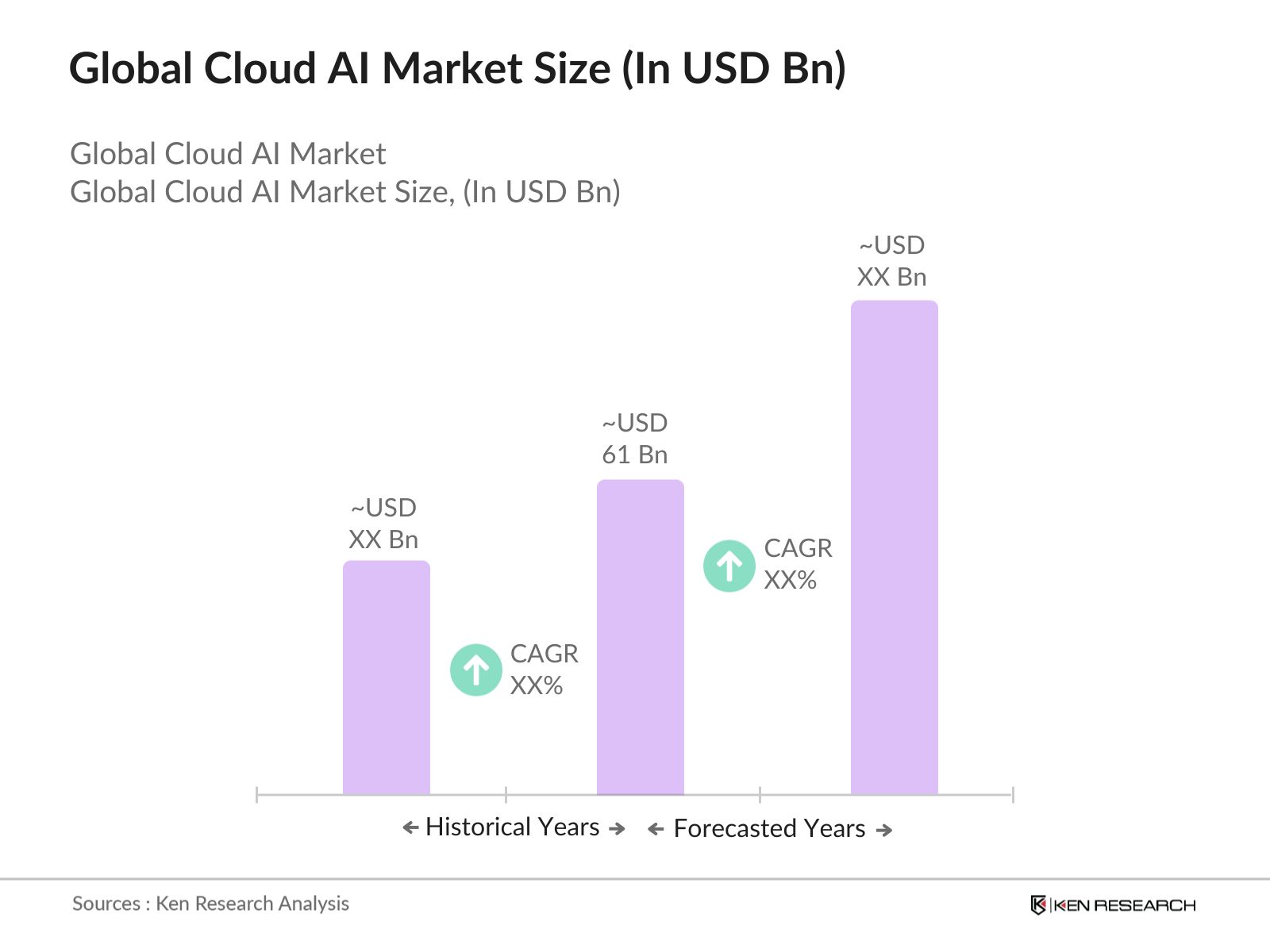
- Countries such as the United States, China, and Germany dominate the market due to their early adoption of cloud AI technologies and strong technological infrastructure. These countries are home to major cloud service providers and AI development hubs, allowing them to lead innovations in AI-driven cloud applications. Their dominance is also attributed to high investments in AI research and development, favorable government regulations, and the presence of a skilled workforce that supports the rapid implementation of cloud AI solutions.
- Governments worldwide are introducing national AI policies to regulate the development and deployment of AI technologies. The U.S. AI Initiative, the European AI Strategy, and China's AI Policy are all set to play a critical role in 2024. For instance, the European Unions AI Act, set for implementation in 2024, mandates that all AI-based cloud solutions comply with strict ethical and legal standards, affecting how cloud AI providers operate. These policies aim to ensure responsible AI development while promoting innovation.
Global Cloud AI Market Segmentation
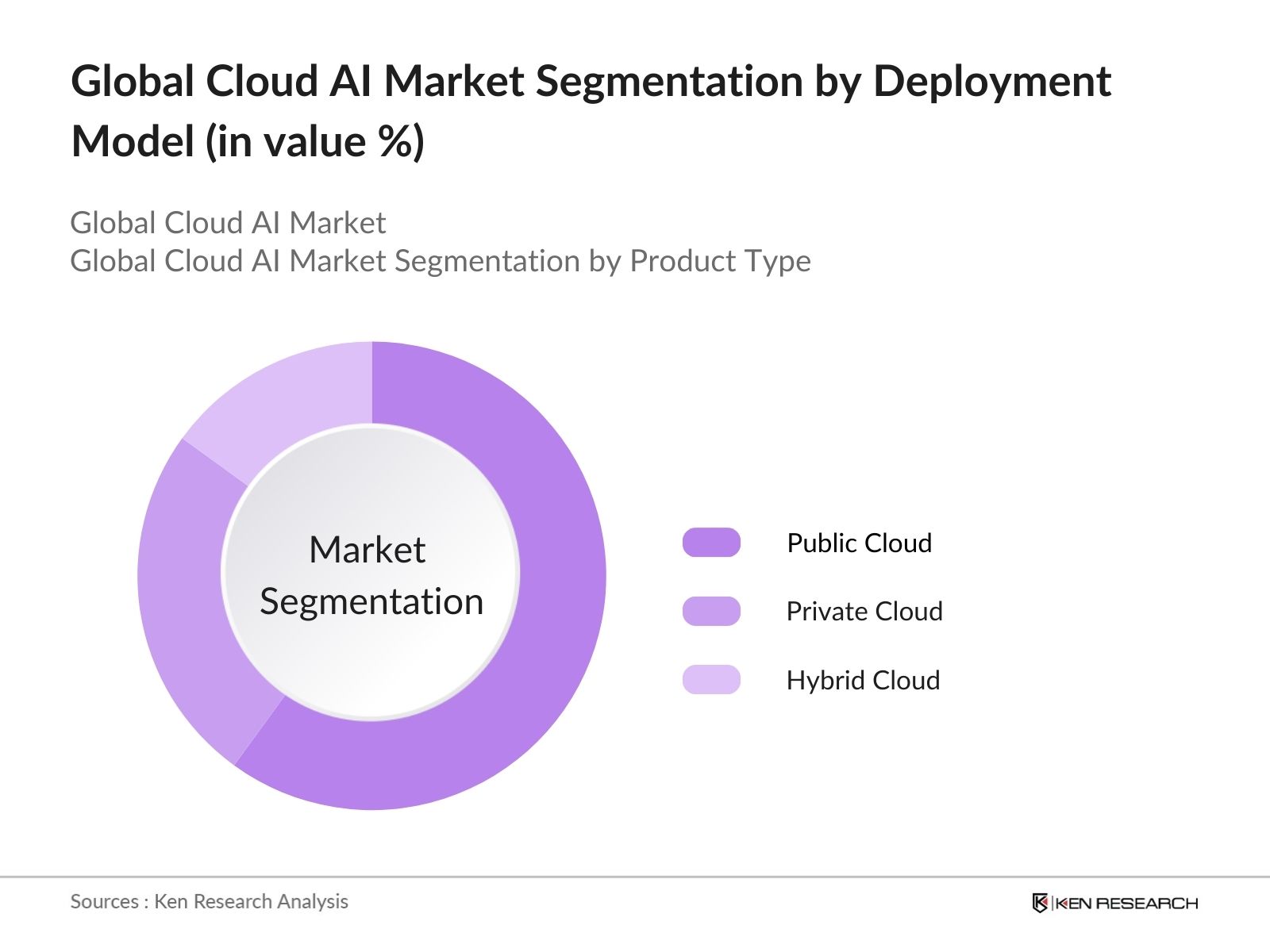
By Deployment Model: The Global Cloud AI market is segmented by deployment models into public cloud, private cloud, and hybrid cloud. Public cloud models currently hold the dominant market share due to their cost-effectiveness, scalability, and ease of implementation. Companies prefer public cloud deployment because it allows them to scale their operations without significant upfront infrastructure costs, which is critical for AI-driven applications.
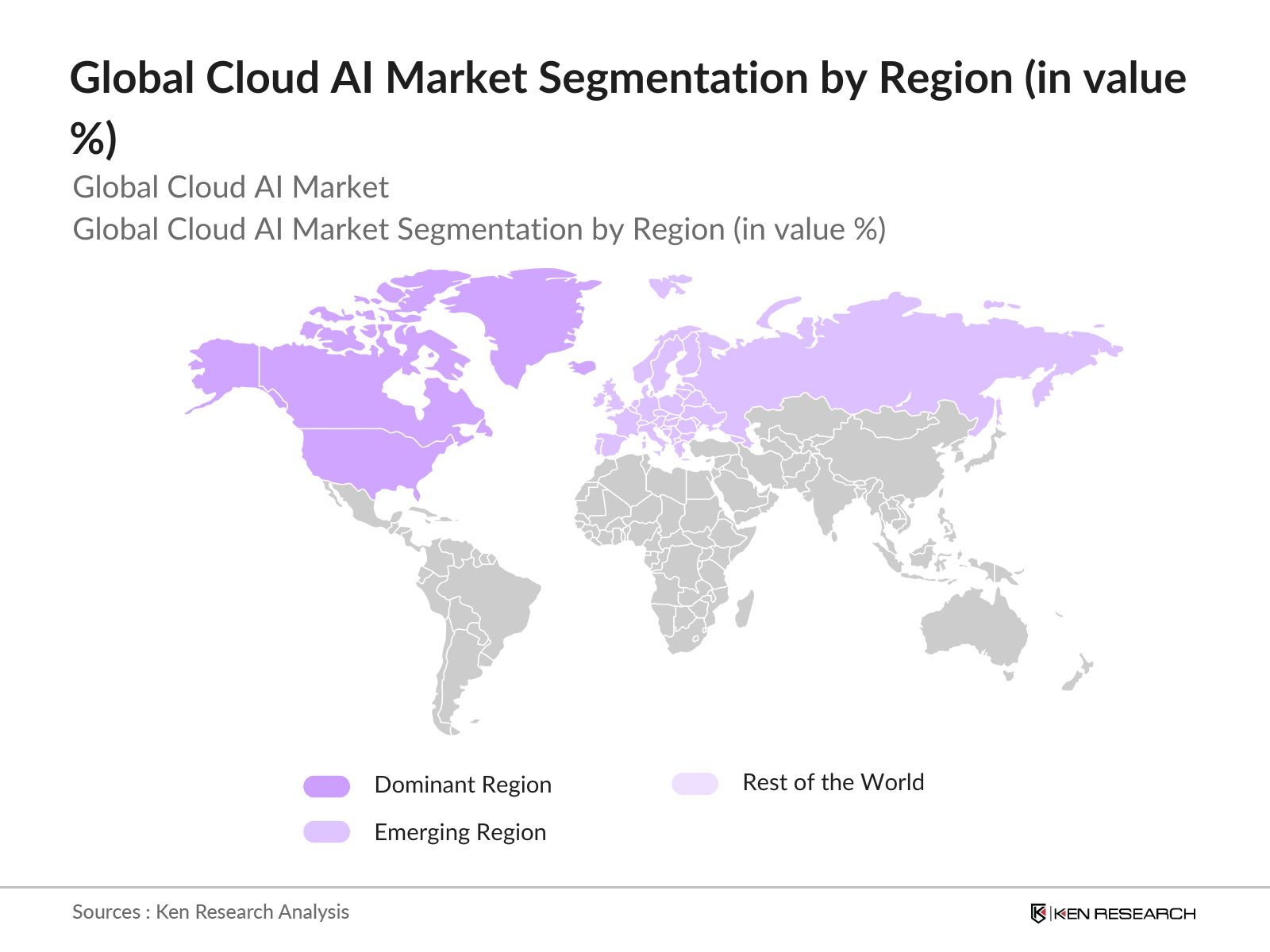
By Region: The Global Cloud AI market is segmented by region into North America, Europe, Asia Pacific, Middle East & Africa, and Latin America. North America dominates the market share due to its technological advancements, early adoption of AI technologies, and the presence of key players such as Amazon, Google, and Microsoft. The robust cloud infrastructure in the region, coupled with favorable regulatory frameworks supporting AI development, further strengthens its market position.
By Solution: The Global Cloud AI market is segmented by solution into machine learning platforms, natural language processing (NLP), computer vision, and AI-driven business analytics. Machine learning platforms have gained a dominant market share due to their widespread use across industries for automating processes, improving decision-making, and predicting future trends. The ability of machine learning models to process vast amounts of data quickly makes them indispensable for cloud AI applications, especially in sectors like healthcare, financial services, and retail, where data-driven decisions are critical.
Global Cloud AI Market Competitive Landscape
The Global Cloud AI market is dominated by several major players that have established themselves through technological innovation, strategic partnerships, and extensive service offerings. These companies not only provide cloud infrastructure but also AI-based platforms that enhance customer experiences and business processes. The market consolidation highlights the influence of these key players in driving AI and cloud adoption globally.
|
Company |
Establishment Year |
Headquarters |
AI Solutions |
Revenue (2023) |
Data Centers |
Patents Held |
AI R&D Centers |
Global Presence |
Strategic Alliances |
|
Microsoft Corporation |
1975 |
Redmond, USA |
- |
- |
- |
- |
- |
- |
- |
|
Amazon Web Services (AWS) |
2006 |
Seattle, USA |
- |
- |
- |
- |
- |
- |
- |
|
Google Cloud Platform |
2008 |
Mountain View, USA |
- |
- |
- |
- |
- |
- |
- |
|
IBM Corporation |
1911 |
Armonk, USA |
- |
- |
- |
- |
- |
- |
- |
|
Alibaba Cloud |
2009 |
Hangzhou, China |
- |
- |
- |
- |
- |
- |
- |
Global Cloud AI Market Analysis
Growth Drivers
- Increasing Cloud Storage Demand: The rising demand for cloud storage is a key driver in the Global Cloud AI Market. By 2024, the global data volume is projected to reach over 180 zettabytes, driven by the exponential growth in digital data generation across industries such as healthcare, finance, and e-commerce. This increased need for scalable cloud storage solutions to accommodate large datasets is fueling investments in cloud infrastructure, which is a critical enabler for AI adoption.
- AI Adoption for Predictive Analytics: Businesses are increasingly adopting AI for predictive analytics, which is enhancing decision-making processes across industries. For example, the finance sector's demand for predictive AI tools in risk management grew sharply, and in 2024 alone, financial institutions are expected to invest $50 billion into AI-based predictive technologies, according to the International Monetary Fund (IMF). Predictive AI models, driven by cloud-based platforms, help companies process large volumes of data in real-time, offering insights that were previously unattainable with traditional tools.
- Growing Use of AI in Healthcare and Financial Sectors: The healthcare and financial sectors are witnessing rapid AI adoption, with cloud AI playing a pivotal role. According to World Bank data, healthcare AI applications, such as diagnostics and personalized treatments, are expected to drive investments, with cloud AI platforms processing large datasets. In 2024, it is estimated that over 30% of healthcare organizations will deploy AI for clinical decision support. Meanwhile, financial services are heavily investing in AI for fraud detection and risk assessment, leveraging cloud-based AI for real-time analysis and decision-making.
Market Challenges
- Compliance with Data Protection Laws: Data privacy regulations are a major challenge in the Cloud AI market. Countries across the globe, including the U.S. with its California Consumer Privacy Act (CCPA) and the EU with GDPR, are tightening regulations on how cloud platforms handle data. According to the European Commission, fines for non-compliance with GDPR in 2024 are expected to surpass $2 billion, pushing cloud AI providers to enhance their compliance frameworks.
- High Capital Investments: One of the main challenges for the cloud AI market is the high upfront capital investment required for infrastructure. Building and maintaining AI-enabled cloud platforms involve significant financial resources. The World Bank estimates that the cost of establishing new cloud data centers capable of supporting AI operations is approximately $1.5 billion per facility, which limits the ability of smaller firms to compete in the AI-driven cloud market. This creates barriers to entry, affecting market expansion.
Global Cloud AI Market Future Outlook
Over the next five years, the Global Cloud AI market is expected to show significant growth, driven by continuous technological advancements in AI, increasing data generation from various industries, and the rising need for efficient data management solutions. The convergence of cloud computing and AI technologies is set to transform industries like healthcare, finance, and manufacturing, enabling businesses to make data-driven decisions and enhance operational efficiency.
Market Opportunities
- Expansion in Edge Computing: Edge computing presents a significant opportunity for the growth of AI in the cloud market. By 2024, the global edge computing market is expected to see a rapid adoption rate, with 75 billion IoT devices connected globally, according to the International Telecommunication Union (ITU). Cloud providers are increasingly integrating edge AI solutions into their offerings, driving new growth avenues and optimizing real-time data processing.
- AI for Workflow Optimization in Enterprises: The growing demand for AI in workflow optimization is reshaping enterprise operations. Cloud-based AI solutions are helping businesses automate tasks and improve operational efficiency. As per the World Bank, in 2024, enterprises are projected to save over $350 billion by automating workflows through AI tools, particularly in sectors such as manufacturing and logistics. This creates a strong opportunity for AI developers to offer cloud-based AI solutions designed to streamline business processes and enhance productivity.
Scope of the Report
|
By Deployment Model |
Public Cloud Private Cloud Hybrid Cloud |
|
By Solution |
Machine Learning Platforms Natural Language Processing (NLP) Computer Vision AI-Driven Business Analytics |
|
By End User Industry |
BFSI Healthcare Retail & E-commerce IT & Telecom Manufacturing |
|
By Application |
Predictive Analytics AI-Driven Business Intelligence Cloud Security Management Customer Relationship Management (CRM) |
|
By Region |
North America Europe Asia Pacific Middle East & Africa Latin America |
Products
Key Target Audience
Cloud Infrastructure Providers
AI Software Developers
Data Analytics Firms
Cloud Service Integrators
Financial Institutions and Banks
Healthcare Institutions
Investors and Venture Capitalist Firms
Government and Regulatory Bodies (e.g., U.S. Department of Commerce, European Commission)
Companies
Players Mentioned in the Report
Microsoft Corporation
Amazon Web Services (AWS)
Google Cloud Platform
IBM Corporation
Alibaba Cloud
Oracle Corporation
Salesforce
SAP SE
Baidu Cloud
Tencent Cloud
Table of Contents
1. Global Cloud AI Market Overview
1.1 Definition and Scope
1.2 Market Taxonomy
1.3 Market Growth Rate
1.4 Market Segmentation Overview
2. Global Cloud AI Market Size (In USD Bn)
2.1 Historical Market Size
2.2 Year-On-Year Growth Analysis
2.3 Key Market Developments and Milestones
3. Global Cloud AI Market Analysis
3.1 Growth Drivers (Cloud Infrastructure Expansion, Data Center Investments, AI Adoption in Businesses, 5G Integration)
3.1.1 Increasing Cloud Storage Demand
3.1.2 AI Adoption for Predictive Analytics
3.1.3 Growing Use of AI in Healthcare and Financial Sectors
3.1.4 Advancements in Natural Language Processing (NLP)
3.2 Market Challenges (Data Privacy Concerns, Skilled Workforce Shortage, Infrastructure Costs, Regulatory Compliance)
3.2.1 Compliance with Data Protection Laws
3.2.2 High Capital Investments
3.2.3 AI Model Scalability Issues
3.2.4 Security Threats and Vulnerabilities
3.3 Opportunities (Edge AI Growth, AI-Driven Automation, SaaS AI Models, AI in Cloud-Based IoT)
3.3.1 Expansion in Edge Computing
3.3.2 AI for Workflow Optimization in Enterprises
3.3.3 AI Integration with IoT Solutions
3.3.4 Development of AI-as-a-Service Platforms
3.4 Trends (Hybrid Cloud AI Adoption, AI in Multi-cloud Environments, Machine Learning Operations (MLOps) Adoption, Cloud-Native AI Tools)
3.4.1 Rise in AI Cloud-Optimization Tools
3.4.2 AI Deployment in Multi-Cloud Strategies
3.4.3 Evolution of AI-based SaaS Solutions
3.4.4 Emergence of AI DevOps Platforms
3.5 Government Regulation (AI Policy Frameworks, Data Protection Laws, Compliance Standards, Cross-Border Data Regulations)
3.5.1 National AI Policies and Regulations
3.5.2 Compliance with Cloud Data Sovereignty Laws
3.5.3 Standardization of AI-based Cloud Applications
3.5.4 Cybersecurity Requirements for AI-Driven Cloud Platforms
3.6 SWOT Analysis
3.7 Stakeholder Ecosystem
3.8 Porters Five Forces Analysis
3.9 Competitive Landscape
4. Global Cloud AI Market Segmentation
4.1 By Deployment Model (In Value %)
4.1.1 Public Cloud
4.1.2 Private Cloud
4.1.3 Hybrid Cloud
4.2 By Solution (In Value %)
4.2.1 Machine Learning Platforms
4.2.2 Natural Language Processing (NLP)
4.2.3 Computer Vision
4.2.4 AI-Driven Business Analytics
4.3 By End User Industry (In Value %)
4.3.1 BFSI
4.3.2 Healthcare
4.3.3 Retail & E-commerce
4.3.4 IT & Telecom
4.3.5 Manufacturing
4.4 By Application (In Value %)
4.4.1 Predictive Analytics
4.4.2 AI-Driven Business Intelligence
4.4.3 Cloud Security Management
4.4.4 Customer Relationship Management (CRM)
4.5 By Region (In Value %)
4.5.1 North America
4.5.2 Europe
4.5.3 Asia Pacific
4.5.4 Middle East & Africa
4.5.5 Latin America
5. Global Cloud AI Market Competitive Analysis
5.1 Detailed Profiles of Major Companies
5.1.1 Microsoft Corporation
5.1.2 Amazon Web Services (AWS)
5.1.3 Google Cloud Platform
5.1.4 IBM Corporation
5.1.5 Oracle Corporation
5.1.6 Alibaba Cloud
5.1.7 Salesforce
5.1.8 SAP SE
5.1.9 Baidu Cloud
5.1.10 Tencent Cloud
5.2 Cross Comparison Parameters (Revenue, AI Cloud Product Offerings, Partnerships/Collaborations, Geographic Presence, AI R&D Investments, Patents Held, Market Share, Deployment Model)
5.3 Market Share Analysis
5.4 Strategic Initiatives (Product Launches, Partnerships, AI Ecosystem Expansion)
5.5 Mergers And Acquisitions
5.6 Investment Analysis (Funding for AI Cloud Infrastructure)
5.7 Venture Capital Funding in Cloud AI Startups
5.8 Government Grants for AI Research
5.9 Private Equity Investments in Cloud AI Companies
6. Global Cloud AI Market Regulatory Framework
6.1 AI-Driven Cloud Compliance Standards
6.2 Certification Processes for AI Cloud Solutions
6.3 International Data Security and Privacy Laws for AI Applications
7. Global Cloud AI Future Market Size (In USD Bn)
7.1 Future Market Size Projections
7.2 Key Factors Driving Future Market Growth
Global Cloud AI Future Market Segmentation
8.1 By Deployment Model (In Value %)
8.2 By Solution (In Value %)
8.3 By End User Industry (In Value %)
8.4 By Application (In Value %)
8.5 By Region (In Value %)
9. Global Cloud AI Market Analysts Recommendations
9.1 TAM/SAM/SOM Analysis
9.2 Customer Cohort Analysis
9.3 Marketing Initiatives
9.4 White Space Opportunity Analysis
Research Methodology
Step 1: Identification of Key Variables
In the initial phase, key variables driving the Global Cloud AI market are identified. These include technological advancements, AI adoption rates, and cloud infrastructure growth. The identification process relies on secondary research, with data gathered from industry reports, government databases, and company filings.
Step 2: Market Analysis and Construction
In this phase, historical data pertaining to the Global Cloud AI market is compiled and analyzed. This includes assessing market penetration of AI solutions in different regions, cloud platform adoption, and the AI-driven business models of major enterprises.
Step 3: Hypothesis Validation and Expert Consultation
Hypotheses about the market are validated through interviews with AI and cloud experts. These consultations offer insights into the operational and financial aspects of cloud AI adoption across industries, ensuring the data collected is accurate and reflective of market trends.
Step 4: Research Synthesis and Final Output
The final phase involves synthesizing all the data collected from primary and secondary sources to produce a comprehensive market report. This output includes detailed insights into the current market scenario, competitive landscape, and future market prospects.
Frequently Asked Questions
01. How big is the Global Cloud AI Market?
The Global Cloud AI market is valued at USD 61 billion, with major growth driven by the adoption of AI-based cloud solutions across industries such as healthcare, BFSI, and retail.
02. What are the challenges in the Global Cloud AI Market?
Key challenges of Global Cloud AI market include high infrastructure costs, data privacy concerns, and the lack of skilled professionals to manage and deploy AI-based cloud applications.
03. Who are the major players in the Global Cloud AI Market?
Leading players of Global Cloud AI market include Microsoft Corporation, Amazon Web Services (AWS), Google Cloud Platform, IBM Corporation, and Alibaba Cloud. These companies dominate the market with their extensive AI offerings and cloud infrastructure.
04. What are the growth drivers of the Global Cloud AI Market?
Global Cloud AI market is driven by factors such as increasing data generation, the need for predictive analytics, and the rise in AI-driven business automation solutions.
Why Buy From Us?

What makes us stand out is that our consultants follows Robust, Refine and Result (RRR) methodology. i.e. Robust for clear definitions, approaches and sanity checking, Refine for differentiating respondents facts and opinions and Result for presenting data with story

We have set a benchmark in the industry by offering our clients with syndicated and customized market research reports featuring coverage of entire market as well as meticulous research and analyst insights.

While we don't replace traditional research, we flip the method upside down. Our dual approach of Top Bottom & Bottom Top ensures quality deliverable by not just verifying company fundamentals but also looking at the sector and macroeconomic factors.

With one step in the future, our research team constantly tries to show you the bigger picture. We help with some of the tough questions you may encounter along the way: How is the industry positioned? Best marketing channel? KPI's of competitors? By aligning every element, we help maximize success.

Our report gives you instant access to the answers and sources that other companies might choose to hide. We elaborate each steps of research methodology we have used and showcase you the sample size to earn your trust.

If you need any support, we are here! We pride ourselves on universe strength, data quality, and quick, friendly, and professional service.