
Global Cloud Database Market Outlook to 2030
Region:Global
Author(s):Yogita Sahu
Product Code:KROD9744
Region:Global
Author(s):Yogita Sahu
Product Code:KROD9744
December 2024
85
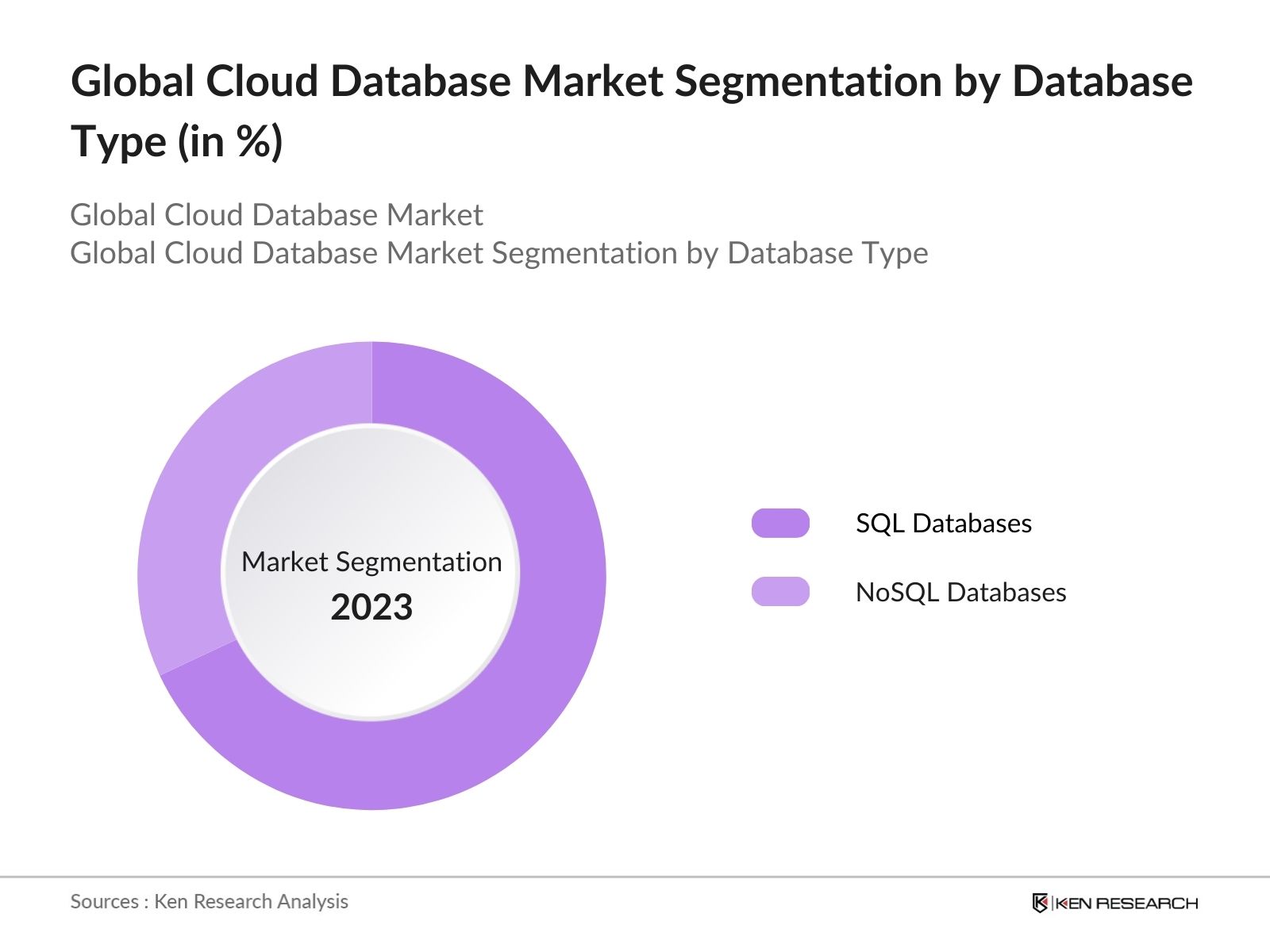
By Database Type: The market is segmented into SQL databases and NoSQL databases. SQL databases continue to dominate, especially within industries that prioritize transaction-oriented systems and strict ACID compliance for consistent data management. The structured nature of SQL databases makes them favorable for applications like customer relationship management (CRM) systems, financial applications, and e-commerce platforms, where transactional integrity is crucial.
By Deployment Model: The deployment models for cloud databases include public cloud, private cloud, and hybrid cloud. The public cloud holds a dominant share in the market due to its widespread adoption, driven by its cost-effectiveness and ease of scalability. Many enterprises, especially small and medium-sized enterprises (SMEs), prefer public cloud solutions to avoid the capital expenses associated with private cloud setups.
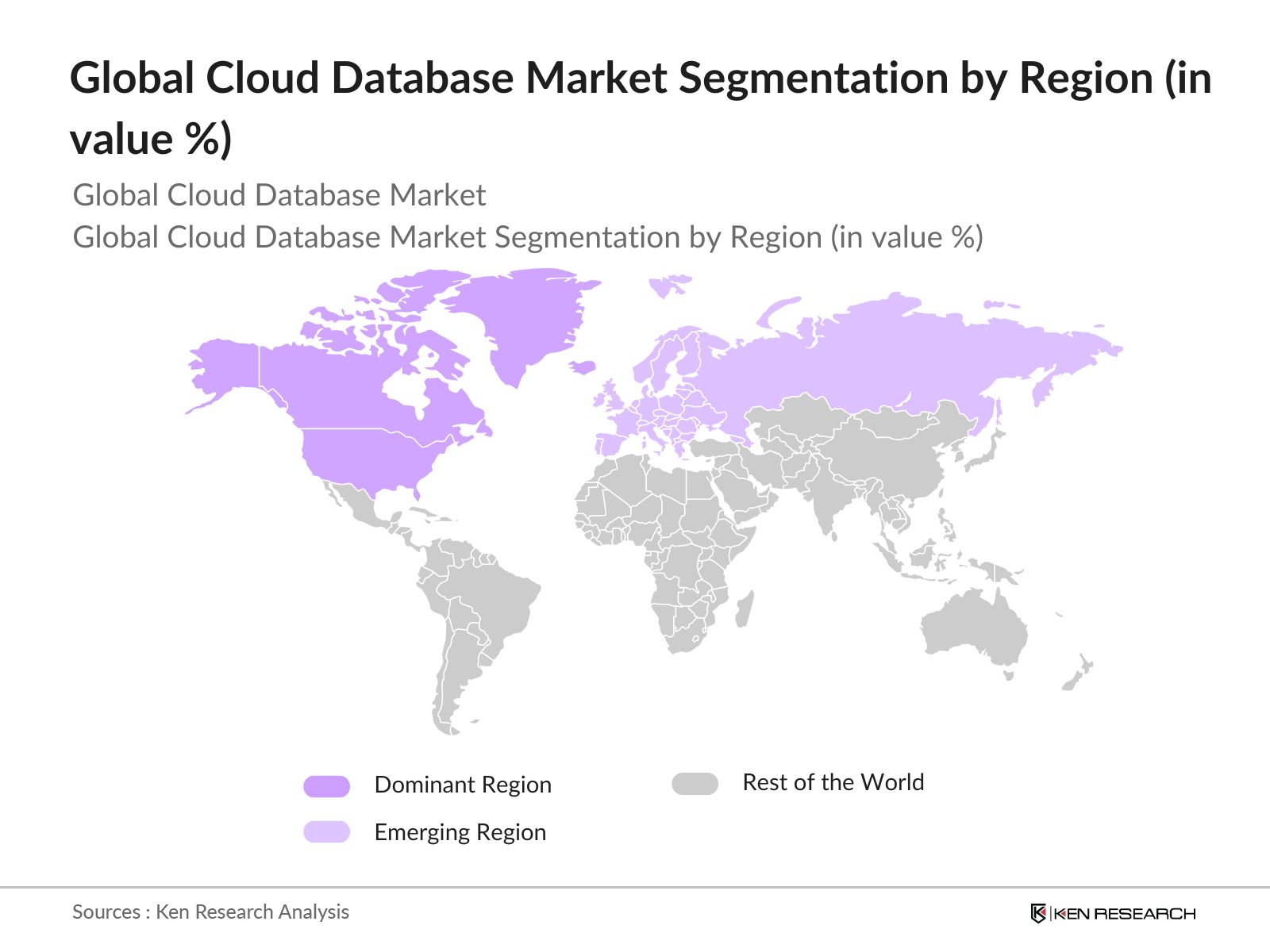
By Region: Geographically, North America continues to dominate the global cloud database market, followed by Europe and Asia Pacific. The dominance of North America is attributed to its advanced technological infrastructure and high cloud adoption rates. The Asia Pacific region is expected to see the fastest growth, with countries like China, India, and Japan leading the charge due to their large-scale digital transformation efforts.
The market is dominated by key players, including major cloud service providers. These companies consistently innovate and introduce new services to maintain their competitive edge.
|
Company |
Year Established |
Headquarters |
Market Cap (USD) |
No. of Employees |
Cloud Offering Strength |
Innovation Index |
Industry Collaborations |
Revenue (2023) |
|
Amazon Web Services |
2006 |
Seattle, USA |
||||||
|
Microsoft Azure |
2010 |
Redmond, USA |
||||||
|
Google Cloud Platform |
2008 |
Mountain View, USA |
||||||
|
IBM Cloud |
2007 |
New York, USA |
||||||
|
Oracle Cloud |
2012 |
Redwood Shores, USA |
Over the next five years, the cloud database industry is expected to experience growth, driven by advancements in big data analytics, artificial intelligence, and the increasing demand for scalable cloud solutions.
|
Database Type |
SQL NoSQL |
|
Deployment Model |
Public Cloud Private Cloud Hybrid Cloud |
|
End-Use Industry |
BFSI IT & Telecom Retail & Consumer Goods Healthcare |
|
Organization Size |
SMEs Large Enterprises |
|
Region |
North America Europe Asia Pacific Latin America MEA |
1.1. Definition and Scope
1.2. Market Taxonomy
1.3. Market Growth Rate
1.4. Market Segmentation Overview
2.1. Historical Market Size
2.2. Year-On-Year Growth Analysis
2.3. Key Market Developments and Milestones
3.1. Growth Drivers
3.1.1. Increased Adoption of Cloud-Based Solutions
3.1.2. Scalability and Flexibility of Cloud Databases
3.1.3. Cost-Effectiveness for Enterprises
3.1.4. Growth of Big Data Analytics
3.2. Market Challenges
3.2.1. Security and Privacy Concerns
3.2.2. Data Sovereignty Issues
3.2.3. Vendor Lock-In Risks
3.3. Opportunities
3.3.1. Multi-Cloud and Hybrid Cloud Adoption
3.3.2. Expansion in Emerging Markets
3.3.3. AI and Machine Learning Integration
3.4. Trends
3.4.1. DBaaS Growth (Database as a Service)
3.4.2. Edge Computing for Data Proximity
3.4.3. Shift from SQL to NoSQL Databases
3.5. Government Regulations
3.5.1. Data Protection Laws (GDPR, CCPA)
3.5.2. Cross-Border Data Regulations
3.6. SWOT Analysis
3.7. Stakeholder Ecosystem
3.8. Porters Five Forces
3.9. Competitive Ecosystem
4.1. By Database Type (In Value %)
4.1.1. SQL Databases
4.1.2. NoSQL Databases
4.2. By Deployment Model (In Value %)
4.2.1. Public Cloud
4.2.2. Private Cloud
4.2.3. Hybrid Cloud
4.3. By End-Use Industry (In Value %)
4.3.1. BFSI
4.3.2. IT & Telecom
4.3.3. Retail & Consumer Goods
4.3.4. Healthcare & Life Sciences
4.3.5. Manufacturing
4.4. By Organization Size (In Value %)
4.4.1. Small and Medium Enterprises (SMEs)
4.4.2. Large Enterprises
4.5. By Region (In Value %)
4.5.1. North America
4.5.2. Europe
4.5.3. Asia Pacific
4.5.4. Latin America
4.5.5. Middle East & Africa
5.1. Detailed Profiles of Major Companies
5.1.1. IBM (U.S.)
5.1.2. Amazon Web Services (U.S.)
5.1.3. Microsoft (U.S.)
5.1.4. Google (U.S.)
5.1.5. Oracle (U.S.)
5.1.6. Alibaba Cloud (China)
5.1.7. SAP SE (Germany)
5.1.8. MongoDB (U.S.)
5.1.9. Teradata (U.S.)
5.1.10. Tencent (China)
5.1.11. Rackspace (U.S.)
5.1.12. Neo4J (U.S.)
5.1.13. Redis Labs (U.S.)
5.1.14. Datastax (U.S.)
5.1.15. SingleStore (U.S.)
5.2. Cross Comparison Parameters (Number of Employees, Headquarters, Inception Year, Revenue, Market Penetration, Cloud Offering Strength, Innovation Index, Industry Collaborations)
5.3. Market Share Analysis
5.4. Strategic Initiatives
5.5. Mergers and Acquisitions
5.6. Investment Analysis
5.7. Venture Capital Funding
5.8. Government Grants
5.9. Private Equity Investments
6.1. Compliance Requirements
6.2. Certification Processes
6.3. Industry Standards
7.1. Future Market Size Projections
7.2. Key Factors Driving Future Market Growth
8.1. By Database Type (In Value %)
8.2. By Deployment Model (In Value %)
8.3. By End-Use Industry (In Value %)
8.4. By Organization Size (In Value %)
8.5. By Region (In Value %)
9.1. TAM/SAM/SOM Analysis
9.2. Customer Cohort Analysis
9.3. Marketing Initiatives
9.4. White Space Opportunity Analysis
In this phase, we mapped the entire ecosystem of stakeholders within the global cloud database market, leveraging secondary research sources and proprietary databases to compile data on market dynamics. Key variables such as cloud adoption rates and technological innovations were identified.
We analyzed historical market data, focusing on revenue generation, customer acquisition costs, and service-level agreements. Additionally, we assessed cloud service providers' market penetration strategies to construct reliable estimates.
Interviews with industry experts helped validate our market hypotheses. These consultations provided critical insights into market trends, operational costs, and technology preferences.
We engaged directly with cloud providers to finalize our findings, incorporating product segmentation, service pricing, and customer demand analysis. This step ensured that our market size projections and growth forecasts were accurate and comprehensive.
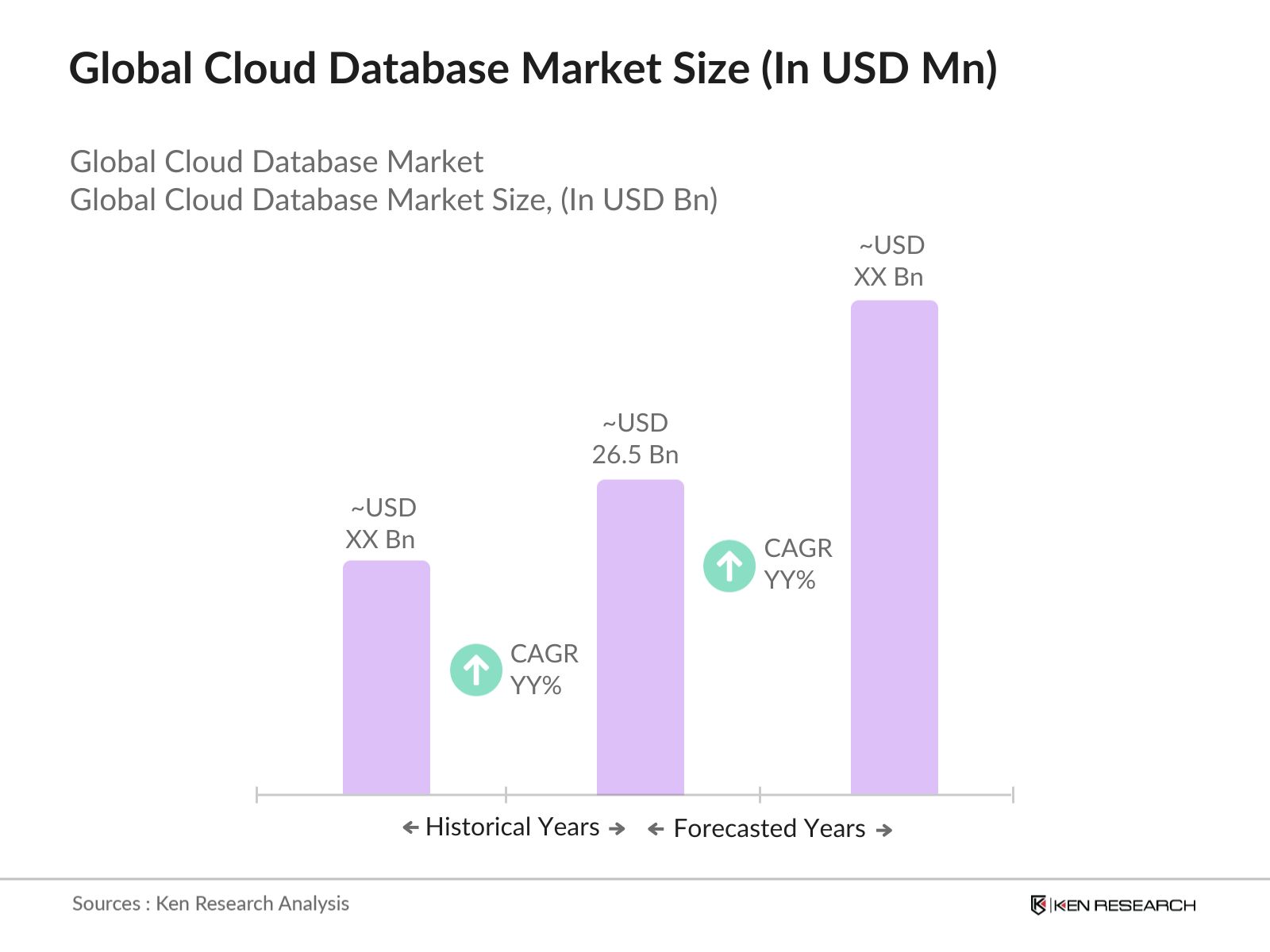
The global cloud database market is valued at USD 26.5 billion, driven by the increasing demand for scalable cloud solutions across industries such as IT & telecom, BFSI, and retail.
Key challenges in the global cloud database market include data security and privacy concerns, particularly in highly regulated industries like healthcare and finance. Companies must also navigate vendor lock-in risks when adopting specific cloud solutions.
The major players in the global cloud database market include Amazon Web Services, Microsoft Azure, Google Cloud Platform, IBM Cloud, and Oracle Cloud, each offering comprehensive cloud database solutions across various industries.
The global cloud database market is driven by the scalability and flexibility of cloud databases, cost-efficiency compared to traditional databases, and the increasing need for big data analytics and real-time data processing capabilities.
Key trends include the rise of multi-cloud and hybrid cloud strategies, increased integration of AI and machine learning for automated database management, and the growing importance of edge computing for faster data processing.

What makes us stand out is that our consultants follows Robust, Refine and Result (RRR) methodology. i.e. Robust for clear definitions, approaches and sanity checking, Refine for differentiating respondents facts and opinions and Result for presenting data with story

We have set a benchmark in the industry by offering our clients with syndicated and customized market research reports featuring coverage of entire market as well as meticulous research and analyst insights.

While we don't replace traditional research, we flip the method upside down. Our dual approach of Top Bottom & Bottom Top ensures quality deliverable by not just verifying company fundamentals but also looking at the sector and macroeconomic factors.

With one step in the future, our research team constantly tries to show you the bigger picture. We help with some of the tough questions you may encounter along the way: How is the industry positioned? Best marketing channel? KPI's of competitors? By aligning every element, we help maximize success.

Our report gives you instant access to the answers and sources that other companies might choose to hide. We elaborate each steps of research methodology we have used and showcase you the sample size to earn your trust.

If you need any support, we are here! We pride ourselves on universe strength, data quality, and quick, friendly, and professional service.