
Global CLT Market Outlook 2030
Region:Global
Author(s):Shivani Mehra
Product Code:KROD3014
Region:Global
Author(s):Shivani Mehra
Product Code:KROD3014
November 2024
84
By Product Type: The global CLT market is segmented by product type into adhesive-bonded CLT and mechanically fastened CLT. Adhesive-bonded CLT holds a dominant market share, as this type is preferred for its strength and structural integrity, which is essential for high-rise constructions. The technology behind adhesive-bonded CLT allows for large-scale production and customization, making it ideal for large commercial and residential projects. Mechanically fastened CLT, while gaining traction, is mostly used in temporary structures or low-rise buildings due to its lower cost and ease of assembly.

By Region: The global CLT market is segmented into North America, Europe, Asia-Pacific, Latin America, and the Middle East & Africa. Europe holds the largest market share, driven by countries like Austria and Germany, which have strong timber industries and government support for sustainable construction. North America is also a key region, with the U.S. and Canada rapidly adopting CLT in commercial and residential building projects due to their abundant forest resources and growing demand for eco-friendly construction materials.

The global CLT market is dominated by major players that include well-established manufacturers from Europe and North America. These companies have built a strong market presence by leveraging advanced manufacturing technologies, expanding their production capacities, and forming strategic partnerships.
|
Company Name |
Year Established |
Headquarters |
Product Portfolio |
Sustainability Initiatives |
Global Presence |
Production Capacity |
R&D Investment |
Strategic Partnerships |
Expansion Plans |
|
Stora Enso |
1998 |
Finland |
|||||||
|
Binderholz GmbH |
1950 |
Austria |
|||||||
|
KLH Massivholz GmbH |
1999 |
Austria |
|||||||
|
Mayr-Melnhof Holz |
1850 |
Austria |
|||||||
|
SmartLam North America |
2012 |
USA |
Market Growth Drivers
Market Challenges:
Over the next five years, the global CLT market is expected to see significant growth, driven by increasing demand for sustainable construction materials and ongoing urbanization. Continuous innovation in CLT manufacturing, combined with governmental policies that promote green building practices, will likely spur demand. Furthermore, advancements in timber technology, such as improved fire resistance and structural properties, will broaden the application of CLT in commercial and residential projects.
Market Opportunities:
|
By Product Type |
Adhesive-bonded CLT Mechanically Fastened CLT |
|
By Application |
Residential Buildings Commercial Buildings Institutional Buildings |
|
By Panel Size |
Small Panels (1-3 ply) Medium Panels (4-6 ply) Large Panels (7 ply and above) |
|
By End-User |
Real Estate Developers Architects and Designers Contractors |
|
By Region |
North America Europe Asia-Pacific Latin America Middle East & Africa |
1.1. Definition and Scope
1.2. Market Taxonomy
1.3. Market Growth Rate (Compound Annual Growth Rate)
1.4. Market Segmentation Overview
2.1. Historical Market Size
2.2. Year-On-Year Growth Analysis
2.3. Key Market Developments and Milestones (Infrastructure Expansion, Adoption in Construction)
3.1. Growth Drivers
3.1.1. Sustainable Construction Practices
3.1.2. Urbanization and Demand for High-Rise Timber Buildings
3.1.3. Government Incentives for Green Buildings
3.1.4. Technological Advancements in Prefabricated Structures
3.2. Market Challenges
3.2.1. High Initial Investment Costs
3.2.2. Lack of Standardization in Codes and Regulations
3.2.3. Limited Awareness and Acceptance in Developing Markets
3.3. Opportunities
3.3.1. Expansion into Emerging Markets (India, Southeast Asia)
3.3.2. Innovations in Fire-Resistant CLT Panels
3.3.3. Increasing Adoption in Commercial Construction
3.4. Trends
3.4.1. CLT in Hybrid Timber Buildings
3.4.2. Integration of CLT with Smart Buildings
3.4.3. Increased Investment in Manufacturing Facilities
3.5. Government Regulations
3.5.1. Green Building Certifications
3.5.2. International Building Code (IBC) Amendments
3.5.3. Subsidies and Grants for Sustainable Construction
3.6. SWOT Analysis
3.7. Stakeholder Ecosystem
3.8. Porters Five Forces Analysis
3.8.1. Bargaining Power of Suppliers
3.8.2. Bargaining Power of Buyers
3.8.3. Threat of New Entrants
3.8.4. Threat of Substitutes
3.8.5. Industry Rivalry
3.9. Competition Ecosystem
4.1. By Product Type (In Value %)
4.1.1. Adhesive-bonded CLT
4.1.2. Mechanically Fastened CLT
4.2. By Application (In Value %)
4.2.1. Residential Buildings
4.2.2. Commercial Buildings
4.2.3. Institutional Buildings
4.3. By Panel Size (In Value %)
4.3.1. Small Panels (1-3 ply)
4.3.2. Medium Panels (4-6 ply)
4.3.3. Large Panels (7 ply and above)
4.4. By End-User (In Value %)
4.4.1. Real Estate Developers
4.4.2. Architects and Designers
4.4.3. Contractors
4.5. By Region (In Value %)
4.5.1. North America
4.5.2. Europe
4.5.3. Asia-Pacific
4.5.4. Latin America
4.5.5. Middle East & Africa
5.1. Detailed Profiles of Major Companies
5.1.1. Stora Enso
5.1.2. Binderholz GmbH
5.1.3. KLH Massivholz GmbH
5.1.4. Mayr-Melnhof Holz
5.1.5. B&K Structures
5.1.6. HASSLACHER Group
5.1.7. Sterling Lumber Company
5.1.8. SmartLam North America
5.1.9. Schilliger Holz AG
5.1.10. Structurlam Mass Timber Corporation
5.1.11. Nordic Structures
5.1.12. Lendlease
5.1.13. XLam NZ Limited
5.1.14. Sdra Building Systems
5.1.15. Mets Wood
5.2. Cross-Comparison Parameters
(Headquarters, Production Capacity, Market Share, Product Portfolio, Revenue, R&D Expenditure, Global Presence, Sustainability Initiatives)
5.3. Market Share Analysis
5.4. Strategic Initiatives
5.5. Mergers and Acquisitions
5.6. Investment Analysis
5.7. Venture Capital Funding
5.8. Government Grants and Subsidies
5.9. Private Equity Investments
6.1. Environmental Standards for Sustainable Construction
6.2. Building Code Compliance
6.3. Certification Processes for Green Buildings
7.1. Future Market Size Projections
7.2. Key Factors Driving Future Market Growth
8.1. By Product Type (In Value %)
8.2. By Application (In Value %)
8.3. By Panel Size (In Value %)
8.4. By End-User (In Value %)
8.5. By Region (In Value %)
9.1. TAM/SAM/SOM Analysis
9.2. Customer Cohort Analysis
9.3. White Space Opportunity Analysis
9.4. Market Expansion Strategies
The initial phase focuses on identifying key stakeholders and variables that influence the global CLT market. This involves conducting thorough desk research using proprietary databases, industry reports, and government publications. The objective is to define the market dynamics that will shape future trends.
Historical data on CLT market penetration and sales will be collected and analyzed. This includes an evaluation of CLT's adoption rate in different regions and the effect on revenue generation. Detailed data on production capacities, application segments, and market demand will also be compiled.
The next step involves validating market hypotheses through consultations with industry experts. Structured interviews will be conducted with key stakeholders, such as timber manufacturers, architects, and government representatives, to confirm market assumptions.
In the final phase, data collected from both primary and secondary sources will be synthesized to provide a comprehensive outlook on the market. This includes validating CLT's market projections and identifying growth opportunities in emerging regions and applications.
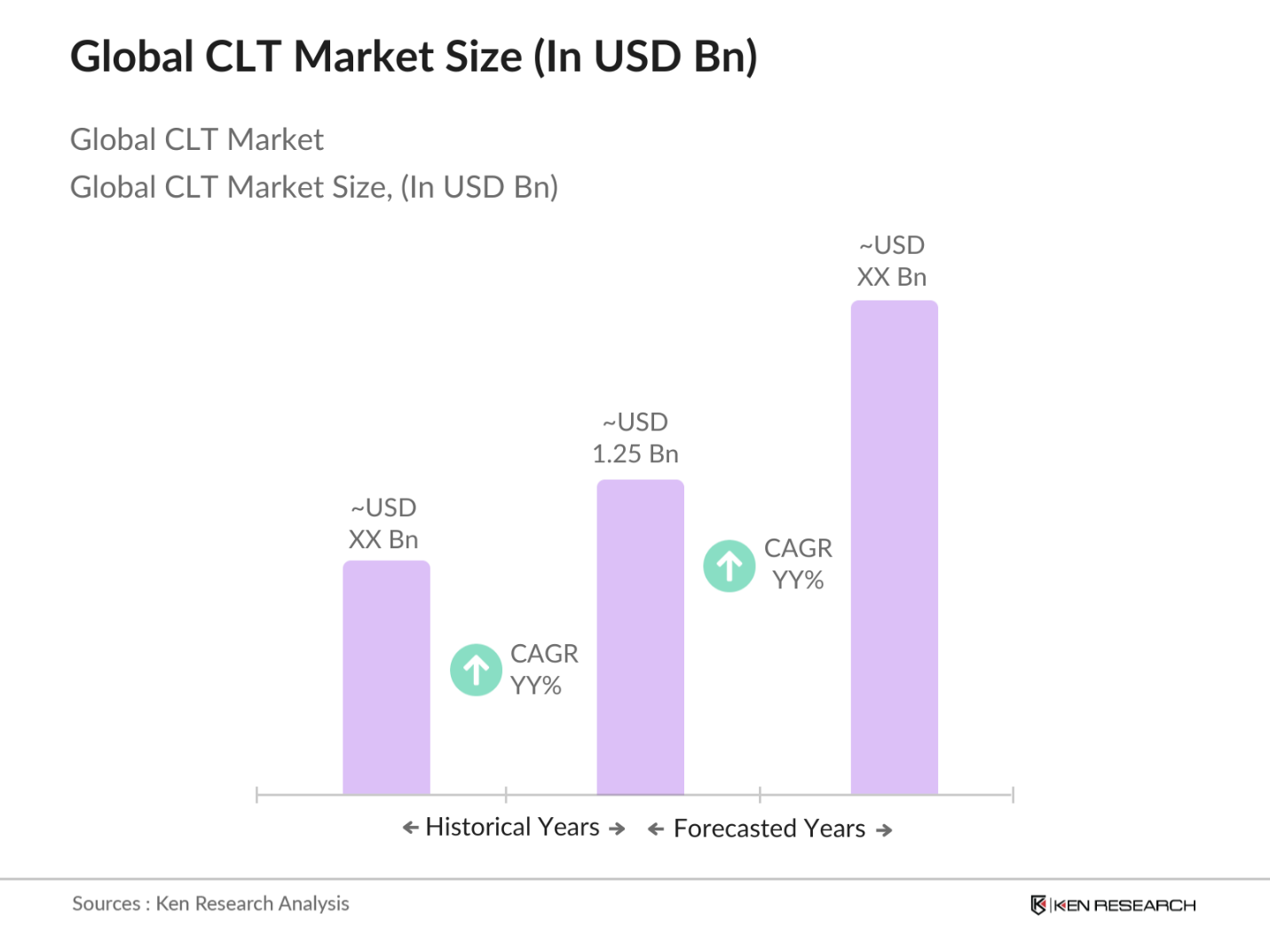
The global CLT market is valued at USD 1.25 billion, driven by the growing adoption of timber in sustainable building practices and government initiatives promoting eco-friendly construction materials.
Key challenges include the high initial investment costs associated with CLT construction, lack of standardization in building codes across regions, and limited awareness of CLT's benefits in certain developing markets.
Key players in the market include Stora Enso, Binderholz GmbH, KLH Massivholz GmbH, Mayr-Melnhof Holz, and SmartLam North America. These companies dominate due to their established production capacities, sustainability initiatives, and wide-reaching global presence.
The market is driven by increasing urbanization, demand for sustainable construction materials, government support for green buildings, and advancements in CLT technology, which have made it a viable alternative to steel and concrete in many projects.

What makes us stand out is that our consultants follows Robust, Refine and Result (RRR) methodology. i.e. Robust for clear definitions, approaches and sanity checking, Refine for differentiating respondents facts and opinions and Result for presenting data with story

We have set a benchmark in the industry by offering our clients with syndicated and customized market research reports featuring coverage of entire market as well as meticulous research and analyst insights.

While we don't replace traditional research, we flip the method upside down. Our dual approach of Top Bottom & Bottom Top ensures quality deliverable by not just verifying company fundamentals but also looking at the sector and macroeconomic factors.

With one step in the future, our research team constantly tries to show you the bigger picture. We help with some of the tough questions you may encounter along the way: How is the industry positioned? Best marketing channel? KPI's of competitors? By aligning every element, we help maximize success.

Our report gives you instant access to the answers and sources that other companies might choose to hide. We elaborate each steps of research methodology we have used and showcase you the sample size to earn your trust.

If you need any support, we are here! We pride ourselves on universe strength, data quality, and quick, friendly, and professional service.