
Global CNC Automation Market Outlook to 2030
Region:Global
Author(s):Paribhasha Tiwari
Product Code:KROD2029
Region:Global
Author(s):Paribhasha Tiwari
Product Code:KROD2029
October 2024
97
Listen to the audio summary
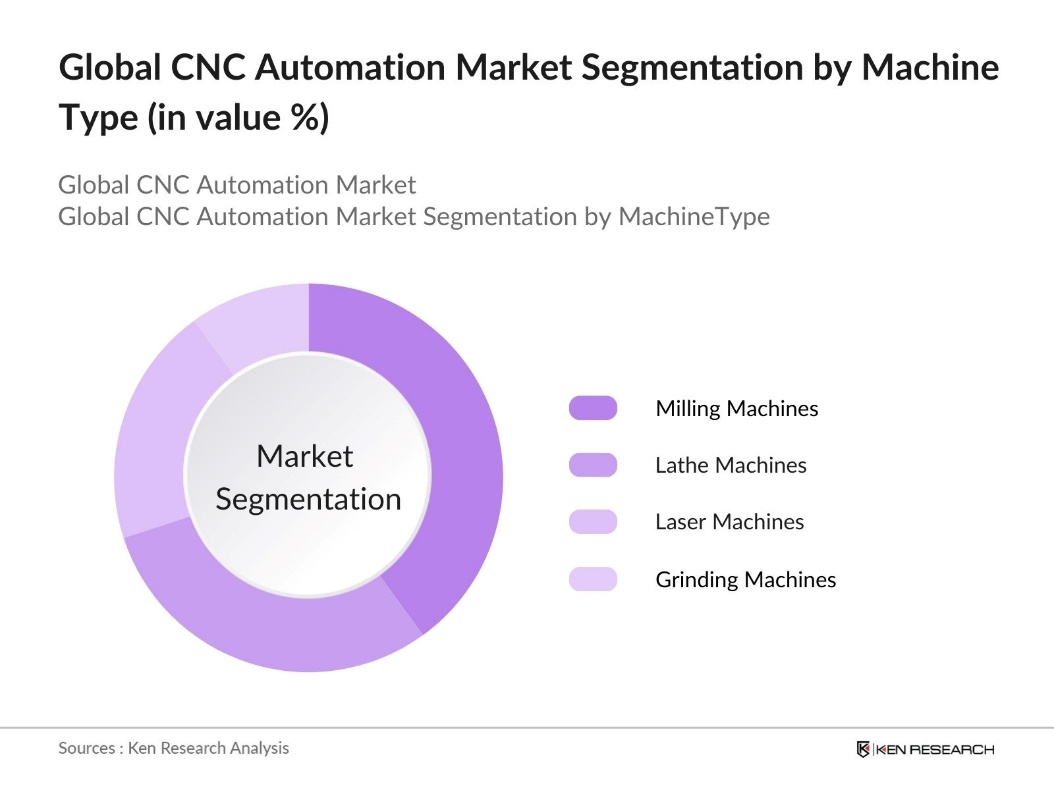
By Machine Type: The CNC automation market is segmented by machine type into Milling Machines, Lathe Machines, Laser Machines, and Grinding Machines. In 2023, milling machines held the largest market share due to their versatility and widespread use across various industries, including automotive, aerospace, and electronics. Their ability to perform complex tasks with high precision makes them a preferred choice for manufacturers looking to optimize production and reduce costs.
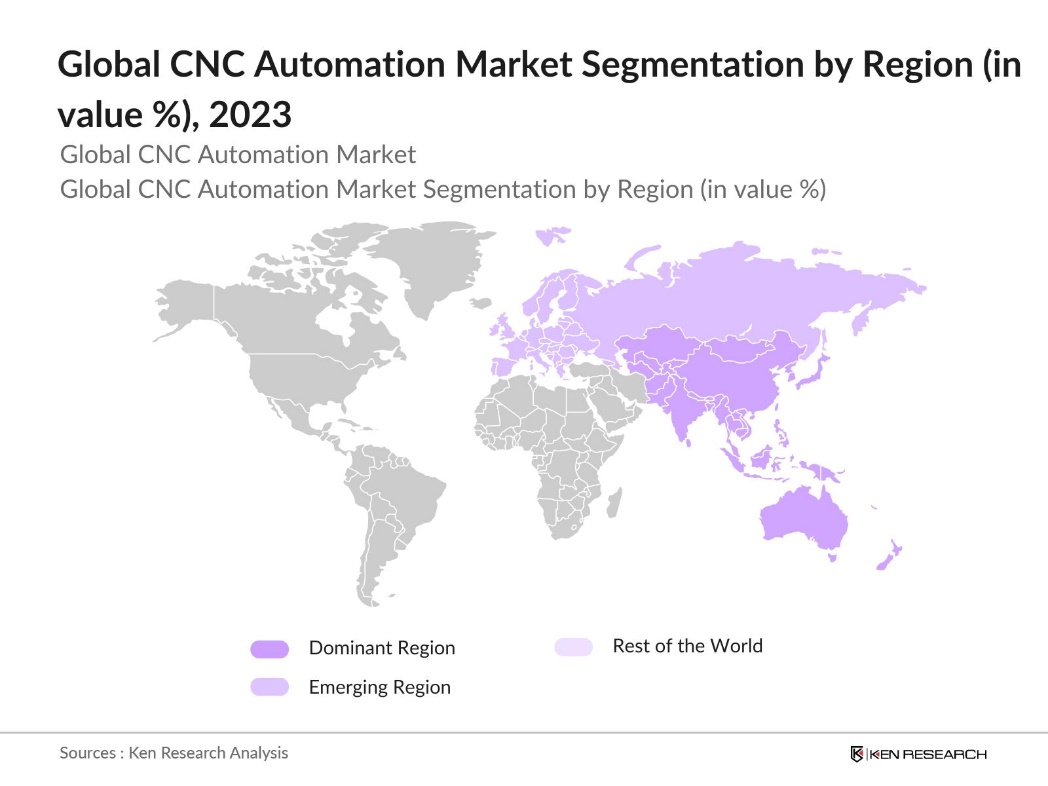
By Region: The CNC automation market is segmented by region into North America, Europe, Asia-Pacific (APAC), Middle East & Africa (MEA), and Latin America. Asia-Pacific (APAC) region dominated the market in 2023. The dominance of APAC in the CNC automation market is attributed to rapid industrialization and significant investments in automation technologies in countries like China, Japan, and South Korea. These countries have a strong manufacturing base and are increasingly adopting CNC technologies to improve production efficiency and reduce labor costs.
By End-Use Industry: The CNC automation market is segmented by end-use industry into Automotive, Aerospace & Defense, Electronics, and Medical Devices. In 2023, the automotive sector accounted for the largest market share, driven by the industry's focus on precision engineering and automation to achieve high-quality production standards and minimize errors. The continuous push for electric vehicles (EVs) also spurred demand for CNC machines capable of handling complex component manufacturing.
|
Company |
Establishment Year |
Headquarters |
|---|---|---|
|
FANUC Corporation |
1956 |
Yamanashi, Japan |
|
Siemens AG |
1847 |
Munich, Germany |
|
Mitsubishi Electric Corporation |
1921 |
Tokyo, Japan |
|
DMG Mori Co., Ltd. |
1948 |
Tokyo, Japan |
|
Haas Automation, Inc. |
1983 |
California, USA |
The Global CNC Automation Market is projected to grow exponentially by 2028. This growth will be driven by the Increasing Adoption of IoT and AI in Manufacturing, Rising Demand for Industrial automation in manufacturing and Expansion of the Electric Vehicle (EV) Market.
|
By Service Type |
Milling Machines Lathe Machines Laser Machines Grinding Machines |
|
By Region |
North America Europe Asia-Pacific (APAC) Middle East & Africa (MEA) Latin America |
|
By End User |
Automotive Aerospace & Defense Electronics Medical Devices |
|
By Component |
Hardware |
|
By Technology |
Multi-Axis CNC Technology |
1.1. Definition and Scope
1.2. Market Taxonomy
1.3. Market Dynamics Overview
1.4. Market Structure
1.5. Evolution of CNC Automation Technologies
2.1. Historical Market Size (in USD Billion)
2.2. Year-on-Year Growth Analysis
2.3. Market Growth Rate (CAGR) Analysis
2.4. Key Market Milestones and Developments
2.5. Market Size Forecast (5-Year Outlook)
3.1. Growth Drivers
3.1.1. Increasing Adoption of IoT and AI in CNC Machines
3.1.2. Rising Demand for Industrial Automation in Manufacturing
3.1.3. Expansion of Electric Vehicle (EV) Manufacturing
3.2. Market Challenges
3.2.1. High Initial Investment and Operational Costs
3.2.2. Shortage of Skilled Workforce for CNC Operations
3.2.3. Cybersecurity Threats in Connected CNC Systems
3.3. Market Opportunities
3.3.1. Technological Advancements and Innovations
3.3.2. Expansion into Emerging Markets
3.3.3. Strategic Partnerships and Collaborations
4.1. Integration of CNC Machines with Digital Twin Technology
4.2. Adoption of Multi-Axis and Hybrid CNC Machines
4.3. Shift Towards Environmentally Sustainable CNC Practices
4.4. Development of Compact and Modular CNC Machines
4.5. Increased Focus on Automated CNC Systems
5.1. U.S. Advanced Manufacturing Initiative
5.2. European Unions Digitalization of Industry Program
5.3. Chinas Made in China 2025 Strategy
5.4. Indian Governments PLI Scheme for CNC Machinery
5.5. International Standards and Compliance Requirements
6.1. By Machine Type
6.1.1. Milling Machines
6.1.2. Lathe Machines
6.1.3. Laser Machines
6.1.4. Grinding Machines
6.1.5. Other CNC Machines
6.2. By Region
6.2.1. North America
6.2.2. Europe
6.2.3. Asia-Pacific
6.2.4. Middle East & Africa
6.2.5. Latin America
6.3. By End-Use Industry
6.3.1. Automotive
6.3.2. Aerospace & Defense
6.3.3. Electronics
6.3.4. Medical Devices
6.3.5. General Manufacturing
6.4. By Component
6.4.1. Hardware
6.4.2. Software
6.4.3. Services
6.5. By Technology
6.5.1. Multi-Axis CNC Technology
6.5.2. CNC Automation Integration with Robotics
6.5.3. AI and Machine Learning Integration
6.5.4. Cloud-Based CNC Solutions
7.1. Regional Market Cross Comparison
7.2. Industry Vertical Cross Comparison
7.3. Technology Adoption Rate by Region
7.4. Competitive Landscape Cross Comparison
8.1. Major Market Players and Market Share Analysis
8.2. Detailed Company Profiles
8.2.1. FANUC Corporation
8.2.2. Siemens AG
8.2.3. Mitsubishi Electric Corporation
8.2.4. DMG Mori Co., Ltd.
8.2.5. Haas Automation, Inc.
8.2.6. Okuma Corporation
8.2.7. Hurco Companies, Inc.
8.2.8. Fagor Automation
8.2.9. GSK CNC Equipment Co., Ltd.
8.2.10. Yamazaki Mazak Corporation
8.2.11. Heidenhain Corporation
8.2.12. Bosch Rexroth AG
8.2.13. Parker Hannifin Corporation
8.2.14. Hardinge Inc.
8.2.15. NUM AG
8.3. Strategic Initiatives and Developments
8.4. Mergers and Acquisitions
8.5. Investment and Expansion Activities
9.1. Industry Standards and Certifications
9.2. Compliance Requirements for CNC Machines
9.3. Safety Regulations and Environmental Standards
9.4. Impact of Trade Policies and Tariffs
9.5. Intellectual Property Rights and CNC Technologies
10.1. Key Raw Material Suppliers
10.2. CNC Machine Component Suppliers
10.3. Distribution Channels and Logistics
10.4. Vendor Evaluation Criteria
10.5. Supplier Market Share and Dynamics
11.1. Market Size Forecast (5-Year Outlook)
11.2. Key Factors Influencing Future Market Growth
11.3. Expected Technological Advancements and Innovations
11.4. Market Entry and Expansion Strategies
11.5. Future Opportunities and White Spaces
12.1. Total Addressable Market (TAM), Serviceable Addressable Market (SAM), and Serviceable Obtainable Market (SOM) Analysis
12.2. Investment Opportunities and Risk Assessment
12.3. Strategic Recommendations for Market Players
12.4. Potential Growth Avenues and Emerging Segments
12.5. Customer Cohort Analysis and Retention Strategies
Ecosystem creation for all the major entities and referring to multiple secondary and proprietary databases to perform desk research around market to collate industry level information.
Collating statistics on Global CNC Automation Market over the years, penetration of marketplaces and service providers ratio to compute revenue generated for Global CNC Automation Industry. We will also review service quality statistics to understand revenue generated which can ensure accuracy behind the data points shared.
Building market hypothesis and conducting CATIs with industry experts belonging to different companies to validate statistics and seek operational and financial information from company representatives.
Our team will approach multiple automation companies and understand nature of product segments and sales, consumer preference and other parameters, which will support us validate statistics derived through bottom to top approach from automation companies.
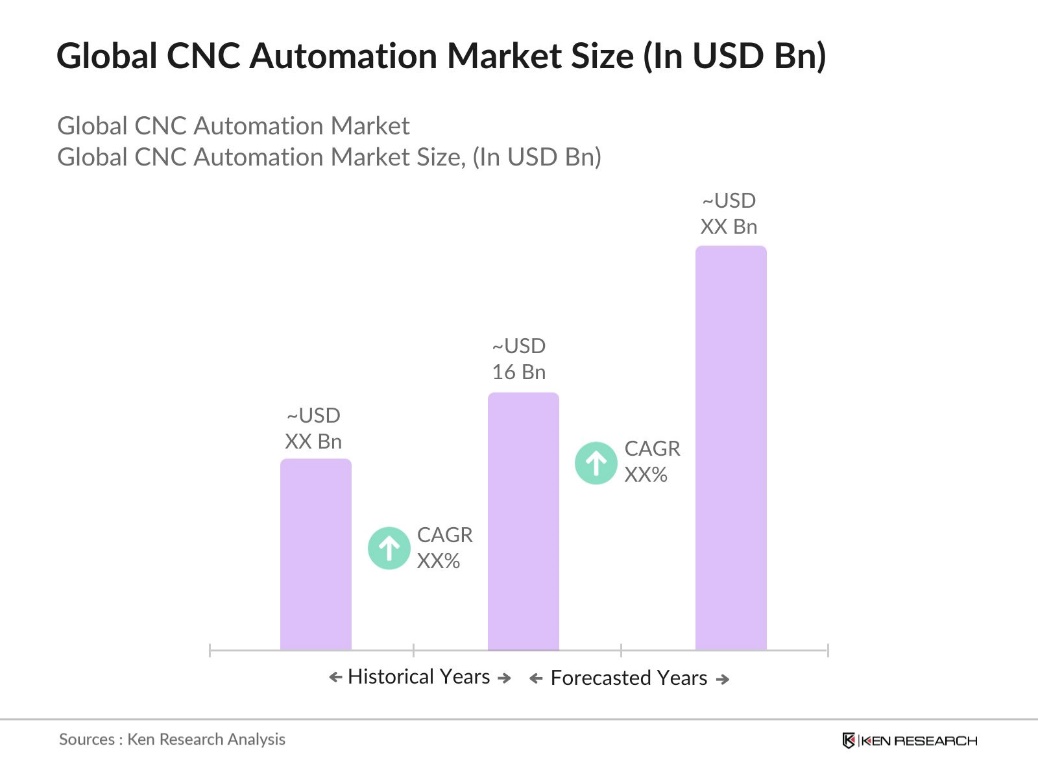
The global CNC automation market was valued at USD 16 Billion in 2023, driven by the increasing demand for high-precision engineering, the rise of Industry 4.0, and the expansion of the electric vehicle (EV) manufacturing sector.
Challenges in the global CNC automation market include high initial investment costs, a shortage of skilled CNC operators, and increasing cybersecurity threats as more machines become networked and integrated with IoT technologies.
Major players in the global CNC automation market include FANUC Corporation, Siemens AG, Mitsubishi Electric Corporation, DMG Mori Co., Ltd., and Haas Automation, Inc. These companies lead due to their technological advancements, extensive product portfolios, and strong global presence.
Growth drivers for the global CNC automation market include Increasing Adoption of IoT and AI in CNC Machines, Rising Demand for Industrial Automation in Manufacturing and Expansion of Electric Vehicle (EV) Manufacturing.

What makes us stand out is that our consultants follows Robust, Refine and Result (RRR) methodology. i.e. Robust for clear definitions, approaches and sanity checking, Refine for differentiating respondents facts and opinions and Result for presenting data with story

We have set a benchmark in the industry by offering our clients with syndicated and customized market research reports featuring coverage of entire market as well as meticulous research and analyst insights.

While we don't replace traditional research, we flip the method upside down. Our dual approach of Top Bottom & Bottom Top ensures quality deliverable by not just verifying company fundamentals but also looking at the sector and macroeconomic factors.

With one step in the future, our research team constantly tries to show you the bigger picture. We help with some of the tough questions you may encounter along the way: How is the industry positioned? Best marketing channel? KPI's of competitors? By aligning every element, we help maximize success.

Our report gives you instant access to the answers and sources that other companies might choose to hide. We elaborate each steps of research methodology we have used and showcase you the sample size to earn your trust.

If you need any support, we are here! We pride ourselves on universe strength, data quality, and quick, friendly, and professional service.