
Global CNC Market Outlook to 2029
Region:Global
Author(s):Dev
Product Code:KROD-042
June 2025
90
About the Report
Global CNC Market Overview
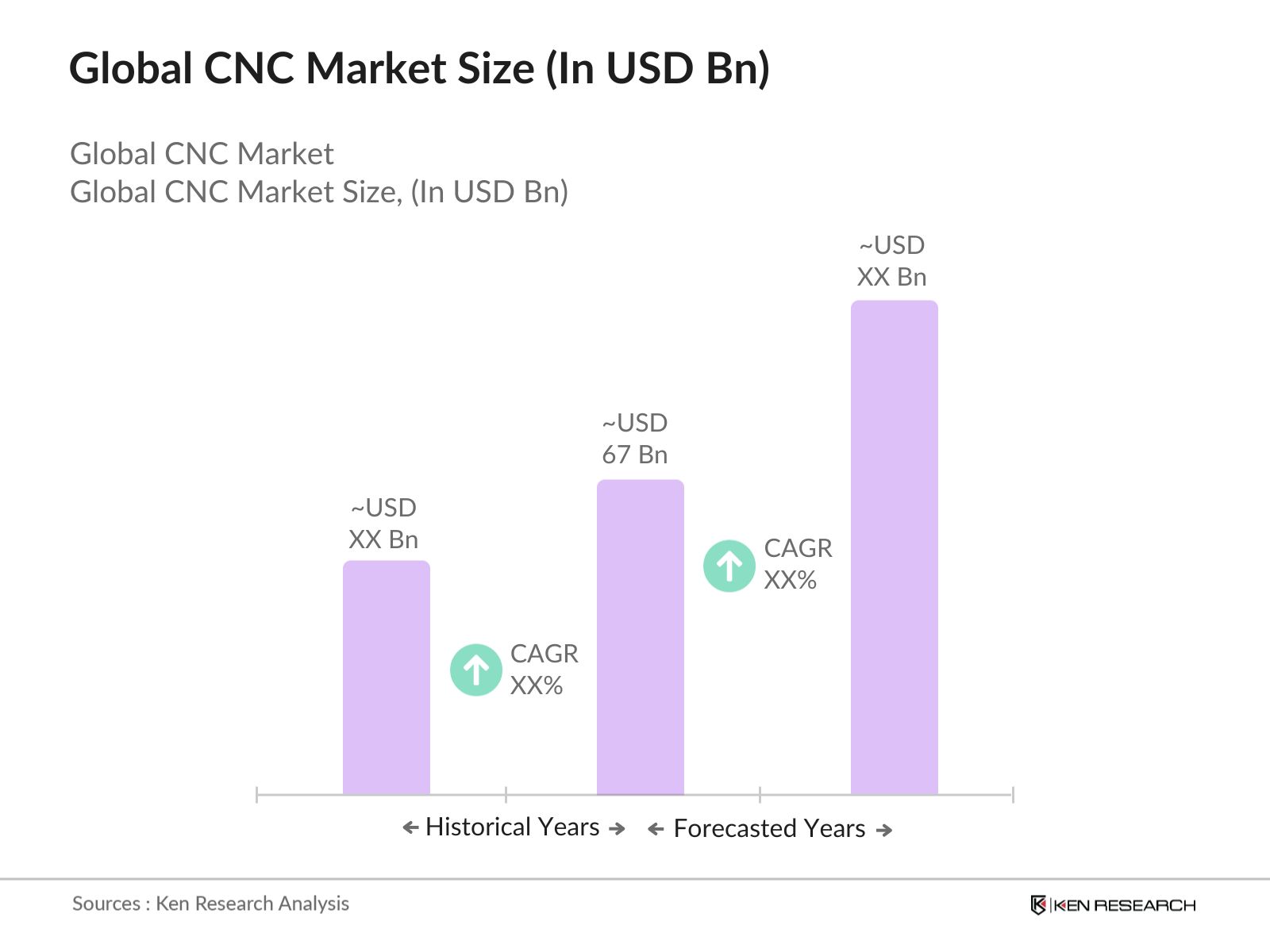
- The Global CNC Market was valued at USD 67 billion, driven by advancements in automation, increasing demand for precision engineering, and the growing adoption of CNC machines across various industries. The market's expansion is largely attributed to the rising need for efficient manufacturing processes and the integration of smart technologies in production lines.
- Countries such as the United States, Germany, and Japan dominate the CNC market due to their strong manufacturing bases, technological advancements, and significant investments in research and development. These nations have established themselves as leaders in the production of high-quality CNC machines, catering to diverse sectors including automotive, aerospace, and electronics.
- In 2023, the U.S. government implemented U.S. National Network for Manufacturing Innovation (NNMI). This initiative supports the adoption and advancement of advanced manufacturing technologies, including CNC systems, by fostering collaboration among industry, academia, and government. It develops regional innovation ecosystems through manufacturing innovation institutes that accelerate the deployment of cutting-edge manufacturing technologies like CNC, enhancing precision manufacturing and automation capabilities within the U.S. manufacturing sector.
Global CNC Market Segmentation
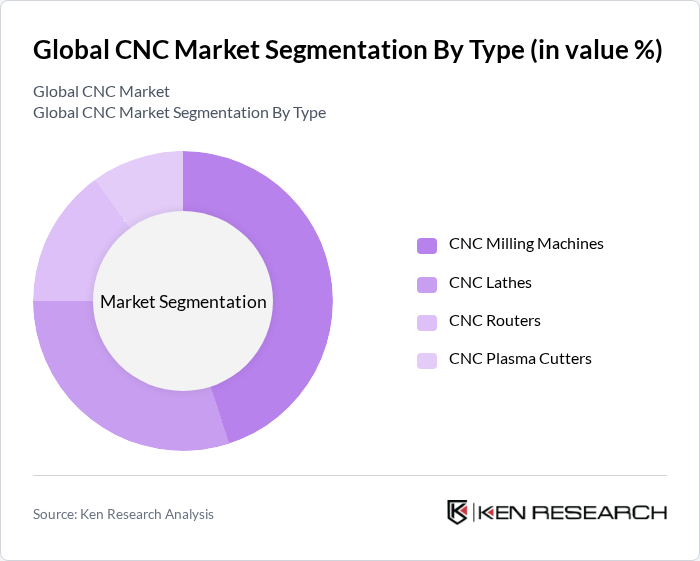
By Type: The CNC market is primarily segmented into CNC milling machines, CNC lathes, CNC routers, and CNC plasma cutters. Among these, CNC milling machines dominate the market due to their versatility and ability to perform complex machining tasks. The increasing demand for precision parts in industries such as aerospace and automotive has led to a surge in the adoption of CNC milling machines, making them a preferred choice for manufacturers seeking efficiency and accuracy in production.
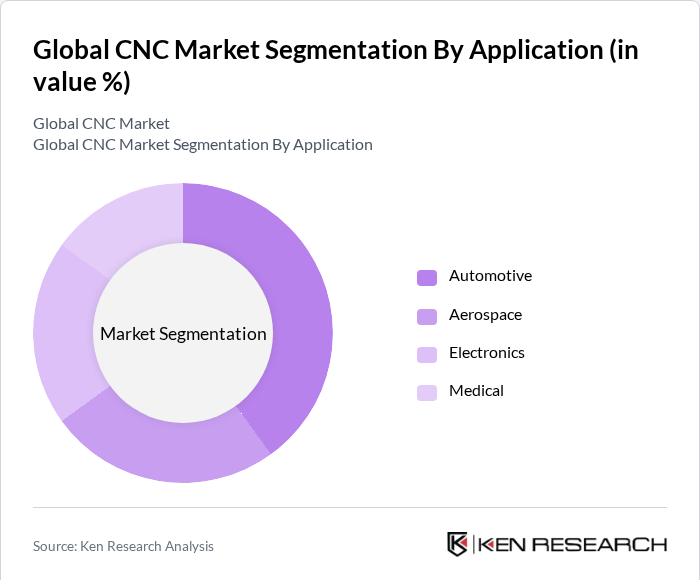
By Application: The CNC market is segmented into automotive, aerospace, electronics, and medical applications. The automotive sector holds a significant share due to the high demand for precision-engineered components and the need for automation in manufacturing processes. As automotive manufacturers increasingly adopt CNC technology to enhance production efficiency and reduce lead times, this segment continues to experience robust growth, driven by the industry's focus on innovation and quality.
Global CNC Market Competitive Landscape
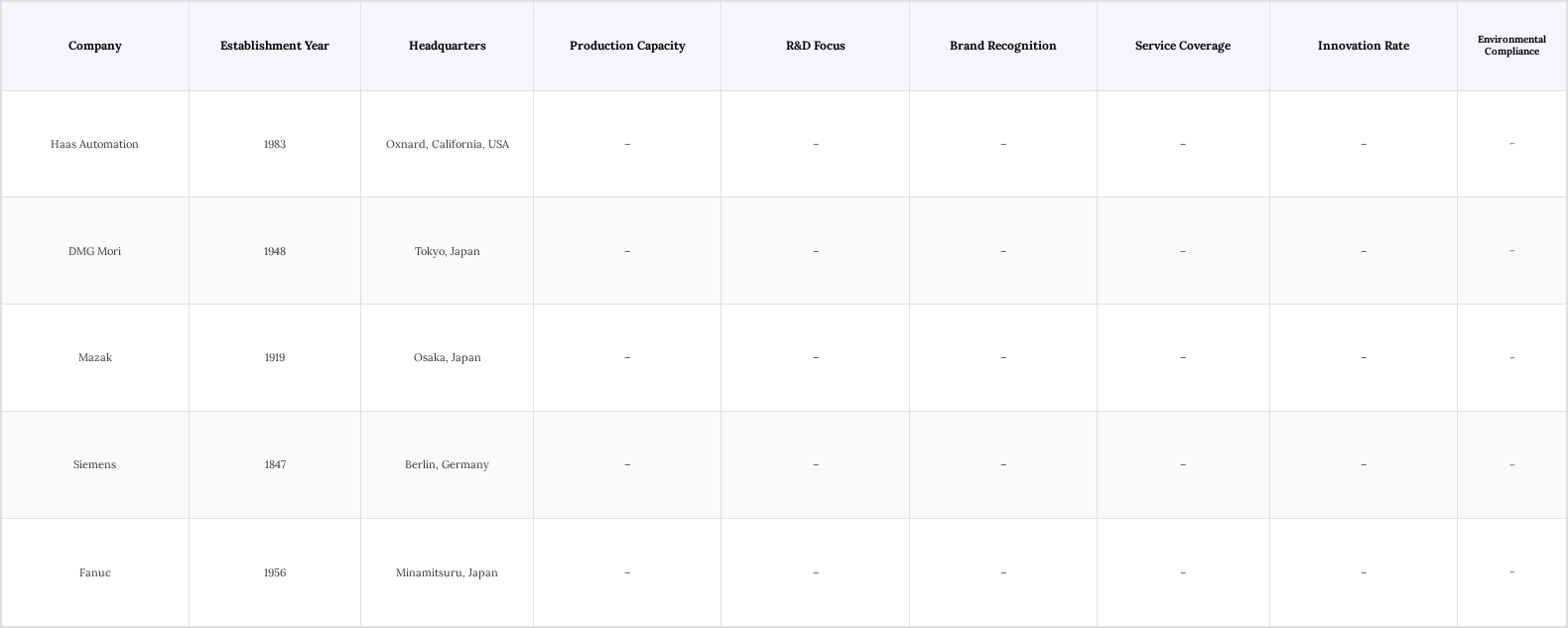
The Global CNC Market is characterized by a competitive landscape featuring key players such as Haas Automation, DMG Mori, Mazak, Siemens, and Fanuc. These companies are known for their innovative technologies and extensive product portfolios, which cater to a wide range of industries. The market is moderately concentrated, with these leading firms continuously investing in research and development to enhance their offerings and maintain a competitive edge.
Global CNC Market Industry Analysis
Growth Drivers
- Increasing Demand for Automation in Manufacturing: The global push towards automation is driving the CNC market, with the manufacturing sector projected to invest approximately USD 1.7 trillion in automation technologies by 2024. This shift is fueled by the need for efficiency, reduced labor costs, and enhanced production capabilities. Countries like Germany and Japan are leading this trend, with automation adoption rates exceeding 70%, significantly boosting CNC machinery demand in these regions.
- Advancements in CNC Technology and Software: Advancements in CNC technology and software are significantly enhancing machine capabilities, driving increased adoption across industries. Innovations such as real-time monitoring, predictive maintenance, and AI integration enable manufacturers to optimize operations, reduce downtime, and improve product quality. The global CNC software market is rapidly expanding, supported by these advanced features that streamline production processes and boost efficiency. As a result, CNC machines are becoming essential tools in sectors like automotive, aerospace, and electronics manufacturing.
- Rising Need for Precision Engineering in Various Industries: The rising need for precision engineering in industries like aerospace and medical is driving strong growth in the CNC market. The aerospace sector alone is expected to require over 1.2 million precision components annually by 2024, reflecting increasing design complexity and stringent quality standards. This demand fuels greater utilization of CNC machines, which offer the accuracy and consistency needed for intricate manufacturing processes.
Market Challenges
- High Initial Investment Costs: The substantial upfront costs associated with CNC machinery can pose a major hurdle for small and medium-sized enterprises (SMEs). These expenses often act as a financial barrier, discouraging potential adopters and restricting market expansion—particularly in regions with limited access to capital or financing support.Skilled Labor Shortage in CNC Operations: The CNC industry continues to grapple with a shortage of skilled labor. This challenge is further intensified by an aging workforce and a lack of comprehensive vocational training programs. As a result, many businesses struggle to fully optimize their CNC operations, leading to reduced productivity and inefficiencies in manufacturing workflows.
Global CNC Market Future Outlook
The future of the CNC market appears promising, driven by technological advancements and increasing automation across industries. As manufacturers seek to enhance productivity and reduce operational costs, the integration of IoT and AI technologies into CNC systems is expected to gain traction. Additionally, the growing emphasis on sustainable manufacturing practices will likely lead to innovations in CNC machinery, further expanding its applications and market reach in the coming years.
Market Opportunities
- Expansion of CNC Applications in Emerging Markets: Emerging markets in Asia-Pacific and Latin America are witnessing rapid industrialization and government support for manufacturing, driving strong growth in CNC machine adoption. Asia-Pacific, led by countries like China, India, and Japan, holds the largest market share due to robust economic growth and investments in smart manufacturing. Latin America is also expanding, supported by low production costs and skilled labor availability.
- Integration of IoT and AI in CNC Machinery: The integration of IoT and AI in CNC machinery is transforming manufacturing by enabling real-time data analytics and predictive maintenance, which enhance operational efficiency and reduce downtime. This technological shift supports smarter, more connected production processes, empowering manufacturers to optimize performance and maintain competitiveness.
Scope of the Report
| By Product Type |
CNC Milling Machines CNC Lathes CNC Routers CNC Plasma Cutters |
| By Application |
Automotive Aerospace Electronics Medical Applications |
| By End-User Industry |
Manufacturing Construction Energy Healthcare |
| By Region |
North America Europe Asia-Pacific Latin America Middle East & Africa |
| By Technology |
2D CNC Machining 3D CNC Machining Hybrid CNC Machining |
Products
Key Target Audience
Investors and Venture Capitalist Firms
Government and Regulatory Bodies (e.g., U.S. Department of Commerce, European Commission)
Manufacturers and Producers
Distributors and Retailers
Original Equipment Manufacturers (OEMs)
Industry Associations (e.g., National Tooling and Machining Association)
Financial Institutions
Supply Chain Management Firms
Companies
Players Mentioned in the Report:
Haas Automation
DMG Mori
Mazak
Siemens
Fanuc
Okuma Corporation
Hurco Companies, Inc.
Mitsubishi Electric
Emag GmbH
Biesse Group
Table of Contents
1. Global CNC Market Overview
1.1. Definition and Scope
1.2. Market Taxonomy
1.3. Market Growth Rate
1.4. Market Segmentation Overview
2. Global CNC Market Size (In USD Bn)
2.1. Historical Market Size
2.2. Year-On-Year Growth Analysis
2.3. Key Market Developments and Milestones
3. Global CNC Market Analysis
3.1. Growth Drivers
3.1.1. Increasing Demand for Automation in Manufacturing
3.1.2. Advancements in CNC Technology and Software
3.1.3. Rising Need for Precision Engineering in Various Industries
3.2. Market Challenges
3.2.1. High Initial Investment Costs
3.2.2. Skilled Labor Shortage in CNC Operations
3.2.3. Rapid Technological Changes and Upgrades
3.3. Opportunities
3.3.1. Expansion of CNC Applications in Emerging Markets
3.3.2. Integration of IoT and AI in CNC Machinery
3.3.3. Growing Demand for Customized Solutions
3.4. Trends
3.4.1. Shift Towards Sustainable Manufacturing Practices
3.4.2. Increasing Adoption of Additive Manufacturing Techniques
3.4.3. Rise of Smart Factories and Industry 4.0 Initiatives
3.5. Government Regulation
3.5.1. Compliance with Safety Standards and Regulations
3.5.2. Environmental Regulations Impacting Manufacturing Processes
3.5.3. Incentives for Adoption of Advanced Manufacturing Technologies
3.5.4. Trade Policies Affecting CNC Equipment Imports and Exports
3.6. SWOT Analysis
3.7. Stake Ecosystem
3.8. Porter’s Five Forces
3.9. Competition Ecosystem
4. Global CNC Market Segmentation
4.1. By Product Type
4.1.1. CNC Milling Machines
4.1.2. CNC Lathes
4.1.3. CNC Routers
4.1.4. CNC Plasma Cutters
4.2. By Application
4.2.1. Automotive
4.2.2. Aerospace
4.2.3. Electronics
4.2.4. Medical Applications
4.3. By End-User Industry
4.3.1. Manufacturing
4.3.2. Construction
4.3.3. Energy
4.3.4. Healthcare
4.4. By Region
4.4.1. North America
4.4.2. Europe
4.4.3. Asia-Pacific
4.4.4. Latin America
4.4.5. Middle East & Africa
4.5. By Technology
4.5.1. 2D CNC Machining
4.5.2. 3D CNC Machining
4.5.3. Hybrid CNC Machining
5. Global CNC Market Competitive Analysis
5.1. Detailed Profiles of Major Companies
5.1.1. Haas Automation
5.1.2. DMG Mori
5.1.3. Mazak
5.1.4. Siemens
5.1.5. Fanuc
5.1.6. Okuma Corporation
5.1.7. Hurco Companies, Inc.
5.1.8. Mitsubishi Electric
5.1.9. Emag GmbH
5.1.10. Biesse Group
5.2. Cross Comparison Parameters
5.2.1. Market Share Analysis
5.2.2. Revenue Growth Rate
5.2.3. Product Portfolio Diversity
5.2.4. Geographic Presence
5.2.5. Customer Base Size
5.2.6. R&D Investment Levels
5.2.7. Technological Advancements
5.2.8. Customer Satisfaction Ratings
6. Global CNC Market Regulatory Framework
6.1. Environmental Standards
6.2. Compliance Requirements
6.3. Certification Processes
7. Global CNC Market Future Market Size (In USD Bn)
7.1. Future Market Size Projections
7.2. Key Factors Driving Future Market Growth
8. Global CNC Market Future Market Segmentation
8.1. By Product Type
8.1.1. CNC Milling Machines
8.1.2. CNC Lathes
8.1.3. CNC Routers
8.1.4. CNC Plasma Cutters
8.2. By Application
8.2.1. Automotive
8.2.2. Aerospace
8.2.3. Electronics
8.2.4. Medical Applications
8.3. By End-User Industry
8.3.1. Manufacturing
8.3.2. Construction
8.3.3. Energy
8.3.4. Healthcare
8.4. By Region
8.4.1. North America
8.4.2. Europe
8.4.3. Asia-Pacific
8.4.4. Latin America
8.4.5. Middle East & Africa
8.5. By Technology
8.5.1. 2D CNC Machining
8.5.2. 3D CNC Machining
8.5.3. Hybrid CNC Machining
9. Global CNC Market Analysts’ Recommendations
9.1. TAM/SAM/SOM Analysis
9.2. Customer Cohort Analysis
9.3. Marketing Initiatives
9.4. White Space Opportunity Analysis
Research Methodology
Step 1: Identification of Key Variables
The initial phase involves constructing an ecosystem map encompassing all major stakeholders within the Global CNC Market. This step is underpinned by extensive desk research, utilizing a combination of secondary and proprietary databases to gather comprehensive industry-level information. The primary objective is to identify and define the critical variables that influence market dynamics.
Step 2: Market Analysis and Construction
In this phase, we will compile and analyze historical data pertaining to the Global CNC Market. This includes assessing market penetration, the ratio of marketplaces to service providers, and the resultant revenue generation. Furthermore, an evaluation of service quality statistics will be conducted to ensure the reliability and accuracy of the revenue estimates.
Step 3: Hypothesis Validation and Expert Consultation
Market hypotheses will be developed and subsequently validated through computer-assisted telephone interviews (CATIs) with industry experts representing a diverse array of companies. These consultations will provide valuable operational and financial insights directly from industry practitioners, which will be instrumental in refining and corroborating the market data.
Step 4: Research Synthesis and Final Output
The final phase involves direct engagement with multiple manufacturers to acquire detailed insights into product segments, sales performance, consumer preferences, and other pertinent factors. This interaction will serve to verify and complement the statistics derived from the bottom-up approach, thereby ensuring a comprehensive, accurate, and validated analysis of the Global CNC Market.
Frequently Asked Questions
01. How big is the Global CNC Market?
The Global CNC Market is valued at USD 67 billion, driven by factors such as increasing demand, technological advancements, and supportive government initiatives.
02. What are the key challenges in the Global CNC Market?
Key challenges in the Global CNC Market include intense competition, regulatory complexities, and infrastructure limitations affecting market dynamics.
03. Who are the major players in the Global CNC Market?
Major players in the Global CNC Market include Haas Automation, DMG Mori, Mazak, Siemens, Fanuc, among others.
04. What are the growth drivers for the Global CNC Market?
The primary growth drivers for the Global CNC Market are increasing consumer demand, favorable policies, innovation, and substantial investment inflows.
Why Buy From Us?

What makes us stand out is that our consultants follows Robust, Refine and Result (RRR) methodology. i.e. Robust for clear definitions, approaches and sanity checking, Refine for differentiating respondents facts and opinions and Result for presenting data with story

We have set a benchmark in the industry by offering our clients with syndicated and customized market research reports featuring coverage of entire market as well as meticulous research and analyst insights.

While we don't replace traditional research, we flip the method upside down. Our dual approach of Top Bottom & Bottom Top ensures quality deliverable by not just verifying company fundamentals but also looking at the sector and macroeconomic factors.

With one step in the future, our research team constantly tries to show you the bigger picture. We help with some of the tough questions you may encounter along the way: How is the industry positioned? Best marketing channel? KPI's of competitors? By aligning every element, we help maximize success.

Our report gives you instant access to the answers and sources that other companies might choose to hide. We elaborate each steps of research methodology we have used and showcase you the sample size to earn your trust.

If you need any support, we are here! We pride ourselves on universe strength, data quality, and quick, friendly, and professional service.