















Global Commercial Aircraft Aviation Fuel Market Outlook to 2030
Region:Global
Author(s):Yogita Sahu
Product Code:KROD7668
November 2024
99
About the Report
Global Commercial Aircraft Aviation Fuel Market Overview
- The global commercial aircraft aviation fuel market is valued at USD 56 billion, based on a five-year historical analysis. This market is primarily driven by the rising demand for air travel, supported by increased airline traffic and fleet expansions globally. With growing awareness of sustainable aviation, the adoption of alternative fuels, such as biofuels and synthetic fuels, is further propelling market demand.
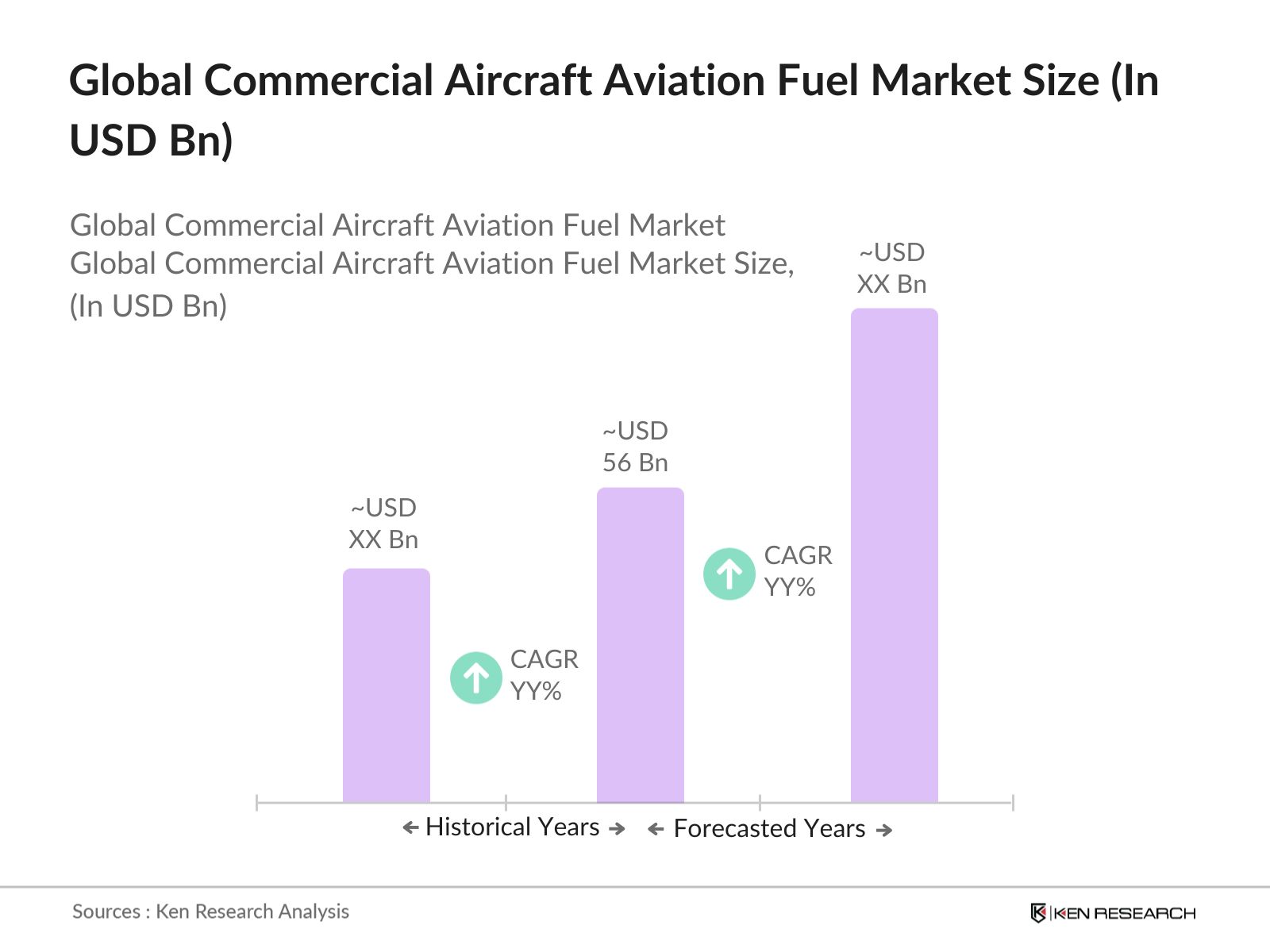
- Countries like the United States, China, and the United Arab Emirates dominate the market due to their advanced aviation infrastructure and significant airline traffic. The presence of major airports, large airline fleets, and consistent government support for aviation innovation contributes to their dominance.
- Governments are introducing financial incentives and tax benefits to increase the production and usage of sustainable aviation fuels (SAF). For instance, in 2024, the U.S. government plans to invest $200 million in SAF production facilities, supporting the aviation industrys shift toward cleaner fuel alternatives. This initiative is expected to play a crucial role in enhancing the supply chain for SAF in North America.
Global Commercial Aircraft Aviation Fuel Market Segmentation
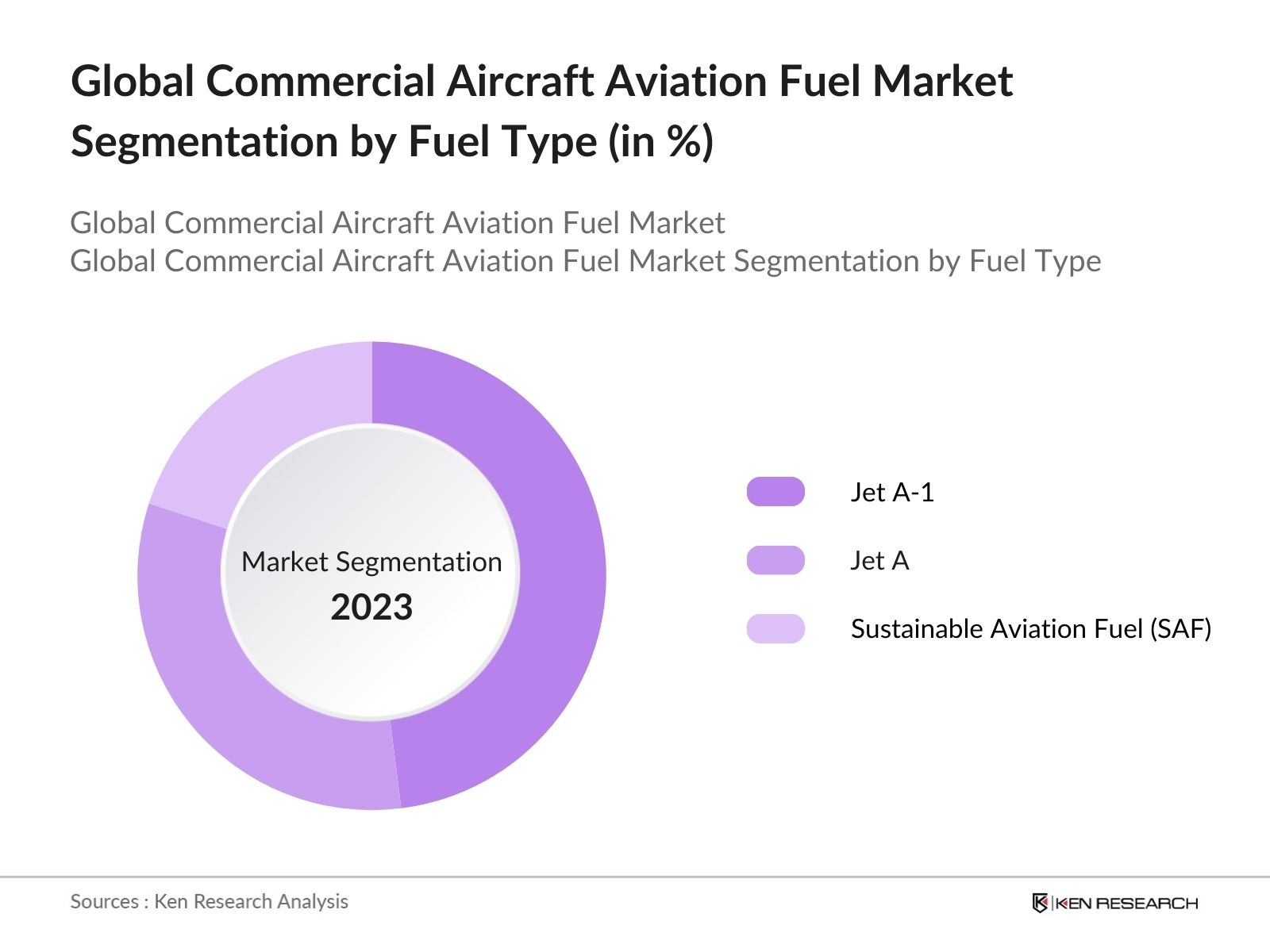
By Fuel Type: The market is segmented by fuel type into Jet A-1, Jet A, and Sustainable Aviation Fuel (SAF). Jet A-1 currently holds the dominant market share due to its global standardization and widespread availability, especially in international aviation. The preference for Jet A-1 is driven by its high flash point and freeze point characteristics, making it suitable for a wide range of operating conditions. SAF is emerging rapidly due to increasing environmental regulations and the push for greener fuel alternatives, although its market penetration remains limited due to higher costs and supply chain constraints.
By Application: The market is segmented by application into commercial airlines and cargo airlines. Commercial airlines dominate this segment with a significant market share, driven by the high volume of passenger flights and the increasing number of long-haul flights requiring fuel-efficient solutions. Cargo airlines, while important, account for a smaller share of the market due to the more specialized nature of their operations, which often rely on different logistical networks and routes compared to passenger airlines.
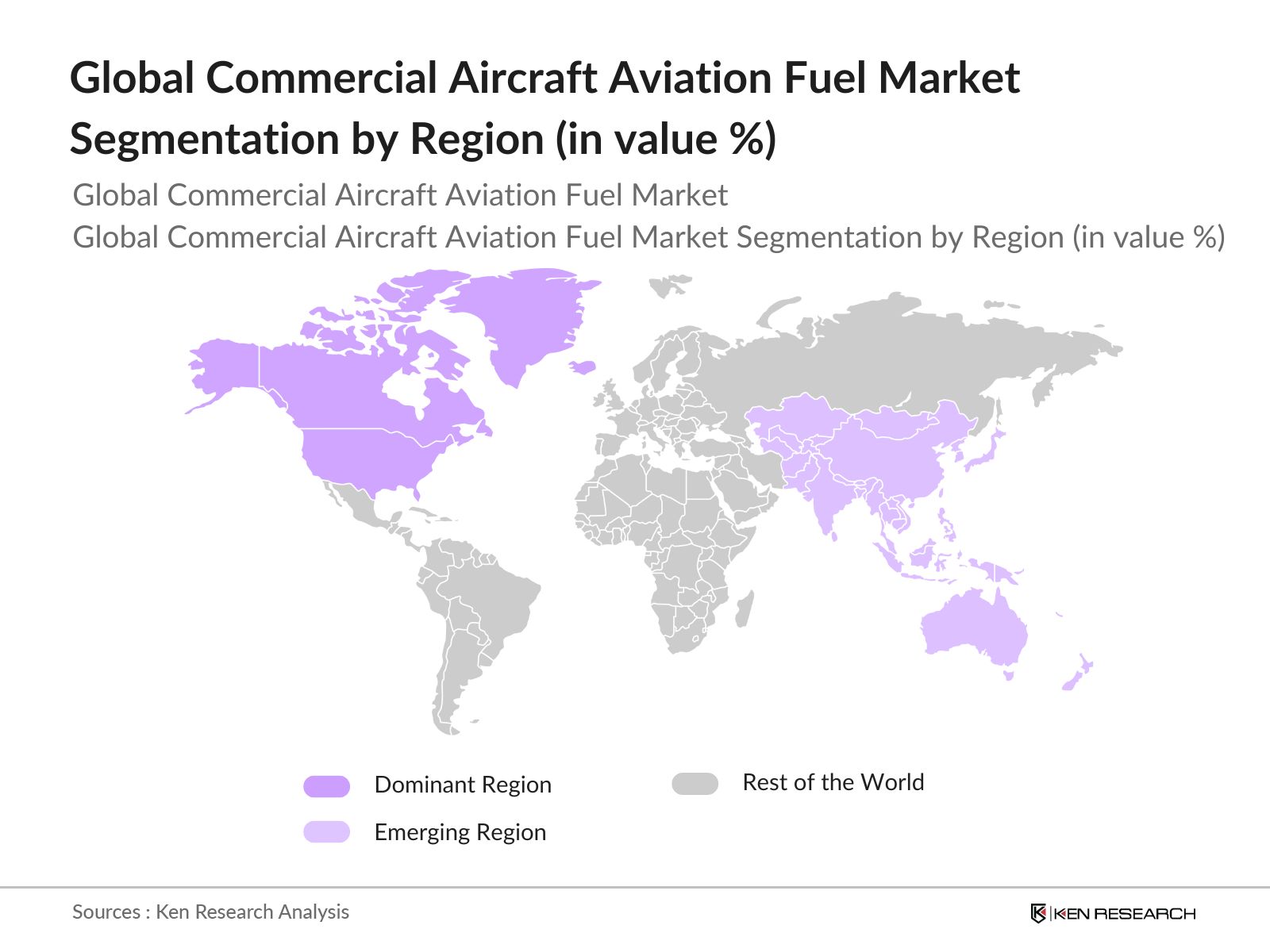
By Region: The market is segmented into North America, Europe, Asia-Pacific, the Middle East & Africa, and Latin America. North America leads the market, driven by the presence of major airlines and fuel suppliers. The region benefits from advanced infrastructure, a high volume of domestic and international flights, and strong government initiatives supporting sustainable aviation fuels. Asia-Pacific follows closely, with rapid growth in airline fleets and increasing demand for air travel, especially in emerging economies like China and India.
Global Commercial Aircraft Aviation Fuel Market Competitive Landscape
The market is dominated by several major players who play a critical role in shaping market dynamics through strategic partnerships, investments in sustainable fuel technologies, and global distribution networks.
|
Company Name |
Established Year |
Headquarters |
No. of Refineries |
SAF Initiatives |
Global Partnerships |
Annual Revenue (USD) |
Fuel Supply Volumes |
Number of Contracts |
Emissions Reduction Programs |
|
ExxonMobil Corporation |
1870 |
Texas, USA |
|||||||
|
Royal Dutch Shell Plc |
1907 |
The Hague, NL |
|||||||
|
BP Plc |
1909 |
London, UK |
|||||||
|
TotalEnergies SE |
1924 |
Paris, FR |
|||||||
|
Neste Oyj |
1948 |
Espoo, FI |
Global Commercial Aircraft Aviation Fuel Market Analysis
Market Growth Drivers
- Rising Air Traffic and Fleet Expansion The global increase in air travel is boosting the demand for aviation fuel. In 2024, around 4.7 billion passengers are expected to travel globally, driving higher consumption of aviation fuel. Airlines are expanding their fleets to accommodate this growth, with around 1,300 new commercial aircraft deliveries expected in 2024, further increasing the demand for fuel.
- Geopolitical Stability in Oil-Producing Regions The stabilization of major oil-producing regions, especially in the Middle East and North Africa, is ensuring a steady supply of aviation fuel. In 2024, oil production levels from key regions are projected to rise, supporting uninterrupted fuel supply to the aviation sector. This stability is crucial for maintaining consistent fuel prices, as disruptions in these regions have previously caused significant fluctuations in fuel costs.
- Regulatory Push for Sustainable Aviation Fuel (SAF) Governments and aviation regulatory bodies are promoting the use of sustainable aviation fuels (SAF) to reduce carbon emissions. In 2024, around 2 million barrels of SAF are expected to be produced globally, with growth projected as part of global sustainability commitments. The demand for SAF will serve as a key driver for market growth, especially in regions such as Europe and North America, where regulatory bodies are enforcing stringent environmental guidelines.
Market Challenges
- Supply Chain Disruptions: Disruptions in the global supply chain, including refinery shutdowns or transportation bottlenecks, present challenges to aviation fuel availability. In 2024, refineries in the U.S. are projected to produce 18 million barrels of jet fuel, a marginal decrease due to maintenance activities. This creates supply-side pressure that could lead to short-term shortages and price hikes in certain regions, impacting flight operations.
- Cost of Sustainable Aviation Fuel (SAF): While SAF is a growing alternative to conventional aviation fuel, its production costs remain significantly higher. In 2024, the cost of SAF is expected to be around 3 times more than conventional jet fuel, creating financial hurdles for airlines trying to meet environmental targets while controlling operational costs. This price disparity limits widespread adoption, presenting an ongoing challenge for market growth.
Global Commercial Aircraft Aviation Fuel Market Future Outlook
Over the next five years, the global commercial aircraft aviation fuel industry is expected to show growth driven by the continuous expansion of airline fleets, increased adoption of sustainable aviation fuels (SAF), and global initiatives to reduce carbon emissions from aviation.
Future Market Opportunities
- Development of Hybrid and Electric Aircraft: Airlines will begin to explore hybrid-electric aircraft options in the next five years, reducing the reliance on traditional aviation fuel. By 2029, it's expected that around 100 commercial hybrid aircraft will be operational globally, primarily serving short-haul routes, thereby reducing overall aviation fuel consumption.
- Expansion of Carbon Trading Schemes: Carbon emission trading schemes will expand further by 2029, with more countries participating. This will result in higher operational costs for airlines that fail to reduce emissions, encouraging greater adoption of fuel-efficient technologies and practices. The global aviation sector will aim to cut carbon emissions by an additional 50 million tons annually by 2029 through these initiatives.
Scope of the Report
|
By Fuel Type |
Jet A-1 Jet A Sustainable Aviation Fuel (SAF) |
|
By Application |
Commercial Airlines Cargo Airlines |
|
By Delivery Method |
Into-plane Delivery Fuel Farms |
|
By End-Use |
Domestic Aviation International Aviation |
|
By Region |
North America Europe Asia-Pacific Middle East and Africa Latin America |
Products
Key Target Audience Organizations and Entities Who Can Benefit by Subscribing This Report:
Banks and Financial Institution
Airline Operators
Private Equity Firms
Government and Regulatory Bodies (International Civil Aviation Organization, U.S. Federal Aviation Administration)
Investors and Venture Capitalist Firms
Biofuel Manufacturers
Aircraft Manufacturers
Companies
Players Mentioned in the Report:
ExxonMobil Corporation
Royal Dutch Shell Plc
BP Plc
Chevron Corporation
TotalEnergies SE
Neste Oyj
Gazprom Neft PJSC
Phillips 66
World Fuel Services Corporation
Air BP
Table of Contents
Global Commercial Aircraft Aviation Fuel Market Overview
1.1. Definition and Scope
1.2. Market Taxonomy
1.3. Market Growth Rate
1.4. Market Segmentation Overview
Global Commercial Aircraft Aviation Fuel Market Size (In USD Bn)
2.1. Historical Market Size
2.2. Year-On-Year Growth Analysis
2.3. Key Market Developments and Milestones
Global Commercial Aircraft Aviation Fuel Market Analysis
3.1. Growth Drivers
3.1.1. Increased Global Air Traffic
3.1.2. Rising Fuel Efficiency Standards
3.1.3. Sustainable Aviation Fuel (SAF) Adoption
3.1.4. Airline Fleet Modernization
3.2. Market Challenges
3.2.1. Volatile Crude Oil Prices
3.2.2. Regulatory Constraints on Emissions
3.2.3. Supply Chain Disruptions
3.3. Opportunities
3.3.1. Shift Towards Biofuels and Green Fuels
3.3.2. Technological Innovations in Fuel Efficiency
3.3.3. Expanding Aviation Markets in Emerging Economies
3.4. Trends
3.4.1. Increasing Adoption of Renewable Aviation Fuels
3.4.2. Growth in Fuel Hedging Practices by Airlines
3.4.3. Partnerships Between Fuel Suppliers and Airlines
3.5. Government Regulation
3.5.1. Carbon Emission Reduction Targets
3.5.2. Global Carbon Offsetting and Reduction Scheme for International Aviation (CORSIA)
3.5.3. Sustainable Aviation Fuel Mandates
3.5.4. Renewable Energy Incentives for Aviation Fuel Suppliers
3.6. SWOT Analysis
3.7. Stakeholder Ecosystem (Aircraft Operators, Fuel Suppliers, Regulators)
3.8. Porters Five Forces
3.9. Competition Ecosystem
Global Commercial Aircraft Aviation Fuel Market Segmentation
4.1. By Fuel Type (In Value %)
4.1.1. Jet A-1
4.1.2. Jet A
4.1.3. Sustainable Aviation Fuel (SAF)
4.2. By Application (In Value %)
4.2.1. Commercial Airlines
4.2.2. Cargo Airlines
4.3. By Delivery Method (In Value %)
4.3.1. Into-plane Delivery
4.3.2. Fuel Farms
4.4. By End-Use (In Value %)
4.4.1. Domestic Aviation
4.4.2. International Aviation
4.5. By Region (In Value %)
4.5.1. North America
4.5.2. Europe
4.5.3. Asia-Pacific
4.5.4. Middle East and Africa
4.5.5. Latin America
Global Commercial Aircraft Aviation Fuel Market Competitive Analysis
5.1 Detailed Profiles of Major Companies
5.1.1. ExxonMobil Corporation
5.1.2. Royal Dutch Shell Plc
5.1.3. BP Plc
5.1.4. Chevron Corporation
5.1.5. TotalEnergies SE
5.1.6. Neste Oyj
5.1.7. Gazprom Neft PJSC
5.1.8. Phillips 66
5.1.9. World Fuel Services Corporation
5.1.10. Air BP
5.1.11. Repsol S.A.
5.1.12. Eni S.p.A.
5.1.13. Vitol Aviation
5.1.14. Marathon Petroleum Corporation
5.1.15. Sinopec Corporation
5.2 Cross Comparison Parameters (Headquarters, Fuel Supply Volumes, Revenue, SAF Adoption Rate, Refinery Locations, No. of Contracts, Fuel Sustainability Index, Global Partnerships)
5.3. Market Share Analysis
5.4. Strategic Initiatives
5.5. Mergers And Acquisitions
5.6. Investment Analysis
5.7. Venture Capital Funding
5.8. Government Grants
5.9. Private Equity Investments
Global Commercial Aircraft Aviation Fuel Market Regulatory Framework
6.1. Emission Standards for Aviation
6.2. Global Aviation Fuel Compliance Regulations
6.3. Certification and Licensing Procedures
Global Commercial Aircraft Aviation Fuel Future Market Size (In USD Bn)
7.1. Future Market Size Projections
7.2. Key Factors Driving Future Market Growth
Global Commercial Aircraft Aviation Fuel Future Market Segmentation
8.1. By Fuel Type (In Value %)
8.2. By Application (In Value %)
8.3. By Delivery Method (In Value %)
8.4. By End-Use (In Value %)
8.5. By Region (In Value %)
Global Commercial Aircraft Aviation Fuel Market Analysts Recommendations
9.1. TAM/SAM/SOM Analysis
9.2. Customer Segmentation Analysis
9.3. White Space Opportunity Analysis
9.4. Marketing and Distribution Strategy
Research Methodology
Step 1: Identification of Key Variables
The initial phase involves constructing an ecosystem map encompassing all major stakeholders within the global commercial aircraft aviation fuel market. This step is underpinned by extensive desk research, utilizing a combination of secondary and proprietary databases to gather comprehensive industry-level information. The primary objective is to identify and define the critical variables that influence market dynamics.
Step 2: Market Analysis and Construction
In this phase, we will compile and analyze historical data pertaining to the global commercial aircraft aviation fuel market. This includes assessing market penetration, the ratio of fuel consumption to flight operations, and resultant revenue generation. Furthermore, an evaluation of sustainability initiatives will be conducted to ensure the reliability and accuracy of the revenue estimates.
Step 3: Hypothesis Validation and Expert Consultation
Market hypotheses will be developed and subsequently validated through computer-assisted telephone interviews (CATIs) with industry experts representing a diverse array of aviation and fuel companies. These consultations will provide valuable operational and financial insights directly from industry practitioners, which will be instrumental in refining and corroborating the market data.
Step 4: Research Synthesis and Final Output
The final phase involves direct engagement with multiple aviation fuel suppliers to acquire detailed insights into product segments, sales performance, sustainability practices, and other pertinent factors. This interaction will serve to verify and complement the statistics derived from the bottom-up approach, thereby ensuring a comprehensive, accurate, and validated analysis of the global commercial aircraft aviation fuel market.
Frequently Asked Questions
01. How big is the global commercial aircraft aviation fuel market?
The global commercial aircraft aviation fuel market is valued at USD 56 billion, driven by the growing airline industry and increasing demand for sustainable fuel options in aviation.
02. What are the challenges in the global commercial aircraft aviation fuel market?
Challenges in the global commercial aircraft aviation fuel market include volatile crude oil prices, regulatory restrictions on carbon emissions, and the high costs associated with developing and adopting sustainable aviation fuel (SAF).
03. Who are the major players in the global commercial aircraft aviation fuel market?
Key players in the global commercial aircraft aviation fuel market include ExxonMobil, Royal Dutch Shell, BP Plc, TotalEnergies, and Neste Oyj, dominating the market with strong global distribution networks and investments in SAF.
04. What are the growth drivers of the global commercial aircraft aviation fuel market?
The global commercial aircraft aviation fuel market is propelled by increasing air traffic, fleet expansions, and a strong push towards reducing carbon emissions through sustainable aviation fuel (SAF) adoption.
05. How is the competitive landscape in the global commercial aircraft aviation fuel market?
The global commercial aircraft aviation fuel market is highly consolidated, with major players forming strategic partnerships and investing in green fuel technologies to maintain their competitive edge.
Why Buy From Us?

What makes us stand out is that our consultants follows Robust, Refine and Result (RRR) methodology. i.e. Robust for clear definitions, approaches and sanity checking, Refine for differentiating respondents facts and opinions and Result for presenting data with story

We have set a benchmark in the industry by offering our clients with syndicated and customized market research reports featuring coverage of entire market as well as meticulous research and analyst insights.

While we don't replace traditional research, we flip the method upside down. Our dual approach of Top Bottom & Bottom Top ensures quality deliverable by not just verifying company fundamentals but also looking at the sector and macroeconomic factors.

With one step in the future, our research team constantly tries to show you the bigger picture. We help with some of the tough questions you may encounter along the way: How is the industry positioned? Best marketing channel? KPI's of competitors? By aligning every element, we help maximize success.

Our report gives you instant access to the answers and sources that other companies might choose to hide. We elaborate each steps of research methodology we have used and showcase you the sample size to earn your trust.

If you need any support, we are here! We pride ourselves on universe strength, data quality, and quick, friendly, and professional service.