Global Condom Market

The global condom market, valued at USD 12.7 billion, is growing due to rising STI prevention awareness, online sales expansion, and sustainable product trends.

Region:Global

Author(s):Geetanshi

Product Code:KRAC0026

Pages:98

Published On:August 2025

About the Report

Base Year 2024

Global Condom Market Overview

  • The Global Condom Market is valued at USD 12.7 billion, based on a five-year historical analysis. Growth is primarily driven by increasing awareness of sexual health, rising demand for contraceptives, and the growing acceptance of condoms as a preventive measure against sexually transmitted infections (STIs). The market has also benefited from innovative product offerings, such as ultra-thin and textured condoms, and targeted marketing strategies aimed at younger demographics and the LGBTQ community. The expansion of online sales channels and the introduction of sustainable and eco-friendly condom options are further supporting market growth .
  • Key players in this market include the United States, China, and India, which dominate due to their large populations and increasing focus on sexual health education. The U.S. market is characterized by a high level of brand awareness and diverse product offerings, while China and India are witnessing rapid growth due to urbanization, government-led family planning initiatives, and changing social attitudes towards sexual health. Asia Pacific, led by China and India, accounts for more than half of global condom sales .
  • In 2023, the European Union implemented regulations mandating that all condoms sold within its member states must meet specific safety and quality standards. This regulation aims to ensure consumer safety and promote the use of high-quality products, thereby enhancing public health outcomes across the region .
Global Condom Market Size

Global Condom Market Segmentation

By Material Type:The material type segmentation includes various subsegments such as latex condoms, polyurethane condoms, polyisoprene condoms, and non-latex (natural membrane/lambskin) condoms. Among these, latex condoms dominate the market due to their widespread availability, cost-effectiveness, and high elasticity, making them the preferred choice for consumers. Polyisoprene condoms are gaining traction as a suitable alternative for those with latex allergies, while non-latex options cater to a niche market focused on natural materials and sensitivity. Recent trends also show increasing demand for sustainable and vegan-certified condom materials .
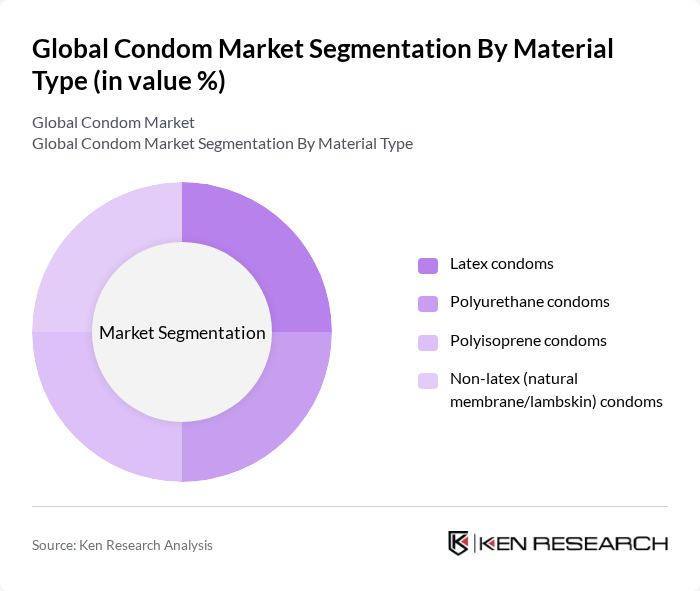
Global Condom Market segmentation by Material Type.

By Product:The product segmentation consists of male condoms and female condoms. Male condoms dominate the market, accounting for the majority of sales due to their established use and effectiveness in preventing pregnancy and STIs. Female condoms, while less popular, are gaining attention as they empower women to take control of their sexual health. The increasing awareness of female sexual health and the need for contraceptive options are driving growth in this segment. The rise in government and NGO-led initiatives to promote female condoms is also contributing to segment expansion .
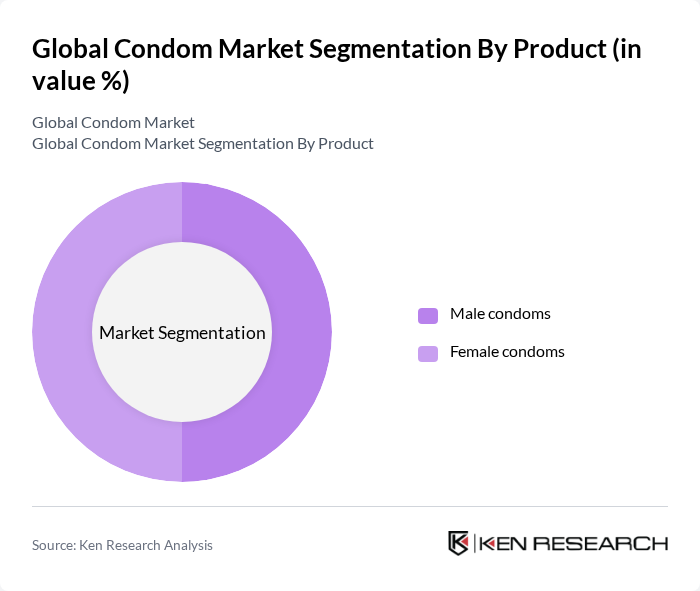
Global Condom Market segmentation by Product.

Global Condom Market Competitive Landscape

The Global Condom Market is characterized by a dynamic mix of regional and international players. Leading participants such as Reckitt Benckiser Group plc (Durex), Church & Dwight Co., Inc. (Trojan), LifeStyles Healthcare Pte Ltd, Okamoto Industries, Inc., Karex Berhad, Cupid Limited, TTK Protective Devices Ltd., HLL Lifecare Limited (Moods), Fuji Latex Co., Ltd., Mankind Pharma Ltd. (Manforce), RRT Medcon, Glyde Health, Sagami Rubber Industries Co., Ltd., RFSU AB, Thai Nippon Rubber Industry Plc (ONE Condoms) contribute to innovation, geographic expansion, and service delivery in this space.

Reckitt Benckiser Group plc (Durex)

1823

Slough, United Kingdom

Church & Dwight Co., Inc. (Trojan)

1846

Ewing, New Jersey, USA

LifeStyles Healthcare Pte Ltd

1985

Singapore

Okamoto Industries, Inc.

1934

Tokyo, Japan

Karex Berhad

1988

Port Klang, Malaysia

Company

Establishment Year

Headquarters

Group Size (Large, Medium, or Small as per industry convention)

Global Condom Revenue (USD, latest FY)

Revenue Growth Rate (%)

Market Share (%)

Geographic Presence (No. of countries/regions)

Product Portfolio Breadth (No. of SKUs/brands)

Global Condom Market Industry Analysis

Growth Drivers

  • Increasing Awareness of Sexual Health:The global emphasis on sexual health education has surged, with over 1.5 billion people reached through various health campaigns in future. This heightened awareness has led to a 20% increase in condom usage among sexually active individuals, particularly in regions where education initiatives have been implemented. The World Health Organization reported that countries investing in sexual health education saw a direct correlation with reduced STI rates, further driving condom demand.
  • Rising Demand for Contraceptives:The contraceptive market is projected to grow significantly, with an estimated 1.2 billion women of reproductive age globally seeking effective birth control methods in future. This demand is fueled by increased access to healthcare services and family planning resources, particularly in developing nations. The United Nations reported that contraceptive prevalence rates have risen by 15% in these regions, directly impacting condom sales as a preferred method of contraception.
  • Growth in E-commerce and Online Sales:E-commerce platforms have revolutionized condom distribution, with online sales expected to reach USD 1.5 billion in future, reflecting a 30% increase from previous periods. The convenience of online shopping, coupled with discreet packaging, has attracted a younger demographic, particularly millennials and Gen Z. According to Statista, 40% of consumers aged 18-34 prefer purchasing sexual health products online, driving significant growth in this segment of the market.

Market Challenges

  • Stigma Associated with Condom Use:Despite increasing awareness, stigma surrounding condom use persists, particularly in conservative cultures. A survey by the Global Health Institute indicated that 35% of individuals in certain regions still feel embarrassed purchasing condoms, which negatively impacts sales. This cultural barrier can hinder market penetration, especially in areas where open discussions about sexual health remain taboo, limiting growth opportunities for manufacturers.
  • Competition from Alternative Contraceptive Methods:The rise of alternative contraceptive methods, such as hormonal implants and IUDs, poses a significant challenge to condom sales. In future, approximately 300 million women are estimated to opt for long-term contraceptive solutions, representing a 25% increase from previous periods. This shift in preference can divert potential customers away from condoms, necessitating innovative marketing strategies to retain market share in an increasingly competitive landscape.

Global Condom Market Future Outlook

The future of the condom market appears promising, driven by ongoing innovations and changing consumer preferences. As awareness of sexually transmitted infections (STIs) continues to rise, the demand for effective protection is expected to grow. Additionally, the integration of technology in product development, such as smart condoms, is likely to attract tech-savvy consumers. Companies that adapt to these trends and focus on sustainability will likely capture a larger market share in the coming years.

Market Opportunities

  • Expansion into Emerging Markets:Emerging markets present significant growth opportunities, with a projected increase of 500 million potential condom users in future. Companies that tailor their products to local preferences and invest in education campaigns can effectively penetrate these markets, enhancing brand loyalty and market presence.
  • Development of Eco-friendly Products:The demand for sustainable products is on the rise, with 60% of consumers willing to pay more for eco-friendly options. Manufacturers focusing on biodegradable materials and sustainable practices can tap into this growing segment, appealing to environmentally conscious consumers and differentiating themselves in a crowded market.

Scope of the Report

SegmentSub-Segments
By Material Type

Latex condoms

Polyurethane condoms

Polyisoprene condoms

Non-latex (natural membrane/lambskin) condoms

By Product

Male condoms

Female condoms

By End-User

Individuals (Men)

Individuals (Women)

Institutional (Government, NGOs, Health Organizations)

By Distribution Channel

Pharmacies/Drug Stores

Supermarkets/Hypermarkets

E-commerce/Online Retail

Mass Merchandisers

Convenience Stores

By Region

North America

Europe

Asia Pacific

Middle East & Africa

South America

Key Target Audience

Investors and Venture Capitalist Firms

Government and Regulatory Bodies (e.g., World Health Organization, Centers for Disease Control and Prevention)

Manufacturers and Producers

Distributors and Retailers

Healthcare Providers and Clinics

Non-Governmental Organizations (NGOs) focused on sexual health

Pharmaceutical Companies

Public Health Agencies

Players Mentioned in the Report:

Reckitt Benckiser Group plc (Durex)

Church & Dwight Co., Inc. (Trojan)

LifeStyles Healthcare Pte Ltd

Okamoto Industries, Inc.

Karex Berhad

Cupid Limited

TTK Protective Devices Ltd.

HLL Lifecare Limited (Moods)

Fuji Latex Co., Ltd.

Mankind Pharma Ltd. (Manforce)

RRT Medcon

Glyde Health

Sagami Rubber Industries Co., Ltd.

RFSU AB

Thai Nippon Rubber Industry Plc (ONE Condoms)

Table of Contents

Market Assessment Phase

1. Executive Summary and Approach


2. Global Condom Market Overview

2.1 Key Insights and Strategic Recommendations

2.2 Global Condom Market Overview

2.3 Definition and Scope

2.4 Evolution of Market Ecosystem

2.5 Timeline of Key Regulatory Milestones

2.6 Value Chain & Stakeholder Mapping

2.7 Business Cycle Analysis

2.8 Policy & Incentive Landscape


3. Global Condom Market Analysis

3.1 Growth Drivers

3.1.1 Increasing awareness of sexual health
3.1.2 Rising demand for contraceptives
3.1.3 Growth in e-commerce and online sales
3.1.4 Innovations in product design and materials

3.2 Market Challenges

3.2.1 Stigma associated with condom use
3.2.2 Competition from alternative contraceptive methods
3.2.3 Regulatory hurdles in different regions
3.2.4 Price sensitivity among consumers

3.3 Market Opportunities

3.3.1 Expansion into emerging markets
3.3.2 Development of eco-friendly products
3.3.3 Collaborations with health organizations
3.3.4 Customization and personalization of products

3.4 Market Trends

3.4.1 Increasing demand for premium products
3.4.2 Growth of subscription services
3.4.3 Rise in awareness of STIs and safe sex
3.4.4 Technological advancements in product features

3.5 Government Regulation

3.5.1 Mandatory health education programs
3.5.2 Regulations on advertising and marketing
3.5.3 Quality standards for manufacturing
3.5.4 Import/export regulations for contraceptives

4. SWOT Analysis


5. Stakeholder Analysis


6. Porter's Five Forces Analysis


7. Global Condom Market Market Size, 2019-2024

7.1 By Value

7.2 By Volume

7.3 By Average Selling Price


8. Global Condom Market Segmentation

8.1 By Material Type

8.1.1 Latex condoms
8.1.2 Polyurethane condoms
8.1.3 Polyisoprene condoms
8.1.4 Non-latex (natural membrane/lambskin) condoms

8.2 By Product

8.2.1 Male condoms
8.2.2 Female condoms

8.3 By End-User

8.3.1 Individuals (Men)
8.3.2 Individuals (Women)
8.3.3 Institutional (Government, NGOs, Health Organizations)

8.4 By Distribution Channel

8.4.1 Pharmacies/Drug Stores
8.4.2 Supermarkets/Hypermarkets
8.4.3 E-commerce/Online Retail
8.4.4 Mass Merchandisers
8.4.5 Convenience Stores

8.5 By Region

8.5.1 North America
8.5.2 Europe
8.5.3 Asia Pacific
8.5.4 Middle East & Africa
8.5.5 South America

9. Global Condom Market Competitive Analysis

9.1 Market Share of Key Players

9.2 KPIs for Cross Comparison of Key Players

9.2.1 Company Name
9.2.2 Group Size (Large, Medium, or Small as per industry convention)
9.2.3 Global Condom Revenue (USD, latest FY)
9.2.4 Revenue Growth Rate (%)
9.2.5 Market Share (%)
9.2.6 Geographic Presence (No. of countries/regions)
9.2.7 Product Portfolio Breadth (No. of SKUs/brands)
9.2.8 R&D/Innovation Spend (% of revenue)
9.2.9 Distribution Network Reach (No. of retail points/partners)
9.2.10 Brand Recognition Index (survey-based score)
9.2.11 Customer Satisfaction Score (NPS or equivalent)
9.2.12 Sustainability/Eco-friendly Product Share (%)

9.3 SWOT Analysis of Top Players

9.4 Pricing Analysis

9.5 Detailed Profile of Major Companies

9.5.1 Reckitt Benckiser Group plc (Durex)
9.5.2 Church & Dwight Co., Inc. (Trojan)
9.5.3 LifeStyles Healthcare Pte Ltd
9.5.4 Okamoto Industries, Inc.
9.5.5 Karex Berhad
9.5.6 Cupid Limited
9.5.7 TTK Protective Devices Ltd.
9.5.8 HLL Lifecare Limited (Moods)
9.5.9 Fuji Latex Co., Ltd.
9.5.10 Mankind Pharma Ltd. (Manforce)
9.5.11 RRT Medcon
9.5.12 Glyde Health
9.5.13 Sagami Rubber Industries Co., Ltd.
9.5.14 RFSU AB
9.5.15 Thai Nippon Rubber Industry Plc (ONE Condoms)

10. Global Condom Market End-User Analysis

10.1 Procurement Behavior of Key Ministries

10.1.1 Government health departments
10.1.2 Educational institutions
10.1.3 NGOs and non-profit organizations
10.1.4 Others

10.2 Corporate Spend on Infrastructure & Energy

10.2.1 Investment in health campaigns
10.2.2 Funding for sexual health education
10.2.3 Partnerships with health organizations
10.2.4 Others

10.3 Pain Point Analysis by End-User Category

10.3.1 Accessibility issues
10.3.2 Affordability concerns
10.3.3 Stigma and cultural barriers
10.3.4 Others

10.4 User Readiness for Adoption

10.4.1 Awareness of product benefits
10.4.2 Availability in local markets
10.4.3 Education on proper usage
10.4.4 Others

10.5 Post-Deployment ROI and Use Case Expansion

10.5.1 Increased usage rates
10.5.2 Feedback from end-users
10.5.3 Expansion into new demographics
10.5.4 Others

11. Global Condom Market Future Size, 2025-2030

11.1 By Value

11.2 By Volume

11.3 By Average Selling Price


Go-To-Market Strategy Phase

1. Whitespace Analysis + Business Model Canvas

1.1


2. Marketing and Positioning Recommendations

2.1


3. Distribution Plan

3.1


4. Channel & Pricing Gaps

4.1


5. Unmet Demand & Latent Needs

5.1


6. Customer Relationship

7.1


7. Value Proposition

8.1


8. Key Activities

9.1


9. Entry Strategy Evaluation

9.1 Domestic Market Entry Strategy

10.1.1

9.2 Export Entry Strategy

10.2.1

10. Entry Mode Assessment

11.1


11. Capital and Timeline Estimation

12.1


12. Control vs Risk Trade-Off

13.1


13. Profitability Outlook

14.1


14. Potential Partner List

15.1


15. Execution Roadmap

15.1 Phased Plan for Market Entry

16.1.1

15.2 Key Activities and Milestones

16.2.1

Research Methodology

ApproachModellingSample

Phase 1: Approach1

Desk Research

  • Analysis of global condom market reports from industry associations and health organizations
  • Review of demographic and sexual health statistics from WHO and national health departments
  • Examination of market trends and consumer behavior studies published in academic journals

Primary Research

  • Interviews with product managers at leading condom manufacturers
  • Surveys with healthcare professionals and sexual health educators
  • Focus groups with consumers to understand preferences and purchasing behavior

Validation & Triangulation

  • Cross-validation of findings with sales data from retail and online channels
  • Triangulation of insights from primary interviews and secondary data sources
  • Sanity checks through expert reviews from industry analysts and market consultants

Phase 2: Market Size Estimation1

Top-down Assessment

  • Estimation of total market size based on global population and sexual health statistics
  • Segmentation by product type (e.g., latex, non-latex, flavored) and distribution channel
  • Incorporation of regional market dynamics and cultural factors influencing condom usage

Bottom-up Modeling

  • Volume estimates derived from sales data of major condom brands across various regions
  • Analysis of pricing strategies and average selling prices in different markets
  • Calculation of market size based on unit sales and revenue generation from key segments

Forecasting & Scenario Analysis

  • Multi-factor regression analysis considering factors like population growth and awareness campaigns
  • Scenario modeling based on potential changes in sexual health policies and education initiatives
  • Development of baseline, optimistic, and pessimistic market projections through 2030

Phase 3: CATI Sample Composition1

Scope Item/SegmentSample SizeTarget Respondent Profiles
Retail Sales of Condoms100Store Managers, Sales Representatives
Healthcare Provider Insights80Doctors, Nurses, Sexual Health Counselors
Consumer Preferences Survey150Adults aged 18-45, Diverse Demographics
Market Trends Analysis70Market Analysts, Industry Experts
Distribution Channel Feedback60Wholesalers, Distributors, Retail Buyers

Frequently Asked Questions

What is the current value of the global condom market?

The global condom market is valued at approximately USD 12.7 billion, driven by increasing awareness of sexual health, rising demand for contraceptives, and innovative product offerings. This market is expected to continue growing as consumer preferences evolve.

What factors are driving the growth of the condom market?

Which regions dominate the global condom market?

What are the main types of condoms available in the market?

Other Regional/Country Reports

Indonesia Global Condom Market

Malaysia Global Condom Market

KSA Global Condom Market

APAC Global Condom Market

SEA Global Condom Market

Vietnam Global Condom Market

Why Buy From Us?

Refine Robust Result (RRR) Framework

What makes us stand out is that our consultants follow Robust, Refine and Result (RRR) methodology. Robust for clear definitions, approaches and sanity checking, Refine for differentiating respondents' facts and opinions, and Result for presenting data with story.

Our Reach Is Unmatched

We have set a benchmark in the industry by offering our clients with syndicated and customized market research reports featuring coverage of entire market as well as meticulous research and analyst insights.

Shifting the Research Paradigm

While we don't replace traditional research, we flip the method upside down. Our dual approach of Top Bottom & Bottom Top ensures quality deliverable by not just verifying company fundamentals but also looking at the sector and macroeconomic factors.

More Insights-Better Decisions

With one step in the future, our research team constantly tries to show you the bigger picture. We help with some of the tough questions you may encounter along the way: How is the industry positioned? Best marketing channel? KPI's of competitors? By aligning every element, we help maximize success.

Transparency and Trust

Our report gives you instant access to the answers and sources that other companies might choose to hide. We elaborate each steps of research methodology we have used and showcase you the sample size to earn your trust.

Round the Clock Support

If you need any support, we are here! We pride ourselves on universe strength, data quality, and quick, friendly, and professional service.

Why Clients Choose Us?

400000+
Reports in repository
150+
Consulting projects a year
100+
Analysts
8000+
Client Queries in 2022








