
Global Container Loading System Market Outlook to 2030
Region:Global
Author(s):Paribhasha Tiwari
Product Code:KROD6806
December 2024
94
About the Report
Global Container Loading System Market Overview
- The global container loading system market is valued at USD 1.5 billion, based on a thorough historical analysis of the last five years. This market growth is propelled by the rising demand for automation in logistics and shipping operations, especially in major ports and industrial sectors worldwide. The integration of automated systems that enhance operational efficiency and reduce manual labor has been a significant growth driver. The increasing focus on optimizing supply chains and reducing shipping time is pushing businesses towards advanced container loading solutions.
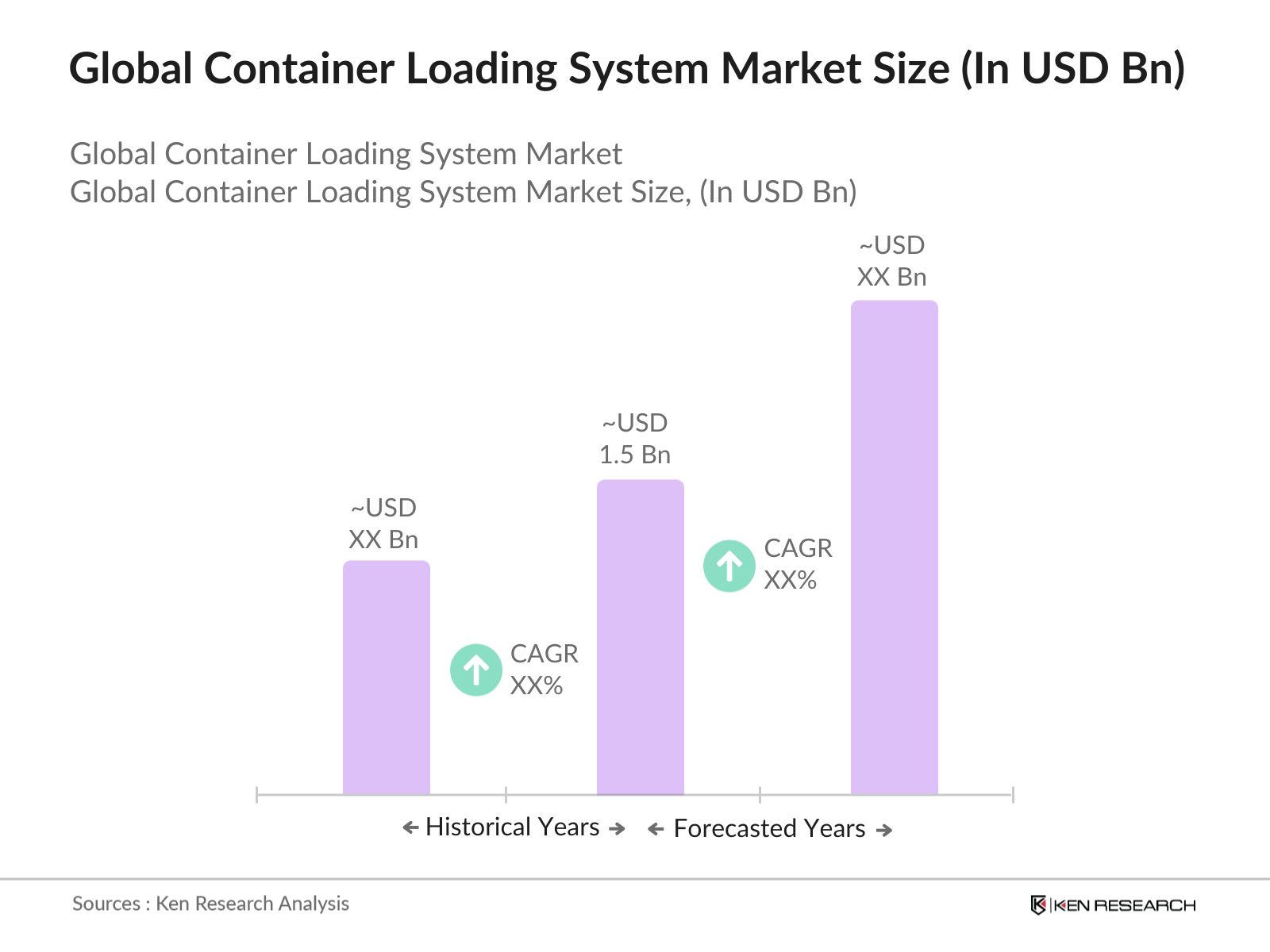
- Countries such as the United States, China, and Germany are the dominant players in the global container loading system market. The U.S. leads due to its advanced logistics infrastructure and the large scale of containerized goods transport. China is dominant due to its position as a global manufacturing hub, where rapid industrialization necessitates the use of efficient container loading systems. Germany's dominance is linked to its strong engineering and manufacturing sector, coupled with a high emphasis on automation and efficiency in the logistics industry.
- Governments across Asia-Pacific and Europe are investing heavily in port infrastructure development to support increasing trade volumes. For example, in 2024, the Indian government allocated $10 billion for port expansion under the Sagarmala project, which includes the installation of modern container loading systems. These government-backed initiatives are aimed at improving the countrys logistics efficiency, making it a critical growth driver for the container loading system market.
Global Container Loading System Market Segmentation
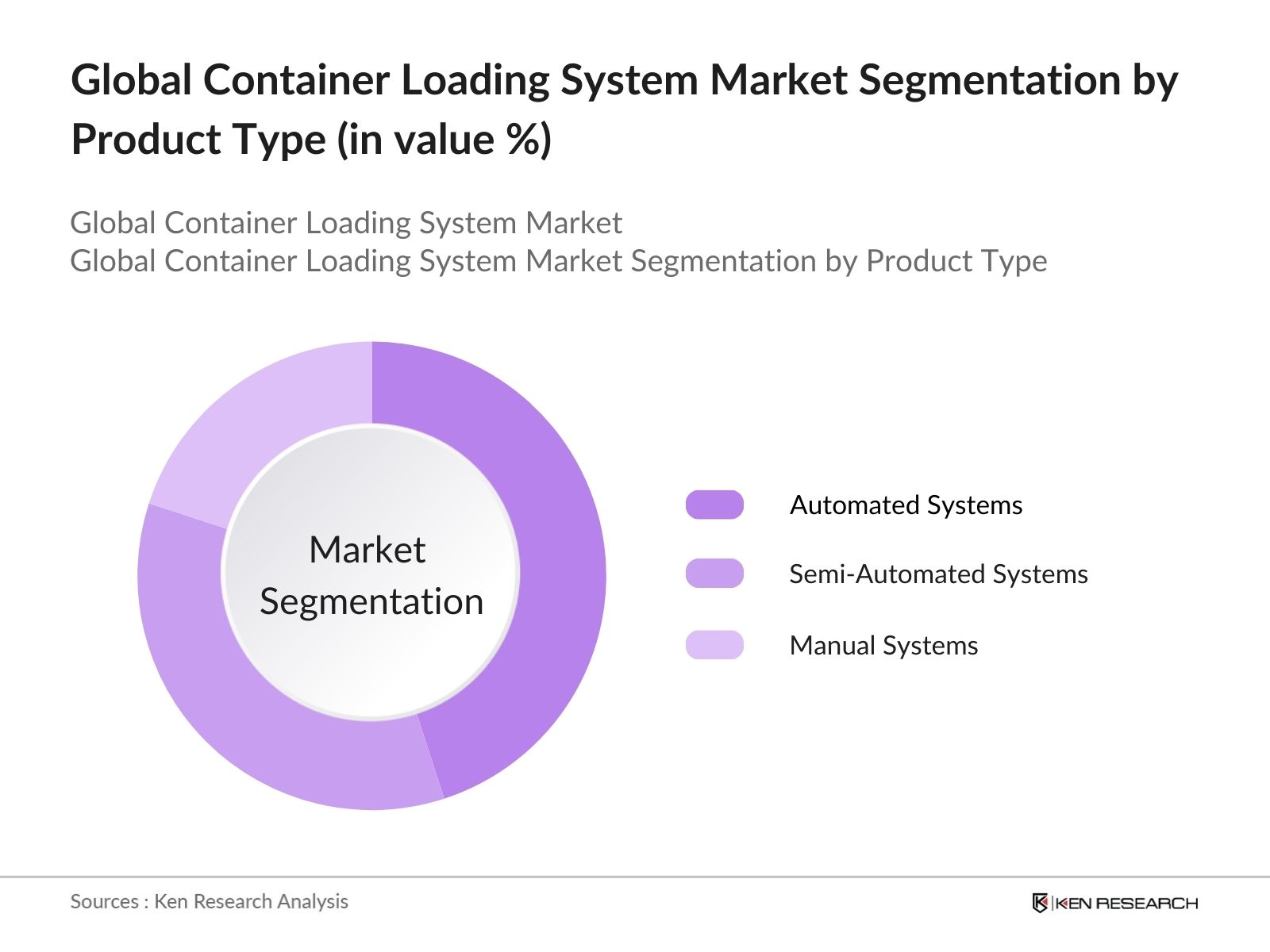
- By Product Type: The container loading system market is segmented by product type into automated systems, semi-automated systems, and manual systems. Automated systems dominate the global market as industries increasingly adopt automation to minimize labor costs and reduce loading times. With automated container loading systems, logistics companies can significantly boost operational efficiency, especially in sectors like shipping and warehousing. The demand for semi-automated systems remains robust in small- to medium-sized operations, particularly in regions where the initial investment costs of fully automated systems are a limiting factor.
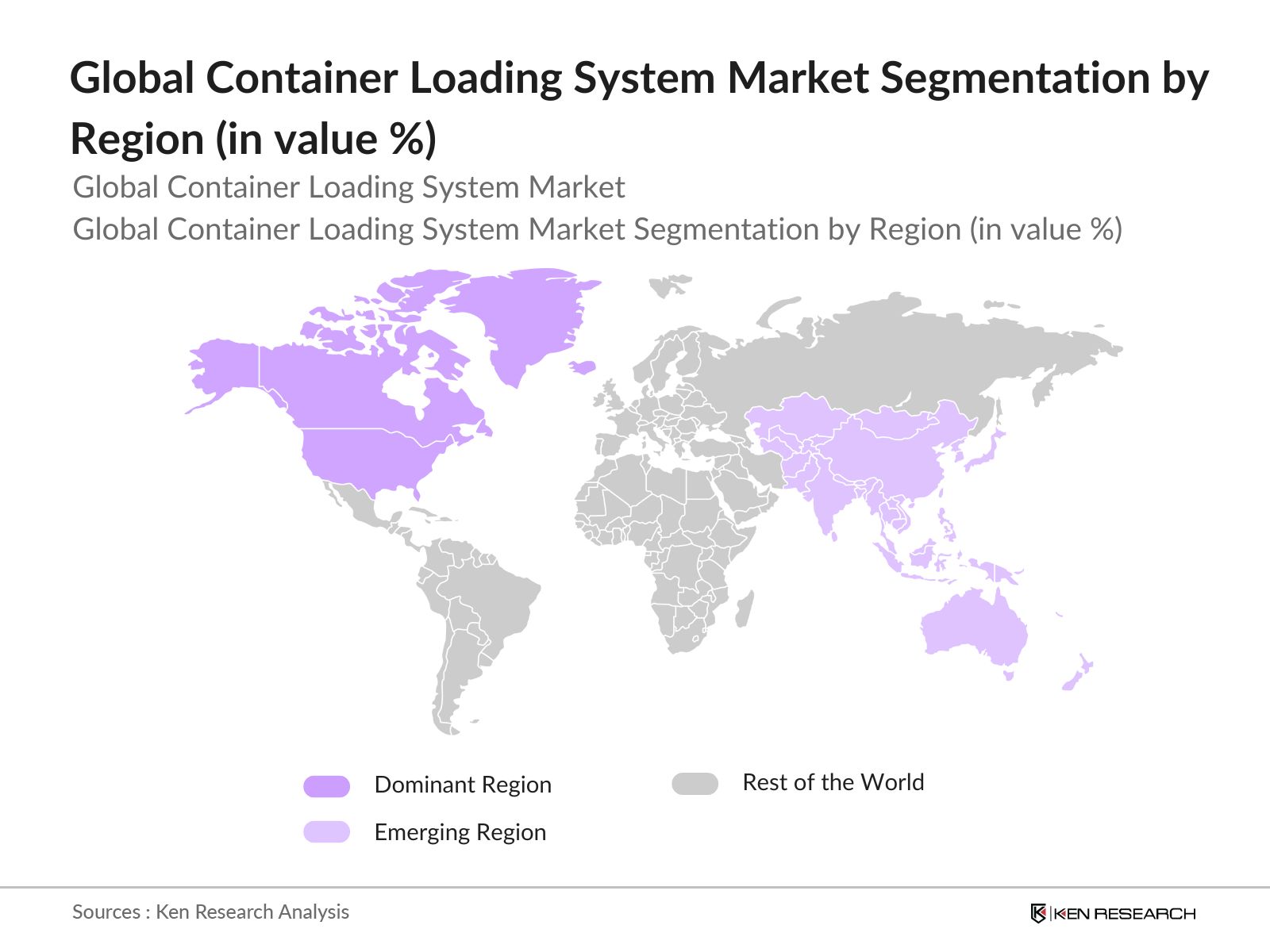
- By Region: Regional segmentation includes North America, Europe, Asia-Pacific, Latin America, and Middle East & Africa. North America holds the largest market share due to advanced technological adoption in logistics and shipping, especially in the U.S. Asia-Pacific follows closely behind, driven by Chinas massive manufacturing and export sector. Europe also has a significant market share, owing to its strong focus on automation and its well-developed logistics network.
- By Application: The market is also segmented by application into manufacturing, shipping, logistics, and warehousing. Shipping dominates this segment as the global demand for containerized goods continues to increase. Ports around the world are adopting automated container loading systems to handle the growing volume of goods being shipped internationally. Logistics and warehousing also see strong growth, driven by the need for faster and more efficient handling of goods in large distribution centers.
Global Container Loading System Market Competitive Landscape
The global container loading system market is concentrated with several key players holding a large market share. Companies are heavily investing in automation technologies and forming strategic partnerships to maintain their competitive edge.
|
Company |
Establishment Year |
Headquarters |
Product Range |
Geographic Reach |
R&D Investment |
Strategic Partnerships |
Client Base |
Pricing Models |
Installed Base |
|---|---|---|---|---|---|---|---|---|---|
|
Joloda Hydraroll |
1962 |
UK |
- | - | - | - | - | - | - |
|
Actiw LoadPlate |
1997 |
Finland |
- | - | - | - | - | - | - |
|
Acculoader |
2001 |
USA |
- | - | - | - | - | - | - |
|
BEUMER Group |
1935 |
Germany |
- | - | - | - | - | - | - |
|
Ancra Systems |
1992 |
Netherlands |
- | - | - | - | - | - | - |
Global Container Loading System Market Analysis
Makret Growth Drivers
- Increasing Automation in Logistics: The logistics sector is rapidly adopting automation, particularly in container loading systems, to reduce operational costs and improve efficiency. In 2024, over 80 million containers are expected to be handled globally, driven by advanced automated systems. Ports like Singapore and Rotterdam are increasingly implementing automated container handling, with systems that streamline loading and unloading processes. This shift is being supported by growing demand for real-time data collection, automation technologies, and robotic systems in global logistics operations. Ports such as these are significantly investing in automated infrastructure to handle the expected surge in container traffic.
- Growth in Global Trade and Containerization: The global trade network is expanding, with around 750 million twenty-foot equivalent units (TEUs) of containers projected to be moved globally in 2024, showing a consistent rise in containerization. Container loading systems are crucial for handling this massive trade volume. Key ports in Asia-Pacific and North America have seen an increase in container throughput, driven by the growth of international trade agreements and the shift toward container-based shipping for efficiency and security. The use of container loading systems supports the quick and efficient movement of goods through these global trade hubs.
- Expansion of Ports and Maritime Trade: Ports worldwide are undergoing significant expansion to accommodate larger vessels and higher container volumes, with global maritime trade expected to handle over 12 billion tons of cargo in 2024. Container loading systems are critical to supporting this growth by improving the speed and efficiency of operations. In markets such as Asia-Pacific and Latin America, governments and private investors are investing billions into expanding port infrastructure, including the integration of automated loading systems. This development is crucial for meeting the rising demand for containerized goods.
Market Challenges
- Technical Complexity of Fully Automated Systems: Fully automated container loading systems are highly complex, requiring advanced software, robotics, and maintenance. This complexity poses a significant challenge for logistics operators, particularly in emerging markets where technical expertise and infrastructure are still developing. For example, over 20% of ports in Asia-Pacific face challenges in integrating fully automated systems due to a lack of skilled technicians and supporting infrastructure. This complexity increases downtime and operational costs if not properly managed, affecting the overall efficiency of container loading.
- High Initial Investment Costs: The installation of automated container loading systems requires significant capital investment, which can be a barrier for small to medium-sized ports and operators. In 2024, it is estimated that the installation of a fully automated container loading system costs between $15 million to $50 million, depending on the size and complexity of the system. Smaller operators in markets such as Latin America and Southeast Asia struggle to secure the necessary funding to implement these systems, limiting their ability to compete with larger, better-funded ports.
Global Container Loading System Market Future Outlook
The global container loading system market is poised for significant growth over the next five years. The increasing integration of automation in logistics, coupled with advancements in robotics and IoT-enabled systems, is expected to drive the market forward. Furthermore, the growing demand for faster, more efficient shipping and logistics services will fuel the need for advanced container loading systems. Major companies are expected to continue investing in research and development to stay ahead of the competition.
Market Opportunities
- Integration with Internet of Things (IoT): The integration of IoT in container loading systems is set to revolutionize logistics by offering real-time monitoring and predictive maintenance. By 2024, it is projected that over 60% of global ports will adopt IoT-enabled container loading systems, improving operational efficiency and reducing downtime. Ports in North America and Europe are leading the adoption of IoT technologies, which enable predictive analytics, ensuring equipment longevity and reducing the likelihood of failures. These systems allow operators to track and optimize loading processes, ultimately cutting down costs and improving throughput.
- Expansion in Emerging Markets (Asia-Pacific, Latin America): Emerging markets, particularly in Asia-Pacific and Latin America, are investing heavily in upgrading their port infrastructure. In 2024, it is expected that Asia-Pacific will invest over $150 billion in port expansion projects, many of which will include advanced container loading systems. Governments in countries like Indonesia and Brazil are providing incentives to attract foreign investment for infrastructure development, positioning these regions as critical growth areas for the container loading system market. These investments will open new markets for automated systems as global trade volumes increase.
Scope of the Report
|
By Product Type |
Automated Systems Semi-Automated Systems Manual Systems |
|
By Application |
Manufacturing Shipping Logistics Warehousing |
|
By Technology |
Robotics Mechanical Conveyance Pneumatic Systems |
|
By Capacity |
Small-Scale Operations Medium-Scale Operations Large-Scale Operations |
|
By Region |
North America Europe Asia-Pacific Latin America Middle East & Africa |
Products
Key Target Audience
Logistics Companies
Shipping Companies
Warehouse Operators
Manufacturing Firms
Investors and Venture Capitalist Firms
Government and Regulatory Bodies (e.g., U.S. Department of Transportation, International Maritime Organization)
Port Authorities
Automation Solution Providers
Companies
Players Mentioned in the Report:
Joloda Hydraroll
Actiw LoadPlate
Acculoader
BEUMER Group
Ancra Systems
Seacon Group
Flexicon Corporation
Dyno Conveyors
Caljan Rite-Hite
EuroSort Systems
Table of Contents
1. Global Container Loading System Market Overview
1.1. Definition and Scope
1.2. Market Taxonomy
1.3. Market Growth Rate
1.4. Market Segmentation Overview
2. Global Container Loading System Market Size (In USD Bn)
2.1. Historical Market Size
2.2. Year-On-Year Growth Analysis
2.3. Key Market Developments and Milestones
3. Global Container Loading System Market Analysis
3.1. Growth Drivers (Automation, Global Logistics Growth, Port Expansions, Environmental Efficiency)
3.1.1. Increasing Automation in Logistics
3.1.2. Growth in Global Trade and Containerization
3.1.3. Expansion of Ports and Maritime Trade
3.1.4. Environmental Efficiency and Energy-Saving Initiatives
3.2. Market Challenges (Technical Complexity, High Initial Investment, Regulatory Compliance, Skilled Labor Shortage)
3.2.1. Technical Complexity of Fully Automated Systems
3.2.2. High Initial Investment Costs
3.2.3. Regulatory Compliance Issues Across Regions
3.2.4. Shortage of Skilled Labor for System Maintenance
3.3. Opportunities (IoT Integration, Emerging Markets, Leasing Options, E-commerce Growth)
3.3.1. Integration with Internet of Things (IoT)
3.3.2. Expansion in Emerging Markets (Asia-Pacific, Latin America)
3.3.3. Introduction of Flexible Leasing and Rental Options
3.3.4. Growth in E-commerce Driving Demand for Efficient Loading Solutions
3.4. Trends (Digitalization, AI-Powered Systems, Robotics, Sustainability)
3.4.1. Adoption of AI-Powered Loading Systems
3.4.2. Integration of Robotics and Automation
3.4.3. Digitalization of Loading Processes
3.4.4. Focus on Sustainability and Carbon Footprint Reduction
3.5. Government Regulations (Safety Standards, Emission Norms, Trade Policies, Local Content Requirements)
3.5.1. International Safety Standards (ISO)
3.5.2. Emission Norms for Logistics Equipment
3.5.3. Trade Policies Impacting Global Freight
3.5.4. Local Content Requirements for System Manufacturers
3.6. SWOT Analysis
3.7. Porters Five Forces Analysis
3.8. Competition Ecosystem Analysis
4. Global Container Loading System Market Segmentation
4.1. By Product Type (Automated Systems, Semi-Automated Systems, Manual Systems)
4.1.1. Fully Automated Container Loading Systems
4.1.2. Semi-Automated Container Loading Systems
4.1.3. Manual Loading Systems
4.2. By Application (Manufacturing, Shipping, Logistics, Warehousing)
4.2.1. Manufacturing Sector
4.2.2. Shipping Industry
4.2.3. Logistics and Distribution
4.2.4. Warehousing and Storage
4.3. By Technology (Robotics, Mechanical Conveyance, Pneumatic Systems)
4.3.1. Robotics-Based Loading Systems
4.3.2. Mechanical Conveyance Systems
4.3.3. Pneumatic Loading Systems
4.4. By Capacity (Small-Scale, Medium-Scale, Large-Scale Operations)
4.4.1. Small-Scale Operations
4.4.2. Medium-Scale Operations
4.4.3. Large-Scale Operations
4.5. By Region (North America, Europe, Asia-Pacific, Latin America, Middle East & Africa)
4.5.1. North America
4.5.2. Europe
4.5.3. Asia-Pacific
4.5.4. Latin America
4.5.5. Middle East & Africa
5. Global Container Loading System Market Competitive Analysis
5.1. Detailed Profiles of Major Companies (Financials, Products, Recent Developments, Market Share)
5.1.1. Joloda Hydraroll
5.1.2. Actiw LoadPlate
5.1.3. Acculoader
5.1.4. Conveyor Industries NZ
5.1.5. JMC Recycling
5.1.6. Ancra Systems
5.1.7. BEUMER Group
5.1.8. Seacon Group
5.1.9. Westmatic Corporation
5.1.10. Caljan Rite-Hite
5.1.11. SAMSON Materials Handling
5.1.12. EuroSort Systems
5.1.13. Vanderlande Industries
5.1.14. Flexicon Corporation
5.1.15. Dyno Conveyors
5.2. Cross Comparison Parameters (Product Range, Geographic Reach, R&D Investment, Installed Base, Partnerships, Client Base, Market Share, Pricing Models)
5.3. Market Share Analysis
5.4. Strategic Initiatives
5.5. Mergers and Acquisitions
5.6. Investment Analysis
6. Global Container Loading System Market Regulatory Framework
6.1. Environmental Standards Compliance
6.2. Safety and Occupational Health Regulations
6.3. Import/Export Policies
6.4. Certification and Licensing Requirements
7. Global Container Loading System Future Market Size (In USD Bn)
7.1. Future Market Size Projections
7.2. Key Factors Driving Future Market Growth
8. Global Container Loading System Future Market Segmentation
8.1. By Product Type
8.2. By Application
8.3. By Technology
8.4. By Capacity
8.5. By Region
9. Global Container Loading System Market Analysts' Recommendations
9.1. TAM/SAM/SOM Analysis
9.2. Competitive Benchmarking
9.3. White Space Opportunity Analysis
9.4. Strategic Market Entry Recommendations
Disclaimer Contact UsResearch Methodology
Step 1: Identification of Key Variables
The first step involves mapping out the entire ecosystem of stakeholders within the global container loading system market. This is achieved through detailed secondary research, which helps identify key variables influencing the market, such as technological trends, supply chain logistics, and automation standards.
Step 2: Market Analysis and Construction
The second step focuses on gathering and analyzing historical data related to the global container loading system market. This includes data on product penetration, market revenue trends, and user adoption rates. The aim is to construct a reliable model that reflects the markets current status.
Step 3: Hypothesis Validation and Expert Consultation
During this phase, interviews with industry experts and key market players are conducted. These consultations help validate hypotheses and provide insights into operational trends, technological developments, and competitive dynamics.
Step 4: Research Synthesis and Final Output
The final stage involves synthesizing the collected data into a comprehensive analysis of the market. This includes triangulating data from various sources and validating it through multiple approaches to ensure its accuracy.
Frequently Asked Questions
01. How big is the global container loading system market?
The global container loading system market is valued at USD 1.5 billion. The market is driven by the rising demand for automation in logistics and enhanced operational efficiency.
02. What are the challenges in the global container loading system market?
Challenges in the global container loading system market include high initial investment costs for automated systems, technical complexities in installation, and the shortage of skilled labor for maintaining advanced systems.
03. Who are the major players in the global container loading system market?
Major players in the global container loading system market include Joloda Hydraroll, Actiw LoadPlate, Acculoader, BEUMER Group, and Ancra Systems. These companies dominate due to their strong global presence and wide range of product offerings.
04. What is driving the growth of the container loading system market?
The growth of the global container loading system market is driven by factors such as the adoption of automated systems, advancements in IoT integration, and the increasing demand for efficiency in logistics and shipping operations.
Why Buy From Us?

What makes us stand out is that our consultants follows Robust, Refine and Result (RRR) methodology. i.e. Robust for clear definitions, approaches and sanity checking, Refine for differentiating respondents facts and opinions and Result for presenting data with story

We have set a benchmark in the industry by offering our clients with syndicated and customized market research reports featuring coverage of entire market as well as meticulous research and analyst insights.

While we don't replace traditional research, we flip the method upside down. Our dual approach of Top Bottom & Bottom Top ensures quality deliverable by not just verifying company fundamentals but also looking at the sector and macroeconomic factors.

With one step in the future, our research team constantly tries to show you the bigger picture. We help with some of the tough questions you may encounter along the way: How is the industry positioned? Best marketing channel? KPI's of competitors? By aligning every element, we help maximize success.

Our report gives you instant access to the answers and sources that other companies might choose to hide. We elaborate each steps of research methodology we have used and showcase you the sample size to earn your trust.

If you need any support, we are here! We pride ourselves on universe strength, data quality, and quick, friendly, and professional service.