
Global Dark Fiber Market Outlook to 2030
Region:Global
Author(s):Mukul
Product Code:KROD6137
December 2024
95
About the Report
Global Dark Fiber Market Overview
- The global dark fibre market is valued at USD 6.5 billion, with a strong demand fueled by the continuous expansion of data-driven technologies such as 5G, cloud computing, and IoT. This growth is driven by the surge in data traffic, requiring enhanced bandwidth and low-latency networks, which dark fiber networks can provide. Enterprises are also looking for greater control over their network infrastructure, further driving demand for dedicated dark fiber lines. The investment in dark fiber continues to expand, as companies are transitioning to more secure, scalable, and flexible solutions to support their data center and network needs.
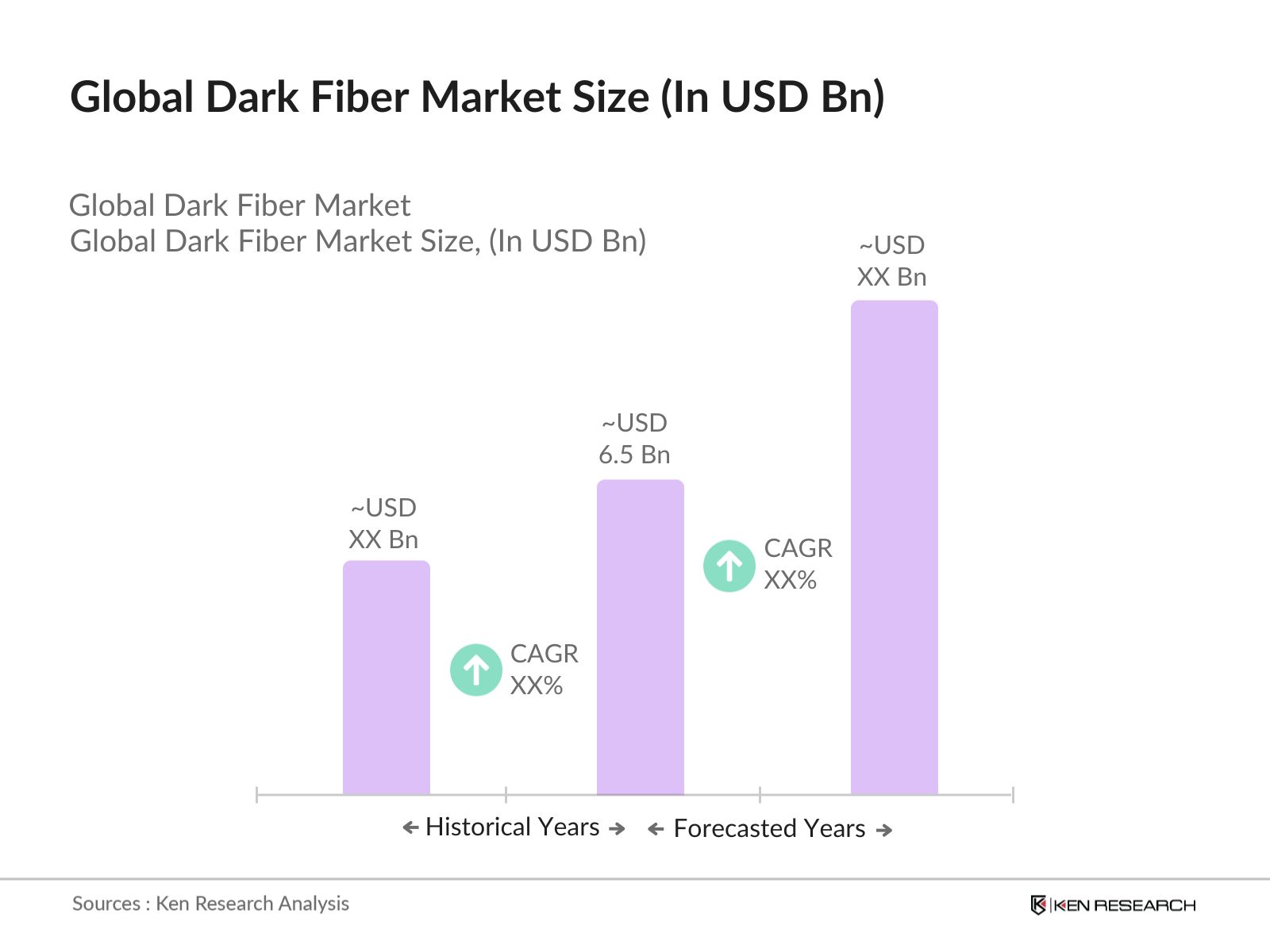
- Key regions such as North America and Europe dominate the global dark fiber market, largely due to their advanced infrastructure, high demand for faster internet speeds, and the growing adoption of cloud-based solutions. The United States leads the market, driven by the concentration of large enterprises and data centers, while Europe benefits from significant investments in smart cities and 5G networks. These regions' dominance is primarily due to favorable regulations and robust investment in high-tech sectors.
- Governments are increasingly focusing on data privacy and security regulations as dark fiber networks expand. In 2023, the European Union's General Data Protection Regulation (GDPR) and similar frameworks in other regions have imposed stringent data handling and security requirements on fiber network operators. Ensuring compliance with these standards requires significant investment in cybersecurity infrastructure and protocols. Network operators must balance the need for rapid fiber deployment with adherence to these regulations to avoid legal and financial penalties.
Global Dark Fiber Market Segmentation
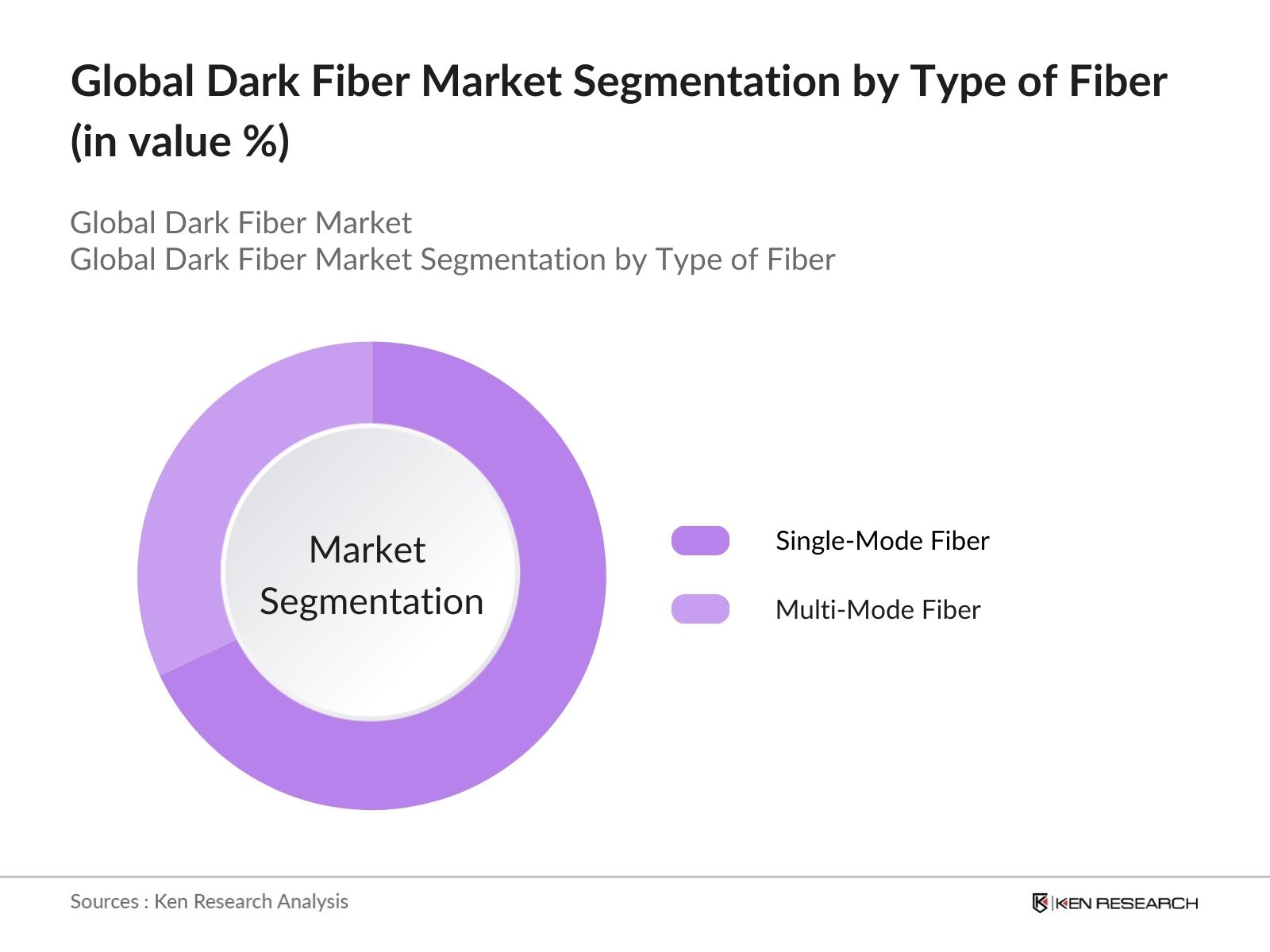
- By Type of Fiber: The dark fiber market is segmented by type of fiber into single-mode fiber and multi-mode fiber. Single-mode fiber dominates the market, primarily due to its ability to transmit data over longer distances with lower signal loss. This characteristic makes it ideal for long-haul networks, where data needs to travel large distances across cities or regions. As enterprises and service providers expand their long-distance networks, single-mode fiber has become the preferred choice for reducing costs and maximizing efficiency.
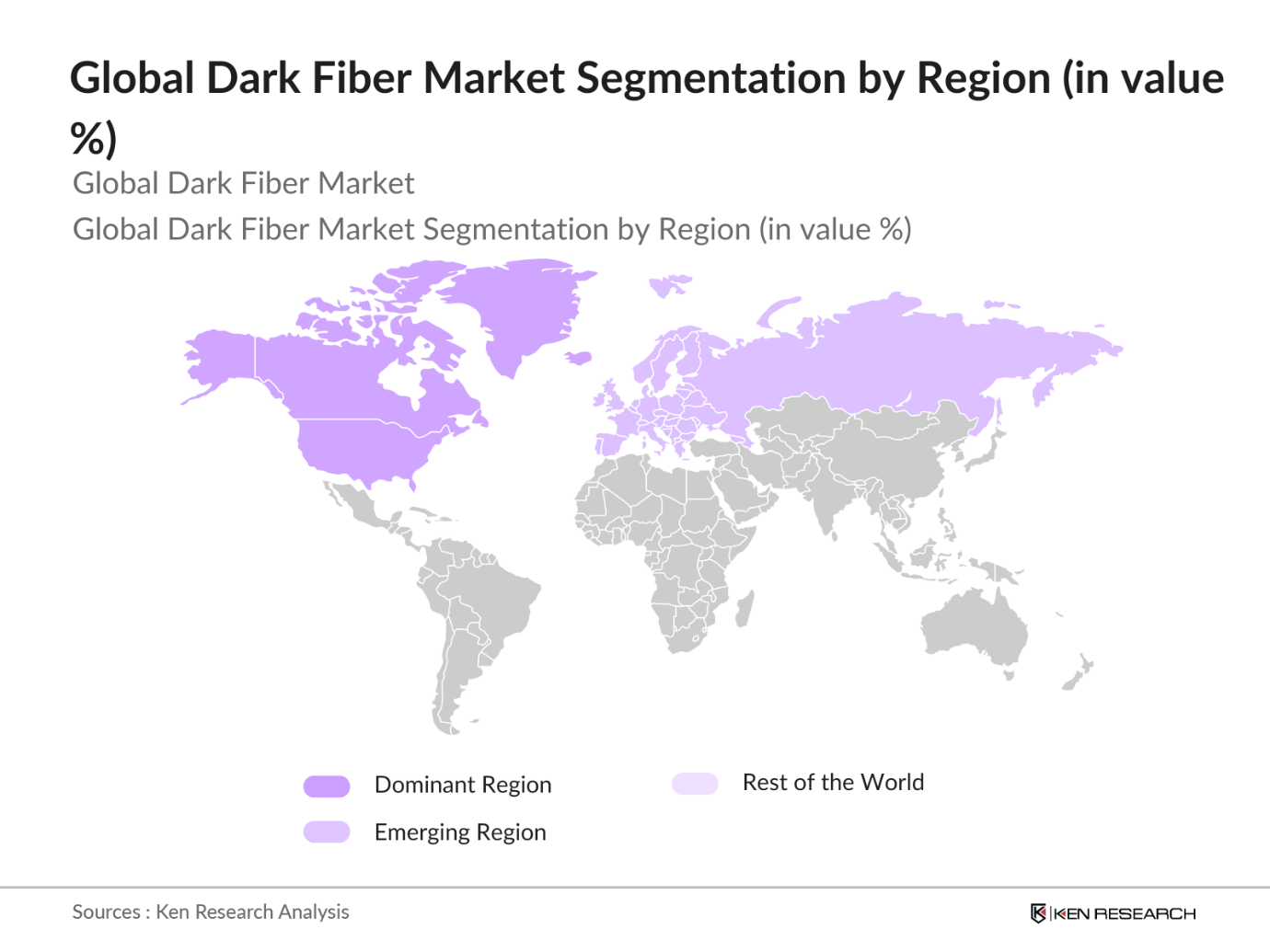
- By Region: Geographically, the dark fiber market is segmented into North America, Europe, Asia Pacific, Latin America, and the Middle East & Africa. North America leads the market, with the United States being the primary contributor due to its strong demand for cloud services, data centers, and telecommunication advancements. The European market follows, benefiting from governmental initiatives to support smart cities and enhanced network infrastructure. In Asia Pacific, the market is growing rapidly, driven by technological advancements and increasing urbanization, particularly in countries like China and India.
- By Application: The dark fiber market is segmented by application into telecom, BFSI, IT and ITES, government and defense, and healthcare. The telecom sector holds the largest market share, driven by the increasing demand for 5G infrastructure and the expansion of high-speed broadband services. Telecom companies are continuously upgrading their networks to handle the growing data demands from mobile users, businesses, and IoT devices. The need for higher bandwidth and lower latency makes dark fiber a critical component for modern telecom networks.
Global Dark Fiber Market Competitive Landscape
The global dark fiber market is dominated by a few key players, with companies focusing on expanding their fiber infrastructure and entering strategic partnerships. These players are investing heavily in enhancing their fiber capacity to meet the growing demands of telecom, cloud services, and data center industries. The competitive landscape is characterized by both large telecom companies and specialized dark fiber providers competing for a share in this fast-growing market.
|
Company Name |
Establishment Year |
Headquarters |
Number of Employees |
Revenue (2023) |
Fiber Mileage (Km) |
Network Reach |
Cloud Data Center Partnerships |
Key Service Offerings |
Recent Strategic Initiative |
|
Zayo Group Holdings |
2007 |
Boulder, Colorado |
- |
- |
- |
- |
- |
- |
- |
|
Lumen Technologies |
1968 |
Monroe, Louisiana |
- |
- |
- |
- |
- |
- |
- |
|
AT&T |
1983 |
Dallas, Texas |
- |
- |
- |
- |
- |
- |
- |
|
Colt Technology Services |
1992 |
London, UK |
- |
- |
- |
- |
- |
- |
- |
|
Verizon Communications |
1983 |
New York, NY |
- |
- |
- |
- |
- |
- |
- |
Global Dark Fiber Industry Analysis
Growth Drivers
- Surge in Data Traffic: The global surge in data traffic has significantly fueled demand for dark fiber. With increasing usage of online platforms, video streaming, and cloud computing, data traffic has surged. According to the International Telecommunication Union (ITU), global data traffic in 2023 exceeded 180,000 GB per second, driven largely by expanding 5G networks and higher internet penetration. This increase has necessitated scalable and efficient network infrastructure, like dark fiber, to handle the massive data load. The rising data consumption is directly tied to the deployment of extensive dark fiber networks to meet connectivity demands.
- Growing Demand for 5G Infrastructure (5G deployment rate): The ongoing expansion of 5G networks has boosted the need for dark fiber to support backhaul infrastructure. In 2023, the Global System for Mobile Communications (GSMA) reported that over 85 countries had deployed 5G networks, with over 6,000 commercial base stations rolled out globally. Dark fiber serves as the backbone for these high-speed connections, offering lower latency and higher data throughput. Dark fiber is crucial for connecting dense urban areas where 5G deployment is most concentrated, supporting the network's bandwidth needs.
- Computing Expansion (Data center growth, measured in petabytes): The exponential growth in cloud computing has led to a sharp increase in data center deployments, contributing to the demand for dark fiber. According to the International Data Corporation (IDC), data centers globally stored more than 1,300 petabytes of data in 2023, driven by cloud service providers such as AWS, Microsoft Azure, and Google Cloud. These data centers require robust dark fiber infrastructure to enable high-speed and secure data transmission between different nodes. The scalability and security of dark fiber make it a preferred choice for large-scale cloud infrastructures.
Market Restraints
- Complex Network Installation Procedures (Regulatory hurdles): The deployment of dark fiber faces regulatory hurdles, including complex installation procedures and lengthy approval processes. According to the European Telecommunications Network Operators' Association (ETNO), the time taken to secure permits for dark fiber installations can range from six months to two years, depending on the country. Factors such as land use rights, environmental regulations, and municipal approvals further complicate the deployment process, delaying the expansion of dark fiber networks. This complexity adds to the costs and time required for infrastructure development.
- Limited Access to Rural Areas (Fiber penetration percentage in rural regions): Despite increased investments, dark fiber penetration in rural areas remains low. In 2023, the International Telecommunication Union (ITU) reported that less than 40% of rural areas globally had access to fiber broadband, in contrast to urban regions where penetration exceeds 70%. The lack of infrastructure, coupled with high deployment costs and sparse populations, limits the viability of expanding dark fiber networks in these regions. Governments and private entities are working to bridge this gap, but rural deployment continues to lag behind urban areas.
Global Dark Fiber Market Future Outlook
Over the next few years, the dark fiber market is expected to witness robust growth, driven by increasing investment in 5G infrastructure, the proliferation of data centers, and the growing need for high-bandwidth applications such as video streaming and IoT. Enterprises are moving towards private networks to enhance security and control, and dark fiber will play a crucial role in fulfilling these needs. Moreover, with the continuous rise of smart cities and the adoption of cloud computing, the demand for dark fiber networks is set to escalate, particularly in emerging economies.
Market Opportunities
- Development of Smart Cities (Dark fiber integration rate): The development of smart cities presents a significant opportunity for dark fiber market growth. According to the United Nations, over 50 cities globally have adopted smart city initiatives, integrating dark fiber networks for advanced connectivity. These cities rely on high-speed, low-latency fiber networks to support IoT devices, real-time data monitoring, and seamless communication between infrastructures. In 2023, the deployment of dark fiber in smart cities increased by 15%, driven by growing urbanization and government initiatives to modernize city infrastructure. Dark fiber plays a crucial role in enabling the real-time data transmission required for smart city functions.
- Expansion in Emerging Economies (New markets penetration): Emerging economies in regions such as Southeast Asia, Africa, and Latin America offer untapped potential for dark fiber networks. According to the World Bank, countries like India, Brazil, and Kenya have been investing in fiber infrastructure, with fiber optic cable networks in these regions expanding by more than 20,000 kilometers in 2023. This expansion is driven by growing demand for internet connectivity, digital transformation initiatives, and increasing investments from both governments and private companies. Dark fiber deployment in these regions is expected to support the future digital economy and offer new revenue streams for fiber providers.
Scope of the Report
|
By Type of Fiber |
Single Mode Multi-Mode |
|
By Application |
Telecom BFSI IT and ITES Government and Defense Healthcare |
|
By Network Type |
Long Haul Metro |
|
By End-User |
ISPs Data Centers Large Enterprises SMEs |
|
By Geography |
North America Europe Asia Pacific Latin America Middle East & Africa |
Products
Key Target Audience
Telecom Operators
Internet Service Providers (ISPs)
Data Center Operators
Government and Regulatory Bodies (Federal Communications Commission, European Union)
Cloud Service Providers
Network Equipment Manufacturers
Investor and Venture Capitalist Firms
Smart City Planners and Developers
Companies
Players Mentioned in the Report:
Zayo Group Holdings
Lumen Technologies
AT&T
Colt Technology Services
Verizon Communications
Crown Castle
GTT Communications
NTT Communications
Comcast Corporation
Spectrum Enterprise
PacketFabric
FirstLight Fiber
Telstra
euNetworks
Superloop
Table of Contents
1. Global Dark Fiber Market Overview
1.1. Definition and Scope
1.2. Market Taxonomy
1.3. Market Growth Rate
1.4. Market Segmentation Overview
2. Global Dark Fiber Market Size (In USD Bn)
2.1. Historical Market Size
2.2. Year-on-Year Growth Analysis
2.3. Key Market Developments and Milestones
3. Global Dark Fiber Market Analysis
3.1. Growth Drivers
3.1.1. Surge in Data Traffic (GB per second growth)
3.1.2. Growing Demand for 5G Infrastructure (5G deployment rate)
3.1.3. Cloud Computing Expansion (Data center growth, measured in petabytes)
3.1.4. Enhanced Government Investment in Network Infrastructure (Investment value in USD)
3.2. Market Challenges
3.2.1. High Initial Deployment Costs (Cost per kilometer of fiber)
3.2.2. Complex Network Installation Procedures (Regulatory hurdles)
3.2.3. Limited Access to Rural Areas (Fiber penetration percentage in rural regions)
3.3. Opportunities
3.3.1. Development of Smart Cities (Dark fiber integration rate)
3.3.2. Expansion in Emerging Economies (New markets penetration)
3.3.3. Proliferation of IoT Applications (IoT devices per kilometer)
3.4. Trends
3.4.1. Adoption of Open Access Networks (Network sharing rates)
3.4.2. Increasing Use of Dense Wavelength Division Multiplexing (DWDM capacity in TB)
3.4.3. Rise in Fiber-to-the-Home (FTTH penetration rate)
3.5. Government Regulations
3.5.1. National Broadband Plans (Country-specific regulations)
3.5.2. Fiber Deployment Subsidies (Government investment schemes)
3.5.3. Environmental and Land Use Policies (Construction permits and approvals)
3.5.4. Data Privacy and Security Standards (Compliance requirements)
3.6. SWOT Analysis
3.7. Stakeholder Ecosystem (Carriers, ISPs, Data Centers)
3.8. Porters Five Forces Analysis
3.8.1. Bargaining Power of Suppliers
3.8.2. Bargaining Power of Buyers
3.8.3. Threat of New Entrants
3.8.4. Threat of Substitutes
3.8.5. Industry Rivalry
3.9. Competition Ecosystem
4. Global Dark Fiber Market Segmentation
4.1. By Type of Fiber (In Value %)
4.1.1. Single Mode
4.1.2. Multi-Mode
4.2. By Application (In Value %)
4.2.1. Telecom
4.2.2. BFSI
4.2.3. IT and ITES
4.2.4. Government and Defense
4.2.5. Healthcare
4.3. By Network Type (In Value %)
4.3.1. Long Haul
4.3.2. Metro
4.4. By End-User (In Value %)
4.4.1. Internet Service Providers (ISPs)
4.4.2. Data Centers
4.4.3. Large Enterprises
4.4.4. Small and Medium Enterprises (SMEs)
4.5. By Geography (In Value %)
4.5.1. North America
4.5.2. Europe
4.5.3. Asia Pacific
4.5.4. Latin America
4.5.5. Middle East & Africa
5. Global Dark Fiber Market Competitive Analysis
5.1. Detailed Profiles of Major Companies
5.1.1. Zayo Group Holdings
5.1.2. Lumen Technologies
5.1.3. AT&T
5.1.4. Colt Technology Services
5.1.5. GTT Communications
5.1.6. NTT Communications
5.1.7. Verizon Communications
5.1.8. Crown Castle
5.1.9. Comcast Corporation
5.1.10. Spectrum Enterprise
5.1.11. PacketFabric
5.1.12. FirstLight Fiber
5.1.13. Telstra
5.1.14. euNetworks
5.1.15. Superloop
5.2. Cross Comparison Parameters
(No. of Employees, Headquarters, Inception Year, Revenue, Fiber Mileage, Network Reach, Data Traffic Handling, Number of Data Centers Connected)
5.3. Market Share Analysis
5.4. Strategic Initiatives
5.5. Mergers and Acquisitions
5.6. Investment Analysis
5.7. Venture Capital Funding
5.8. Government Grants
5.9. Private Equity Investments
6. Global Dark Fiber Market Regulatory Framework
6.1. Telecom Regulations and Licensing
6.2. Fiber Deployment Policies
6.3. Infrastructure Sharing Mandates
7. Global Dark Fiber Future Market Size (In USD Bn)
7.1. Future Market Size Projections
7.2. Key Factors Driving Future Market Growth
8. Global Dark Fiber Future Market Segmentation
8.1. By Type of Fiber (In Value %)
8.2. By Application (In Value %)
8.3. By Network Type (In Value %)
8.4. By End-User (In Value %)
8.5. By Geography (In Value %)
9. Global Dark Fiber Market Analysts Recommendations
9.1. TAM/SAM/SOM Analysis
9.2. Customer Cohort Analysis
9.3. Marketing Initiatives
9.4. White Space Opportunity Analysis
Research Methodology
Step 1: Identification of Key Variables
In this phase, the key variables that influence the global dark fiber market are identified. This includes a detailed analysis of the stakeholders involved, such as telecom operators, data center providers, and government bodies. Extensive desk research was conducted using credible industry databases to map out the ecosystem.
Step 2: Market Analysis and Construction
This step involves a thorough examination of historical data related to the global dark fiber market. Metrics such as fiber mileage, penetration rates, and network utilization are analyzed. Additionally, the ratio of service providers to customers and the resultant revenue data are gathered to ensure accuracy in market sizing.
Step 3: Hypothesis Validation and Expert Consultation
Market assumptions were validated through interviews with industry experts from various organizations, including telecom companies and cloud service providers. These insights provided operational and financial data, which was crucial for validating the research findings.
Step 4: Research Synthesis and Final Output
The final stage integrates data from telecom providers and other dark fiber stakeholders to synthesize a comprehensive market report. This bottom-up approach ensures a validated analysis of the market dynamics and forecast trends.
Frequently Asked Questions
01. How big is the Global Dark Fiber Market?
The global dark fiber market is valued at USD 6.5 billion, driven by increasing demand for high-speed internet infrastructure, particularly in cloud services and 5G networks.
02. What are the challenges in the Global Dark Fiber Market?
Challenges include high installation costs, complex regulatory frameworks, and difficulties in rural deployment. Additionally, infrastructure-sharing policies in certain regions can limit the profitability of dark fiber leasing.
03. Who are the major players in the Global Dark Fiber Market?
Key players include Zayo Group Holdings, Lumen Technologies, AT&T, Colt Technology Services, and Verizon Communications. These companies dominate the market due to their extensive fiber networks and strategic partnerships with cloud providers.
04. What are the growth drivers of the Global Dark Fiber Market?
Growth is propelled by the rising demand for 5G networks, expansion of cloud computing services, and increasing investment in smart cities. The need for high-capacity, low-latency networks is driving this growth.
Why Buy From Us?

What makes us stand out is that our consultants follows Robust, Refine and Result (RRR) methodology. i.e. Robust for clear definitions, approaches and sanity checking, Refine for differentiating respondents facts and opinions and Result for presenting data with story

We have set a benchmark in the industry by offering our clients with syndicated and customized market research reports featuring coverage of entire market as well as meticulous research and analyst insights.

While we don't replace traditional research, we flip the method upside down. Our dual approach of Top Bottom & Bottom Top ensures quality deliverable by not just verifying company fundamentals but also looking at the sector and macroeconomic factors.

With one step in the future, our research team constantly tries to show you the bigger picture. We help with some of the tough questions you may encounter along the way: How is the industry positioned? Best marketing channel? KPI's of competitors? By aligning every element, we help maximize success.

Our report gives you instant access to the answers and sources that other companies might choose to hide. We elaborate each steps of research methodology we have used and showcase you the sample size to earn your trust.

If you need any support, we are here! We pride ourselves on universe strength, data quality, and quick, friendly, and professional service.