















Global Data Monetization Market Outlook to 2030
Region:Global
Author(s):Abhinav kumar
Product Code:KROD2420
December 2024
92
About the Report
Global Data Monetization Market Overview
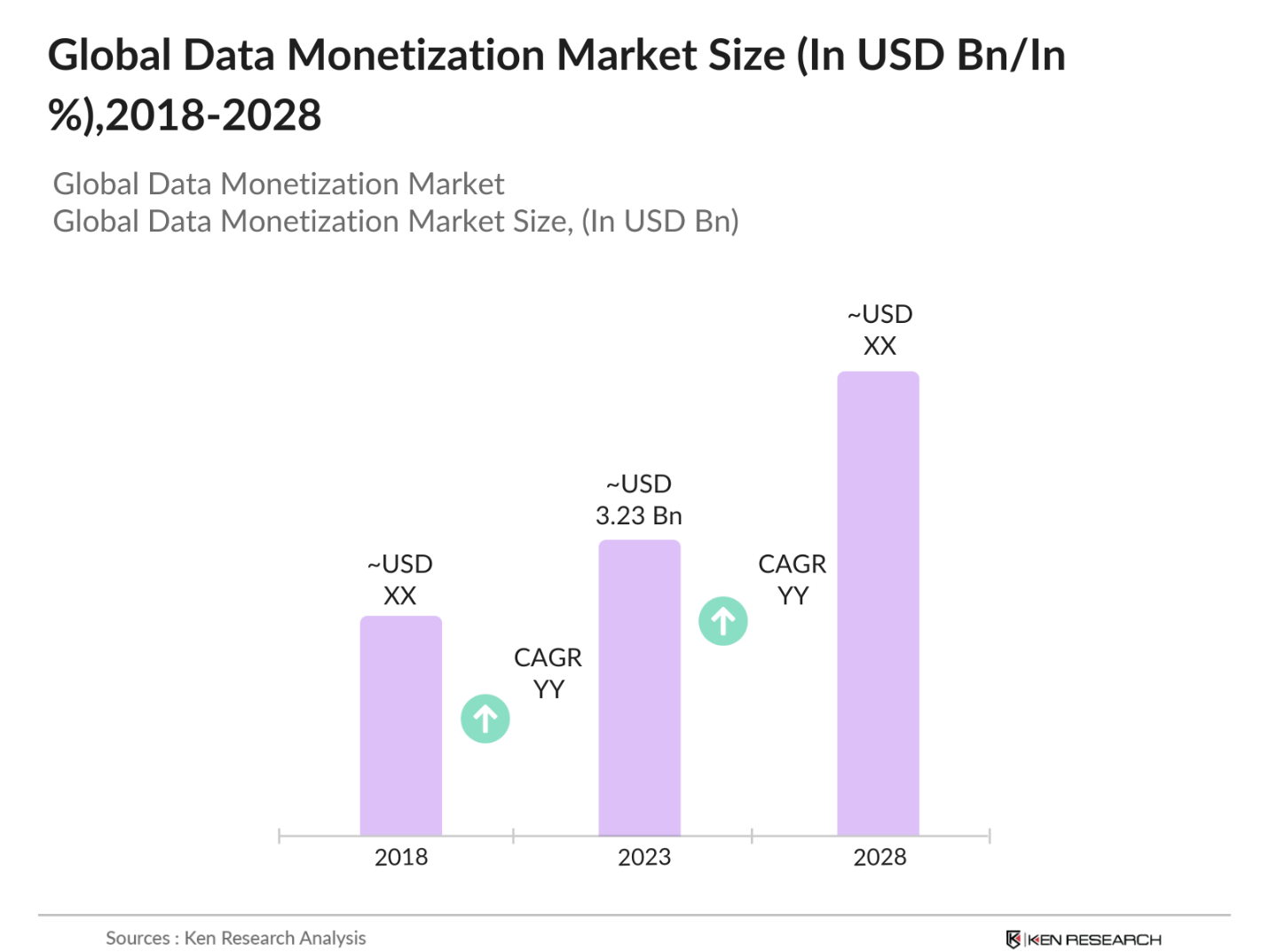
- The Global Data Monetization Market is valued at USD 3.23 billion based on a comprehensive analysis of the market over the last five years. This growth is driven by the exponential increase in data generation, largely attributed to the proliferation of digital services, IoT, and Big Data. As businesses increasingly recognize the value of data as an asset, the adoption of data monetization strategies has accelerated, further spurred by advancements in AI and machine learning technologies. Credible sources such as IDC and McKinsey underline these market developments.
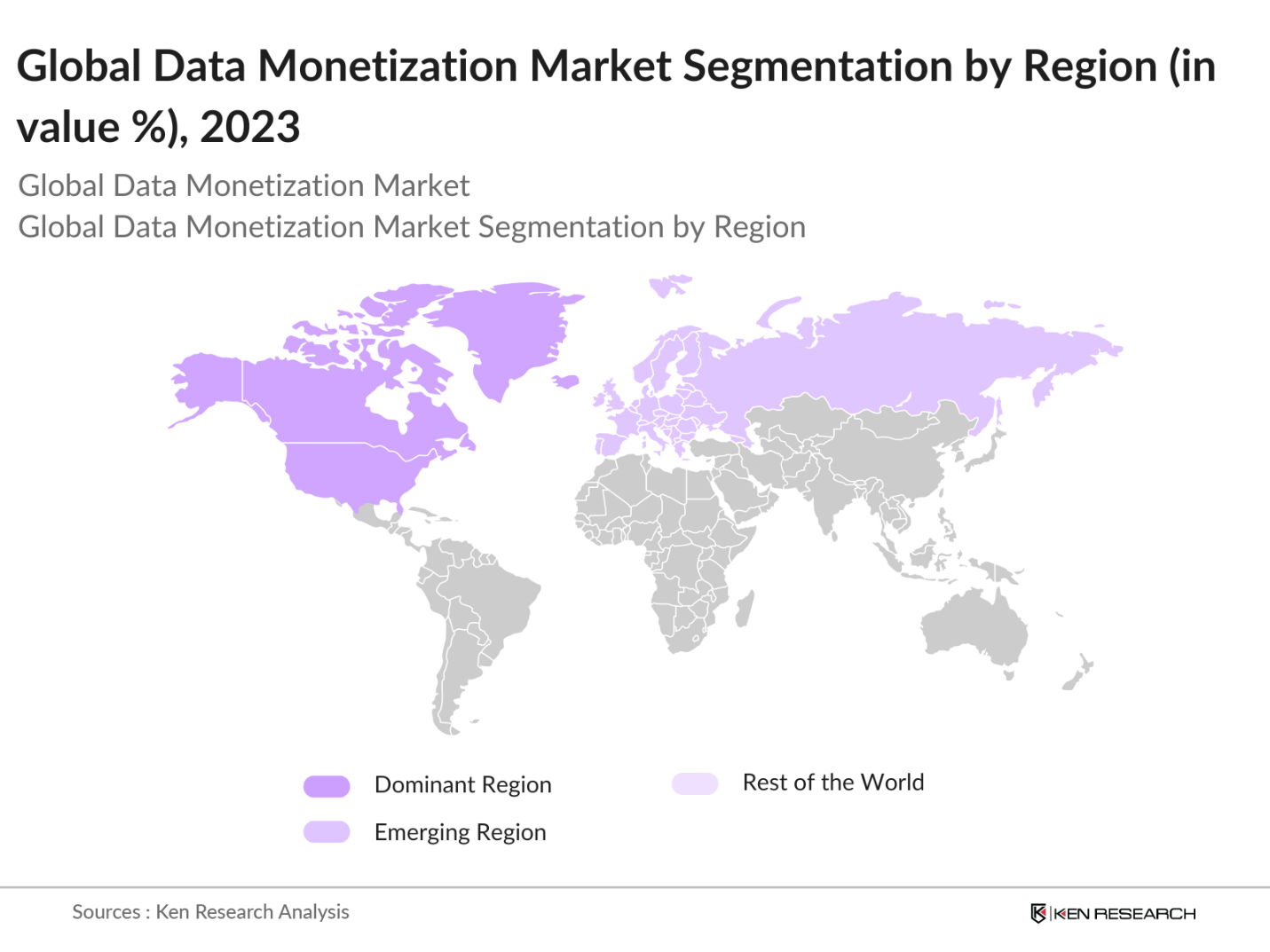
- North America, particularly the United States, dominates the Data Monetization market due to its advanced technological infrastructure, high concentration of data-centric businesses, and favorable regulatory frameworks. Additionally, Europe, led by Germany and the UK, has seen significant growth, driven by the expansion of Industry 4.0 initiatives. These regions have long-standing data governance policies and an ecosystem that supports innovation and monetization opportunities, making them the leading markets globally.
- Sector-specific regulations play a vital role in determining how data can be monetized. For instance, healthcare data in the United States is governed by HIPAA, which imposes strict controls on patient data usage. In 2024, more than $1.5 trillion in healthcare transactions will be influenced by HIPAA compliance, requiring companies to ensure that their data monetization practices do not violate patient confidentiality. Similar regulations exist in finance (e.g., GDPR, CCPA), limiting how data can be monetized across sectors.
Global Data Monetization Market Segmentation
By Region: The Global Data Monetization Market is segmented by region into North America, Europe, Asia-Pacific, Latin America, and Middle East & Africa. North America leads the market with a strong presence of tech companies and favorable data regulation policies. This regions dominance is driven by significant investments in data-driven business models and advanced analytics capabilities, particularly in the United States. Europe follows, with Germany and the UK leading initiatives in Industry 4.0 and data governance.
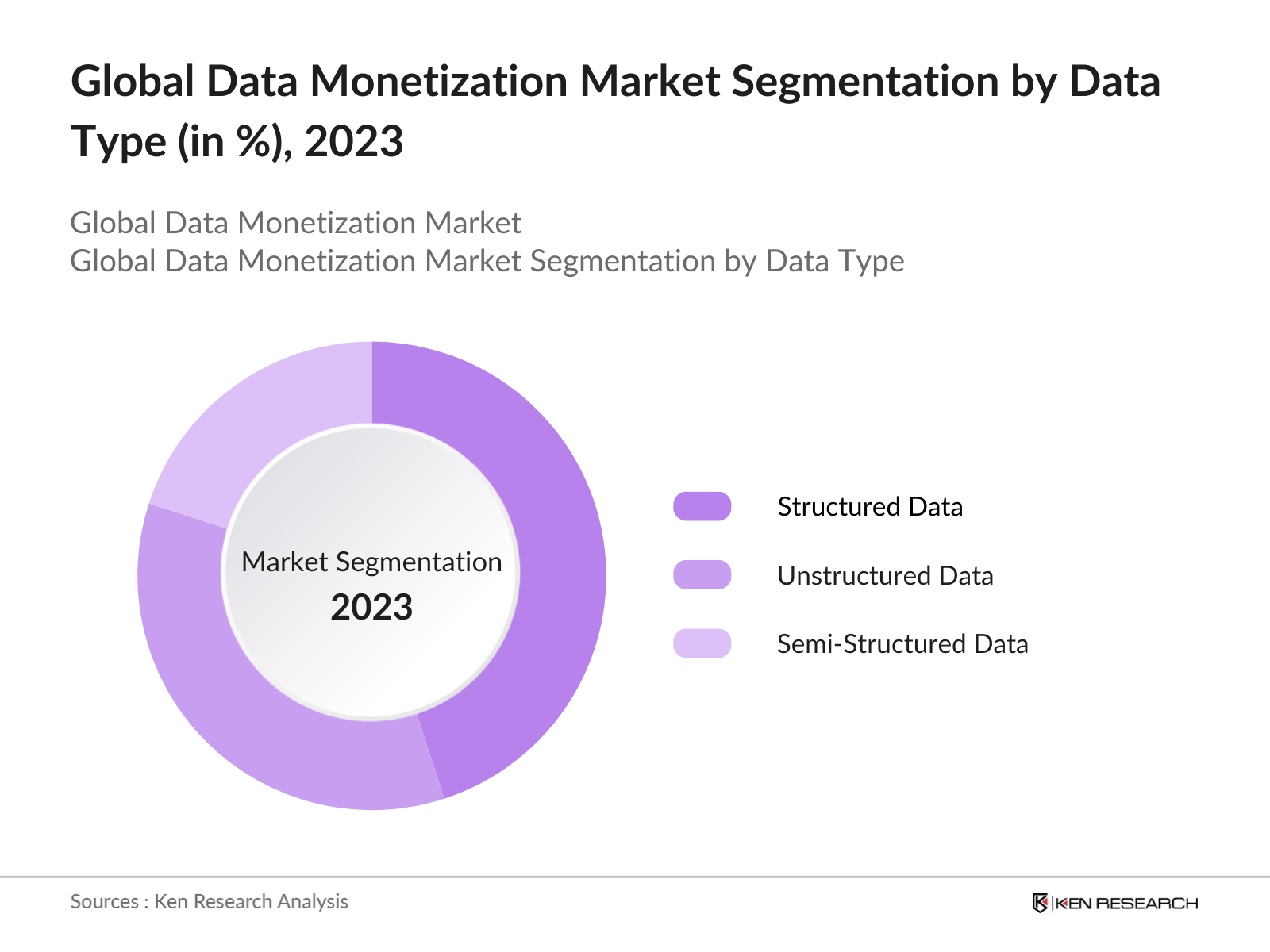
By Data Type: The Global Data Monetization Market is segmented by data type into Structured Data, Unstructured Data, and Semi-Structured Data. Structured data holds a dominant share due to its ease of processing and integration into existing business systems. Enterprises, particularly in sectors such as BFSI and retail, rely heavily on structured data to derive actionable insights through AI and analytics solutions. This dominance is expected to continue, driven by businesses focusing on optimizing customer data for personalized services.
By Industry Vertical: The Global Data Monetization Market is segmented by industry vertical into BFSI, IT & Telecom, Healthcare, Retail & E-commerce, and Manufacturing. The BFSI sector dominates, driven by the increasing need for real-time data analytics in fraud detection, customer profiling, and personalized services. Financial institutions are heavily investing in data analytics platforms to gain a competitive edge, particularly in terms of customer retention and risk management.
Global Data Monetization Market Competitive Landscape
The Global Data Monetization Market is dominated by major technology companies that provide data analytics, storage, and monetization solutions. This includes a mix of established global players and innovative startups that are contributing to the evolution of the market. Key players leverage advanced technologies like AI, machine learning, and blockchain to offer cutting-edge solutions to enterprises. This competitive landscape fosters innovation, with these companies engaging in strategic partnerships, mergers, and acquisitions to expand their market presence.
|
Company Name |
Year of Establishment |
Headquarters |
|
IBM Corporation |
1911 |
Armonk, NY, USA |
|
Microsoft Corporation |
1975 |
Redmond, WA, USA |
|
SAP SE |
1972 |
Walldorf, Germany |
|
Oracle Corporation |
1977 |
Austin, TX, USA |
|
Google LLC |
1998 |
Mountain View, CA, USA |
Global Data Monetization Industry Analysis
Global Data Monetization Market Growth Drivers
- Proliferation of IoT Devices: The increasing adoption of IoT devices is significantly driving data monetization opportunities. In 2024, it is projected that more than 29 billion IoT devices will be in use globally, creating a vast volume of data. The expansion of connected devices has led to exponential data generation, offering industries the potential to monetize the collected data. A surge in smart device production across sectors like healthcare, automotive, and manufacturing has provided the infrastructure to utilize big data for real-time analytics, enhancing decision-making processes.
- Growth of Artificial Intelligence and Machine Learning: Artificial Intelligence (AI) and Machine Learning (ML) technologies have become central to data monetization strategies. By 2024, the global AI industry is expected to see investments worth $190 billion, directly contributing to data-driven solutions. AI and ML enable the processing of vast datasets to extract actionable insights, facilitating efficient data monetization. This growth is especially prevalent in industries like finance, healthcare, and retail, where AI-driven analytics help in creating new revenue streams from data.
- Cloud Computing Expansion: The global expansion of cloud computing has been a key driver for data monetization. By 2024, over 70% of global organizations are using cloud platforms, resulting in increased data generation and storage capabilities. Cloud infrastructure allows businesses to store, process, and monetize large datasets securely and cost-effectively. This expansion supports real-time data access and sharing, empowering companies to offer data-driven services across various sectors such as e-commerce, healthcare, and finance.
Global Data Monetization Market Challenges
- Complex Regulatory Framework: Navigating the regulatory landscape remains one of the most critical challenges for data monetization. In 2024, over 120 countries have implemented data protection laws, which pose constraints on cross-border data flow and utilization. Regulatory requirements like GDPR (Europe), CCPA (USA), and HIPAA (healthcare) limit how companies can monetize data. Organizations must invest in legal and compliance teams to avoid fines, which amounted to over $5 billion globally in 2023 due to non-compliance with data privacy laws.
- Data Quality and Integration Issues: Data quality and integration issues hinder effective data monetization. According to global studies in 2024, poor data quality costs companies an estimated $3.1 trillion annually. The complexity of integrating data from disparate sources within an organization remains a significant hurdle. Data cleansing, standardization, and integration across platforms, especially in industries like banking and insurance, demand substantial investments in infrastructure and skilled personnel.
Global Data Monetization Market Future Outlook
Over the next five years, the Global Data Monetization Market is expected to witness continued growth, driven by the increasing adoption of advanced analytics, AI, and machine learning technologies. As more businesses recognize the value of data as a core asset, the demand for data-driven solutions will surge. Additionally, the rise of IoT, coupled with 5G deployment, will further augment data generation, thereby creating significant monetization opportunities. Expanding into emerging markets, particularly in Asia-Pacific, will also offer substantial growth potential as companies look to leverage data for competitive advantage.
- Rise of 5G and Edge Computing: The proliferation of 5G networks and edge computing offers substantial opportunities for data monetization. By 2024, more than 1.5 billion 5G subscriptions are expected worldwide, enabling faster data processing and transmission. Edge computing reduces latency, allowing real-time data analysis and creating new monetization models, particularly in smart cities, autonomous vehicles, and industrial IoT. This development provides businesses with more localized and efficient methods to monetize the vast amounts of data generated by 5G-enabled devices.
- Monetization via Data as a Service (DaaS): The Data as a Service (DaaS) model is gaining traction as organizations seek new ways to monetize their data. By 2024, the global DaaS market is projected to grow to $150 billion, offering opportunities for companies to sell or lease their data to third parties. This model is particularly effective in sectors such as finance, retail, and healthcare, where real-time data sharing enables businesses to generate additional revenue streams while offering valuable insights to buyers.
Scope of the Report
|
Data Type |
Structured Data Unstructured Data Semi-Structured Data |
|
Business Function |
Sales and Marketing Finance and Accounting Human Resources Operations |
|
Industry Vertical |
BFSI IT & Telecom Healthcare Retail and E-commerce Manufacturing |
|
Deployment Model |
On-premise Cloud-based Hybrid |
|
Region |
North America Europe Asia-Pacific Latin America Middle East & Africa |
Products
Key Target Audience Organizations and Entities Who Can Benefit by Subscribing to This Report:
Data-Driven Companies
IT Service Companies
Technology Solution Industries
Cloud Service Companies
Investments and Venture Capitalist Firms
Government and Regulatory Bodies (GDPR, CCPA, HIPAA Compliance Authorities)
Telecommunication Companies
Large Enterprises and Conglomerates
Companies
Players Mentioned in the Report:
IBM Corporation
Microsoft Corporation
Oracle Corporation
SAP SE
Google LLC
Amazon Web Services (AWS)
Accenture
Cloudera Inc.
SAS Institute
Teradata Corporation
Table of Contents
1. Global Data Monetization Market Overview
1.1. Definition and Scope
1.2. Market Taxonomy
1.3. Market Growth Rate
1.4. Market Segmentation Overview
2. Global Data Monetization Market Size (In USD Bn)
2.1. Historical Market Size
2.2. Year-on-Year Growth Analysis
2.3. Key Market Developments and Milestones
3. Global Data Monetization Market Analysis
3.1. Growth Drivers (Increased Data Generation, Advanced Analytics Adoption, Big Data Growth)
3.1.1. Proliferation of IoT Devices
3.1.2. Growth of Artificial Intelligence and Machine Learning
3.1.3. Cloud Computing Expansion
3.1.4. Data-Driven Decision Making
3.2. Market Challenges (Data Privacy, Regulatory Compliance, Security Concerns)
3.2.1. Complex Regulatory Framework
3.2.2. Data Quality and Integration Issues
3.2.3. Lack of Data Monetization Expertise
3.3. Opportunities (Industry 4.0, New Business Models, Smart Cities)
3.3.1. Rise of 5G and Edge Computing
3.3.2. Monetization via Data as a Service (DaaS)
3.3.3. Expansion into Emerging Markets
3.4. Trends (Real-time Data Monetization, Blockchain for Data Security)
3.4.1. AI-Driven Data Monetization Solutions
3.4.2. Monetization through Data Marketplaces
3.4.3. Increasing Adoption of Self-Service Data Platforms
3.5. Government Regulation (GDPR, CCPA, HIPAA Compliance)
3.5.1. Data Localization Laws
3.5.2. Sector-Specific Data Monetization Regulations
3.5.3. Emerging Privacy and Security Legislation
3.6. SWOT Analysis
3.7. Stake Ecosystem (Data Owners, Data Consumers, Aggregators, Service Providers)
3.8. Porter’s Five Forces
3.9. Competition Ecosystem
4. Global Data Monetization Market Segmentation
4.1. By Data Type (In Value %)
4.1.1. Structured Data
4.1.2. Unstructured Data
4.1.3. Semi-Structured Data
4.2. By Business Function (In Value %)
4.2.1. Sales and Marketing
4.2.2. Finance and Accounting
4.2.3. Human Resources
4.2.4. Operations
4.3. By Industry Vertical (In Value %)
4.3.1. BFSI
4.3.2. IT & Telecom
4.3.3. Healthcare
4.3.4. Retail and E-commerce
4.3.5. Manufacturing
4.4. By Deployment Model (In Value %)
4.4.1. On-premise
4.4.2. Cloud-based
4.4.3. Hybrid
4.5. By Region (In Value %)
4.5.1. North America
4.5.2. Europe
4.5.3. Asia-Pacific
4.5.4. Latin America
4.5.5. Middle East & Africa
5. Global Data Monetization Market Competitive Analysis
5.1. Detailed Profiles of Major Companies
5.1.1. IBM Corporation
5.1.2. Microsoft Corporation
5.1.3. Oracle Corporation
5.1.4. SAP SE
5.1.5. Salesforce Inc.
5.1.6. Amazon Web Services (AWS)
5.1.7. Accenture
5.1.8. Google LLC
5.1.9. Cloudera Inc.
5.1.10. SAS Institute
5.1.11. Teradata Corporation
5.1.12. Palantir Technologies
5.1.13. Alteryx Inc.
5.1.14. Informatica
5.1.15. TIBCO Software Inc.
5.2. Cross Comparison Parameters (Revenue, Number of Employees, Headquarters, Market Presence, R&D Spend, Customer Base, Data Solutions Offered, Key Partnerships)
5.3. Market Share Analysis
5.4. Strategic Initiatives
5.5. Mergers and Acquisitions
5.6. Investment Analysis
5.7. Venture Capital Funding
5.8. Government Grants
5.9. Private Equity Investments
6. Global Data Monetization Market Regulatory Framework
6.1. Data Privacy Regulations (GDPR, CCPA, HIPAA, etc.)
6.2. Compliance Requirements
6.3. Data Certification and Standardization
7. Global Data Monetization Future Market Size (In USD Bn)
7.1. Future Market Size Projections
7.2. Key Factors Driving Future Market Growth
8. Global Data Monetization Future Market Segmentation
8.1. By Data Type
8.2. By Business Function
8.3. By Industry Vertical
8.4. By Deployment Model
8.5. By Region
9. Global Data Monetization Market Analysts’ Recommendations
9.1. TAM/SAM/SOM Analysis
9.2. Customer Cohort Analysis
9.3. Marketing Initiatives
9.4. White Space Opportunity Analysis
Disclaimer
Contact Us
Research Methodology
Step 1: Identification of Key Variables
The initial phase involved constructing an ecosystem map for the Global Data Monetization Market. This step incorporated comprehensive desk research and the use of proprietary databases to gather industry-level information, aiming to identify the key factors influencing market dynamics.
Step 2: Market Analysis and Construction
In this phase, historical data was compiled and analyzed, assessing market penetration, revenue generation, and the ratio of data providers to service users. We also evaluated service quality statistics to ensure the reliability of the analysis.
Step 3: Hypothesis Validation and Expert Consultation
Market hypotheses were validated through consultations with industry experts using computer-assisted telephone interviews (CATIs). These insights helped refine the market data and provided practical, operational insights from key industry stakeholders.
Step 4: Research Synthesis and Final Output
The final phase engaged data service providers and businesses utilizing data monetization platforms to verify product segmentations, sales performance, and consumer preferences, ensuring a comprehensive, validated market analysis.
Frequently Asked Questions
1. How big is the Global Data Monetization Market?
The global data monetization market was valued at USD 3.23 billion, driven by the proliferation of digital services, IoT, and AI technologies that generate large volumes of actionable data.
2. What are the challenges in the Global Data Monetization Market?
Key challenges include regulatory compliance with data privacy laws, data security concerns, and the technical complexity involved in managing and monetizing large datasets.
3. Who are the major players in the Global Data Monetization Market?
Major players include IBM, Microsoft, SAP, Oracle, and Google, all of which leverage advanced analytics and cloud solutions to drive data monetization across various industries.
4. What are the growth drivers of the Global Data Monetization Market?
Growth is driven by the increased adoption of AI, cloud computing, and IoT technologies, alongside businesses growing recognition of data as a core asset for competitive advantage.
Why Buy From Us?

What makes us stand out is that our consultants follows Robust, Refine and Result (RRR) methodology. i.e. Robust for clear definitions, approaches and sanity checking, Refine for differentiating respondents facts and opinions and Result for presenting data with story

We have set a benchmark in the industry by offering our clients with syndicated and customized market research reports featuring coverage of entire market as well as meticulous research and analyst insights.

While we don't replace traditional research, we flip the method upside down. Our dual approach of Top Bottom & Bottom Top ensures quality deliverable by not just verifying company fundamentals but also looking at the sector and macroeconomic factors.

With one step in the future, our research team constantly tries to show you the bigger picture. We help with some of the tough questions you may encounter along the way: How is the industry positioned? Best marketing channel? KPI's of competitors? By aligning every element, we help maximize success.

Our report gives you instant access to the answers and sources that other companies might choose to hide. We elaborate each steps of research methodology we have used and showcase you the sample size to earn your trust.

If you need any support, we are here! We pride ourselves on universe strength, data quality, and quick, friendly, and professional service.