
Global Digital Camera Market Outlook 2030
Region:Global
Author(s):Shivani Mehra
Product Code:KROD6853
Region:Global
Author(s):Shivani Mehra
Product Code:KROD6853
December 2024
84

By Product Type: The global digital camera market is segmented by product type into DSLR cameras, mirrorless cameras, compact digital cameras, and bridge cameras. Among these, mirrorless cameras dominate the market share due to their advanced features, compact size, and ability to rival DSLR cameras in image quality. With brands like Sony leading in innovation, mirrorless cameras have become increasingly popular among professionals and enthusiasts alike, who seek both portability and performance. The rise of vlogging and online content creation has further cemented their dominance, as these cameras provide seamless video and image capabilities.

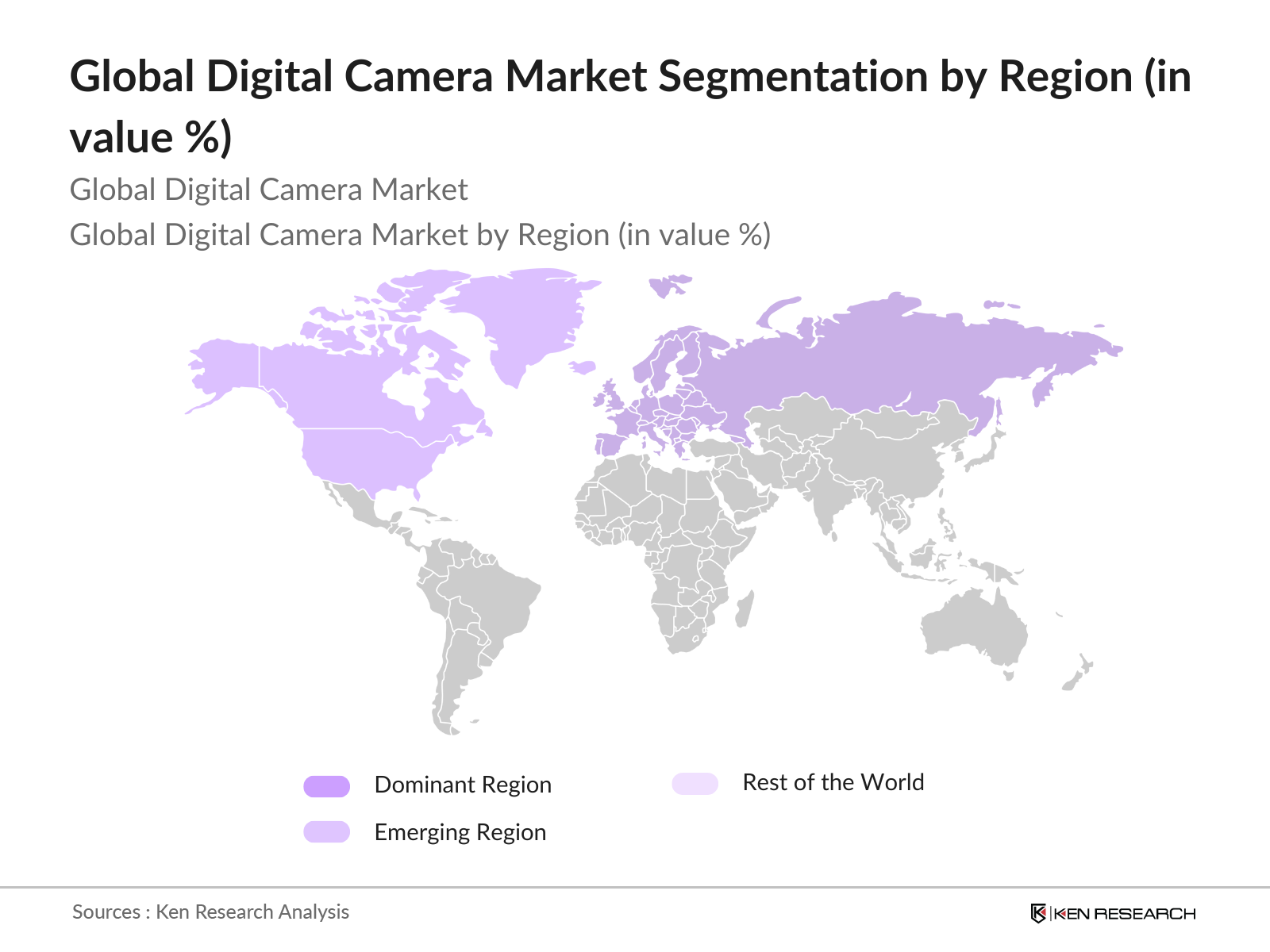
By Region: The digital camera market is segmented into North America, Europe, Asia-Pacific, Latin America, and the Middle East & Africa. Asia-Pacific leads the global market due to strong demand from countries like Japan, China, and South Korea. Japan, in particular, dominates because of its leading position in camera manufacturing, with companies like Canon, Nikon, and Sony headquartered there. Additionally, the rise of e-commerce platforms and the growing number of content creators in the region has amplified demand. Europe follows closely due to the presence of premium brands and a strong base of professional photographers.
The global digital camera market is dominated by key players, many of whom have been in the industry for decades. These companies have established strong global footprints through innovative product lines, strategic mergers, and marketing efforts. The consolidation of top players such as Canon, Nikon, and Sony ensures that the market remains highly competitive, with these firms continually developing advanced technologies to maintain their market positions.
|
Company Name |
Year of Establishment |
Headquarters |
Market Specific Parameters |
|
Canon Inc. |
1937 |
Tokyo, Japan |
|
|
Nikon Corporation |
1917 |
Tokyo, Japan |
|
|
Sony Corporation |
1946 |
Tokyo, Japan |
|
|
Olympus Corporation |
1919 |
Tokyo, Japan |
|
|
Fujifilm Holdings Corp. |
1934 |
Tokyo, Japan |
Over the next five years, the global digital camera market is expected to see steady growth, driven by the ongoing shift towards mirrorless cameras, advancements in imaging technologies, and increasing consumer interest in photography and content creation. The market will likely be influenced by rising demand for lightweight and compact cameras, particularly among social media content creators and vloggers. Continued innovation in sensor technology and features such as 4K and 8K video recording are anticipated to fuel the market's expansion, particularly in professional and high-end consumer segments.
|
By Product Type |
DSLR Cameras Mirrorless Cameras Compact Digital Cameras Bridge Cameras |
|
By Application |
Consumer Professional |
|
By Sensor Size |
Full-Frame APS-C Micro Four Thirds Medium Format |
|
By Distribution Channel |
Online Retail Offline Retail |
|
By Region |
North America Europe Asia-Pacific Latin America Middle East & Africa |
1.1. Definition and Scope
1.2. Market Taxonomy
1.3. Market Growth Rate
1.4. Market Segmentation Overview
2.1. Historical Market Size
2.2. Year-On-Year Growth Analysis
2.3. Key Market Developments and Milestones
3.1. Growth Drivers
3.1.1. Technological Advancements in Imaging Sensors
3.1.2. Rising Demand for High-Resolution Cameras
3.1.3. Increasing Popularity of Photography as a Hobby
3.1.4. Expansion of Digital Content Creation Platforms
3.2. Market Challenges
3.2.1. Competition from Smartphones
3.2.2. High Costs of Professional Cameras
3.2.3. Market Saturation in Developed Regions
3.3. Opportunities
3.3.1. Emerging Markets for Entry-Level Cameras
3.3.2. Integration of AI and Smart Features
3.3.3. Increasing Demand for Mirrorless Cameras
3.4. Trends
3.4.1. Growth in Mirrorless Camera Segment
3.4.2. Integration of 4K and 8K Video Recording
3.4.3. Rise of Compact and Lightweight Cameras
3.5. Government Regulation
3.5.1. Import Tariffs and Trade Restrictions
3.5.2. Environmental Regulations on Electronic Waste
3.5.3. Certification Standards for Camera Manufacturers
3.6. SWOT Analysis
3.7. Stakeholder Ecosystem
3.8. Porters Five Forces Analysis
3.9. Competition Ecosystem
4.1. By Product Type (In Value %)
4.1.1. DSLR Cameras
4.1.2. Mirrorless Cameras
4.1.3. Compact Digital Cameras
4.1.4. Bridge Cameras
4.2. By Application (In Value %)
4.2.1. Consumer
4.2.2. Professional
4.3. By Sensor Size (In Value %)
4.3.1. Full-Frame
4.3.2. APS-C
4.3.3. Micro Four Thirds
4.3.4. Medium Format
4.4. By Distribution Channel (In Value %)
4.4.1. Online Retail
4.4.2. Offline Retail
4.5. By Region (In Value %)
4.5.1. North America
4.5.2. Europe
4.5.3. Asia-Pacific
4.5.4. Latin America
4.5.5. Middle East & Africa
5.1. Detailed Profiles of Major Companies
5.1.1. Canon Inc.
5.1.2. Nikon Corporation
5.1.3. Sony Corporation
5.1.4. Panasonic Corporation
5.1.5. Olympus Corporation
5.1.6. Fujifilm Holdings Corporation
5.1.7. GoPro Inc.
5.1.8. Leica Camera AG
5.1.9. Ricoh Imaging Company
5.1.10. Samsung Electronics
5.1.11. Hasselblad
5.1.12. Sigma Corporation
5.1.13. Polaroid
5.1.14. Blackmagic Design
5.1.15. Casio Computer Co., Ltd.
5.2. Cross Comparison Parameters (No. of Employees, Headquarters, Inception Year, Revenue, Market Share, Product Portfolio, Innovation Index, Global Presence)
5.3. Market Share Analysis
5.4. Strategic Initiatives
5.5. Mergers and Acquisitions
5.6. Investment Analysis
5.7. Venture Capital Funding
5.8. Government Grants
5.9. Private Equity Investments
6.1. Environmental Standards
6.2. Compliance Requirements
6.3. Certification Processes
7.1. Future Market Size Projections
7.2. Key Factors Driving Future Market Growth
8.1. By Product Type (In Value %)
8.2. By Application (In Value %)
8.3. By Sensor Size (In Value %)
8.4. By Distribution Channel (In Value %)
8.5. By Region (In Value %)
9.1. TAM/SAM/SOM Analysis
9.2. Customer Cohort Analysis
9.3. Marketing Initiatives
9.4. White Space Opportunity Analysis
This step involves mapping out all key stakeholders in the global digital camera market, including manufacturers, distributors, and end-users. Extensive secondary research is conducted using proprietary databases and credible industry sources to define critical market variables, such as consumer trends and technological innovations.
Historical data is analyzed to identify market penetration and revenue generation across various segments, including product type and region. This analysis ensures a comprehensive understanding of market dynamics, which is used to project future trends and revenue forecasts.
Market hypotheses are validated through interviews with industry professionals, ensuring that market insights are reliable and accurately reflect operational realities. These consultations also provide real-time insights into emerging trends and customer preferences.
The final phase synthesizes the research findings into a comprehensive market analysis, verified by industry experts. The bottom-up approach ensures that all market data is accurate and represents a reliable overview of the global digital camera market.
The global digital camera market is valued at approximately USD 8.56 billion, driven by technological advancements, growing consumer interest in photography, and a robust content creation industry.
Key challenges include competition from smartphones, high production costs for professional cameras, and market saturation in developed regions, limiting new customer acquisition.
Major players include Canon Inc., Nikon Corporation, Sony Corporation, Fujifilm Holdings Corp., and Olympus Corporation, all of which dominate due to their technological leadership, strong global distribution, and product innovation.
Growth drivers include increasing demand for high-quality cameras, the rise of vlogging and digital content creation, technological advancements in sensors and lenses, and the expanding mirrorless camera segment.

What makes us stand out is that our consultants follows Robust, Refine and Result (RRR) methodology. i.e. Robust for clear definitions, approaches and sanity checking, Refine for differentiating respondents facts and opinions and Result for presenting data with story

We have set a benchmark in the industry by offering our clients with syndicated and customized market research reports featuring coverage of entire market as well as meticulous research and analyst insights.

While we don't replace traditional research, we flip the method upside down. Our dual approach of Top Bottom & Bottom Top ensures quality deliverable by not just verifying company fundamentals but also looking at the sector and macroeconomic factors.

With one step in the future, our research team constantly tries to show you the bigger picture. We help with some of the tough questions you may encounter along the way: How is the industry positioned? Best marketing channel? KPI's of competitors? By aligning every element, we help maximize success.

Our report gives you instant access to the answers and sources that other companies might choose to hide. We elaborate each steps of research methodology we have used and showcase you the sample size to earn your trust.

If you need any support, we are here! We pride ourselves on universe strength, data quality, and quick, friendly, and professional service.