
Global Digital Mapping Market Outlook 2030
Region:Global
Author(s):Shivani Mehra
Product Code:KROD1235
December 2024
90
About the Report
Global Digital Mapping Market Overview
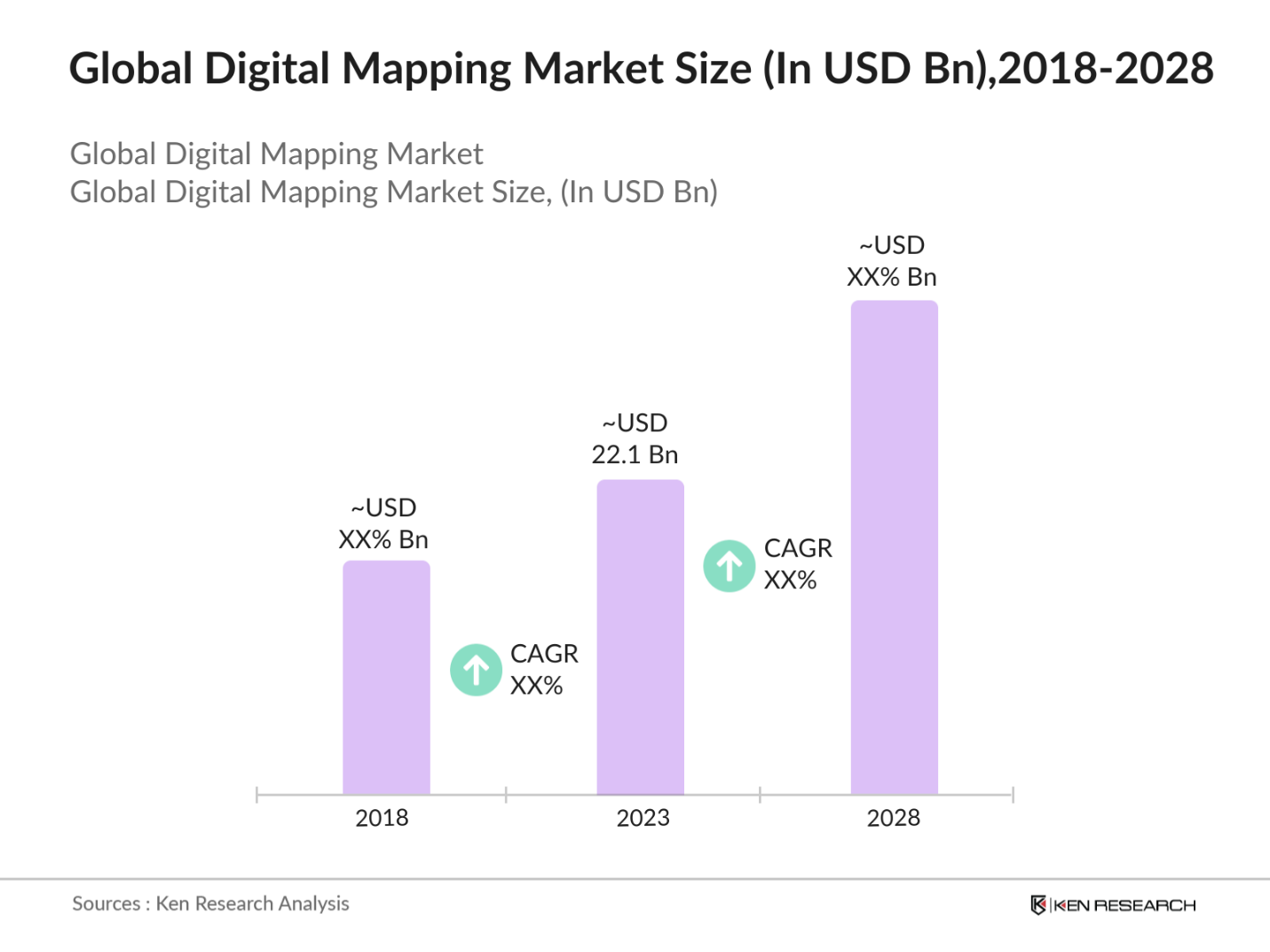
- The global digital mapping market was valued at USD 22.1 billion in 2023, driven by rapid advancements in GPS technology and the rising demand for geospatial data across various sectors. The integration of digital mapping solutions in industries such as automotive, healthcare, and urban planning has propelled market growth. Enhanced accuracy and real-time updates in digital maps are key factors driving this expansion, particularly as smart city initiatives gain momentum globally.
- Key players such as Google LLC, HERE Technologies, Esri, Apple Inc., and TomTom NV. Google, with its extensive Google Maps platform, continues to lead, offering unmatched global coverage and real-time data. HERE Technologies follows, providing high-precision maps that are extensively used in automotive applications. Esri's ArcGIS remains a top choice for businesses and government agencies for geospatial analytics. Apple and TomTom also play crucial roles with their respective mapping services.
- In 2023, TomTom unveiled its new map visualization technology called TomTom Premium Map Display, powered by its Orbis Maps. This next-generation solution provides users with a highly immersive and visually stunning experience when interacting with digital maps. The Premium Map Display sets a new standard for map coverage and visualization, pushing the boundaries of what's possible with map data representation
- Cities like New York, Tokyo, London, and Singapore dominate the digital mapping market due to their advanced infrastructure, high urban density, and the early adoption of smart city technologies. These cities require accurate and real-time mapping solutions for efficient traffic management, urban planning, and emergency response services. The implementation of cutting-edge technologies like 5G and IoT further strengthens their demand for sophisticated digital maps.
Global Digital Mapping Market Segmentation
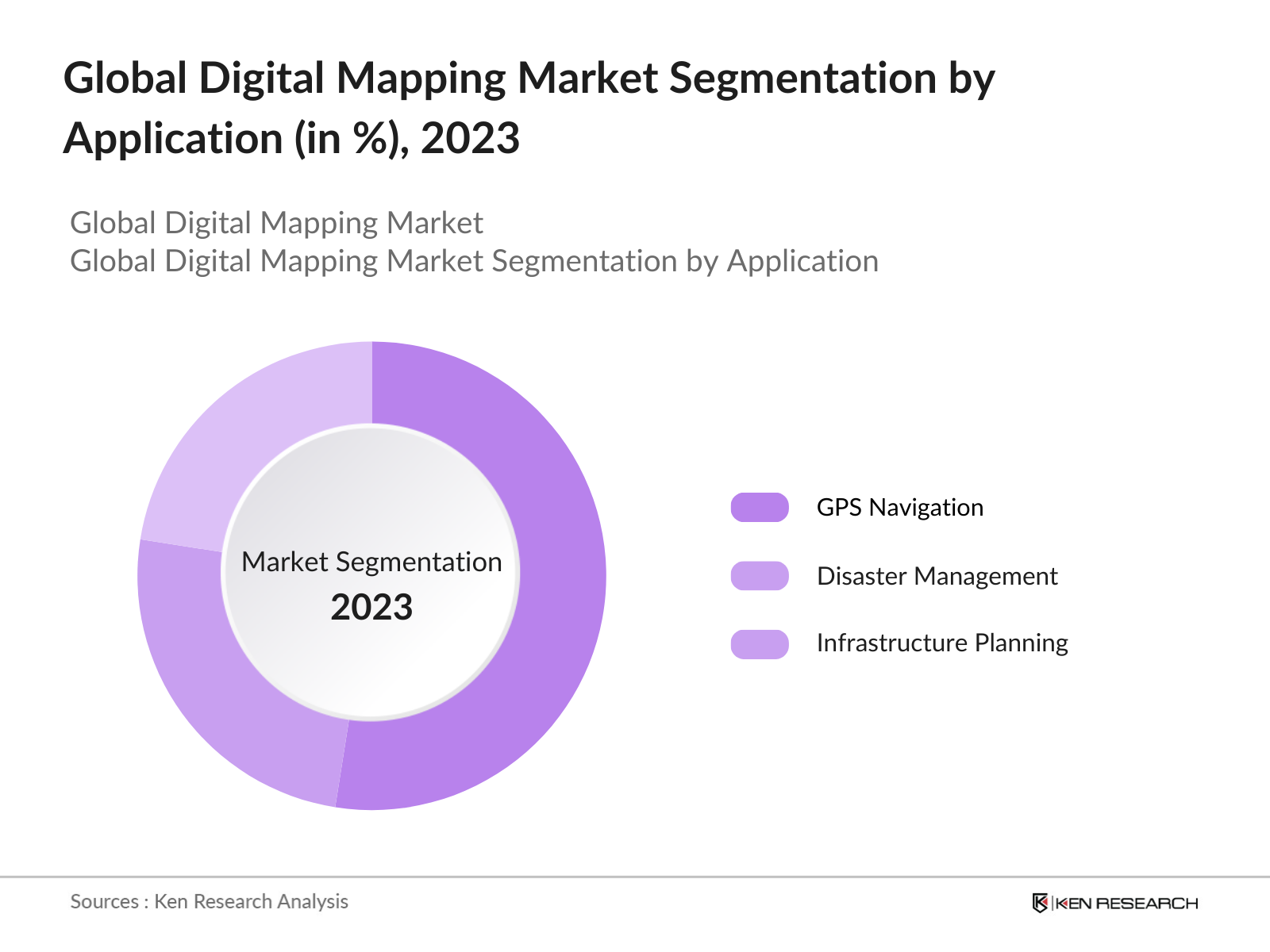
By Application: The global digital mapping market is segmented by application into GPS Navigation, Disaster Management, Infrastructure Planning, and Automotive Applications. In 2023, GPS Navigation dominated the market, driven by widespread adoption across consumer electronics and mobile devices. The integration of GPS with advanced mapping services, such as real-time traffic updates and route optimization, has made it an essential tool for everyday navigation.
By End-User Industry: The market is segmented by end-user industry into Automotive, Healthcare, Government, and Retail. In 2023, the automotive segment held the largest market share within the digital mapping market. This dominance is largely attributed to the growing adoption of digital maps in autonomous vehicles and advanced driver-assistance systems (ADAS). Automotive manufacturers increasingly rely on high-definition maps to improve vehicle safety and navigation accuracy, which are essential for the effective operation of these advanced systems.
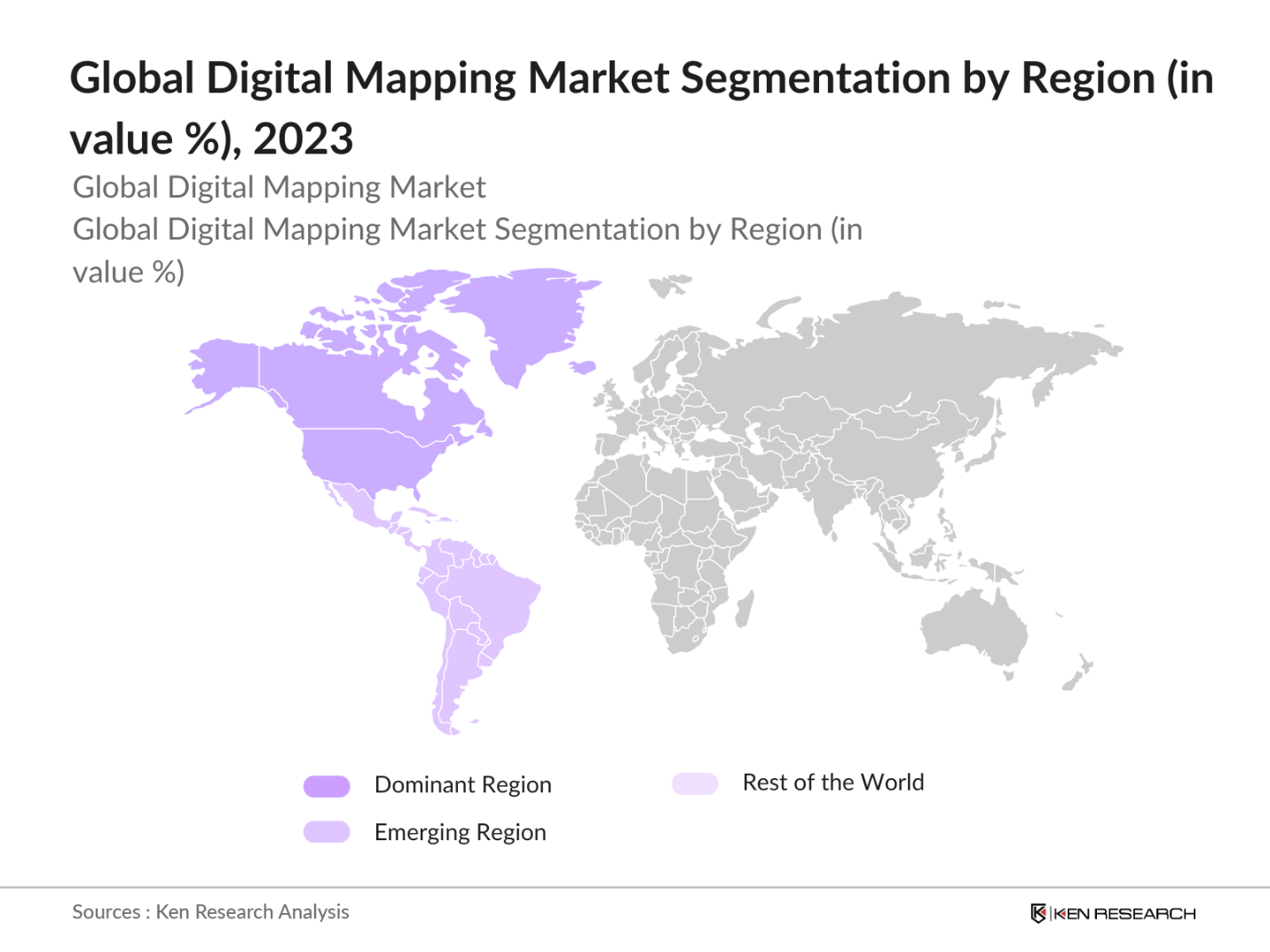
By Region: The market is segmented by region into North America, Europe, Asia-Pacific (APAC), Latin America, and the Middle East & Africa (MEA). In 2023, North America dominated the global digital mapping market, accounting for the largest share. This dominance is attributed to the region's advanced technological infrastructure, high penetration of GPS and IoT devices, and significant investments in autonomous vehicle technology.
Global Digital Mapping Market Competitive Landscape
|
Company Name |
Establishment Year |
Headquarters |
|
Google LLC |
1998 |
Mountain View, CA, USA |
|
HERE Technologies |
1985 |
Eindhoven, Netherlands |
|
Esri |
1969 |
Redlands, CA, USA |
|
Apple Inc. |
1976 |
Cupertino, CA, USA |
|
TomTom NV |
1991 |
Amsterdam, Netherlands |
- Google LLC: In April 2024, Google announced the rollout of new AI-powered features for Google Maps, including the Immersive View for routes, which allows users to preview their journeys in detail, whether they are driving, walking, or cycling.
- Esri: In November 2023, Esri announced enhancements to its ArcGIS platform, integrating AI-driven analytics to enhance data visualization and decision-making processes. Key features include improved real-time data processing capabilities, which are vital for applications like emergency response and urban planning.
Global Digital Mapping Market Analysis
Global Digital Mapping Market Growth Drivers
- Government Initiatives in SmartCity Development: Governments worldwideare investingheavily in smartcity initiatives, which incorporatedigital mappingtechnologiesfor urban planningand infrastructuremanagement. TheU.S. Departmentof Transportationannounced a $160 million investmentin smart cityprojects in2023, emphasizingthe need foradvanced mappingsolutions tooptimize transportationsystems and enhancepublic safety.
- Growth in E-commerce and Delivery Services: In 2022, U.S. e-commerce sales did reach approximately $1 trillion, This rapid growth has indeed necessitated significant changes in logistics, including the optimization of delivery routes and increased demand for digital mapping technologies to enhance efficiency and meet consumer expectations for faster and more reliable deliveries.
- Growth in E-commerce and Logistics: The boom in e-commerce and logistics is driving the demand for digital mapping solutions. In 2024, global e-commerce sales are projected to surpass$6.3 trillion, necessitating precise and real-time mapping for last-mile delivery and supply chain optimization. Companies like Amazon and Alibaba are heavily investing in digital maps to enhance their delivery networks, reduce transportation costs, and improve customer satisfaction.
Global Digital Mapping Market Challenges
- Data Privacy Concerns: Data privacy is indeed a significant challenge in the digital mapping sector, particularly with the rise of location-based services. The introduction of stricter regulations, such as the General Data Protection Regulation (GDPR) in the European Union, has heightened the focus on how companies collect, store, and utilize geospatial data. Compliance with these regulations necessitates substantial investments in data security, which can impede market growth.
- High Costs of Mapping Technology: The development and maintenance of high-definition maps are costly, posing a challenge for companies in the digital mapping market. These high costs can be prohibitive, particularly for smaller companies, limiting market entry and expansion. The need for continuous updates and the integration of real-time data further exacerbates these costs.
Global Digital Mapping Market Government Initiatives
- Funding for Geospatial Projects: Governments are increasingly allocating funds to support geospatial projects that utilize digital mapping technologies. In 2024, the U.S. government is expected to invest over in initiatives aimed at enhancing geospatial data infrastructure, which will facilitate better urban planning and disaster management. This funding is crucial for advancing the capabilities of digital maps and ensuring that they are integrated into public services effectively.
- United States: In 2023, the U.S. government is expected to implement policies that streamline the approval of geospatial technologies, particularly for applications in transportation and urban planning. The National Geospatial Advisory Committee is anticipated to release new guidelines aimed at fostering innovation, which will reduce regulatory hurdles and encourage tech companies to develop cutting-edge mapping solutions.
Global Digital Mapping Market Outlook
In 2028, the global digital mapping market is poised for significant growth, driven by several key trends that will shape its future trajectory. The ongoing expansion of 5G networks and the Internet of Things (IoT), along with the increased adoption of digital twin technology, will be at the forefront of this transformation.
Future Trends:
- Expansion of 5G and IoT to Drive Market Growth: By 2028, the expansion of 5G networks and the Internet of Things (IoT) will significantly drive the digital mapping market. The integration of 5G with digital maps will enable ultra-fast data transmission and real-time updates, enhancing the accuracy and responsiveness of mapping services. IoT devices, embedded with geospatial sensors, will provide continuous streams of data, further improving map accuracy. The proliferation of smart cities, driven by 5G and IoT, will create substantial demand for advanced digital mapping solutions.
- Increased Use of Digital Twin Technology: The use of Digital twin technology is indeed expected to grow significantly by 2028, with applications extending across various sectors, including urban planning and infrastructure development.
Scope of the Report
|
By Application |
GPS Navigation Disaster Management Infrastructure Planning Automotive Applications |
|
By End-User Industry |
Automotive Healthcare Government Retail |
|
By Technology Type |
Satellite-Based Systems Cloud-Based Mapping AI-Driven Mapping Solutions LiDAR Mapping Augmented Reality (AR) Mapping |
|
By Data Source |
Aerial Imaging Street-Level Imaging Satellite Imagery Sensor-Based Data Crowdsourced Data |
|
By Region |
North America Europe APAC Latin America MEA |
Products
Key Target Audience:
Automotive Manufacturers
Disaster Management Authorities
Infrastructure Development Companies
Investments and Venture Capitalist Firms
Government and Regulatory Bodies (NGA)
Companies
Players Mentioned in the Report:
Google LLC
HERE Technologies
Esri
Apple Inc.
TomTom NV
Baidu Inc.
MapQuest
Nearmap Ltd.
Telenav Inc.
Pitney Bowes Inc.
DigitalGlobe, Inc. (a Maxar Technologies Company)
OpenStreetMap Foundation
Mapbox Inc.
AutoNavi (subsidiary of Alibaba Group)
Trimble Inc.
Table of Contents
01. Global Digital Mapping Market Overview
1.1. Market Definition and Scope
1.2. Market Size and Growth
1.3. Key Market Drivers
1.4. Overview of Market Segmentation
02. Global Digital Mapping Market Size and Analysis, 2018-2023
2.1. Historical Market Size
2.2. Year-on-Year Growth Analysis
2.3. Key Market Developments and Milestones
03. Global Digital Mapping Market Dynamics
3.1. Growth Drivers
3.1.1. Adoption of Autonomous Vehicles
3.1.2. Expansion of Smart Cities
3.1.3. Growth in E-commerce and Logistics
3.2. Market Challenges
3.2.1. Data Privacy Concerns
3.2.2. High Costs of Mapping Technology
3.2.3. Limited Accuracy in Rural Areas
3.3. Market Opportunities
3.3.1. Advancements in AI and Machine Learning
3.4. Current Market Trends
3.4.1. Integration of AI and Machine Learning
3.4.2. Growth of Indoor Mapping
3.4.3. Adoption of Blockchain for Data Security
04. Global Digital Mapping Market Segmentation, 2023
4.1. By Application (Value %)
4.1.1. GPS Navigation
4.1.2. Disaster Management
4.1.3. Infrastructure Planning
4.1.4. Automotive Applications
4.2. By End-User Industry (Value %)
4.2.1. Automotive
4.2.2. Healthcare
4.2.3. Government
4.2.4. Retail
4.3. By Region (Value %)
4.3.1. North America
4.3.2. Europe
4.3.3. APAC
4.3.4. Latin America
4.3.5. MEA
4.4. By Technology Type (Value %)
4.4.1. Satellite-Based Systems
4.4.2. Cloud-Based Mapping
4.4.3. AI-Driven Mapping Solutions
4.4.4. LiDAR Mapping
4.4.5. Augmented Reality (AR) Mapping
4.5. By Data Source (Value %)
4.5.1. Aerial Imaging
4.5.2. Street-Level Imaging
4.5.3. Satellite Imagery
4.5.4. Sensor-Based Data
4.5.5. Crowdsourced Data
05. Global Digital Mapping Market Competitive Landscape
5.1. Key Players and Market Share Analysis
5.2. Strategic Initiatives and Developments
5.3. Mergers, Acquisitions, and Investments
5.4. Company Profiles
5.4.1. Google LLC
5.4.2. HERE Technologies
5.4.3. Esri
5.4.4. Apple Inc.
5.4.5. TomTom NV
06. Global Digital Mapping Market Regulatory and Legal Framework
6.1. Government Initiatives and Support
6.2. Data Privacy and Security Regulations
6.3. Certification and Regulatory Approvals
07. Global Digital Mapping Market Forecast, 2023-2028
7.1. Future Market Size Projections
7.2. Factors Influencing Future Market Growth
7.3. Forecast Analysis by Region and Application
08. Global Digital Mapping Market Future Market Segmentation, 2028
8.1. By Application (Value %)
8.2. By End-User Industry (Value %)
8.3. By Technology (Value %)
8.4. By Region (Value %)
8.5. By Data Source (Value %)
09. Global Digital Mapping Market Analyst Recommendations and Strategic Insights
9.1. Total Addressable Market (TAM) Analysis
9.2. Customer and Market Potential Analysis
9.3. Key Strategic Initiatives for Market Penetration
10. Global Digital Mapping Market Analysts Recommendations
10.1. TAM/SAM/SOM Analysis
10.2. Customer Cohort Analysis
10.3. Marketing Initiatives
10.4. White Space Opportunity Analysis
Disclaimer Contact UsResearch Methodology
Step 1: Identifying Key Variables
Ecosystem creation for all the major entities and referring to multiple secondary and proprietary databases to perform desk research around the market to collate industry-level information.
Step 2: Market Building
Collating statistics on the Global Digital Mapping Market over the years, penetration of marketplaces and service providers ratio to compute revenue generated for the Global Digital Mapping Market. We will also review service quality statistics to understand revenue generated which can ensure accuracy behind the data points shared.
Step 3: Validating and Finalizing
Building market hypotheses and conducting CATIs with industry experts belonging to different companies to validate statistics and seek operational and financial information from company representatives.
Step 4: Research Output
Our team will approach multiple Digital Mapping Market companies and understand nature of product segments and sales, consumer preference and other parameters, which will support us validate statistics derived through bottom to top approach from Digital Mapping Market companies.
Frequently Asked Questions
01. How big is the Global Digital Mapping Market?
The Global Digital Mapping Market was valued at USD 22.1 billion in 2023, driven by the growing demand for geospatial data across various industries, advancements in GPS technology, and the rise of smart city initiatives.
02. What are the challenges in the Global Digital Mapping Market?
Challenges in the Global Digital Mapping Market include data privacy concerns, high costs of developing and maintaining high-definition maps, and limited mapping accuracy in rural and remote areas, which hampers service quality.
03. Who are the major players in the Global Digital Mapping Market?
Key players in the Global Digital Mapping Market include Google LLC, HERE Technologies, Esri, Apple Inc., and TomTom NV. These companies lead the market due to their technological expertise, extensive global coverage, and continuous innovation.
04. What are the growth drivers of the Global Digital Mapping Market?
The Global Digital Mapping Market is driven by the adoption of autonomous vehicles, the expansion of smart cities, and the growth of e-commerce and logistics, all of which require accurate and real-time digital mapping solutions for efficient operation and management.
Why Buy From Us?

What makes us stand out is that our consultants follows Robust, Refine and Result (RRR) methodology. i.e. Robust for clear definitions, approaches and sanity checking, Refine for differentiating respondents facts and opinions and Result for presenting data with story

We have set a benchmark in the industry by offering our clients with syndicated and customized market research reports featuring coverage of entire market as well as meticulous research and analyst insights.

While we don't replace traditional research, we flip the method upside down. Our dual approach of Top Bottom & Bottom Top ensures quality deliverable by not just verifying company fundamentals but also looking at the sector and macroeconomic factors.

With one step in the future, our research team constantly tries to show you the bigger picture. We help with some of the tough questions you may encounter along the way: How is the industry positioned? Best marketing channel? KPI's of competitors? By aligning every element, we help maximize success.

Our report gives you instant access to the answers and sources that other companies might choose to hide. We elaborate each steps of research methodology we have used and showcase you the sample size to earn your trust.

If you need any support, we are here! We pride ourselves on universe strength, data quality, and quick, friendly, and professional service.