
Global Digital Textile Printing Market Outlook to 2030
Region:Global
Author(s):Shambhavi
Product Code:KROD7695
December 2024
84
About the Report
Global Digital Textile Printing Market Overview
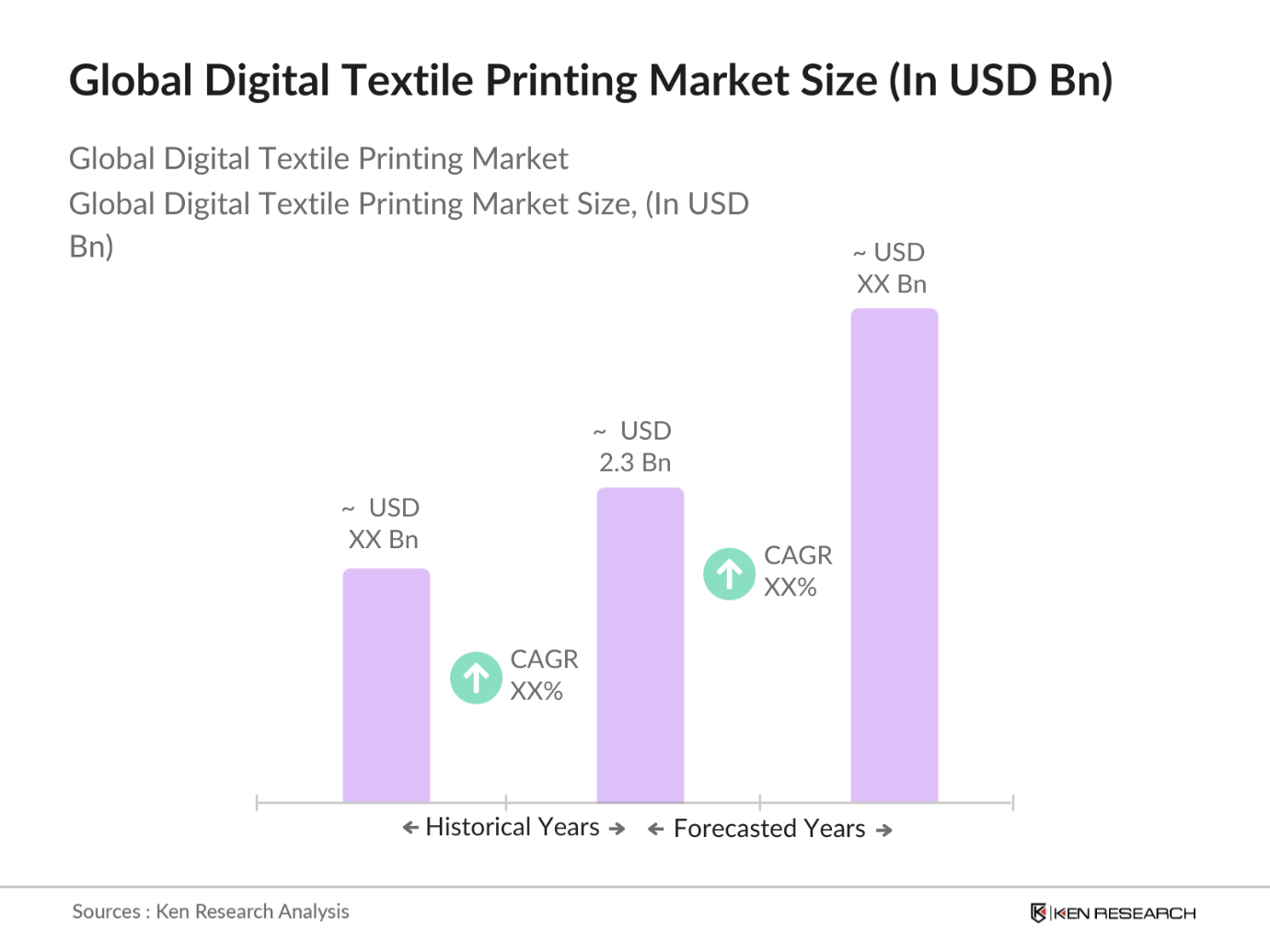
- The Global Digital Textile Printing Market is valued at USD 2.3 billion, supported by a five-year historical analysis. This market is largely driven by the increasing demand for customized textile products across various sectors, including fashion, home dcor, and promotional materials. Innovation in inkjet technology and eco-friendly printing processes has further propelled the industry, catering to the rising consumer shift towards sustainable solutions. Governments worldwide have been promoting digital printing to reduce waste and pollution, boosting adoption rates in several regions.
- Key regions dominating the digital textile printing industry include North America and Europe. North America benefits from advanced technological infrastructure, making it easier for companies to implement cutting-edge printing solutions. Europe, especially Italy and Germany, leads due to a longstanding tradition of textile manufacturing and a high demand for fashion and home textiles. In Asia, Chinas manufacturing capabilities and rapid adoption of digital printing technology further solidify its dominant position in the market.
- Government regulations regarding environmental protection are significantly influencing the digital textile printing market. Many countries are implementing stricter environmental standards that require manufacturers to reduce waste and emissions associated with textile production. For instance, the European Unions regulations on hazardous substances have compelled companies to adopt cleaner production techniques. This shift towards compliance with environmental standards is driving investments in digital printing technologies that offer lower environmental impact compared to traditional printing methods, thereby fostering market growth.
Global Digital Textile Printing Market Segmentation
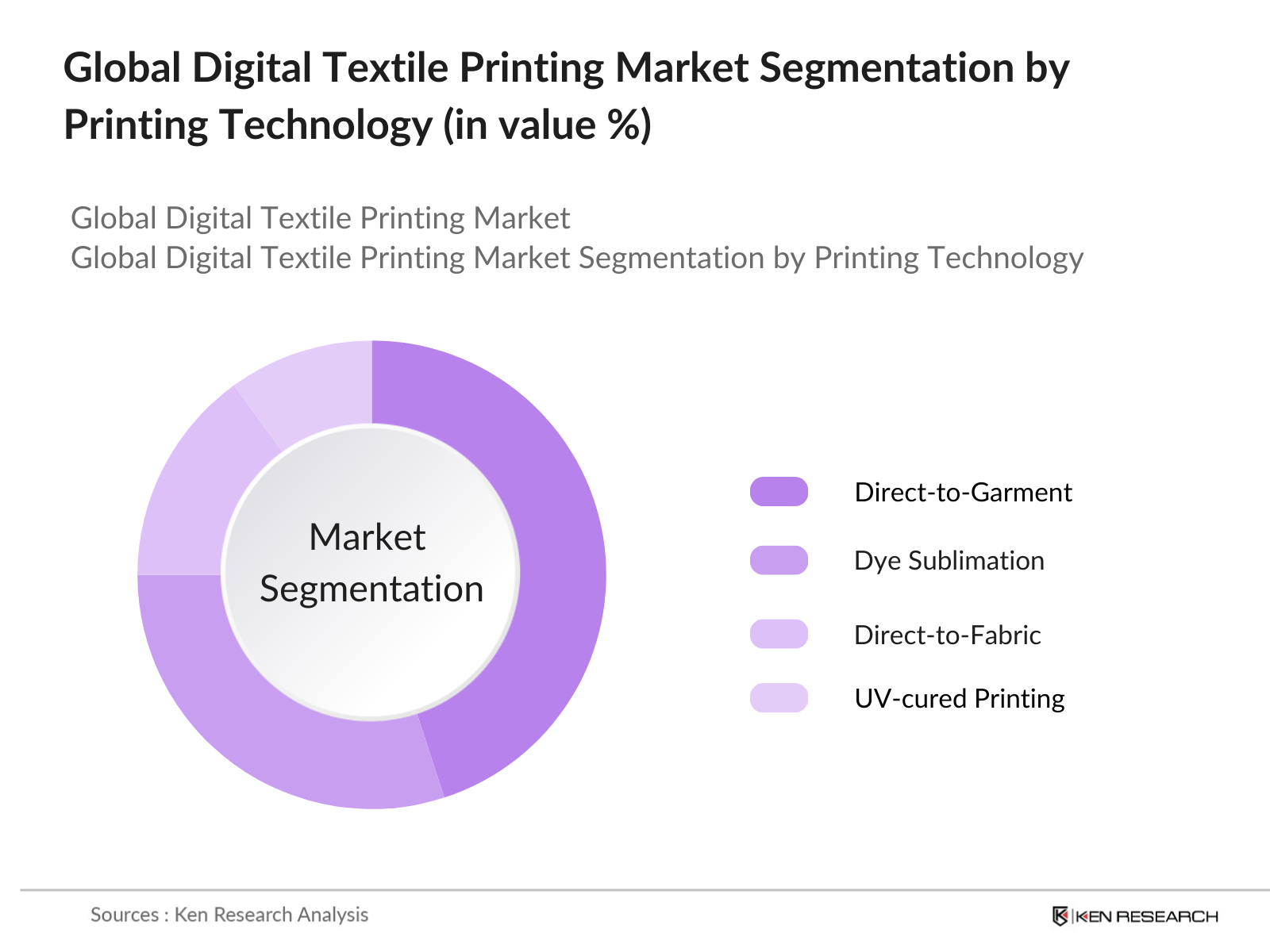
By Printing Technology: The digital textile printing market is segmented by printing technology, including direct-to-garment (DTG), dye sublimation, direct-to-fabric, and UV-cured printing. Among these, direct-to-fabric holds a leading position due to its versatility in applications such as apparel, home textiles, and flags. Its popularity stems from its efficiency in handling large-scale prints with high color accuracy, making it ideal for industrial textile manufacturing.
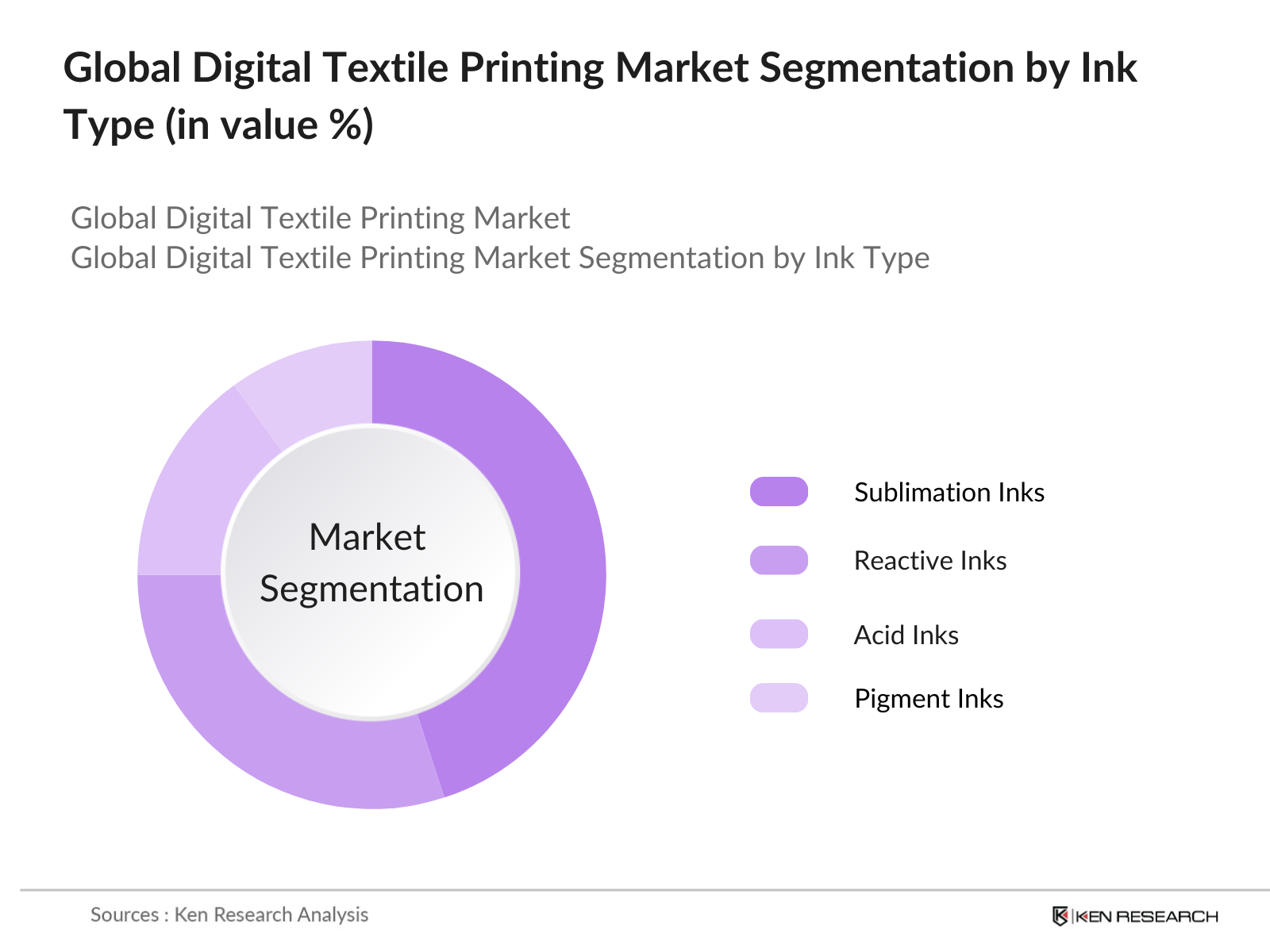
By Ink Type: The market is also segmented by ink type: sublimation inks, reactive inks, acid inks, and pigment inks. Sublimation inks lead due to their durability, especially in sportswear and outdoor textiles, providing vibrant, long-lasting colors. Their ease of use and compatibility with polyester fabrics make them a preferred choice in high-demand textile sectors.
Global Digital Textile Printing Market Competitive Landscape
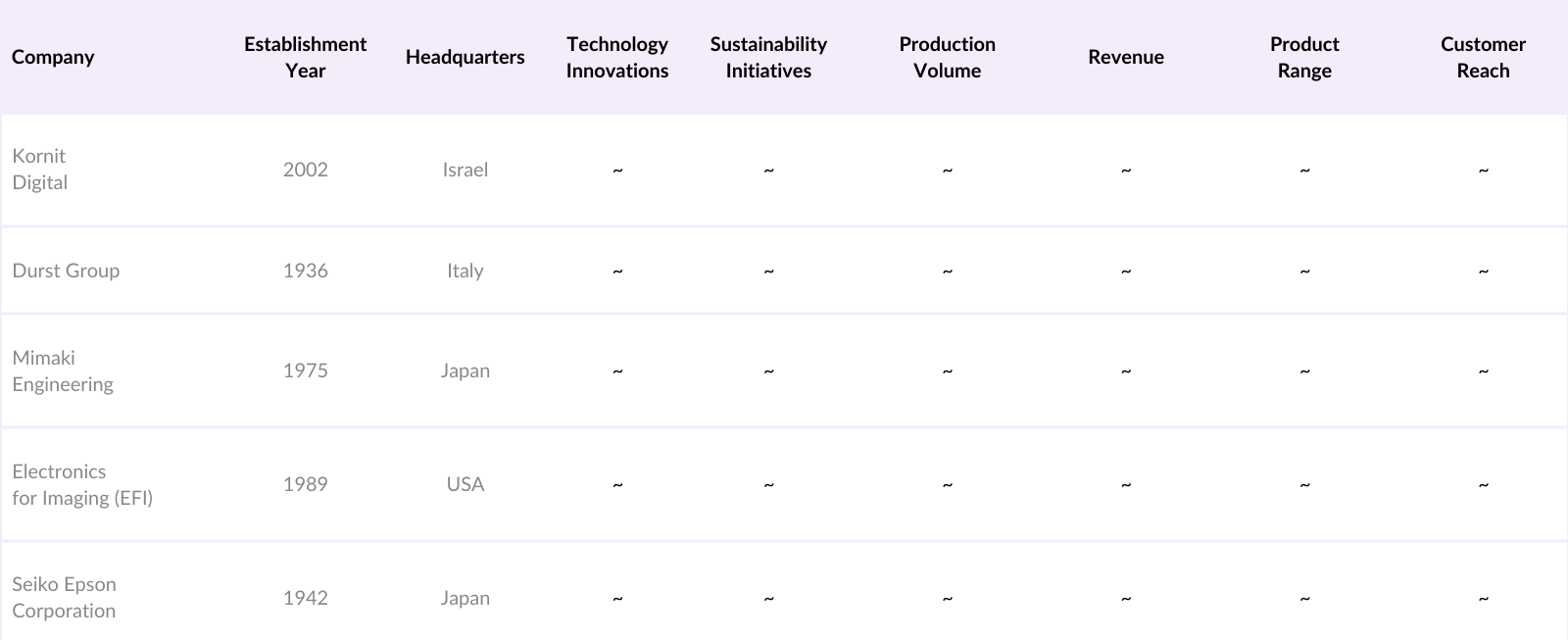
The digital textile printing market is consolidated, with prominent companies leveraging advanced technology and extensive distribution networks. Key players include:
Global Digital Textile Printing Market Analysis
Growth Drivers
- Technological Advancements: The digital textile printing market is experiencing significant growth driven by continuous advancements in printing technology. The global investment in R&D for digital textile printing technologies reached approximately $5 billion in 2023, highlighting the industry's commitment to innovation. This influx of investment is not only enhancing the quality of prints but also reducing production times. The adoption of advanced ink formulations and high-speed printing technologies allows manufacturers to meet the increasing demand for customization and short-run productions effectively, thus driving market growth.
- Rising Demand for Customization: The shift towards personalized and customized products in the fashion and home decor sectors is propelling the growth of digital textile printing. In 2023, the global market for customized apparel was valued at over $150 billion, with a significant portion attributed to digital textile printing methods. This trend is fueled by consumer preferences for unique designs and the ability of digital printing to produce intricate patterns and graphics on demand, allowing brands to respond quickly to changing fashion trends and consumer tastes.
- Environmental Sustainability: As the textile industry faces increasing pressure to adopt sustainable practices, digital textile printing offers an eco-friendly alternative to traditional methods. Digital printing significantly reduces water consumptionestimated to be up to 90% less than conventional printing techniquesand minimizes waste through precise ink application. In 2023, approximately 30% of textile manufacturers reported switching to digital methods as part of their sustainability initiatives, driven by regulatory requirements and consumer demand for greener products. This shift is positioning digital textile printing as a key player in sustainable fashion.
Market Challenges
- High Initial Investment: One of the primary barriers to entry in the digital textile printing market is the substantial initial investment required for advanced printing equipment. The cost of high-quality digital printers can range from $50,000 to $500,000, depending on their capabilities. Many small and medium-sized enterprises (SMEs) face challenges in securing funding for such investments, which hinders their ability to compete in the market. Moreover, ongoing maintenance costs and the need for skilled personnel to operate advanced machines further exacerbate this challenge.
- Technical Limitations: Despite the advancements in digital textile printing technology, there are still several technical limitations that pose challenges to the market's growth. For instance, not all inks are compatible with every type of fabric, which restricts the range of materials that can be printed digitally. Additionally, issues related to color accuracy and durability of prints on certain fabrics can impact customer satisfaction. The industry is currently addressing these limitations through ongoing research and development, but the need for consistent quality across various substrates remains a challenge for manufacturers.
Global Digital Textile Printing Market Future Outlook
Over the next several years, the global digital textile printing market is set to expand due to advancements in digital printing technology and the drive for environmentally sustainable solutions. Key factors expected to fuel this growth include increased automation, demand for personalized products, and ongoing government support for eco-friendly printing alternatives. The shift towards online retail and the need for shorter production runs are also likely to support the digital transformation in the textile printing industry.
Opportunities
- Emerging Markets: The digital textile printing market is poised for significant growth in emerging markets, particularly in regions like Asia-Pacific and Latin America. In 2022, the textile and apparel market in Asia-Pacific was valued at over $200 billion, and it is expected to grow as countries like India and Vietnam expand their manufacturing capabilities. The increasing adoption of digital printing technologies in these regions presents opportunities for businesses to tap into a burgeoning consumer base that values customization and quality. Investments in infrastructure and technology will be key to capitalizing on this potential.
- Innovations in Printing Technologies: Continuous innovations in digital printing technologies are creating new opportunities for market expansion. For instance, advancements in printer speed and ink formulation are enabling faster production times and broader applications, including sportswear and home textiles. Companies are exploring eco-solvent and water-based inks, which not only cater to the growing demand for sustainable solutions but also enhance print quality and durability. The introduction of hybrid printing systems that combine digital and traditional techniques is also gaining traction, offering flexibility to manufacturers to diversify their product offerings.
Scope of the Report
|
Segment |
Sub-segments |
|
By Technology |
Inkjet Printing |
|
Sublimation Printing |
|
|
Direct-to-Fabric Printing |
|
|
Digital Screen Printing |
|
|
By Ink Type |
Reactive Inks |
|
Disperse Inks |
|
|
Pigment Inks |
|
|
Sublimation Inks |
|
|
By Application |
Apparel |
|
Home Textiles |
|
|
Technical Textiles |
|
|
Fashion Accessories |
|
|
By Region |
North America |
|
Europe |
|
|
Asia-Pacific |
|
|
Latin America |
|
|
Middle East & Africa |
Products
Key Target Audience
Textile Manufacturing Companies
Digital Printing Equipment Manufacturers
Apparel and Fashion Brands
Home Textile Retailers
Advertising and Branding Agencies
Investors and Venture Capitalist Firms
Government and Regulatory Bodies (Environmental Protection Agency, Bureau of Indian Standards)
E-commerce Platforms
Companies
Players mentioned in the report
Kornit Digital
Durst Group
Mimaki Engineering Co., Ltd.
Electronics For Imaging (EFI)
Seiko Epson Corporation
Roland DG Corporation
Dover Corporation
Ricoh Company, Ltd.
HP Inc.
Brother Industries, Ltd.
Konica Minolta, Inc.
Colorjet Group
Mutoh Holdings Co., Ltd.
Aeoon Technologies GmbH
SPGPrints B.V.
Table of Contents
1. Global Digital Textile Printing Market Overview
1.1. Definition and Scope
1.2. Market Taxonomy
1.3. Market Growth Rate
1.4. Market Segmentation Overview
2. Global Digital Textile Printing Market Size (In USD Bn)
2.1. Historical Market Size
2.2. Year-On-Year Growth Analysis
2.3. Key Market Developments and Milestones
3. Global Digital Textile Printing Market Analysis
3.1. Growth Drivers
3.1.1. Technological Advancements (Investment in R&D, Adoption of New Inks)
3.1.2. Rising Demand for Customization (Market Trends in Fashion and Home Decor)
3.1.3. Environmental Sustainability (Shift Towards Eco-friendly Printing Solutions)
3.1.4. Growth in E-commerce (Expansion of Online Retailing)
3.2. Market Challenges
3.2.1. High Initial Investment (Cost Analysis of Digital Printing Equipment)
3.2.2. Technical Limitations (Issues with Ink Compatibility and Fabric Types)
3.2.3. Skilled Labor Shortage (Availability of Trained Personnel in the Industry)
3.3. Opportunities
3.3.1. Emerging Markets (Expansion Opportunities in Asia-Pacific and Latin America)
3.3.2. Innovations in Printing Technologies (Development of Faster and More Efficient Printers)
3.3.3. Collaborations with Fashion Brands (Partnerships for Exclusive Collections)
3.4. Trends
3.4.1. Digitalization of the Supply Chain (Integration with Smart Manufacturing)
3.4.2. Adoption of Sustainable Practices (Focus on Waste Reduction)
3.4.3. Increased Use of Automation (Utilization of AI and Machine Learning)
3.5. Government Regulation
3.5.1. Compliance with Environmental Standards (Regulations on Waste Disposal)
3.5.2. Support for Green Technologies (Incentives for Sustainable Practices)
3.5.3. Intellectual Property Rights (Regulations on Design Copyrights)
3.6. SWOT Analysis
3.7. Stakeholder Ecosystem
3.8. Porters Five Forces
3.9. Competition Ecosystem
4. Global Digital Textile Printing Market Segmentation
4.1. By Technology (In Value %)
4.1.1. Inkjet Printing
4.1.2. Sublimation Printing
4.1.3. Direct-to-Fabric Printing
4.1.4. Digital Screen Printing
4.2. By Ink Type (In Value %)
4.2.1. Reactive Inks
4.2.2. Disperse Inks
4.2.3. Pigment Inks
4.2.4. Sublimation Inks
4.3. By Application (In Value %)
4.3.1. Apparel
4.3.2. Home Textiles
4.3.3. Technical Textiles
4.3.4. Fashion Accessories
4.4. By Region (In Value %)
4.4.1. North America
4.4.2. Europe
4.4.3. Asia-Pacific
4.4.4. Latin America
4.4.5. Middle East & Africa
5. Global Digital Textile Printing Market Competitive Analysis
5.1 Detailed Profiles of Major Companies
5.1.1. Mimaki Engineering Co., Ltd.
5.1.2. Kornit Digital Ltd.
5.1.3. Durst Phototechnik AG
5.1.4. Epson America, Inc.
5.1.5. HP Inc.
5.1.6. Roland DG Corporation
5.1.7. Brother Industries, Ltd.
5.1.8. J-Teck3 S.r.l.
5.1.9. Caldera Graphics
5.1.10. Atexco Co., Ltd.
5.1.11. Hohenstein Institute
5.1.12. Neenah, Inc.
5.1.13. Avery Dennison Corporation
5.1.14. Gerber Technology
5.1.15. Sawgrass Technologies, Inc.
5.2 Cross Comparison Parameters (Revenue, Headquarters, Inception Year, Number of Employees, Product Portfolio, Market Share, Key Innovations, Geographic Presence)
5.3 Market Share Analysis
5.4 Strategic Initiatives
5.5 Mergers and Acquisitions
5.6 Investment Analysis
5.7 Venture Capital Funding
5.8 Government Grants
5.9 Private Equity Investments
6. Global Digital Textile Printing Market Regulatory Framework
6.1 Environmental Standards
6.2 Compliance Requirements
6.3 Certification Processes
7. Global Digital Textile Printing Market Future Market Size (In USD Bn)
7.1 Future Market Size Projections
7.2 Key Factors Driving Future Market Growth
8. Global Digital Textile Printing Market Future Segmentation
8.1 By Technology (In Value %)
8.2 By Ink Type (In Value %)
8.3 By Application (In Value %)
8.4 By Region (In Value %)
9. Global Digital Textile Printing Market Analysts Recommendations
9.1 TAM/SAM/SOM Analysis
9.2 Customer Cohort Analysis
9.3 Marketing Initiatives
9.4 White Space Opportunity Analysis
Disclaimer Contact Us
Research Methodology
Step 1: Identification of Key Variables
Initial analysis involves mapping critical market dynamics, including the adoption rate of digital printing across major textiles. This process includes extensive desk research, gathering quantitative data from reliable databases.
Step 2: Market Analysis and Construction
We analyze historical and recent data, focusing on metrics like adoption rates, production efficiency, and revenue streams within the textile printing market.
Step 3: Hypothesis Validation and Expert Consultation
Market hypotheses are refined through consultations with experts in textile manufacturing, gaining insights on market practices, competitive landscape, and technological advancements.
Step 4: Research Synthesis and Final Output
Engaging directly with industry stakeholders enables us to corroborate data, producing an accurate and validated market report that addresses the comprehensive dynamics of the global digital textile printing market.
Frequently Asked Questions
How big is the Global Digital Textile Printing Market?
The global digital textile printing market is valued at USD 2.3 billion, driven by technological advancements and a rising demand for customized textile solutions.
What are the challenges in the Global Digital Textile Printing Market?
Challenges include high equipment costs and the limited availability of skilled labor, which restricts the adoption of advanced digital printing technology in certain regions.
Who are the major players in the Global Digital Textile Printing Market?
Key players in the market include Kornit Digital, Durst Group, Mimaki Engineering, and Seiko Epson Corporation, known for their innovative and sustainable printing solutions.
What drives the Global Digital Textile Printing Market?
The market is propelled by increased consumer demand for eco-friendly, customized products, along with advancements in inkjet technology that enable high-quality, efficient printing.
Which regions dominate the Global Digital Textile Printing Market?
North America and Europe lead the market due to established infrastructure, with Asia catching up due to its manufacturing capabilities and rapid adoption of digital technologies.
Why Buy From Us?

What makes us stand out is that our consultants follows Robust, Refine and Result (RRR) methodology. i.e. Robust for clear definitions, approaches and sanity checking, Refine for differentiating respondents facts and opinions and Result for presenting data with story

We have set a benchmark in the industry by offering our clients with syndicated and customized market research reports featuring coverage of entire market as well as meticulous research and analyst insights.

While we don't replace traditional research, we flip the method upside down. Our dual approach of Top Bottom & Bottom Top ensures quality deliverable by not just verifying company fundamentals but also looking at the sector and macroeconomic factors.

With one step in the future, our research team constantly tries to show you the bigger picture. We help with some of the tough questions you may encounter along the way: How is the industry positioned? Best marketing channel? KPI's of competitors? By aligning every element, we help maximize success.

Our report gives you instant access to the answers and sources that other companies might choose to hide. We elaborate each steps of research methodology we have used and showcase you the sample size to earn your trust.

If you need any support, we are here! We pride ourselves on universe strength, data quality, and quick, friendly, and professional service.