















Global Digital Twin Market Size, Segments, Outlook, and Revenue Forecast 2022-2028 by Type (Parts Twin, Product Twin, Process Twin, and System Twin), Application (Product Design, Product Development, Inventory Management, Predictive Maintenance, Performance Monitoring, and Business Optimization), End-User (Aerospace & Defense, Automotive & Transportation, Manufacturing, Healthcare, Retail, Energy & Utilities, Home & Commercial, and IT & Telecom) and Region (North America, Europe, Asia-Pacific, and Latin America, Middle East and Africa (LAMEA))
Region:Global
Product Code:KRBR131
Invalid Date
150
About the Report
Market Overview:
A digital twin is a digital representation of a real-world entity or system. The implementation of the digital twin is an encapsulated software object or model that reflects a unique physical object, process, organization, person, or other abstraction. Data from multiple digital twins can be used for composite views across different real-world entities, such as power plants or cities and their associated processes. For instance, wind turbines are equipped with various sensors related to important functional areas. These sensors generate data on various aspects of physical object performance, such as energy output, temperature, and weather conditions.
According to Ken Research Analysis, the Global Digital Twin Market was valued at ~US$ 3 billion in 2017. It is estimated to be ~US$ 8 billion in 2022 and is forecasted to reach a market size of ~US$ 40 billion, growing at a CAGR of ~30% owing to the rising demand from the manufacturing industry.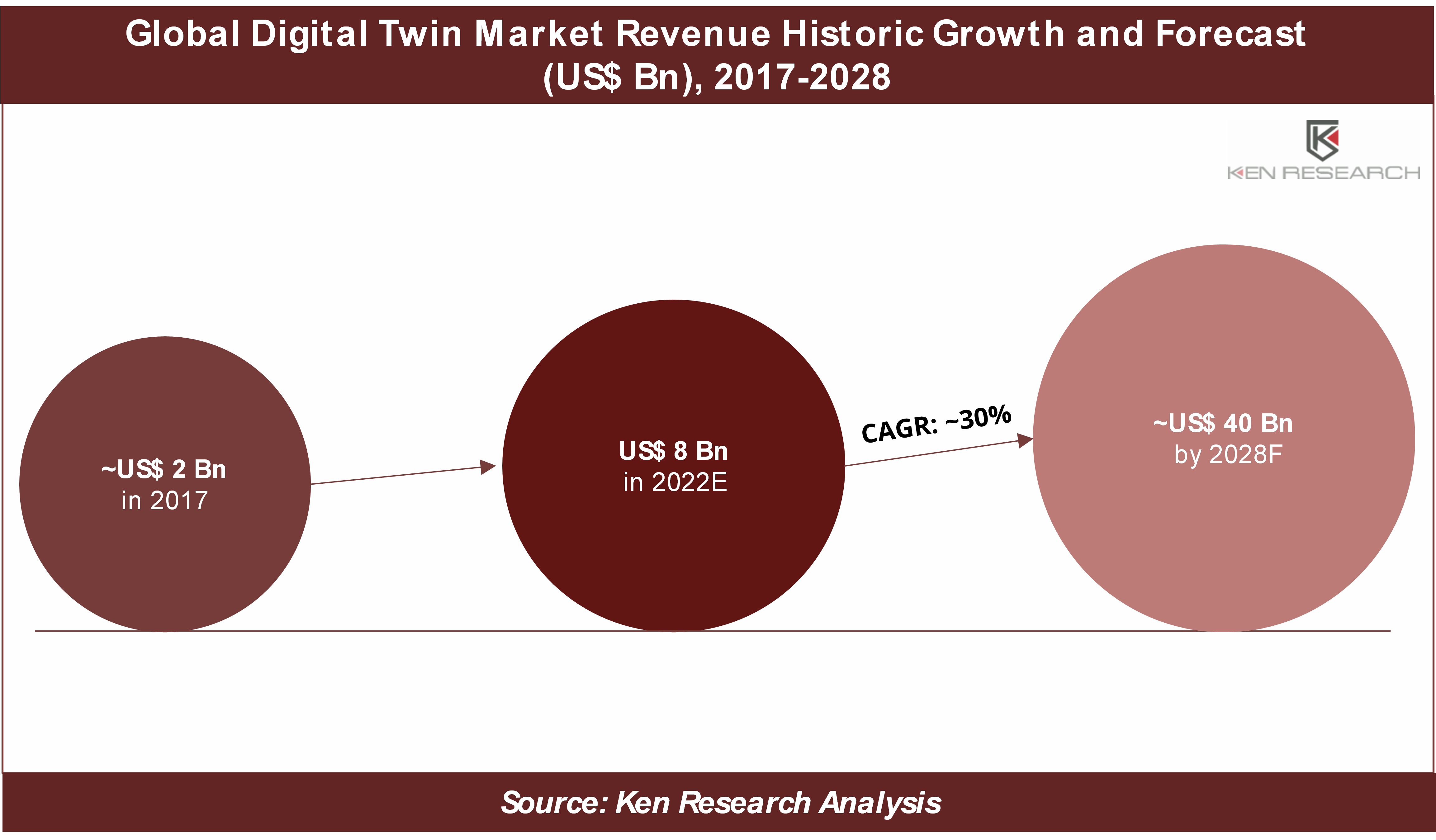
- Increasing the use of digital twins in manufacturing sectors to cut costs and enhance supply chain efficiency is the major driving factor for the digital twin market. The advantage of using digital twin is that it helps to reduce the extra cost and time needed at the manufacturing time. Digital Twin helps engineers improve a product's performance by analyzing and altering the physical design of the prototype, due to which almost all industries are using this technology for the enhancement of their business.
- The cost of implementing Digital Twin technology in an organization is pretty high. High cost of implementation act as a barrier to the growth of the global digital twin market. Digital twins & related technologies
- The market was negatively impacted by the COVID-19 pandemic during the first half of 2020, owing to the strict regulations in several countries that temporarily halted all types of companies. Production halts and supply chain disruptions during the COVID-19 pandemic led to the suspension of several other activities along the value chain of industries, such as aerospace, manufacturing, and automotive. However, the market experienced a sudden boom as all the companies were adopting digital twin as a part of its processes. Digital twins could help build predictive models and determine the probability of success of physical prototypes before they are rolled out. The pandemic has accelerated the adoption of digital twin technology across various applications in several verticals beyond manufacturing, including real estate, healthcare, telecom, and retail, driving the growth prospects of the market.
Scope of the Report:
The Digital Twin market is segmented by type, application, end-user and region. In addition, the report also covers the market size for each of the four regions' Digital Twin market. The revenue used to size and forecast the market for each segment is US$ billion.
|
Type |
|
|
Application |
|
|
End-User |
|
|
Region |
|
|
Key Players |
|
Key Trends by Market Segment
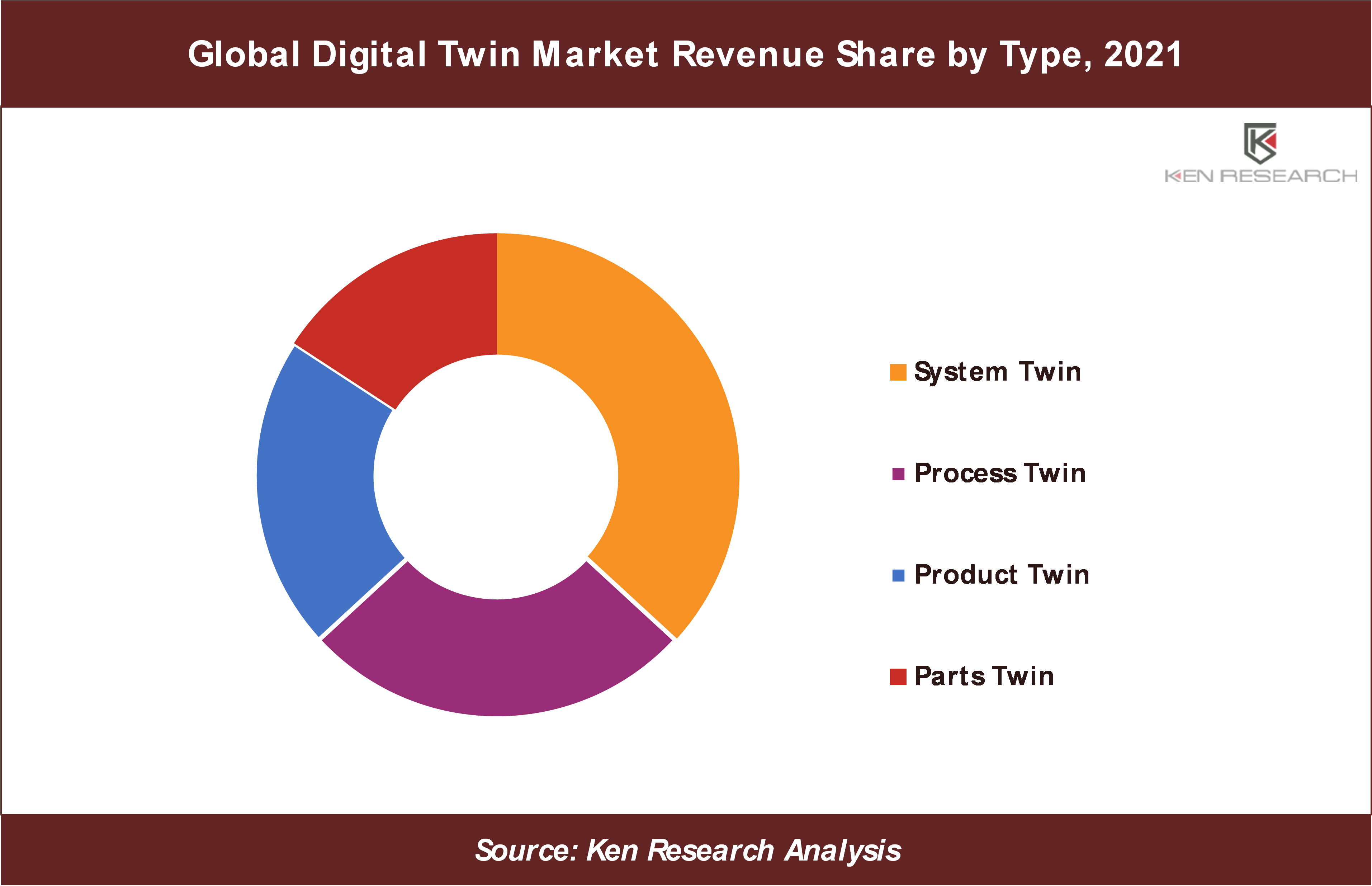
By Type: The system twin segment held the largest market share in the global digital twin market in 2021, owing to the high deployment of digital twins for designing and developing prototypes of communication systems, full-scale automotive models, and piping systems in the oil & gas industry, among others.
- System twins help engineers observe the system performance and synchronization of components during operation. The deployment of digital twin technology helps identify any anomalies in system operations and enhance performance.
- The process segment is expected to register the highest CAGR during the forecast period, as the organizations are focusing on improving coordination across operations to optimize workflow processes and cut down on operational costs.
By Application: The product design segment held the largest market share in the global digital twin market in 2021, due to mounting demand for digital twin technology in product design and development applications.
- Digital twin technology speeds up the designing process, improving the time-to-market for new products, which is foreseen to further accelerate product penetration in the sector.
- Businesses with a complete digital footprint of products are increasingly incorporating digital twin technology as it allows them to identify physical issues sooner and track outcomes precisely, enhancing product quality and life cycle.

By End-User: The automotive & transportation segment held the largest market share in the global digital twin market in 2021, due to the adoption of Electric Vehicles (EVs), lean adoption, and the rising usage of simulation technologies.
- The incorporation of digital twin technology in the automotive sector helps engineers capture operational and behavioral data of the vehicle, thereby facilitating further enhancements in automobile design and optimizing costs.
- Upcoming trends in the automobile industry, including autonomous and connected vehicles, shared mobility, and electrification, are also expected to increase the adoption of this technology.
By Region: North Americaheld the largest market share among all other regions within the global digital twin market in 2021, due to the supporting government policies to augment the growth of the region.
- North America is the prime hub of the different manufacturers as well as suppliers of digital twin technology, and due to the digitalization of industries such as manufacturing, automotive, and healthcare in the region, the demand for digital twin has increased.
- North America dominates the IoT industry in aerospace, automotive, and manufacturing. The region has developed economies like the USA and Canada, where massive investments are found in R&D activities, thus contributing to developing new technologies such as smart sensors, edge analytics, 3D printing, and digital twin.

Competitive Landscape
The Global Digital Twin Market is highly competitive with ~200 players, including globally diversified players, regional players, and many country-niche players. Most of the regional players are the developers of digital twin used in various end-user industries.
Country-niche players constitute ~35% of the total number of competitors, while regional players dominate representing ~45% of total competitors. Some of the major players in the market include Accenture, Autodesk Inc., General Electric, IBM Corporation, Microsoft, Bentley Systems, Incorporated, Robert Bosch GmbH, SAP SE, Schneider Electric, and Siemens, among others.


Recent Developments Related to Major Players and Organizations
- In September 2022, two U.K.-based technology companies, Sharp End Partnership, Ltd and Threedium LTD, combined their top technology solutions to let marketers provide linked experiences with Metaverse. The interactions include the ability to quickly tap or scan embedded QR and NFC to unlock digital twins of physical objects. Through this, brands could soon activate storytelling 3D/AR applications and tokenize their products.
- In March 2022, Valiot, a USA-based AI and software company, enhanced its manufacturing software through digital twin technology. Artificial intelligence capabilities applied to the value chain empowered manufacturers to predict and react to unexpected changes in every part of the value chain, including demand, supply, production, and distribution.
- In March 2021, The Lamina Tower, an ultra-luxury residential condominium tower in the Middle East, partnered with Cityzenith LLC to create a multi-purpose digital twin using the SmartWorldOS Digital Twin desktop application to create a 3D view of the property and surroundings, along with other requirements.
Conclusion
The Global Digital Twin Market witnessed a negative impact due to COVID-19 owing to the strict regulations in several countries that temporarily halted all types of processes and shut down all the major industries. System twin is the most common type of digital twin among other types such as part twin, product twin, and process twin. Majorly, the digital twin technology is used for product design and development that can further be utilized in various end-use industries such as aerospace & defense, automotive & transportation, manufacturing, healthcare, retail, and others. Though the market is competitive with over ~200 participants, regional players control the dominant share in the market and country-niche players also hold a significant share.
Note: This is an On-Demand/Planned report, so the figures quoted here for market size estimate, forecast, growth, segment share, and competitive landscape are based on initial findings and might vary slightly in the actual report. Also, any required customizations can be covered to the best feasible extent for Pre-booking clients and report delivered within a maximum of 2 working weeks.
Key Topics Covered in the Report
- Snapshot of Global Digital Twin Market
- Industry Value Chain and Ecosystem Analysis
- Market size and Segmentation of the Global Digital Twin Market
- Historic Growth of Overall Global Digital Twin Market and Segments
- Competition Scenario of the Market and Key Developments of Competitors
- Porter’s 5 Forces Analysis of Global Digital Twin Industry
- Overview, Product Offerings, Strengths, & Weaknesses of Key Competitors
- Covid-19 Impact on the Overall Global Digital Twin Market
- Future Market Forecast and Growth Rates of the Total Global Digital Twin Market and Segments
- Analysis of Global Digital Twin Market
- Major Production/Supply and Consumption/Demand Hubs within Each Region
- Major Country-wise Historic and Future Market Growth Rates of the Total Market and Segments
- Overview of Notable Emerging Competitor Companies within Each Region
Notable Key Players Mentioned in the Report
- Accenture
- Autodesk Inc.
- General Electric
- IBM Corporation
- Microsoft
- Bentley Systems, Incorporated
- Robert Bosch GmbH
- SAP SE
- Schneider Electric
- Siemens
Notable Emerging Companies Mentioned in the Report
- Digital Construction Works
- Allvision IO
- DigitalTwin Technology GmbH
- MEIK LABS SpA
- MetaTwin GmbH
Key Target Audience – Organizations and Entities Who Can Benefit by Subscribing This Report
- Digital Twin Solution Developers
- Digital Twin Solution Suppliers
- Digital Twin Solution Implementors
- Product Twin Developers
- Process Twin Developers
- System Twin Developers
- Digital Twin Distributors
- Emerging and Startups in Digital Twin Industry
- Simulation Solutions Companies
- Different Types of Digital Twin Manufacturing Hubs
- Government Departments of Electronics
- Government Ministries and Departments of Information Technology
- Financial Institutions focused on Information Technology Industry
- PE and VC Firms focused on Information Technology Industry
- Potential Entrants into Information Technology Industry
- Potential Entrants into Simulation Solutions
Period Captured in the Report
- Historical Period: 2017-2021
- Forecast Period: 2022E-2028F
Frequently Asked Questions
- What is the Study Period of this Market Report?
The Global Digital Twin Market is covered from 2017-2028 in this report, which includes a forecast for the period (2022-2028).
- What is the Future Growth Rate of the Global Digital Twin Market?
The global digital twin market is expected to witness a CAGR of ~30% over the next 6 years.
- What are the Key Factors Driving the Global Digital Twin Market?
The growing demand for digital twin technology from the manufacturing industry is one of the primary drivers for the growth of the global digital twin market.
- Which is the Largest Application Segment within the Global Digital Twin Market?
The product design segment held the largest share of the global digital twin market in 2021.
- Who are the Key Players in the Global Digital Twin Market?
Accenture, Autodesk Inc., General Electric, IBM Corporation, Microsoft, Bentley Systems, Incorporated, Robert Bosch GmbH, SAP SE, Schneider Electric, Siemens, among others are the major companies operating in Global digital twin Market.
Products
Companies
Notable Key Players Mentioned in the Report
Accenture
Autodesk Inc.
General Electric
IBM Corporation
Microsoft
Bentley Systems, Incorporated
Robert Bosch GmbH
SAP SE
Schneider Electric
Siemens
Notable Emerging Companies Mentioned in the Report
Digital Construction Works
Allvision IO
DigitalTwin Technology GmbH
MEIK LABS SpA
MetaTwin GmbH
Table of Contents
- 1. Executive Summary
1.1 Highlights of Global Digital Twin Market Historic Growth & Forecast
1.2 Highlights of Market Trends, Challenges, and Competition
1.3 Highlights of Market Revenue Share by Segments
- 2. Market Overview and Key Trends Impacting Growth
2.1 Global Digital Twin Market Taxonomy
2.2 Industry Value Chain
2.3 The Ecosystem of Major Entities in the Global Digital Twin Market
2.4 Government Regulations & Developments
2.5 Key Growth Drivers & Challenges Impacting the Market
2.6 COVID-19 Impact on Global Digital Twin Market
2.7 Total Digital Twin Market Historic Growth by Segment Type, 2017-2021
2.7.1 By Type
2.7.2 By Application
2.7.3 By End-User
2.7.4 By Region
2.8 Total Global Digital Twin Market Historic Growth and Forecast, 2017-2028
2.9 Key Takeaways
- 3. Global - Market Segmentation by Type, Historic Growth, Outlook & Forecasts
3.1 Market Definition - Segmentation by Type
3.2 Market Revenue Share, Historic Growth, Outlook, and Forecasts by Type, 2017-2028
3.2.1 Parts Twin
3.2.2 Product Twin
3.2.3 Process Twin
3.2.4 System Twin
3.3 Key Takeaways from Market Segmentation by Type
- 4. Global - Market Segmentation by Application, Historic Growth, Outlook & Forecasts
4.1 Market Definition - Segmentation by Application
4.2 Market Revenue Share, Historic Growth, Outlook, and Forecasts by Application, 2017-2028
4.2.1 Care
4.2.2 Others
4.2.3 Product Design
4.2.4 Product Development
4.2.5 Inventory Management
4.2.6 Predictive Maintenance
4.2.7 Performance Monitoring
4.2.8 Business Optimization
4.2.9 Others
4.3 Key Takeaways from Market Segmentation by Application
- 5. Global - Market Segmentation by End-User, Historic Growth, Outlook & Forecasts
5.1 Market Definition - Segmentation by End-User
5.2 Market Revenue Share, Historic Growth, Outlook, and Forecasts by End-User, 2017-2028
5.2.1 Aerospace & Defense
5.2.2 Automotive & Transportation
5.2.3 Manufacturing
5.2.4 Healthcare
5.2.5 Retail
5.2.6 Energy & Utilities
5.2.7 Home & Commercial
5.2.8 IT & Telecom
5.2.9 Others
5.3 Key Takeaways from Market Segmentation by End-User
- 6. Industry / Competition Analysis - Competitive Landscape
6.1 Types of Players (Competitors) & Share of Competition
6.2 Porter’s 5 Forces Analysis of Global Digital Twin Competitors
6.3 Key Developments in the Global Digital Twin Sector Impacting Market Growth
6.4 Comparison of Leading Competitors within Global Digital Twin Market, 2021
6.5 Comparison of Leading Competitors within Global Digital Twin Market by Coverage of Type, 2021
6.6 Comparison of Leading Competitors within Global Digital Twin Market by Coverage of Application, 2021
6.7 Comparison of Leading Competitors within Global Digital Twin Market by Coverage of End-User, 2021
6.8 Comparison of Leading Competitors within Global Digital Twin Market by Coverage of Region, 2021
6.9 Key Takeaways from Competitive Landscape
- 7. Key Competitor Profiles (Company Overview, Product Offerings, and Strengths & Weaknesses Analysis)
7.1 Accenture
7.2 Autodesk Inc.
7.3 General Electric
7.4 IBM Corporation
7.5 Microsoft
7.6 Bentley Systems, Incorporated
7.7 Robert Bosch GmbH
7.8 SAP SE
7.9 Schneider Electric
7.10 Siemens
- 8. Geographic Analysis & Major Countries Market Historic Growth, Outlook, and Forecasts
8.1 Major Countries Comparison of Macroeconomic Factors
8.2 Global- Market Revenue Share, Historic Growth, Outlook and Forecasts by Region, 2017-2028
8.3 Major Countries Market Analysis, Historic Growth, Outlook & Forecasts
8.4 North America – Digital Twin Market Analysis
8.4.1 Major Production and Consumption Hubs in North America
8.4.2 Notable Emerging Digital Twin Companies in North America
8.4.3 Market Revenue Share, Historic Growth, Outlook and Forecasts by Type, 2017-2028
8.4.4 Market Revenue Share, Historic Growth, Outlook and Forecasts by Application, 2017-2028
8.4.5 Market Revenue Share, Historic Growth, Outlook and Forecasts by End-User, 2017-2028
8.4.6 Market Revenue Share, Historic Growth, Outlook, and Forecasts by Major Countries, 2017-2028
- USA
- Canada
- Mexico
8.5 Europe – Digital Twin Market Analysis
8.5.1 Major Production and Consumption Hubs in Europe
8.5.2 Notable Emerging Digital Twin Companies in Europe
8.5.3 Market Revenue Share, Historic Growth, Outlook and Forecasts by Type, 2017-2028
8.5.4 Market Revenue Share, Historic Growth, Outlook and Forecasts by Application, 2017-2028
8.5.5 Market Revenue Share, Historic Growth, Outlook and Forecasts by End-User, 2017-2028
8.5.6 Market Revenue Share, Historic Growth, Outlook, and Forecasts by Major Countries, 2017-2028
- Germany
- UK
- France
- Spain
- Italy
- Rest of Europe
8.6 Asia Pacific – Digital Twin Market Analysis
8.6.1 Major Production and Consumption Hubs in the Asia Pacific
8.6.2 Notable Emerging Digital Twin Companies in the Asia Pacific
8.6.3 Market Revenue Share, Historic Growth, Outlook and Forecasts by Type, 2017-2028
8.6.4 Market Revenue Share, Historic Growth, Outlook and Forecasts by Application, 2017-2028
8.6.5 Market Revenue Share, Historic Growth, Outlook and Forecasts by End-User, 2017-2028
8.6.6 Market Revenue Share, Historic Growth, Outlook, and Forecasts by Major Countries, 2017-2028
- China
- Japan
- South Korea
- India
- Indonesia
- Australia
- Rest of Asia Pacific
8.7 LAMEA – Digital Twin Market Analysis
8.7.1 Major Production and Consumption Hubs in LAMEA
8.7.2 Notable Emerging Digital Twin Companies in LAMEA
8.7.3 Market Revenue Share, Historic Growth, Outlook and Forecasts by Type, 2017-2028
8.7.4 Market Revenue Share, Historic Growth, Outlook and Forecasts by Application, 2017-2028
8.7.5 Market Revenue Share, Historic Growth, Outlook and Forecasts by End-User, 2017-2028
8.7.6 Market Revenue Share, Historic Growth, Outlook, and Forecasts by Major Sub-Regions, 2017-2028
- Latin America
- Middle East
- Africa
- 9. Industry Expert’s Opinions/Perspectives
9.1 Notable Statements/Quotes from Industry Experts and C-Level Executives on Current Status and Future Outlook of the Market
- 10. Analyst Recommendation
10.1 Analyst Recommendations on Identified Major Opportunities and Potential Strategies to Gain from Opportunities
- 11. Appendix
11.1 Research Methodology - Market Size Estimation, Forecast, and Sanity Check Approach
11.2 Sample Discussion Guide
Disclaimer
Why Buy From Us?

What makes us stand out is that our consultants follows Robust, Refine and Result (RRR) methodology. i.e. Robust for clear definitions, approaches and sanity checking, Refine for differentiating respondents facts and opinions and Result for presenting data with story

We have set a benchmark in the industry by offering our clients with syndicated and customized market research reports featuring coverage of entire market as well as meticulous research and analyst insights.

While we don't replace traditional research, we flip the method upside down. Our dual approach of Top Bottom & Bottom Top ensures quality deliverable by not just verifying company fundamentals but also looking at the sector and macroeconomic factors.

With one step in the future, our research team constantly tries to show you the bigger picture. We help with some of the tough questions you may encounter along the way: How is the industry positioned? Best marketing channel? KPI's of competitors? By aligning every element, we help maximize success.

Our report gives you instant access to the answers and sources that other companies might choose to hide. We elaborate each steps of research methodology we have used and showcase you the sample size to earn your trust.

If you need any support, we are here! We pride ourselves on universe strength, data quality, and quick, friendly, and professional service.