















Global Direct Energy Weapon Market Outlook to 2030
Region:Global
Author(s):Shubham
Product Code:KROD5265
October 2024
81
About the Report
Global Direct Energy Weapon Market Overview
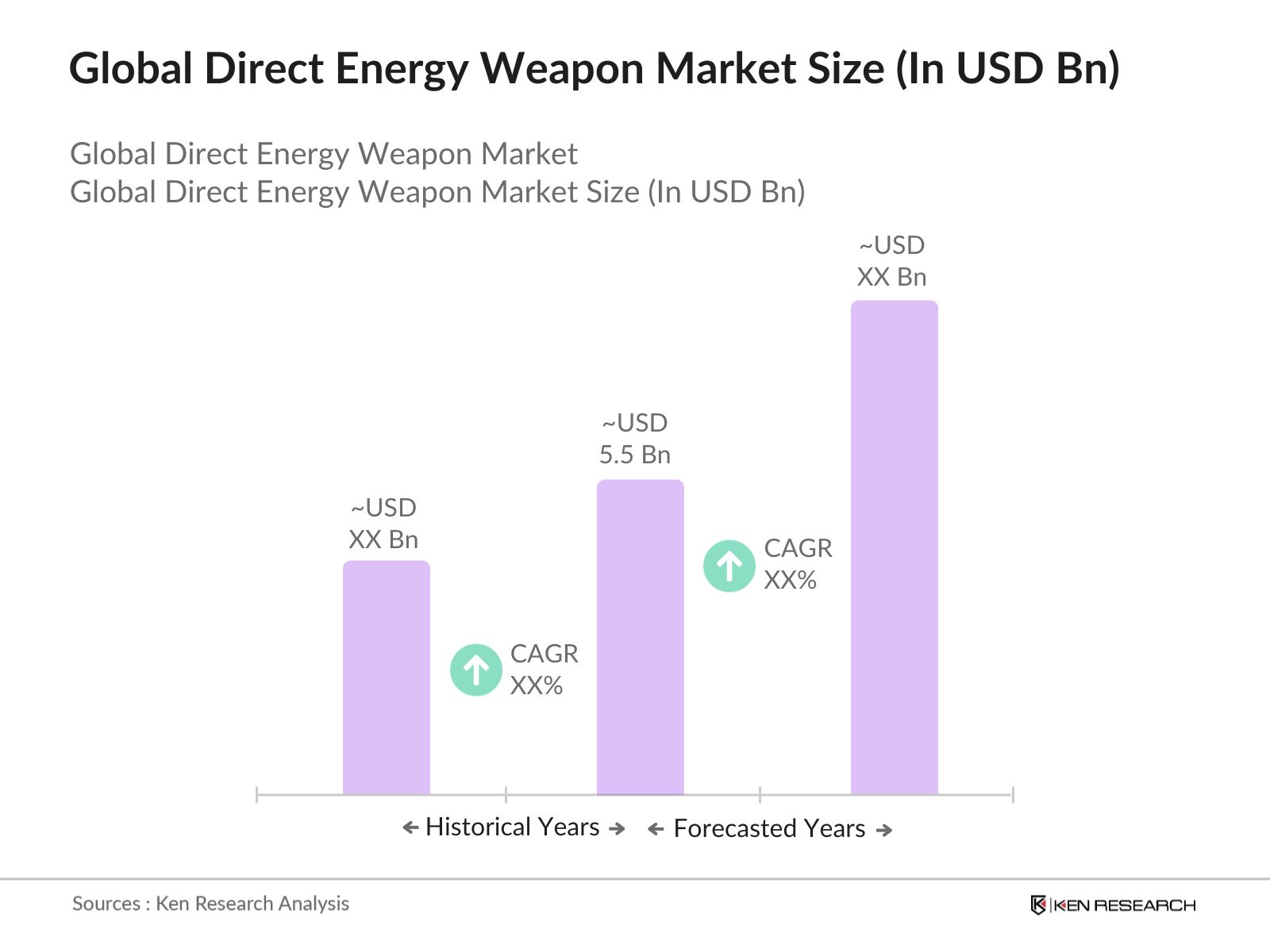
- The global direct energy weapon market is currently valued at USD 5.5 billion, driven by increasing investments in advanced military technologies and the growing demand for precision-targeting systems. Direct energy weapons (DEWs) such as high-energy lasers (HEL) and high-power microwave (HPM) weapons are gaining prominence due to their ability to neutralize threats without conventional ammunition. The use of DEWs in missile defense, vehicle-mounted systems, and anti-drone technologies is expected to further fuel market growth over the forecast period.
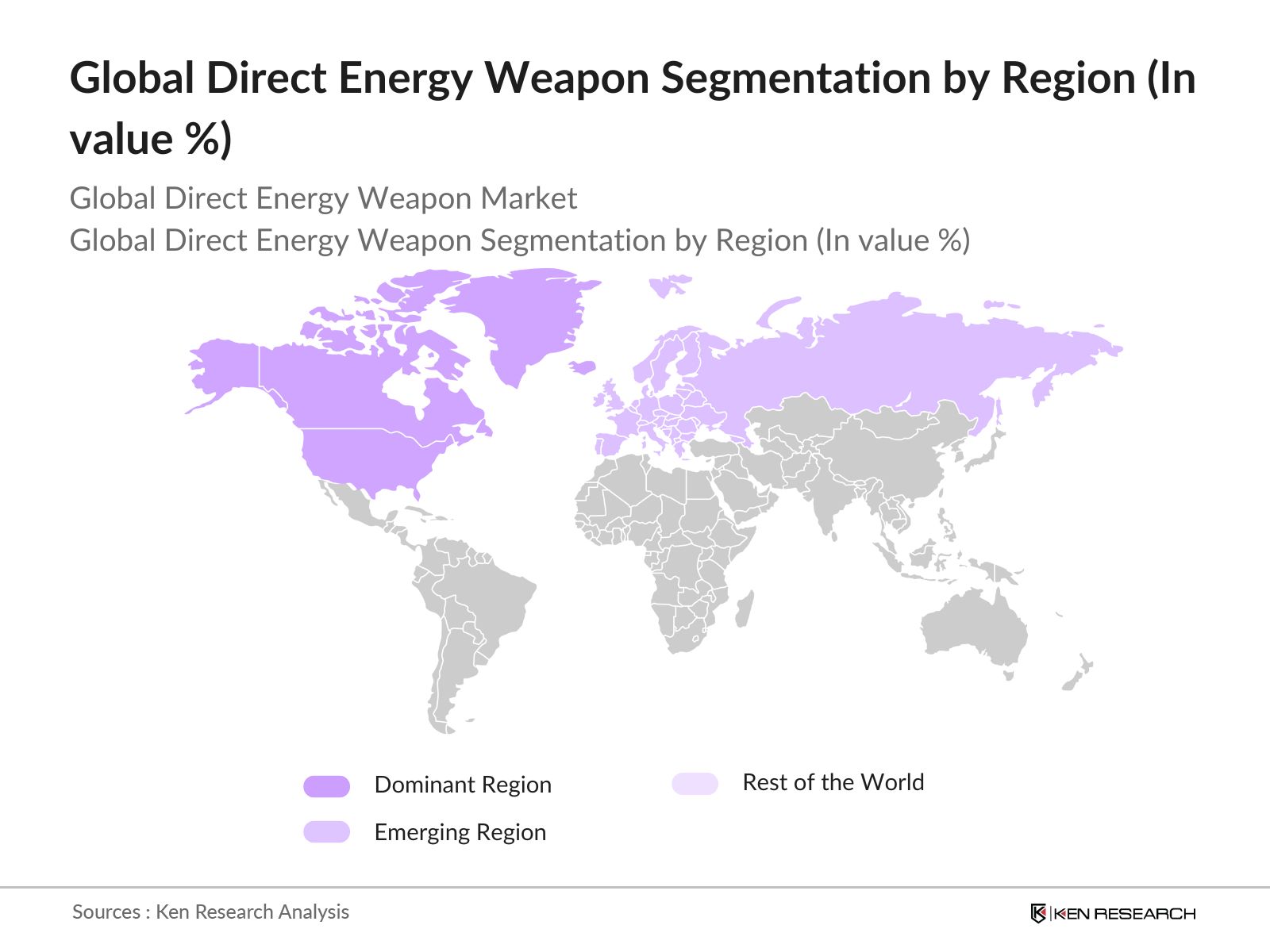
- The leading regions in the global direct energy weapon market include North America, Europe, and Asia Pacific. North America, particularly the United States, dominates the market due to significant investments in defense modernization and the presence of key DEW manufacturers. In Europe, defense strategies focused on technological advancements and international security collaborations contribute to growth. Meanwhile, in Asia Pacific, countries such as China and India are increasing defense spending, particularly in areas involving next-generation warfare technologies.
- International directives, such as the Convention on Certain Conventional Weapons (CCW), play a critical role in regulating DEWs. In 2023, discussions were held by the UN to further regulate the deployment of DEWs, particularly those with anti-personnel capabilities. These arms control efforts are intended to ensure that DEWs are used in accordance with international humanitarian law, while still allowing nations to develop the technology for defensive purposes. Such regulations continue to shape the global DEW landscape.
Global Direct Energy Weapon Market Segmentation
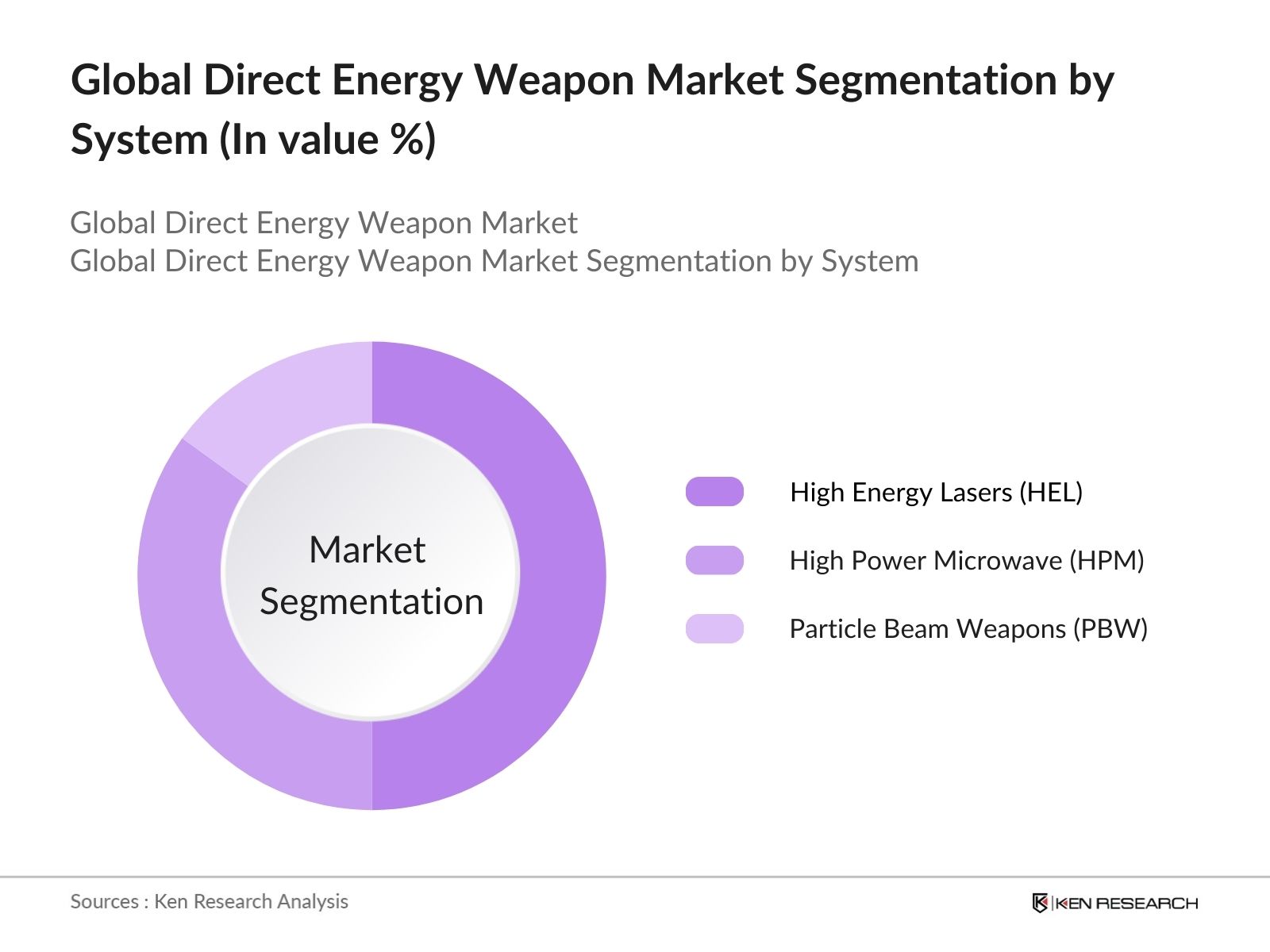
- By System Type: The market is segmented by system type into high-energy lasers (HEL), high-power microwaves (HPM), and particle beam weapons (PBW). High-energy lasers currently dominate the market due to their proven effectiveness in countering aerial threats, such as drones and missiles, with precision. The U.S. militarys ongoing adoption of HEL systems for critical missile defense operations and its success in real-world combat situations have solidified the dominance of this sub-segment.
- By End-User: The market is further segmented by end-user into defense forces, homeland security, and law enforcement agencies. Defense forces dominate the market as major military powers increasingly adopt direct energy weapons to enhance national security. The need for advanced, energy-efficient weapons to counter modern threats such as drone swarms and missile attacks is driving the demand for DEWs in defense operations globally.
- By Region: The market is segmented by region into North America, Europe, Asia Pacific, Latin America, and the Middle East & Africa. North America dominates the market due to significant defense spending and technological advancements in directed energy weapon systems. The U.S. leads the region with large-scale investments in high-energy lasers and high-power microwave weapons, driven by the need to counter modern aerial and missile threats. Government initiatives, such as the U.S. Department of Defenses modernization programs, further bolster the region's dominance.
Global Direct Energy Weapon Market Competitive Landscape
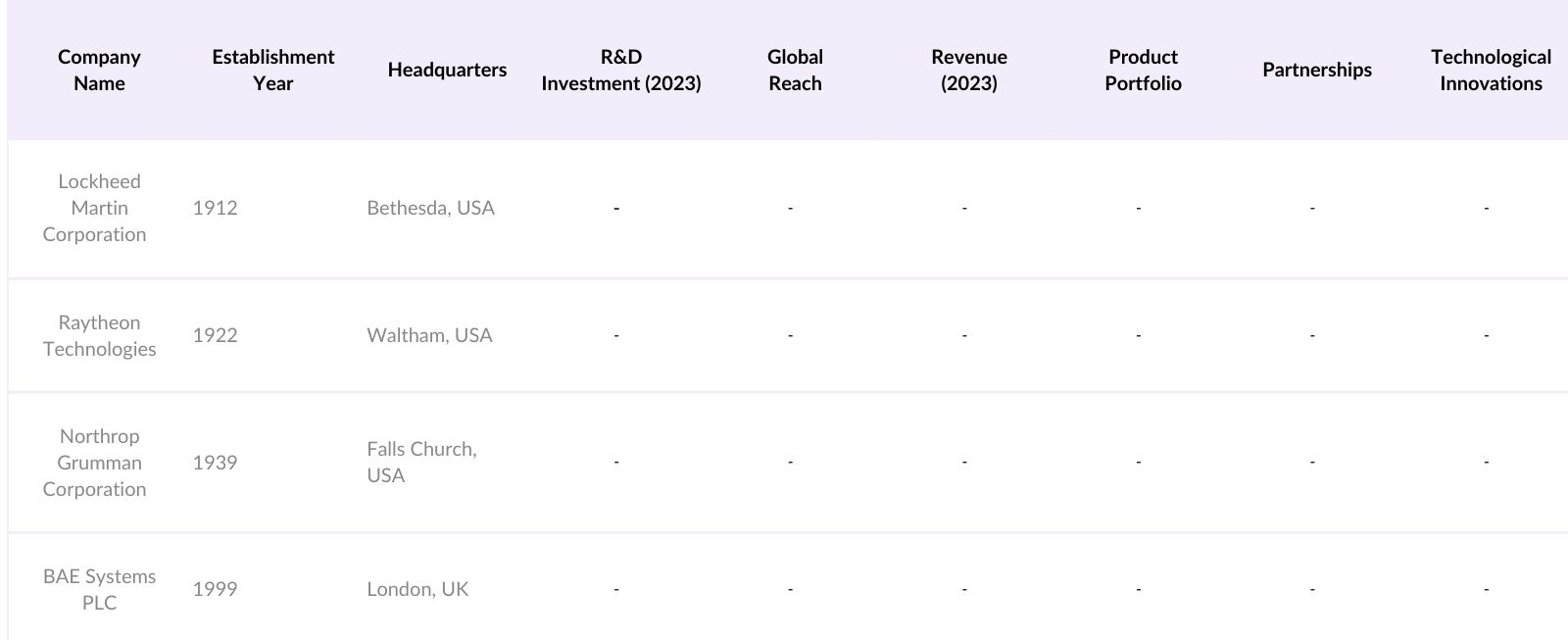
The global direct energy weapon market is characterized by leading defense contractors, investing heavily in research and development (R&D) to deliver cutting-edge technologies. These players are focused on strategic partnerships with military organizations to strengthen their market position.
The market is dominated by these key players, whose strategic collaborations with defense ministries and militaries worldwide ensure their leading position. These companies invest in R&D to create high-performance, energy-efficient, and scalable DEW solutions.
Global Direct Energy Weapon Market Analysis
Growth Drivers
- Increased Military Spending: Countries like the U.S., China, and Russia have prioritized the modernization of their military forces, focusing on integrating DEWs into their defense systems. In 2023, China spent over USD 260 billion on defense, a portion of which was allocated for modernizing its missile defense systems and incorporating laser-based technologies. Similarly, the U.S. budget for defense budget including modernization programs and DEWs, stood at USD 857 billion. These investments are aimed at upgrading air and missile defense capabilities and boosting strategic deterrence capabilities using DEWs.
- Increasing Geopolitical Tensions: Increasing geopolitical tensions in regions like the South China Sea, the Middle East, and Eastern Europe have accelerated defense spending. In 2023, NATO's defense spending surged by nearly $400 billion, partly directed toward DEW research and procurement to enhance counter-aircraft and missile capabilities. Escalating conflicts in Eastern Europe, particularly with Russia's actions in Ukraine, have prompted NATO to fast-track DEW integration into defense systems to counter potential missile threats and UAV attacks.
- Technological Advancements: The development of Direct Energy Weapons (DEWs) is driven by significant technological advancements in high-energy laser systems, radio frequency weapons, and microwave-based solutions. In 2023, various nations, such as the United States, invested heavily in DEW research, with the U.S. Department of Defense allocating billions for DEW-related R&D. This funding is aimed at improving system efficiency and reliability. Advancements in solid-state lasers and beam control technologies have enabled more precise targeting and increased power outputs, making DEWs viable for combat scenarios. These innovations align with broader defense modernization efforts globally.
Market Challenges
- High Development Costs: Deploying DEWs is capital-intensive due to the high cost of R&D, production, and maintenance. The operational deployment of laser-based DEWs involves significant expenses, including testing and integration costs. The complexity of these systems, coupled with the advanced technology required, creates financial challenges for many defense budgets. Both naval and land forces worldwide face difficulties in allocating sufficient resources for the full-scale deployment of DEWs, especially when considering their additional infrastructure and maintenance needs. These factors contribute to the high cost, making it a hurdle for nations with limited defense funding.
- Huge Energy Requirements: DEWs, particularly high-energy lasers, require vast amounts of power to operate effectively. These systems need substantial energy inputs to function, especially during peak operation scenarios like disabling UAVs or missile threats. Energy requirements remain a major technical challenge, particularly for mobile or portable systems used in ground operations. Defense organizations are continuously exploring alternative power sources, including nuclear and hybrid technologies, to address the immense energy needs of these advanced weapons and improve their operational efficiency. These efforts are crucial for enhancing the reliability and deployment of DEWs across different military applications.
Global Direct Energy Weapon Market Future Outlook
The global direct energy weapon market is projected to grow steadily through 2028, driven by rising military spending, technological advancements, and increasing demand for precision-targeting systems. As governments and military organizations continue to adopt DEWs as part of their defense modernization programs, the market is expected to witness greater deployment of these systems across naval, aerial, and ground platforms. Additionally, the integration of direct energy weapons with emerging technologies, such as autonomous defense systems, will further drive market growth.
Future Market Opportunities
- R&D Investments: Substantial opportunities exist for R&D in DEWs, especially with governments prioritizing innovation in defense technologies. In 2023, the U.S. allocated a substantial amount for directed energy R&D, focusing on improving system efficiency and durability. Similarly, countries like India have begun investing in DEW technologies, with its Defense Research and Development Organization (DRDO) receiving a noteworthy budgetary for DEW projects. These investments highlight a growing global focus on DEW development, offering vast opportunities for defense contractors and research institutions.
- Collaboration with Defense Organizations: Opportunities for collaboration between private sector defense contractors and governmental defense bodies are expanding. In 2023, companies such as Boeing and Northrop Grumman entered into partnerships with the U.S. Air Force to co-develop advanced laser weapon systems for aerial platforms. Additionally, the European Defence Agency (EDA) has launched initiatives to foster collaboration among EU member states for joint R&D projects in DEWs, potentially driving advancements in the field.
Scope of the Report
|
System Type |
High Energy Lasers (HEL) High Power Microwave (HPM) Particle Beam Weapons (PBW) Other Systems |
|
End-User |
Defense Forces Homeland Security Law Enforcement Agencies |
|
Power Type |
100 KW to 500 KW Above 500 KW Below 100 KW |
|
Application |
Missile Defense Anti-Aircraft Drone Neutralization Naval Combat |
|
Region |
North America Europe Asia Pacific Latin America Middle East & Africa |
Products
Key Target Audience
Defense Contractors
Aerospace and Defense OEMs
Government and Regulatory Bodies (U.S. Department of Defense, European Defense Agency)
Investors and Venture Capitalist Firms
Banks and Financial Institutions
Homeland Security Agencies
Military Research Laboratories
Arms Manufacturers and Suppliers
Companies
Players Mentioned in the Report
Lockheed Martin Corporation
Raytheon Technologies
Northrop Grumman Corporation
BAE Systems PLC
Rheinmetall AG
General Atomics
L3Harris Technologies, Inc.
MBDA Systems
Thales Group
Leonardo SpA
Textron Inc.
Rafael Advanced Defense Systems
Boeing Company
Kratos Defense & Security Solutions, Inc.
Elbit Systems Ltd.
Table of Contents
1. Global Direct Energy Weapon Market Overview
1.1. Definition and Scope
1.2. Market Taxonomy
1.3. Market Dynamics Overview
1.4. Market Segmentation Overview (System Type, End-User, Power Type, Application, Region)
2. Global Direct Energy Weapon Market Size (In USD Mn)
2.1. Historical Market Size
2.2. Key Market Developments and Milestones
2.3. Year-on-Year Growth Analysis
3. Global Direct Energy Weapon Market Segmentation
3.1 By System Type (In Value %)
3.1.1 High Energy Lasers (HEL)
3.1.2 High Power Microwave (HPM)
3.1.3 Particle Beam Weapons (PBW)
3.1.4 Other Systems
3.2 By End-User (In Value %)
3.2.1 Defense Forces
3.2.2 Homeland Security
3.2.3 Law Enforcement Agencies
3.3 By Technology (In Value %)
3.3.1 Lethal Direct Energy Weapons
3.3.2 Non-Lethal Direct Energy Weapons
3.4 By Power (In Value %)
3.4.1 100 KW to 500 KW
3.4.2 500 KW and Above
3.4.3 Below 100 KW
3.3 By Region (In Value %)
3.3.1 North America
3.3.2 Europe
3.3.3 Asia Pacific
3.3.4 Latin America
3.3.5 Middle East & Africa
4. Global Direct Energy Weapon Market Competitive Landscape
4.1 Detailed Profiles of Major Companies
4.1.1 Lockheed Martin Corporation
4.1.2 Raytheon Technologies
4.1.3 Boeing Company
4.1.4 Northrop Grumman Corporation
4.1.5 Rheinmetall AG
4.1.6 BAE Systems PLC
4.1.7 Leonardo SpA
4.1.8 General Atomics
4.1.9 L3Harris Technologies, Inc.
4.1.10 MBDA Systems
4.2 Cross Comparison Parameters (Revenue, Product Portfolio, Global Reach, Patents Filed, R&D Investment, Technological Innovations, Partnerships, Government Contracts)
4.3 Market Share Analysis
4.4 Strategic Initiatives
4.5 Mergers and Acquisitions
4.6 Investment Analysis
4.7 Venture Capital Funding
4.8 Government Grants
4.9 Private Equity Investments
5. Global Direct Energy Weapon Market Regulatory Framework
5.1 National Defense Regulations
5.2 International Arms Control Treaties
5.3 Compliance Standards for DEW Manufacturers
5.4 Ethical Considerations in Direct Energy Weapon Usage
6. Global Direct Energy Weapon Market Future Outlook (2028)
6.1 Future Market Size Projections
6.2 Key Factors Driving Future Market Growth (Technology Advancements, Military Spending)
6.3 Expansion Opportunities in Emerging Markets
7. Global Direct Energy Weapon Market Future Segmentation
7.1 By System Type
7.2 By End-User
7.3 By Power Type
7.4 By Technology
7.5 By Region
8. Global Direct Energy Weapon Market Analysts Recommendations
8.1 TAM/SAM/SOM Analysis
8.2 Strategic Recommendations for New Market Entrants
8.3 Key Investment Areas for Existing Players
8.4 Marketing Strategies for Penetration
9. Market Analysts Recommendations
9.1. TAM/SAM/SOM Analysis
9.2. Customer Segmentation
9.3. Strategic Entry Points for New Market Entrants
9.4. Key Investment Areas
Research Methodology
Step 1: Identification of Key Variables
The research began by identifying key variables influencing the global direct energy weapon market, focusing on key players, emerging technologies, and defense spending trends. Data from reputable sources, including government defense reports, was used to construct the initial market framework.
Step 2: Market Analysis and Construction
Historical data was gathered on DEW deployments, defense budgets, and the adoption of directed energy technologies across military platforms. This phase also involved analyzing technological advancements in high-energy lasers and high-power microwaves.
Step 3: Hypothesis Validation and Expert Consultation
Market assumptions were validated through consultations with defense industry experts, including representatives from major DEW manufacturers. These interviews provided insights into market trends, growth drivers, and challenges.
Step 4: Research Synthesis and Final Output
The final report synthesizes all data collected and includes bottom-up analysis of DEW deployments and government contracts, ensuring the reports accuracy and comprehensiveness.
Frequently Asked Questions
01. How big is the Global Direct Energy Weapon Market?
The global direct energy weapon market is valued at USD 5.5 billion, driven by growing defense budgets and increased investments in next-generation military technologies.
02. What are the challenges in the Global Direct Energy Weapon Market?
Challenges include the high cost of development and deployment, as well as energy management issues, which limit the widespread use of direct energy weapons in combat scenarios.
03. Who are the major players in the Global Direct Energy Weapon Market?
Key players include Lockheed Martin Corporation, Raytheon Technologies, Northrop Grumman Corporation, BAE Systems PLC, and Rheinmetall AG, all of which dominate the market through their technological innovations and government contracts.
04. What are the growth drivers of the Global Direct Energy Weapon Market?
Growth in this market is driven by rising defense budgets, advancements in directed energy technologies, and increasing geopolitical tensions that push nations to invest in advanced military capabilities.
Why Buy From Us?

What makes us stand out is that our consultants follows Robust, Refine and Result (RRR) methodology. i.e. Robust for clear definitions, approaches and sanity checking, Refine for differentiating respondents facts and opinions and Result for presenting data with story

We have set a benchmark in the industry by offering our clients with syndicated and customized market research reports featuring coverage of entire market as well as meticulous research and analyst insights.

While we don't replace traditional research, we flip the method upside down. Our dual approach of Top Bottom & Bottom Top ensures quality deliverable by not just verifying company fundamentals but also looking at the sector and macroeconomic factors.

With one step in the future, our research team constantly tries to show you the bigger picture. We help with some of the tough questions you may encounter along the way: How is the industry positioned? Best marketing channel? KPI's of competitors? By aligning every element, we help maximize success.

Our report gives you instant access to the answers and sources that other companies might choose to hide. We elaborate each steps of research methodology we have used and showcase you the sample size to earn your trust.

If you need any support, we are here! We pride ourselves on universe strength, data quality, and quick, friendly, and professional service.