
Global Drone Battery Market Outlook to 2030
Region:Global
Author(s):Naman Rohilla
Product Code:KROD6872
Region:Global
Author(s):Naman Rohilla
Product Code:KROD6872
December 2024
99
The global drone battery market is consolidated, with a few key players holding a major share. Companies like DJI and Parrot dominate the commercial sector, while firms like Ballard Power Systems and Doosan Mobility Innovation focus on advanced battery technologies for defence applications. These players' strong brand equity, continuous innovation, and large-scale production capabilities position them as market leaders.
|
Company |
Establishment Year |
Headquarters |
Technology Innovation |
Production Capacity |
Battery Type Specialization |
Strategic Partnerships |
Revenue |
Employee Strength |
|
DJI Technology Co. Ltd. |
2006 |
Shenzhen, China |
- |
- |
- |
- |
- |
- |
|
Parrot Drones |
1994 |
Paris, France |
- |
- |
- |
- |
- |
- |
|
Ballard Power Systems |
1979 |
Burnaby, Canada |
- |
- |
- |
- |
- |
- |
|
Doosan Mobility Innovation |
2014 |
South Korea |
- |
- |
- |
- |
- |
- |
|
LG Chem |
1947 |
Seoul, South Korea |
- |
- |
- |
- |
- |
- |
Over the next five years, the global drone battery market is expected to experience major growth driven by technological advancements in battery systems, increasing adoption of drones across various sectors, and growing government investments in defence drones. The market will witness new developments in energy-efficient batteries, such as solid-state and hydrogen fuel cell technologies, to meet the demands of extended flight durations and sustainable energy consumption. Moreover, the commercial sector will see increased drone adoption for logistics, delivery, and industrial applications, further boosting demand for advanced battery systems.
|
Battery Type |
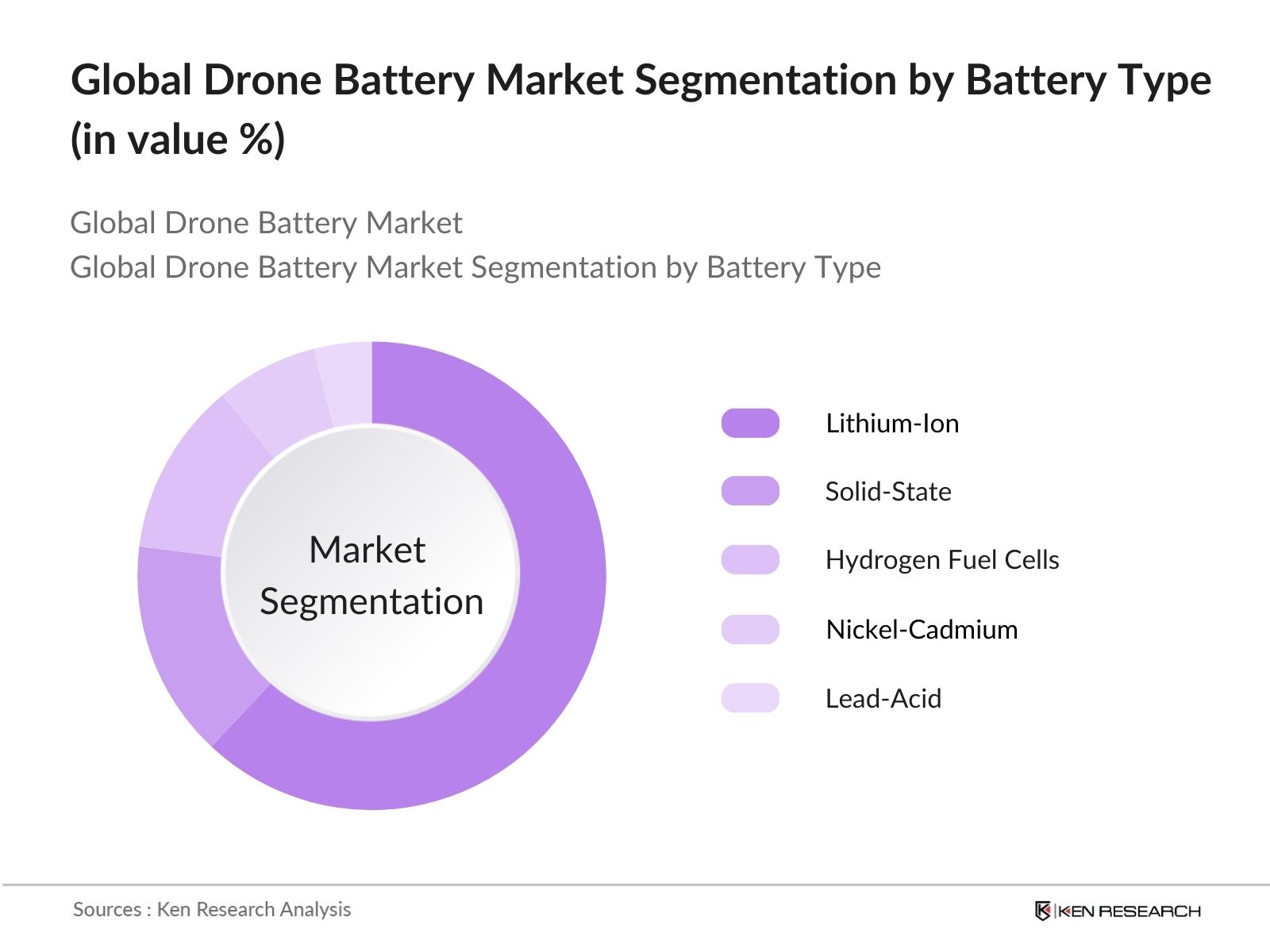
Lithium-Ion Solid-State Hydrogen Fuel Cells Nickel-Cadmium Lead-Acid |
|
Drone Type |
Commercial Drones Defence Drones Agricultural Drones Delivery Drones Surveying and Mapping Drones |
|
Capacity |
<5000 mAh 5000-10000 mAh 10000-20000 mAh >20000 mAh |
|
Technology |
Fast-Charging Smart Batteries High Energy Density |
|
Region |
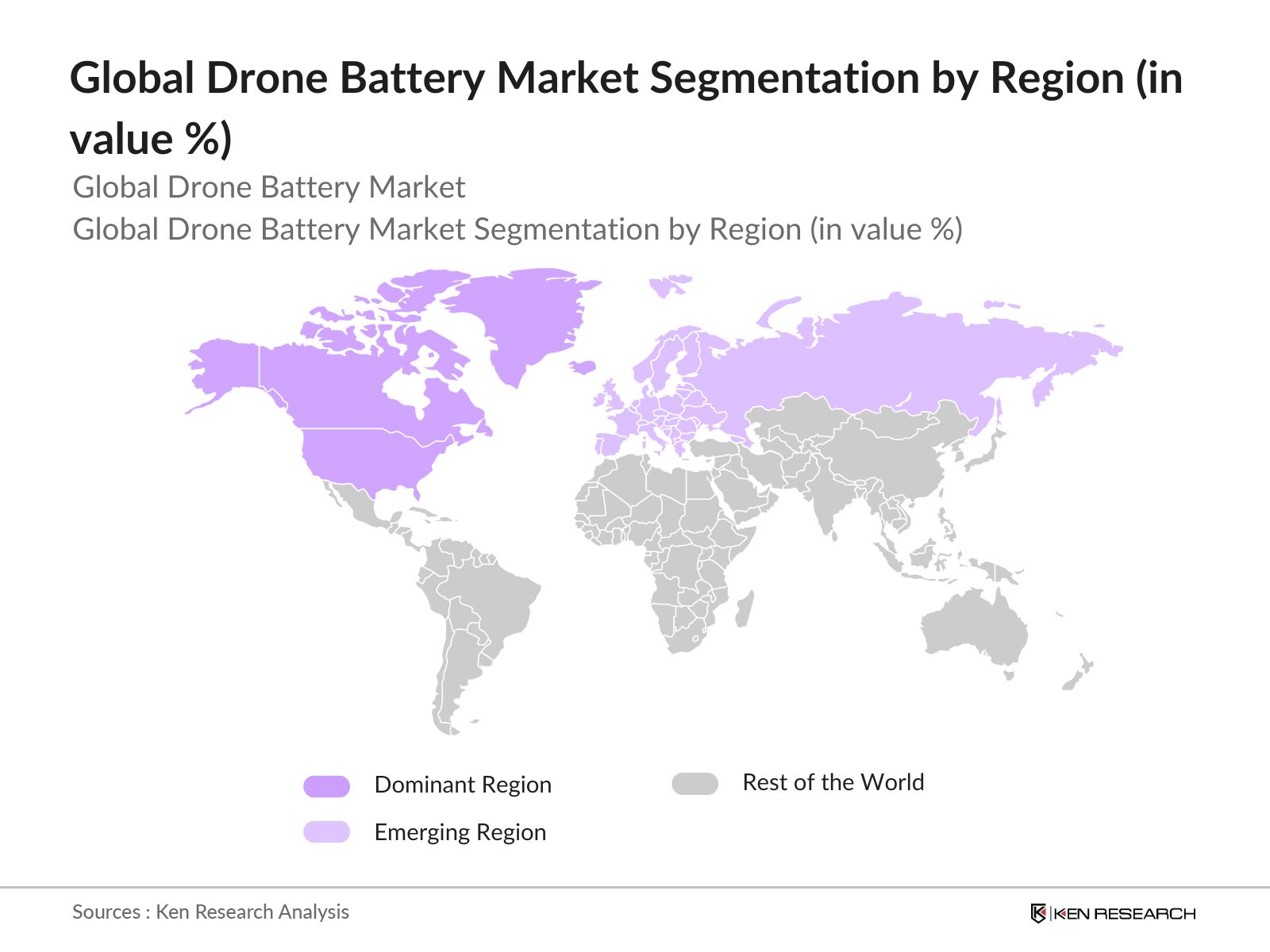
North America Europe Asia-Pacific Latin America Middle East & Africa |
1.1 Definition and Scope
1.2 Market Taxonomy
1.3 Market Growth Rate
1.4 Market Segmentation Overview
2.1 Historical Market Size
2.2 Year-On-Year Growth Analysis
2.3 Key Market Developments and Milestones
3.1 Growth Drivers
3.1.1 Increasing Demand for UAVs in Commercial and Defence Applications
3.1.2 Advancements in Battery Technology (Lithium-Ion, Solid-State, etc.)
3.1.3 Rising Adoption of Drones in Delivery Services
3.1.4 Growing Investments in Drone Startups
3.2 Market Challenges
3.2.1 High Initial Battery Costs
3.2.2 Limited Battery Life and Range
3.2.3 Regulatory Restrictions
3.2.4 Lack of Charging Infrastructure
3.3 Opportunities
3.3.1 Development of High-Efficiency Batteries (e.g., Hydrogen Fuel Cells)
3.3.2 Expansion in Emerging Markets
3.3.3 Growing Demand for Drone-Based Logistics and Surveillance
3.4 Trends
3.4.1 Shift Towards Lightweight and Energy-Dense Batteries
3.4.2 Use of Solar-Powered Drone Batteries
3.4.3 Battery Swapping Technologies
3.5 Government Regulations
3.5.1 Drone Battery Compliance with Aviation Safety Standards
3.5.2 Emission Reduction Targets
3.5.3 Battery Recycling Regulations
3.5.4 Certifications for Lithium-Ion and Alternative Batteries
3.6 SWOT Analysis
3.7 Stakeholder Ecosystem (Manufacturers, Suppliers, UAV Producers)
3.8 Porters Five Forces
3.9 Competitive Ecosystem
4.1 By Battery Type (In Value %)
4.1.1 Lithium-Ion
4.1.2 Solid-State
4.1.3 Hydrogen Fuel Cells
4.1.4 Nickel-Cadmium
4.1.5 Lead-Acid
4.2 By Drone Type (In Value %)
4.2.1 Commercial Drones
4.2.2 Defence Drones
4.2.3 Agricultural Drones
4.2.4 Delivery Drones
4.2.5 Surveying and Mapping Drones
4.3 By Capacity (In Value %)
4.3.1 <5000 mAh
4.3.2 5000-10000 mAh
4.3.3 10000-20000 mAh
4.3.4 >20000 mAh
4.4 By Technology (In Value %)
4.4.1 Fast-Charging
4.4.2 Smart Batteries (Battery Management Systems)
4.4.3 High Energy Density Batteries
4.5 By Region (In Value %)
4.5.1 North America
4.5.2 Europe
4.5.3 Asia-Pacific
4.5.4 Latin America
4.5.5 Middle East & Africa
5.1 Detailed Profiles of Major Companies
5.1.1 DJI Technology Co. Ltd.
5.1.2 Parrot Drones
5.1.3 Yuneec International Co. Ltd.
5.1.4 Ballard Power Systems
5.1.5 Ultratech Power Products
5.1.6 BYD Company Ltd.
5.1.7 Sion Power Corporation
5.1.8 Panasonic Corporation
5.1.9 Toshiba Corporation
5.1.10 Samsung SDI
5.1.11 LG Chem
5.1.12 Epsilor Electric Fuel Ltd.
5.1.13 BSLBATT Battery
5.1.14 Doosan Mobility Innovation
5.1.15 Plug Power Inc.
5.2 Cross Comparison Parameters (Technology Innovation, Market Share, Production Capacity, Number of Patents, Employee Strength, Revenue, Headquarters Location, Strategic Partnerships)
5.3 Market Share Analysis
5.4 Strategic Initiatives
5.5 Mergers And Acquisitions
5.6 Investment Analysis
5.7 Venture Capital Funding
5.8 Government Grants
5.9 Private Equity Investments
6.1 Environmental Standards
6.2 Compliance Requirements for Battery Manufacturing
6.3 Safety Certifications for UAV Batteries
7.1 Future Market Size Projections
7.2 Key Factors Driving Future Market Growth
8.1 By Battery Type (In Value %)
8.2 By Drone Type (In Value %)
8.3 By Capacity (In Value %)
8.4 By Technology (In Value %)
8.5 By Region (In Value %)
9.1 TAM/SAM/SOM Analysis
9.2 Customer Cohort Analysis
9.3 Marketing Initiatives
9.4 White Space Opportunity Analysis
Disclaimer Contact UsThe research began by mapping the ecosystem of stakeholders in the drone battery market, focusing on major manufacturers, technology providers, and end-users. Secondary data sources, including industry reports, government publications, and proprietary databases, were utilized to define the key variables influencing the market.
A detailed analysis of historical market data was conducted, evaluating market penetration, battery efficiency, and adoption rates across drone segments. Revenue trends, market demand, and key technological advancements were assessed to ensure accuracy in future market projections.
Industry experts from major battery manufacturers and UAV producers were consulted to validate research findings. These experts provided valuable insights into operational efficiencies, technological challenges, and financial performance in the drone battery sector.
The data from secondary research and expert consultations were synthesized to produce a final report that provides a holistic view of the global drone battery market. This report includes market forecasts, competitor analysis, and key trends shaping the market.
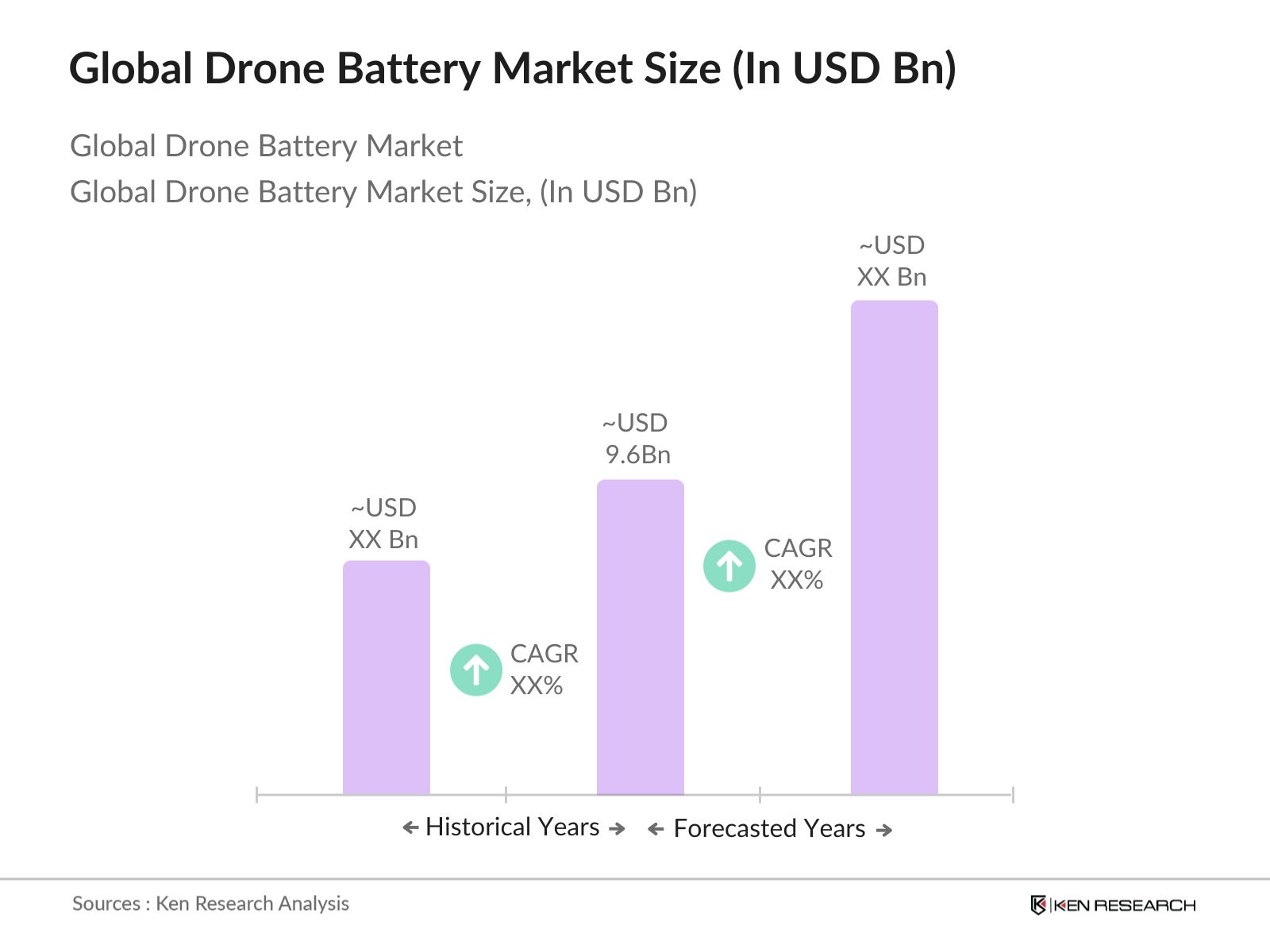
The global drone battery market is valued at USD 9.6 billion, driven by technological advancements and increasing demand for UAVs across defence, commercial, and industrial sectors.
Key challenges in the global drone battery market include the high cost of battery development, limited flight times due to current battery capacities, and regulatory hurdles concerning UAV operations and battery safety.
Major players in the global drone battery market include DJI Technology, Parrot Drones, Ballard Power Systems, Ultratech Power Products, and BYD Company Ltd., known for their innovation in battery technologies and UAV applications.
The global drone battery market is driven by increased UAV applications in logistics, defence, and surveillance, alongside innovations in lithium-ion and hydrogen fuel cell battery technologies that extend drone flight times.

What makes us stand out is that our consultants follows Robust, Refine and Result (RRR) methodology. i.e. Robust for clear definitions, approaches and sanity checking, Refine for differentiating respondents facts and opinions and Result for presenting data with story

We have set a benchmark in the industry by offering our clients with syndicated and customized market research reports featuring coverage of entire market as well as meticulous research and analyst insights.

While we don't replace traditional research, we flip the method upside down. Our dual approach of Top Bottom & Bottom Top ensures quality deliverable by not just verifying company fundamentals but also looking at the sector and macroeconomic factors.

With one step in the future, our research team constantly tries to show you the bigger picture. We help with some of the tough questions you may encounter along the way: How is the industry positioned? Best marketing channel? KPI's of competitors? By aligning every element, we help maximize success.

Our report gives you instant access to the answers and sources that other companies might choose to hide. We elaborate each steps of research methodology we have used and showcase you the sample size to earn your trust.

If you need any support, we are here! We pride ourselves on universe strength, data quality, and quick, friendly, and professional service.