
Global Dry Ice Market Outlook 2030
Region:Global
Author(s):Shivani
Product Code:KROD6867
Region:Global
Author(s):Shivani
Product Code:KROD6867
November 2024
90
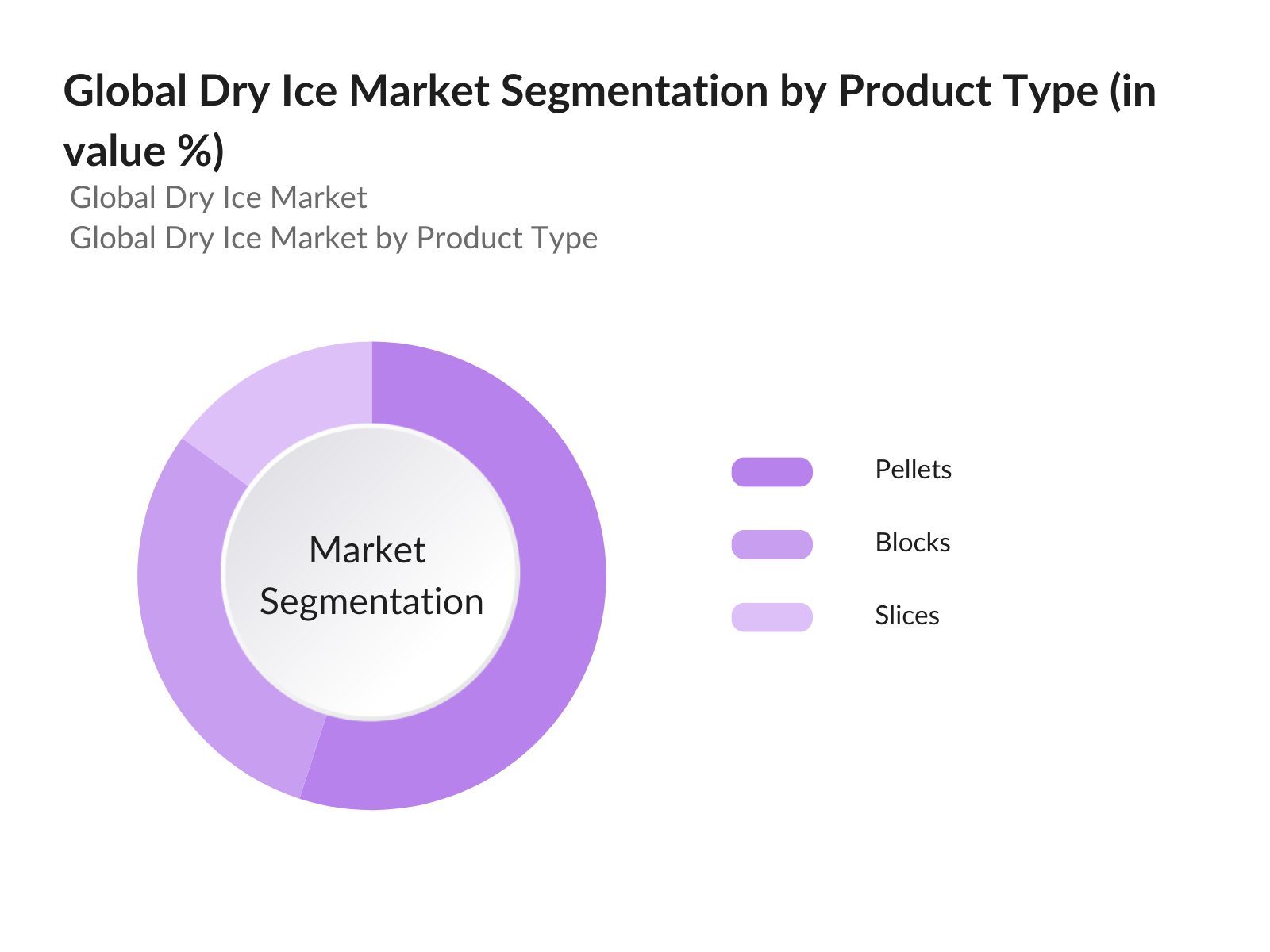
By Product Type: The global dry ice market is segmented by product type into pellets, blocks, and slices. Pellets hold a dominant market share due to their versatility and widespread use in industrial applications such as cleaning and blasting. The ease of handling and faster sublimation of pellets compared to other forms makes them highly popular in sectors like manufacturing and pharmaceuticals. This form of dry ice is also commonly used in transportation to maintain cold chain integrity, particularly for perishables and medical supplies, further driving its dominance.
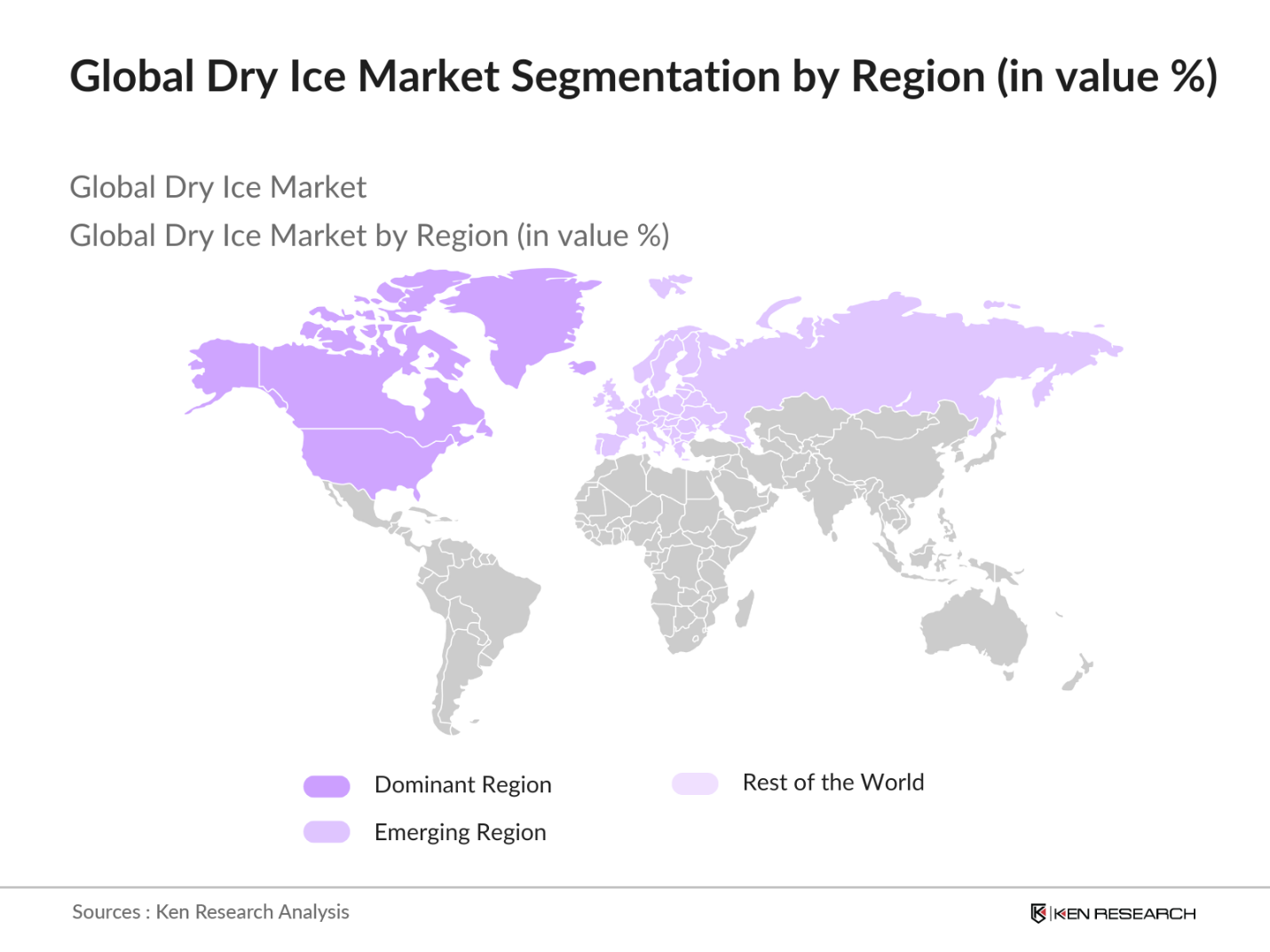
By Region: The market is segmented by region into North America, Europe, Asia-Pacific, Middle East & Africa, and Latin America. North America leads the market due to the strong presence of industries such as pharmaceuticals, food processing, and manufacturing, all of which are significant consumers of dry ice. The growing demand for sustainable and eco-friendly cleaning solutions in this region also boosts the adoption of dry ice blasting technologies. Additionally, North America's cold chain logistics sector, particularly in the United States, benefits from the extensive use of dry ice for transporting temperature-sensitive goods.
The global dry ice market is dominated by several key players, both regional and international, that have established themselves through innovations and technological advancements. Companies in the market leverage economies of scale and extensive distribution networks to maintain their leadership.
|
Company Name |
Establishment Year |
Headquarters |
Product Type Focus |
Revenue (USD Bn) |
Regional Presence |
R&D Investment |
Strategic Partnerships |
Manufacturing Facilities |
|
Air Liquide |
1902 |
Paris, France |
Dry Ice Pellets |
|||||
|
Linde AG |
1879 |
Dublin, Ireland |
Industrial Cleaning |
|||||
|
Continental Carbonic Products |
1978 |
Decatur, Illinois, USA |
Dry Ice Pellets |
|||||
|
Praxair Technology |
1907 |
Danbury, Connecticut, USA |
CO2 Recovery Systems |
|||||
|
Polar Ice |
1980 |
Alberta, Canada |
Dry Ice Blocks |
Market Challenges
Over the next five years, the global dry ice market is expected to experience steady growth, driven by the increasing adoption of sustainable technologies in cleaning and manufacturing processes. The food and beverage industry will continue to be a major driver due to the growing demand for efficient cold chain logistics. Additionally, advancements in dry ice production techniques, along with the expansion of healthcare infrastructure globally, will further fuel the demand for dry ice. Key innovations in CO2 recovery systems and automation will enhance production efficiency and reduce costs, thereby promoting market expansion.
|
By Product Type |
Dry Ice Pellets Dry Ice Blocks Dry Ice Slices |
|
By Application |
Food and Beverage Healthcare and Pharmaceuticals Industrial Cleaning Others (Entertainment, Laboratory) |
|
By Technology |
Direct CO2 Recovery Indirect CO2 Recovery |
|
By End-User Industry |
Food Industry Industrial Manufacturing Pharmaceuticals and Healthcare Aerospace and Electronics |
|
By Region |
North America Europe Asia-Pacific Middle East & Africa Latin America |
1.1. Definition and Scope
1.2. Market Taxonomy
1.3. Market Growth Rate
1.4. Market Segmentation Overview
2.1. Historical Market Size
2.2. Year-On-Year Growth Analysis
2.3. Key Market Developments and Milestones
3.1. Growth Drivers
3.1.1. Demand in Food Transportation
3.1.2. Usage in Industrial Cleaning
3.1.3. Application in Medical and Healthcare
3.1.4. Adoption in Entertainment and Special Effects
3.2. Market Challenges
3.2.1. Availability of Substitutes
3.2.2. High Production Costs
3.2.3. Environmental Concerns
3.3. Opportunities
3.3.1. Expansion in Emerging Markets
3.3.2. Technological Advancements
3.3.3. Increasing Demand in Cold Chain Logistics
3.4. Trends
3.4.1. Growing Focus on Sustainable Production
3.4.2. Use of Dry Ice in 3D Printing
3.4.3. Integration with Automated Cleaning Systems
3.5. Government Regulations [Global Environmental Standards, Certifications]
3.6. SWOT Analysis [Global Market Strengths, Weaknesses, Opportunities, Threats]
3.7. Stakeholder Ecosystem [Raw Material Suppliers, End-Users, Manufacturers]
3.8. Porters Five Forces [Supplier Power, Buyer Power, Threat of Substitutes, New Entrants, Industry Rivalry]
3.9. Competitive Landscape [Global Competitors, Market Concentration]
4.1. By Product Type (In Value %)
4.1.1. Dry Ice Pellets
4.1.2. Dry Ice Blocks
4.1.3. Dry Ice Slices
4.2. By Application (In Value %)
4.2.1. Food and Beverage
4.2.2. Healthcare and Pharmaceuticals
4.2.3. Industrial Cleaning
4.2.4. Others (Entertainment, Laboratory)
4.3. By Technology (In Value %)
4.3.1. Direct CO2 Recovery
4.3.2. Indirect CO2 Recovery
4.4. By End-User Industry (In Value %)
4.4.1. Food Industry
4.4.2. Industrial Manufacturing
4.4.3. Pharmaceuticals and Healthcare
4.4.4. Aerospace and Electronics
4.5. By Region (In Value %)
4.5.1. North America
4.5.2. Europe
4.5.3. Asia-Pacific
4.5.4. Middle East & Africa
4.5.5. Latin America
5.1 Detailed Profiles of Major Companies
5.1.1. Air Liquide
5.1.2. Linde AG
5.1.3. Messer Group
5.1.4. Praxair Technology
5.1.5. Continental Carbonic Products
5.1.6. Polar Ice
5.1.7. Sicgil India Limited
5.1.8. Tripti Dry Ice Co.
5.1.9. CryoCarb
5.1.10. Air Products and Chemicals, Inc.
5.1.11. Dry Ice Corp.
5.1.12. Tomco2 Systems
5.1.13. EcoIce Dry Ice
5.1.14. A-Gas International
5.1.15. CryoFX
5.2 Cross Comparison Parameters [Product Portfolio, Revenue, Regional Presence, R&D Investments, Market Share, Number of Employees, Market Penetration, Strategic Initiatives]
5.3. Market Share Analysis [Global Market, Regional Comparison]
5.4. Strategic Initiatives [Mergers, Acquisitions, Partnerships]
5.5. Investment Analysis [Venture Capital, Private Equity, Government Grants]
6.1. Environmental Standards
6.2. Compliance Requirements
6.3. Certification Processes
7.1. Future Market Size Projections
7.2. Key Factors Driving Future Market Growth
8.1. By Product Type (In Value %)
8.2. By Application (In Value %)
8.3. By Technology (In Value %)
8.4. By End-User Industry (In Value %)
8.5. By Region (In Value %)
9.1. TAM/SAM/SOM Analysis
9.2. Customer Cohort Analysis
9.3. Marketing Initiatives
9.4. White Space Opportunity Analysis
The research began by identifying key variables affecting the global dry ice market, including demand drivers, technological innovations, and regulatory changes. This involved comprehensive desk research using both proprietary and public databases to gather relevant industry-level data.
The second step involved analyzing historical data on dry ice production, distribution, and consumption trends. This was combined with supply chain analysis to estimate market penetration across various industries, with particular focus on regional demand.
In this phase, expert consultations were conducted through phone interviews and surveys with key players in the dry ice market. These insights helped validate market assumptions and provided a clearer understanding of industry challenges and opportunities.
Finally, the data was synthesized into a cohesive analysis, combining bottom-up approaches with industry feedback. This final stage ensured the accuracy of market estimates and the identification of future growth opportunities.
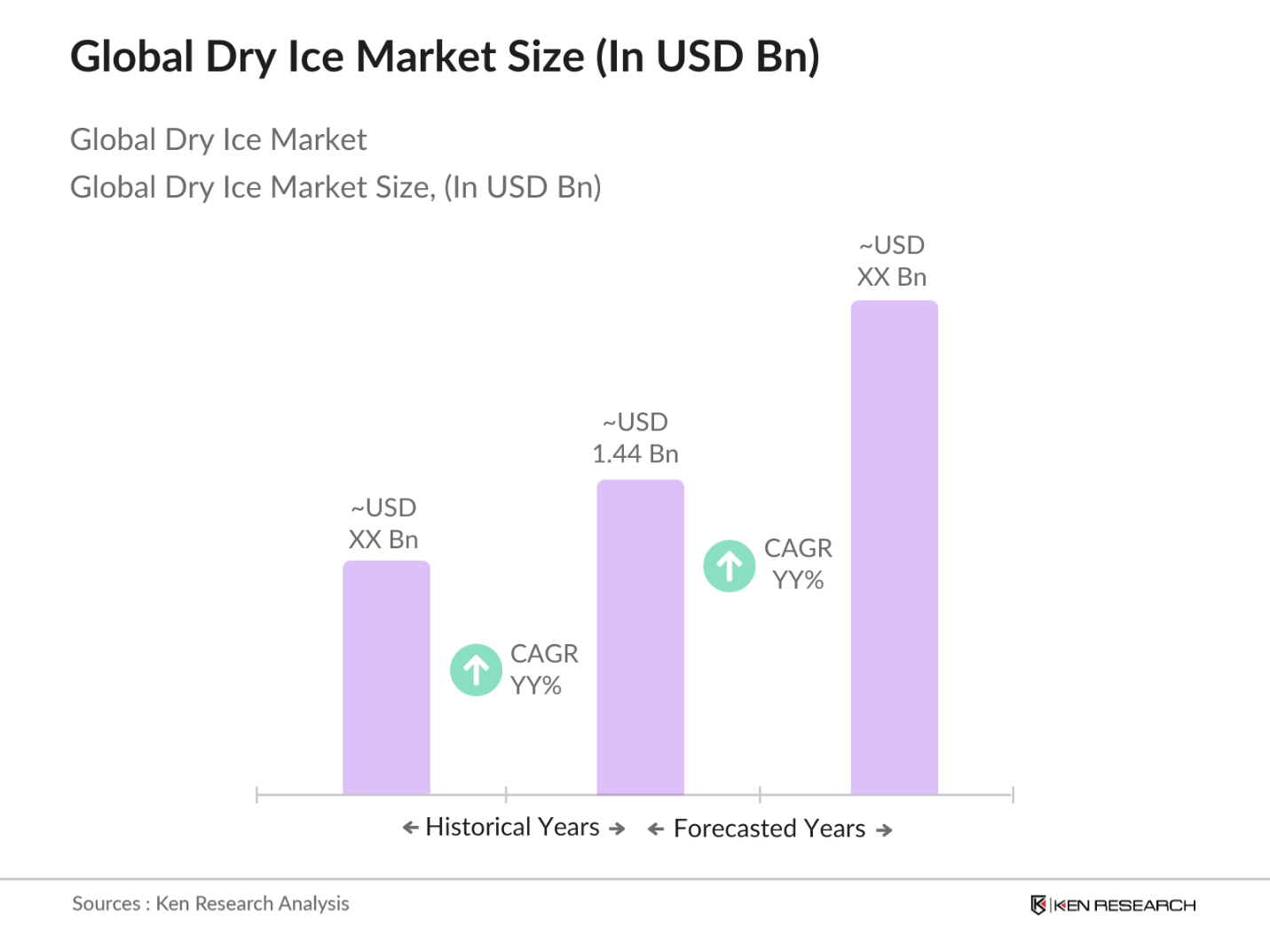
The global dry ice market is valued at USD 1.44 billion, driven by increasing demand across industries such as food, healthcare, and manufacturing, particularly for cold chain logistics and industrial cleaning.
Major challenges include high production costs due to the energy-intensive nature of CO2 recovery and environmental concerns regarding the use of CO2 in dry ice production. The availability of substitutes also affects market growth.
Key players include Air Liquide, Linde AG, Continental Carbonic Products, Praxair Technology, and Polar Ice. These companies dominate due to their extensive production capabilities and global distribution networks.
Growth is driven by the increasing demand for cold chain logistics in the food and beverage industry, the rise in healthcare applications such as vaccine storage, and the adoption of eco-friendly industrial cleaning solutions.

What makes us stand out is that our consultants follows Robust, Refine and Result (RRR) methodology. i.e. Robust for clear definitions, approaches and sanity checking, Refine for differentiating respondents facts and opinions and Result for presenting data with story

We have set a benchmark in the industry by offering our clients with syndicated and customized market research reports featuring coverage of entire market as well as meticulous research and analyst insights.

While we don't replace traditional research, we flip the method upside down. Our dual approach of Top Bottom & Bottom Top ensures quality deliverable by not just verifying company fundamentals but also looking at the sector and macroeconomic factors.

With one step in the future, our research team constantly tries to show you the bigger picture. We help with some of the tough questions you may encounter along the way: How is the industry positioned? Best marketing channel? KPI's of competitors? By aligning every element, we help maximize success.

Our report gives you instant access to the answers and sources that other companies might choose to hide. We elaborate each steps of research methodology we have used and showcase you the sample size to earn your trust.

If you need any support, we are here! We pride ourselves on universe strength, data quality, and quick, friendly, and professional service.