Global E-Fuels Market Outlook to 2030

Region:Global

Author(s):Sanjeev

Product Code:KROD1342

Published On

November 2024

Total pages

84

About the Report

Global E-Fuels Market Overview

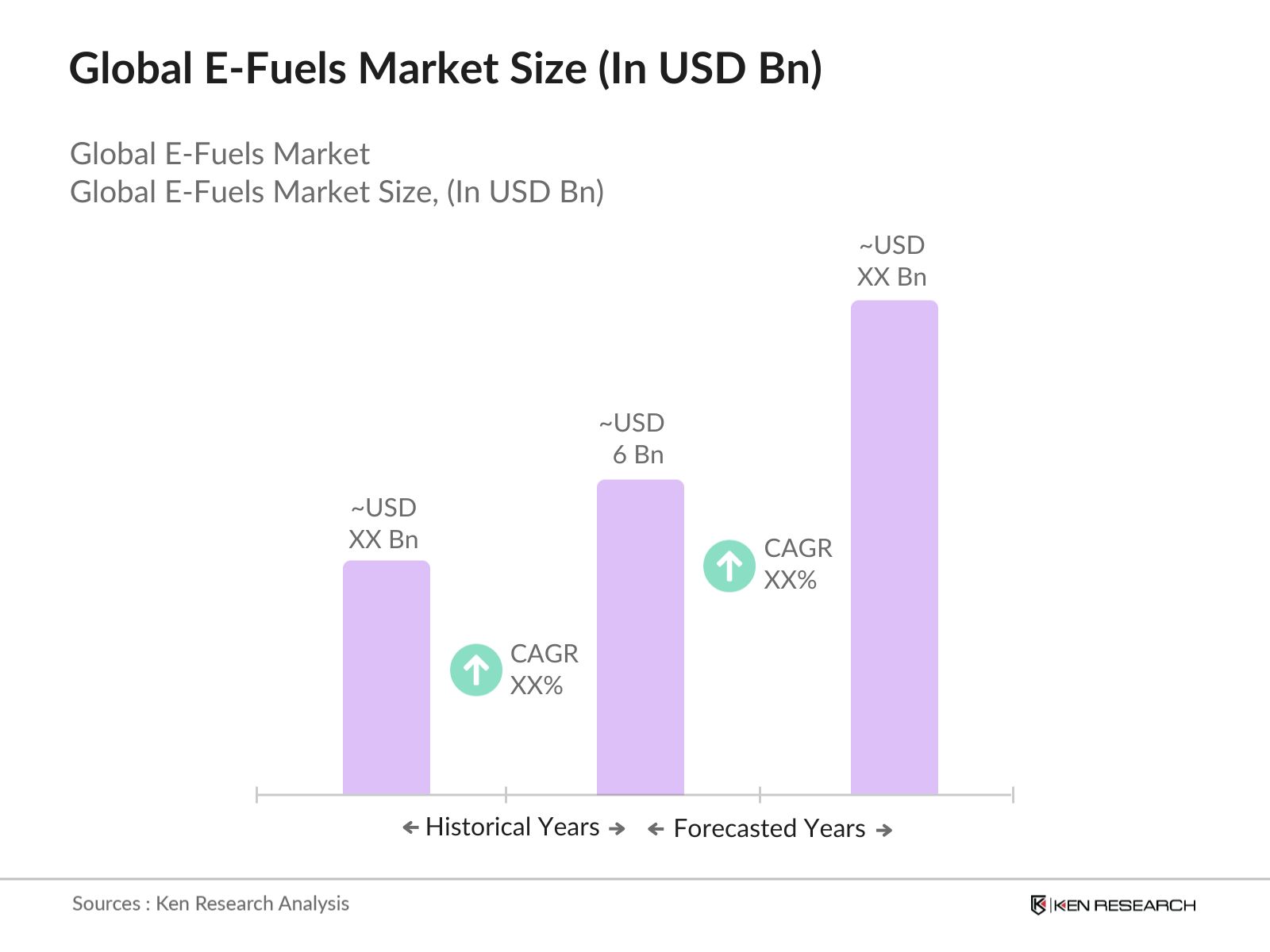
  • In 2023, the Global E-Fuels Market was valued at USD 6 billion, reflecting significant growth driven by increasing environmental concerns and the need for sustainable energy solutions. The market is propelled by advancements in electrolysis technology and governmental policies promoting carbon neutrality.
  • Prominent players in the E-Fuels market include Audi AG, Porsche AG, Siemens Energy, ExxonMobil, and Air Liquide. These companies are at the forefront of developing and commercializing e-fuels. Audi AG is known for its synthetic e-gasoline, while Siemens Energy has made substantial investments in e-fuel production facilities.
  • Europe, particularly Germany, leads the market due to strong governmental support and early adoption of renewable energy technologies. The region's focus on reducing carbon emissions has driven substantial investments in e-fuel infrastructure.
  • In 2023, Porsche AG announced a collaboration with Siemens Energy to build a large-scale e-fuel production plant in Chile, marking a significant advancement in the industry. This plant aims to produce synthetic fuels using wind energy, highlighting the integration of renewable resources in e-fuel production.

market overviews

Global E-Fuels Market Segmentation

The market can be segmented based on product, application and region:

  • By Product Type: The market is segmented into e-diesel, e-gasoline and e-kerosene. In 2023, e-diesel held a substantial market share due to its compatibility with existing diesel engines and infrastructure. Companies like Audi AG and Bosch have capitalized on this trend by developing e-diesel solutions for commercial and passenger vehicles.market overviews
  • By Application: The market is segmented by application into transportation, power generation, and industrial. The transportation segment led the market in 2023, accounting for a share due to the growing demand for sustainable alternatives to conventional fuels. The aviation industry, in particular, has shown increased interest in e-kerosene as a means to reduce carbon emissions.
  • By Region: The market is segmented by region into North America, Europe, Asia-Pacific, Latin America, and Middle East & Africa. Europe led the global market in 2023, holding the largest share due to strong regulatory support and investment in R&D. North America follows closely, driven by increasing environmental regulations and technological advancements.market overviews

Global E-Fuels Market Competitive Landscape

Company

Establishment Year

Headquarters

Audi AG

1909

Ingolstadt, Germany

Porsche AG

1931

Stuttgart, Germany

Siemens Energy

2020

Munich, Germany

ExxonMobil

1870

Irving, USA

Air Liquide

1902

Paris, France

  • Audi AG: In 2023, Audi AG made an advancement in e-fuels technology with the launch of their new synthetic e-gasoline. This fuel is produced using renewable electricity and CO2, offering a sustainable alternative to conventional gasoline. Audi's e-gasoline can be used in existing gasoline engines without modifications.
  • Air Liquide: In 2023, Air Liquide announced the development of a new e-fuel production facility in Norway. This facility uses electrolysis to produce hydrogen, which is then combined with CO2 to create synthetic fuels. This initiative enhances the company's portfolio of sustainable energy solutions.

Global E-Fuels Industry Analysis

Growth Drivers:

  • Environmental Regulations: The increasing stringency of environmental regulations globally is driving the e-fuels market. The European Union, for instance, has set ambitious targets for reducing carbon emissions by 55% by 2030 as part of its "Fit for 55" package. This regulatory framework includes measures such as carbon pricing, renewable energy incentives, and strict emission standards, pushing the adoption of sustainable fuels.
  • Increasing Investments in Renewable Energy: Government funding and private sector investment are boosting the e-fuels market. The US government has allocated billions of dollars in funding for clean energy research and development through initiatives like the Department of Energy's ARPA-E program. Additionally, companies like ExxonMobil and TotalEnergies have announced substantial investments in e-fuel production facilities, aiming to enhance their sustainable energy portfolios.
  • Growing Adoption in the Aviation Sector: The aviation industry is a major consumer of e-fuels due to its commitment to reducing carbon emissions. Airlines and aviation companies are investing in sustainable aviation fuel (SAF) initiatives, with e-kerosene being a key component. For example, Lufthansa and British Airways have begun incorporating SAF into their operations to meet emission reduction targets.

Market Challenges:

  • High Production Costs: The production costs for e-fuels remain high due to the complex technologies and processes involved. The European Commission reported that the cost of producing e-fuels is still higher than conventional fuels, which poses a challenge for market competitiveness.
  • Infrastructure Limitations: The existing infrastructure for fuel distribution is primarily designed for conventional fuels. Adapting this infrastructure to accommodate e-fuels requires significant investment, which can be a barrier to widespread adoption.

Government Initiatives:

  • EU Green Deal: The European Union has launched the Green Deal, which includes substantial funding for the development of renewable energy technologies, including e-fuels. This initiative aims to make Europe the first climate-neutral continent by 2050. The Green Deal encompasses various projects and investments to boost energy efficiency, renewable energy adoption, and carbon reduction technologies.
  • US Clean Energy Grants: The US government has introduced new grant programs to support the development of clean energy technologies, including e-fuels. The Department of Energy (DOE) has allocated millions of dollars for research and development projects aimed at reducing carbon emissions. These grants are designed to foster innovation in clean energy, enhance e-fuel production capabilities, and support the transition to a low-carbon economy.

Global E-Fuels Market Future Outlook

The Global E-Fuels Market is poised for remarkable growth, driven by the expansion of renewable energy sources, advancements in production technologies, and increasing regulatory support.

Future Market Trends:

  • Expansion in Aviation Sector: By 2028, the use of e-fuels in the aviation sector is expected to expand. This growth will be driven by the aviation industry's commitment to reducing carbon emissions and the development of e-kerosene as a viable alternative to conventional jet fuel.
  • Emergence of Large-Scale Production Plants: The market for e-fuels is projected to see an increase in large-scale production facilities by 2028. These plants will leverage renewable energy sources such as wind and solar to produce synthetic fuels, contributing to the market's growth.
  • Integration with Renewable Energy Systems: The integration of e-fuels with renewable energy systems, such as wind and solar farms, is expected to become more prevalent. This trend will enhance the sustainability of e-fuels and promote their adoption as a key component of the global energy mix.

Scope of the Report

By Region

North America

Europe

Asia-Pacific

Latin America

Middle East & Africa

By Product Type

E-Diesel

E-Gasoline

E-Kerosene

Others

By Application Type

Transportation

Power Generation

Industrial

By Production Method

Electrolysis

Carbon Capture and Utilization (CCU)

Biomass Gasification

By Distribution Channel

Offline

Online

Products

Key Target Audience Organizations and Entities Who Can Benefit by Subscribing This Report:

  • Banks and Financial Institutions

  • Government and Regulatory Bodies (IMO, ZEMBA, BIS)

  • Venture Capitalist Firms

  • Renewable Energy Companies

  • Oil and Gas Companies

  • Automotive Manufacturers

  • Aviation Companies

  • Industrial Manufacturers

  • Technology Companies

Time Period Captured in the Report:

  • Historical Period: 2018-2023

  • Base Year: 2023

  • Forecast Period: 2023-2028

Companies

Players Mentioned in the Report:

  • Audi AG

  • Porsche AG

  • Siemens Energy

  • ExxonMobil

  • Air Liquide

  • BP

  • Shell

  • TotalEnergies

  • Neste

  • Eni

  • Repsol

  • Chevron

  • Valero

  • BASF

  • Linde

Table of Contents

1. Global E-Fuels Market Overview

1.1. Definition and Scope

1.2. Market Taxonomy

1.3. Market Growth Rate

1.4. Market Segmentation Overview

2. Global E-Fuels Market Size (in USD Bn), 2018-2023

2.1. Historical Market Size

2.2. Year-on-Year Growth Analysis

2.3. Key Market Developments and Milestones

3. Global E-Fuels Market Analysis

3.1. Growth Drivers

3.1.1. Environmental Regulations

3.1.2. Increasing Investments in Renewable Energy

3.1.3. Growing Adoption in the Aviation Sector

3.2. Restraints

3.2.1. High Production Costs

3.2.2. Infrastructure Limitations

3.2.3. Regulatory Hurdles

3.3. Opportunities

3.3.1. Expansion in Aviation Sector

3.3.2. Emergence of Large-Scale Production Plants

3.3.3. Integration with Renewable Energy Systems

3.4. Trends

3.4.1. Technological Advancements in Production

3.4.2. Strategic Collaborations and Partnerships

3.4.3. Increasing Focus on Sustainable Energy Solutions

3.5. Government Regulation

3.5.1. EU Green Deal

3.5.2. US Clean Energy Grants

3.5.3. Global Environmental Initiatives

3.5.4. Regional Support Programs

3.6. SWOT Analysis

3.7. Stake Ecosystem 3.8. Competition Ecosystem

4. Global E-Fuels Market Segmentation, 2023

4.1. By Product Type (in Value %)

4.1.1. E-Diesel 4.1.2. E-Gasoline

4.1.3. E-Kerosene

4.2. By Application (in Value %)

4.2.1. Transportation

4.2.2. Power Generation

4.2.3. Industrial

4.3. By Production Method (in Value %)

4.3.1. Electrolysis

4.3.2. Carbon Capture and Utilization (CCU)

4.3.3. Biomass Gasification

4.4. By Distribution Channel (in Value %)

4.4.1. Offline 4.4.2. Online

4.5. By Region (in Value %)

4.5.1. North America

4.5.2. Europe

4.5.3. Asia-Pacific

4.5.4. Latin America

4.5.5. Middle East & Africa

5. Global E-Fuels Market Cross Comparison

5.1. Detailed Profiles of Major Companies

5.1.1. Audi AG 5.1.2. Porsche AG

5.1.3. Siemens Energy

5.1.4. ExxonMobil

5.1.5. Air Liquide

5.1.6. BP

5.1.7. Shell

5.1.8. TotalEnergies

5.1.9. Neste

5.1.10. Eni

5.1.11. Repsol

5.1.12. Chevron

5.1.13. Valero

5.1.14. BASF

5.1.15. Linde

5.2. Cross Comparison Parameters (No. of Employees, Headquarters, Inception Year, Revenue)

6. Global E-Fuels Market Competitive Landscape

6.1. Market Share Analysis

6.2. Strategic Initiatives

6.3. Mergers and Acquisitions

6.4. Investment Analysis

6.4.1. Venture Capital Funding

6.4.2. Government Grants

6.4.3. Private Equity Investments

7. Global E-Fuels Market Regulatory Framework

7.1. Environmental Standards

7.2. Compliance Requirements

7.3. Certification Processes

8. Global E-Fuels Future Market Size (in USD Bn), 2023-2028

8.1. Future Market Size Projections

8.2. Key Factors Driving Future Market Growth

9. Global E-Fuels Future Market Segmentation, 2028

9.1. By Product Type (in Value %)

9.2. By Application (in Value %)

9.3. By Production Method (in Value %)

9.4. By Distribution Channel (in Value %)

9.5. By Region (in Value %)

10. Global E-Fuels Market Analysts Recommendations

10.1. TAM/SAM/SOM Analysis

10.2. Customer Cohort Analysis

10.3. Marketing Initiatives

10.4. White Space Opportunity Analysis

Disclaimer Contact Us

Research Methodology

Step 1: Identification of Key Variables

The initial phase involves mapping the ecosystem of the Global E-Fuels market, including stakeholders like manufacturers, distributors, and end-users. This stage relies on secondary research, leveraging proprietary databases and industry reports to define critical variables influencing market dynamics.

Step 2: Market Analysis and Construction

This phase compiles and analyzes historical market data, including penetration rates and revenue generation statistics. It assesses the performance of various segments to derive reliable market estimates and projections for Global E-Fuels products.

Step 3: Hypothesis Validation and Expert Consultation

Market hypotheses are validated through interviews with industry experts and stakeholders. These consultations provide qualitative insights that refine the statistical data, ensuring a comprehensive understanding of the market landscape.

Step 4: Research Synthesis and Final Output

The final phase involves engaging with manufacturers to gather insights on product performance, consumer preferences, and market trends. This interaction verifies and complements the data derived from earlier analyses, resulting in a well-rounded market assessment.

Frequently Asked Questions

01. How big is the Global E-Fuels Market?

In 2023, the Global E-Fuels Market was valued at USD 5 billion, reflecting significant growth driven by increasing environmental concerns and advancements in renewable energy technologies. The market's growth is attributed to the rising adoption of sustainable energy solutions and stringent environmental regulations aimed at reducing carbon emissions.

02.  What are the challenges in the Global E-Fuels Market?

Challenges in the Global E-Fuels Market include high production costs due to advanced technologies, infrastructure adaptation for e-fuels, and regulatory hurdles. The complexity of integrating renewable energy sources and scaling up production also poses significant challenges.

03. Who are the major players in the Global E-Fuels Market?

Major players in the Global E-Fuels Market include Audi AG, Porsche AG, Siemens Energy, ExxonMobil, and Air Liquide. These companies are leading the industry with significant investments in R&D and large-scale production facilities.

04. What are the growth drivers of the Global E-Fuels Market?

Growth drivers of the Global E-Fuels Market include stringent environmental regulations, technological advancements in production, increasing demand for sustainable energy, and significant government initiatives aimed at achieving carbon neutrality. The rising adoption of e-fuels in the transportation and aviation sectors further accelerates market growth.

Why Buy From Us?

RRR
Refine Robust Result (RRR) Framework

What makes us stand out is that our consultants follows Robust, Refine and Result (RRR) methodology. i.e. Robust for clear definitions, approaches and sanity checking, Refine for differentiating respondents facts and opinions and Result for presenting data with story

Our Reach Is Unmatched

We have set a benchmark in the industry by offering our clients with syndicated and customized market research reports featuring coverage of entire market as well as meticulous research and analyst insights.

Research
Shifting the Research Paradigm

While we don't replace traditional research, we flip the method upside down. Our dual approach of Top Bottom & Bottom Top ensures quality deliverable by not just verifying company fundamentals but also looking at the sector and macroeconomic factors.

Insite
More Insights-Better Decisions

With one step in the future, our research team constantly tries to show you the bigger picture. We help with some of the tough questions you may encounter along the way: How is the industry positioned? Best marketing channel? KPI's of competitors? By aligning every element, we help maximize success.

Trust
Transparency and Trust

Our report gives you instant access to the answers and sources that other companies might choose to hide. We elaborate each steps of research methodology we have used and showcase you the sample size to earn your trust.

support
Round the Clock Support

If you need any support, we are here! We pride ourselves on universe strength, data quality, and quick, friendly, and professional service.

Why Client Choose Us?

400000+ Reports in repository
150+ Consulting project a year
100+ Analysts
8000+ Client Queries in 2022