
Global Electric Bike Kit Market Outlook to 2030
Region:Global
Author(s):Yogita Sahu
Product Code:KROD5275
November 2024
89
About the Report
Global Electric Bike Kit Market Overview
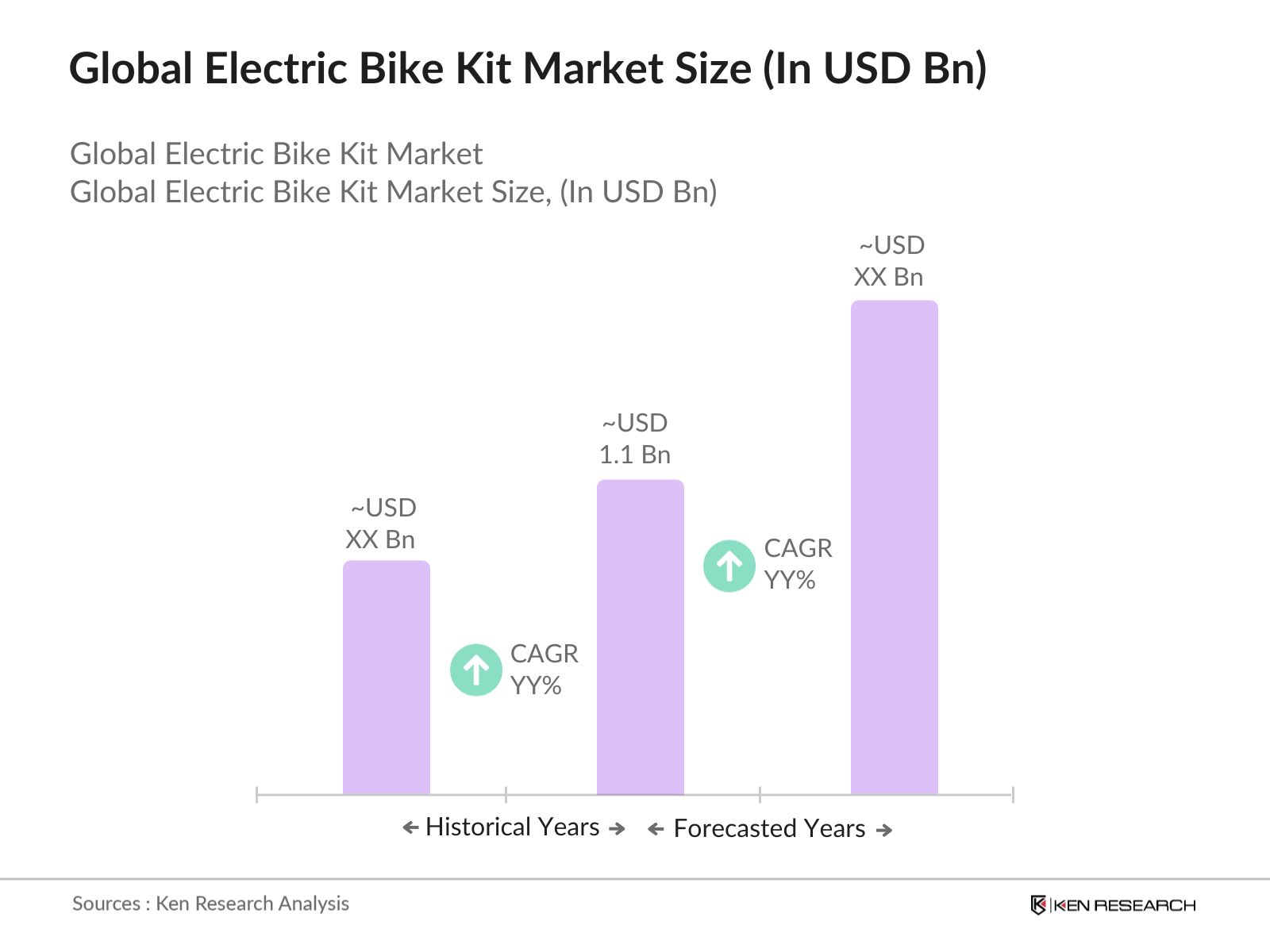
- The global electric bike kit market is valued at USD 1.1 billion, according to a five-year historical analysis. This expansion is driven by several factors, including increasing awareness of environmental concerns and the demand for cost-effective transportation solutions. The rising adoption of electric mobility worldwide, combined with favorable government policies supporting green transportation alternatives, plays a vital role in sdriving the market.
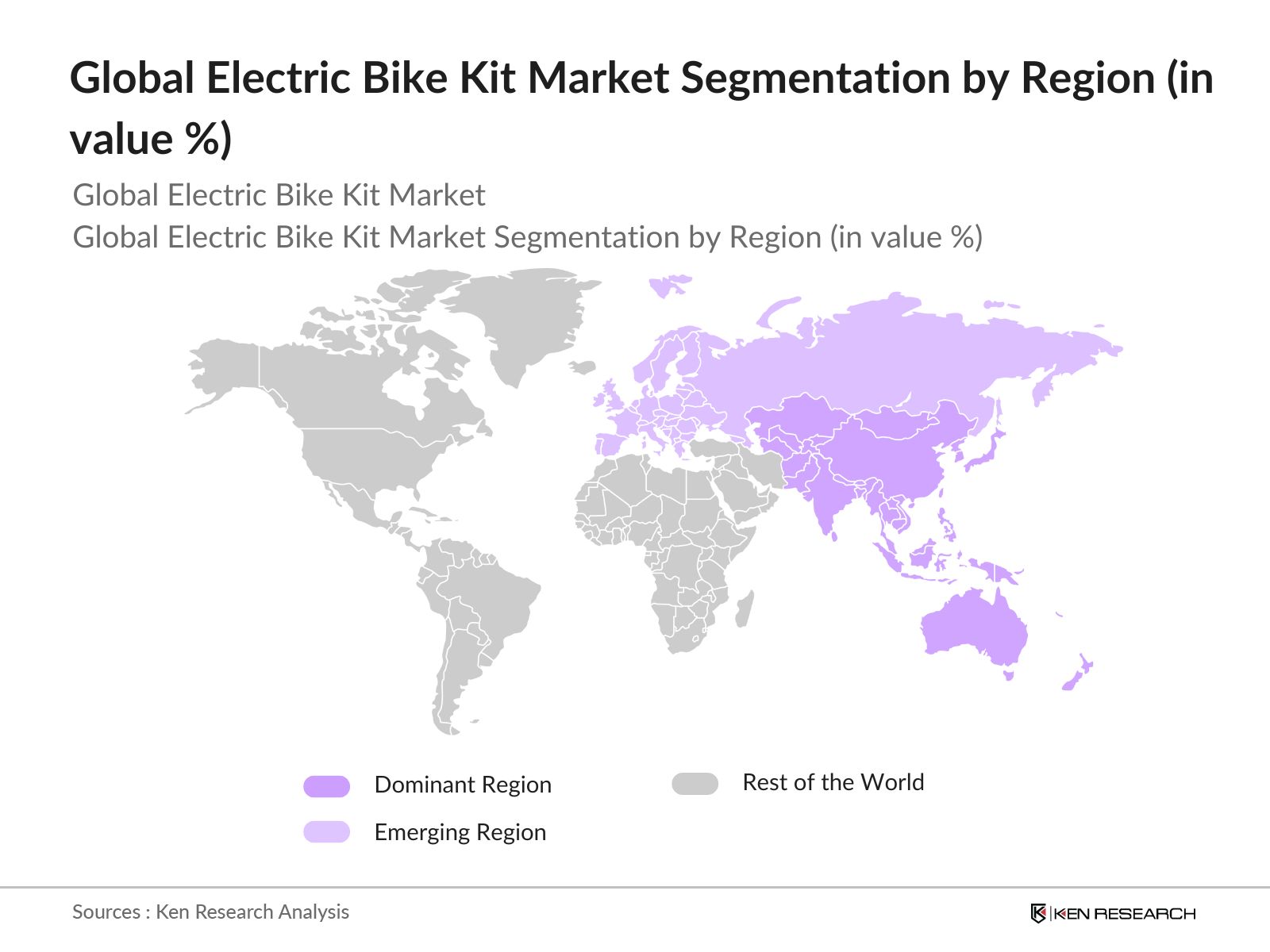
- Key regions dominating the market include North America, Europe, and Asia-Pacific. North America, particularly the United States, is a significant contributor to the market due to its high rate of adoption of electric vehicles, coupled with governmental incentives promoting eco-friendly transportation. Europe is also a leading player, with countries like Germany and the Netherlands having strong e-bike cultures supported by a robust cycling infrastructure.
- The European Union has pledged $1.7 billion in 2024 to support electric mobility solutions, including electric bikes, as part of its Green Deal. This funding is expected to promote the use of e-bikes across member countries by providing incentives for converting traditional bikes using electric bike kits, thereby fueling market growth over the next few years.
Global Electric Bike Kit Market Segmentation
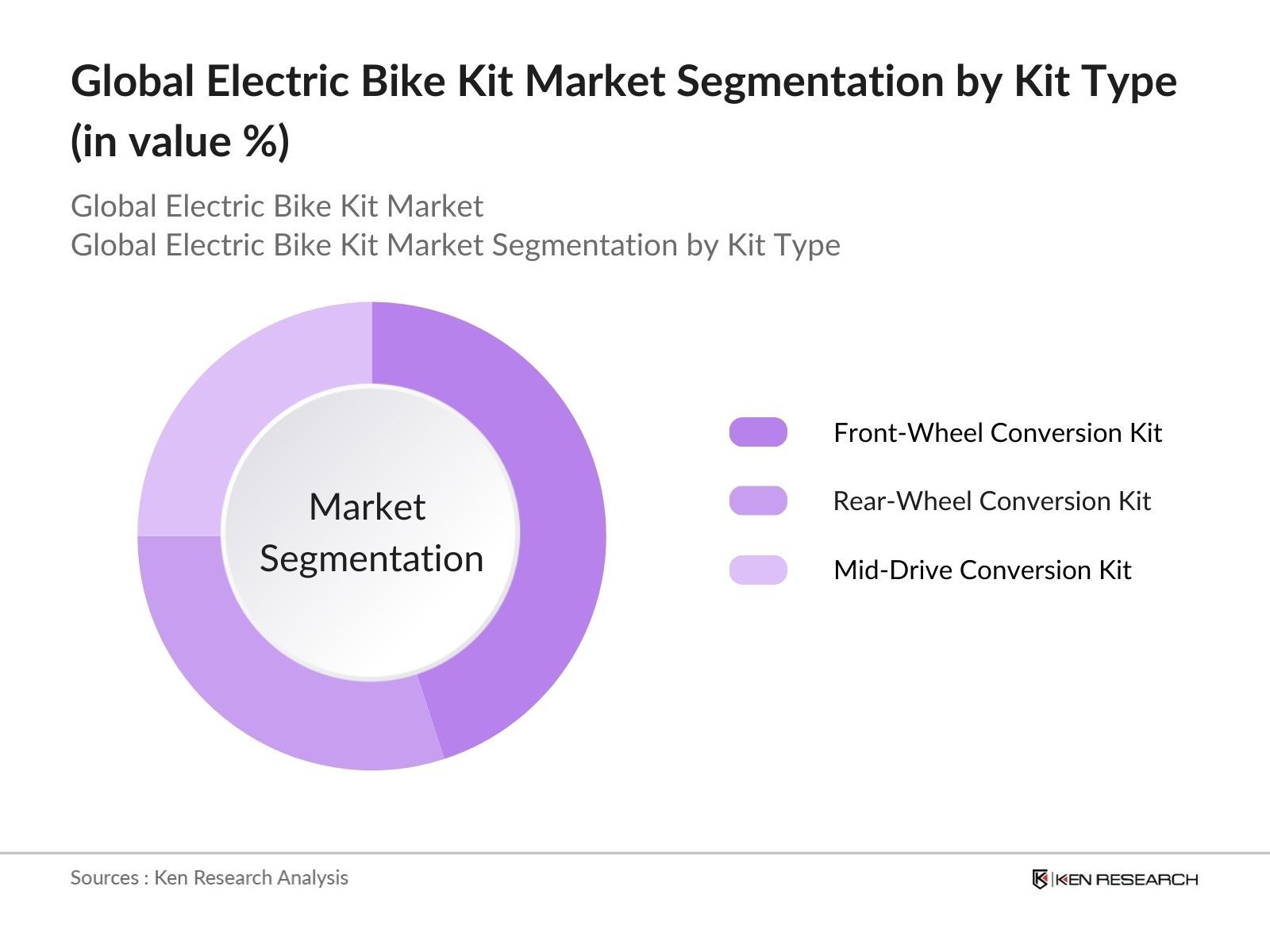
By Product Type: The market is segmented by product type into hub motor kits, mid-drive motor kits, and friction drive kits. Hub motor kits have the dominant market share. This dominance is attributed to their ease of installation and affordability, making them accessible to a broad range of users. Hub motors are commonly preferred in urban settings where commuters seek a simple yet effective solution for converting traditional bicycles into electric-powered bikes.
By Battery Type: The market is segmented by battery type into lithium-ion batteries, lead-acid batteries, and nickel-cadmium batteries. Lithium-ion batteries dominate this segment with a significant market share. Their lightweight nature, long life cycle, and superior energy density make them the preferred choice for electric bike kits. Additionally, advancements in lithium-ion technology have led to faster charging times and improved safety features, further bolstering their popularity among both manufacturers and consumers.
By Region: The market is segmented by region into North America, Europe, Asia-Pacific, Latin America, and Middle East & Africa. Asia-Pacific leads the market due to the strong presence of electric bike manufacturers in China, the growing adoption of electric mobility in urban centers, and favorable government policies supporting the transition to electric vehicles.
Global Electric Bike Kit Market Competitive Landscape
The market is dominated by a few key players, both global and regional. The competition is largely based on technological innovation, pricing, and distribution networks. Companies like Bafang Electric and Bosch eBike Systems have established a significant foothold through their reliable and performance-driven products.
|
Company |
Establishment Year |
Headquarters |
Product Range |
Annual Revenue (USD Mn) |
No. of Employees |
Global Presence |
Partnerships |
R&D Investments |
|
Bafang Electric |
2003 |
China |
||||||
|
Bosch eBike Systems |
2010 |
Germany |
||||||
|
Shimano Inc. |
1921 |
Japan |
||||||
|
Yamaha Motor Co. |
1955 |
Japan |
||||||
|
Dillenger Electric Bikes |
2007 |
Australia |
Global Electric Bike Kit Market Analysis
Market Growth Drivers
- Increasing Demand for E-Bike Customization: Consumers in countries like the U.S. and Germany have shown a growing interest in customizing their electric bikes (e-bikes), which has driven demand for electric bike kits. In 2023, over 2 million e-bikes were customized globally with various add-ons like motor enhancements, battery upgrades, and wheel modifications. This trend is anticipated to continue into 2024 as customization options expand, increasing the sale of e-bike kits by around 300,000 units, particularly in regions where bicycle commuting is common, such as Europe and Asia.
- Government Subsidies for E-Bike Adoption: Several governments across Europe and North America have rolled out subsidies for e-bikes as part of their sustainable transportation initiatives. For instance, in 2024, the U.S. government allocated over $500 million to incentivize the purchase of electric vehicles, including e-bikes, as part of its green energy plan. This financial assistance is projected to boost the demand for electric bike kits as consumers look for affordable options to convert traditional bicycles into electric ones.
- Increased Investment in Infrastructure for E-Bikes: Governments and private companies are heavily investing in infrastructure that supports electric vehicles, including e-bikes. In 2024, cities like Amsterdam and New York committed around $1.2 billion towards building more bike lanes and e-bike charging stations. This push toward eco-friendly transportation infrastructure is expected to drive the growth of electric bike kits, as more riders opt for electric-assisted mobility to take advantage of the new facilities.
Market Challenges
- High Initial Cost of Conversion Kits: While e-bike kits offer a cost-effective solution compared to purchasing a brand-new electric bike, the average price of high-quality conversion kits remains a barrier. As of 2024, a standard kit costs between $300 and $800, depending on the power output and battery capacity, which can be prohibitive for some consumers. Despite price reductions in recent years, the upfront cost still limits mass adoption in price-sensitive regions like Southeast Asia and parts of South America.
- Regulatory Barriers for E-Bike Conversions: Various countries have stringent regulations regarding e-bikes, especially when it comes to retrofitting traditional bicycles. For example, the European Union mandates that electric bikes converted using kits must not exceed a motor output of 250W and must have pedal-assist features to qualify as legal for road use. Non-compliance can lead to fines or bans. In 2024, compliance with these regulations has slowed the adoption of electric bike kits in countries like France and Italy, where consumers are concerned about navigating complex rules.
Global Electric Bike Kit Market Future Outlook
Over the next five years, the global electric bike kit market is poised for growth. This expansion is driven by several factors, including continuous advancements in battery technology, increasing urbanization, and growing consumer interest in eco-friendly transportation solutions.
Future Market Opportunities
- Growth of Subscription-Based Models for E-Bike Kits: By 2025, companies are likely to introduce subscription-based models for electric bike kits, allowing consumers to lease kits rather than purchasing them outright. This model will lower the financial barrier for adoption, particularly in price-sensitive regions like Southeast Asia and South America, potentially adding 500,000 new users annually by 2028.
- Integration of Smart Technology in E-Bike Kits: In the next five years, e-bike kits will likely feature more advanced smart technology, including GPS integration, speed monitoring, and wireless charging capabilities. This trend will align with the growing consumer demand for connectivity, particularly in markets like Europe, where over 2 million e-bikes were connected to smart devices in 2024.
Products
Key Target Audience Organizations and Entities Who Can Benefit by Subscribing This Report:
Electric Bike Manufacturers
Banks and Financial Institution
Battery Manufacturers
Government and Regulatory Bodies (U.S. Department of Energy, European Commission)
E-commerce Platforms
Investors and Venture Capitalist Firms
Private Equity Firms
End-User Communities and Cycling Groups
Companies
Players Mentioned in the Report:
Bafang Electric
Bosch eBike Systems
Shimano Inc.
Yamaha Motor Co.
Dillenger Electric Bikes
ProdecoTech
Golden Motor Technology Co.
Rad Power Bikes
Lectric eBikes
EVELO Electric Bicycle Company
Pedego Electric Bikes
Superpedestrian
Tongsheng Electric Co.
X-Treme Electric Bicycles
Hilltopper Electric Bike Company
Table of Contents
1. Global Electric Bike Kit Market Overview
1.1. Definition and Scope
1.2. Market Taxonomy
1.3. Market Growth Rate
1.4. Market Segmentation Overview
2. Global Electric Bike Kit Market Size (In USD Bn)
2.1. Historical Market Size
2.2. Year-On-Year Growth Analysis
2.3. Key Market Developments and Milestones
3. Global Electric Bike Kit Market Analysis
3.1. Growth Drivers
3.1.1. Adoption of Electric Mobility
3.1.2. Government Incentives for Electric Vehicles
3.1.3. Rising Environmental Awareness
3.1.4. Technological Advancements in Battery and Motor Technology
3.2. Market Challenges
3.2.1. High Initial Costs of Electric Bike Kits
3.2.2. Regulatory Hurdles
3.2.3. Limited Infrastructure in Emerging Markets
3.2.4. Competition from Pre-Built Electric Bikes
3.3. Opportunities
3.3.1. Customization and Retrofit Market Growth
3.3.2. Increasing E-Commerce Penetration
3.3.3. Expansion in Off-Road and Mountain Biking Segments
3.3.4. Collaborations with Local Manufacturers
3.4. Trends
3.4.1. Lightweight and Compact Kits
3.4.2. Integration with IoT and Smart Devices
3.4.3. Rising Popularity of DIY Kits
3.4.4. Modular and Upgradable Kits
3.5. Government Regulations
3.5.1. Incentives for Electric Vehicle Adoption
3.5.2. E-Bike Legislation and Safety Standards
3.5.3. Import Tariffs and Trade Policies
3.5.4. Emission Reduction Programs
3.6. SWOT Analysis
3.7. Stake Ecosystem
3.8. Porters Five Forces
3.9. Competition Ecosystem
4. Global Electric Bike Kit Market Segmentation
4.1. By Product Type (In Value %)
4.1.1. Hub Motor Kits
4.1.2. Mid-Drive Motor Kits
4.1.3. Friction Drive Kits
4.1.4. Custom Electric Bike Kits
4.2. By Battery Type (In Value %)
4.2.1. Lithium-Ion Battery Kits
4.2.2. Lead-Acid Battery Kits
4.2.3. Nickel-Cadmium Battery Kits
4.2.4. Ultra-Capacitor Kits
4.3. By Application (In Value %)
4.3.1. City and Urban Bikes
4.3.2. Mountain and Off-Road Bikes
4.3.3. Folding Bikes
4.3.4. Cargo and Utility Bikes
4.4. By Distribution Channel (In Value %)
4.4.1. Offline Retailers
4.4.2. Online E-commerce Platforms
4.4.3. Specialty Stores
4.4.4. Direct to Consumer Sales
4.5. By Region (In Value %)
4.5.1. North America
4.5.2. Europe
4.5.3. Asia-Pacific
4.5.4. Latin America
4.5.5. Middle East & Africa
5. Global Electric Bike Kit Market Competitive Analysis
5.1. Detailed Profiles of Major Companies
5.1.1. Bafang Electric
5.1.2. Shimano Inc.
5.1.3. Bosch eBike Systems
5.1.4. Yamaha Motor Co., Ltd.
5.1.5. EVELO Electric Bicycle Company
5.1.6. Dillenger Electric Bikes
5.1.7. Pedego Electric Bikes
5.1.8. Superpedestrian (Copenhagen Wheel)
5.1.9. Tongsheng Electric Co., Ltd.
5.1.10. Rad Power Bikes
5.1.11. Golden Motor Technology Co., Ltd.
5.1.12. ProdecoTech
5.1.13. X-Treme Electric Bicycles
5.1.14. Lectric eBikes
5.1.15. Hilltopper Electric Bike Company
5.2. Cross Comparison Parameters (No. of Employees, Headquarters, Inception Year, Revenue, Product Portfolio, Technology Partnerships, Pricing Strategy, Sales Channel Distribution)
5.3. Market Share Analysis
5.4. Strategic Initiatives
5.5. Mergers and Acquisitions
5.6. Investment Analysis
5.7. Venture Capital Funding
5.8. Government Grants
5.9. Private Equity Investments
6. Global Electric Bike Kit Market Regulatory Framework
6.1. Environmental Standards for Electric Vehicles
6.2. Compliance Requirements for E-Bike Kits
6.3. Certification Processes
6.4. Import and Export Regulations
7. Global Electric Bike Kit Future Market Size (In USD Bn)
7.1. Future Market Size Projections
7.2. Key Factors Driving Future Market Growth
8. Global Electric Bike Kit Future Market Segmentation
8.1. By Product Type (In Value %)
8.2. By Battery Type (In Value %)
8.3. By Application (In Value %)
8.4. By Distribution Channel (In Value %)
8.5. By Region (In Value %)
9. Global Electric Bike Kit Market Analysts Recommendations
9.1. TAM/SAM/SOM Analysis
9.2. Customer Cohort Analysis
9.3. Marketing Initiatives
9.4. White Space Opportunity Analysis
Research Methodology
Step 1: Identification of Key Variables
The initial phase involves constructing an ecosystem map encompassing all major stakeholders within the Global Electric Bike Kit Market. This step is underpinned by extensive desk research, utilizing a combination of secondary and proprietary databases to gather comprehensive industry-level information. The primary objective is to identify and define the critical variables that influence market dynamics.
Step 2: Market Analysis and Construction
In this phase, we will compile and analyze historical data pertaining to the Global Electric Bike Kit Market. This includes assessing market penetration, the ratio of marketplaces to service providers, and the resultant revenue generation. Furthermore, an evaluation of service quality statistics will be conducted to ensure the reliability and accuracy of the revenue estimates.
Step 3: Hypothesis Validation and Expert Consultation
Market hypotheses will be developed and subsequently validated through computer-assisted telephone interviews (CATIs) with industry experts representing a diverse array of companies. These consultations will provide valuable operational and financial insights directly from industry practitioners, which will be instrumental in refining and corroborating the market data.
Step 4: Research Synthesis and Final Output
The final phase involves direct engagement with multiple electric bike kit manufacturers to acquire detailed insights into product segments, sales performance, consumer preferences, and other pertinent factors. This interaction will serve to verify and complement the statistics derived from the bottom-up approach, thereby ensuring a comprehensive, accurate, and validated analysis of the Global Electric Bike Kit market.
Frequently Asked Questions
01. How big is the Global Electric Bike Kit Market?
The global electric bike kit market is valued at USD 1.1 billion, based on a five-year historical analysis. The market's growth is attributed to increasing demand for eco-friendly transportation solutions and advancements in electric bike technologies.
02. What are the challenges in the Global Electric Bike Kit Market?
The challenges in the global electric bike kit market include high initial costs of electric bike kits, regulatory hurdles in some regions, and competition from pre-built electric bikes, which may deter some consumers from opting for retrofitting kits.
03. Who are the major players in the Global Electric Bike Kit Market?
Key players in the global electric bike kit market include Bafang Electric, Bosch eBike Systems, Shimano Inc., Yamaha Motor Co., and Dillenger Electric Bikes. These companies dominate due to their technological innovations, broad distribution networks, and competitive pricing strategies.
04. What are the growth drivers of the Global Electric Bike Kit Market?
The global electric bike kit market is driven by factors such as increasing urbanization, government incentives for electric vehicles, advancements in battery technology, and the growing popularity of retrofitting existing bicycles with electric kits.
05. What is the future outlook for the Global Electric Bike Kit Market?
The global electric bike kit market is expected to show substantial growth over the next five years, driven by continuous technological advancements, increased consumer awareness about eco-friendly transportation, and supportive government policies encouraging electric vehicle adoption.
Why Buy From Us?

What makes us stand out is that our consultants follows Robust, Refine and Result (RRR) methodology. i.e. Robust for clear definitions, approaches and sanity checking, Refine for differentiating respondents facts and opinions and Result for presenting data with story

We have set a benchmark in the industry by offering our clients with syndicated and customized market research reports featuring coverage of entire market as well as meticulous research and analyst insights.

While we don't replace traditional research, we flip the method upside down. Our dual approach of Top Bottom & Bottom Top ensures quality deliverable by not just verifying company fundamentals but also looking at the sector and macroeconomic factors.

With one step in the future, our research team constantly tries to show you the bigger picture. We help with some of the tough questions you may encounter along the way: How is the industry positioned? Best marketing channel? KPI's of competitors? By aligning every element, we help maximize success.

Our report gives you instant access to the answers and sources that other companies might choose to hide. We elaborate each steps of research methodology we have used and showcase you the sample size to earn your trust.

If you need any support, we are here! We pride ourselves on universe strength, data quality, and quick, friendly, and professional service.