Ken Research Logo

Global Factory Automation Market Outlook to 2030

Region:Global

Author(s):Naman Rohilla

Product Code:KROD1882

Published On

November 2024

Total pages

85

About the Report

Global Factory Automation Market Overview

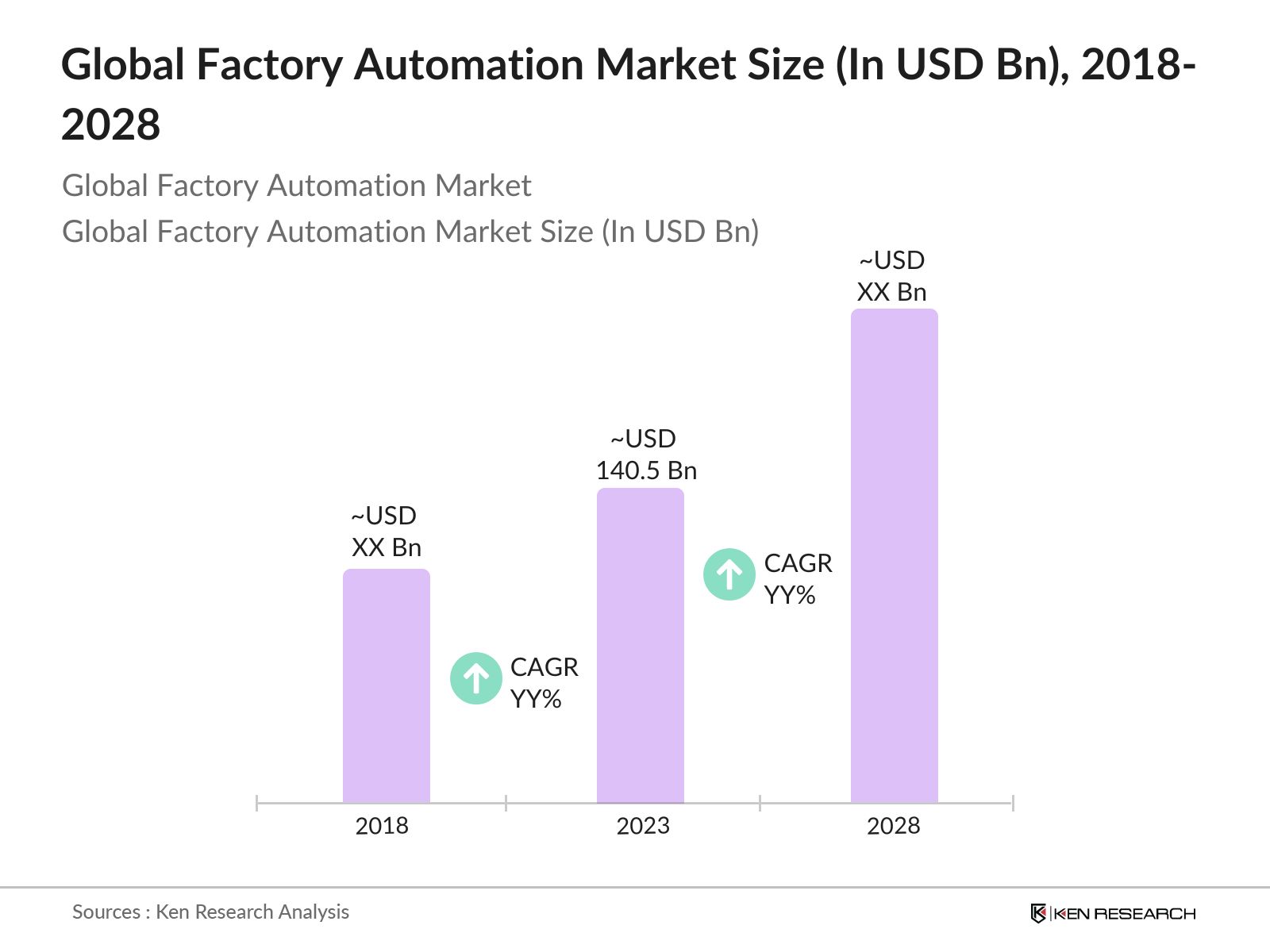
  • The Global Factory Automation Market was valued at USD 140.5 billion in 2023. The market is primarily driven by the increasing adoption of advanced automation technologies across various industries, including automotive, electronics, food and beverage, and pharmaceuticals.
  • Major players in the factory automation market include Siemens AG, ABB Ltd., Rockwell Automation, Inc., Mitsubishi Electric Corporation, and Schneider Electric SE. These companies are at the forefront of developing cutting-edge automation solutions, focusing on enhancing operational efficiency, energy management, and safety standards to meet the evolving demands of various industries.
  • Siemens AG has recently launched its next-generation Simatic controllers i.e. S7-1500 TM which incorporates AI-based analytics to optimize manufacturing processes in real-time. The S7-1500 TM neural processing unit (NPU) module enables the Simatic S7-1500 controller and ET 200MP I/O system to make real-time adjustments based on data inputs, effectively mimicking human decision-making processes.
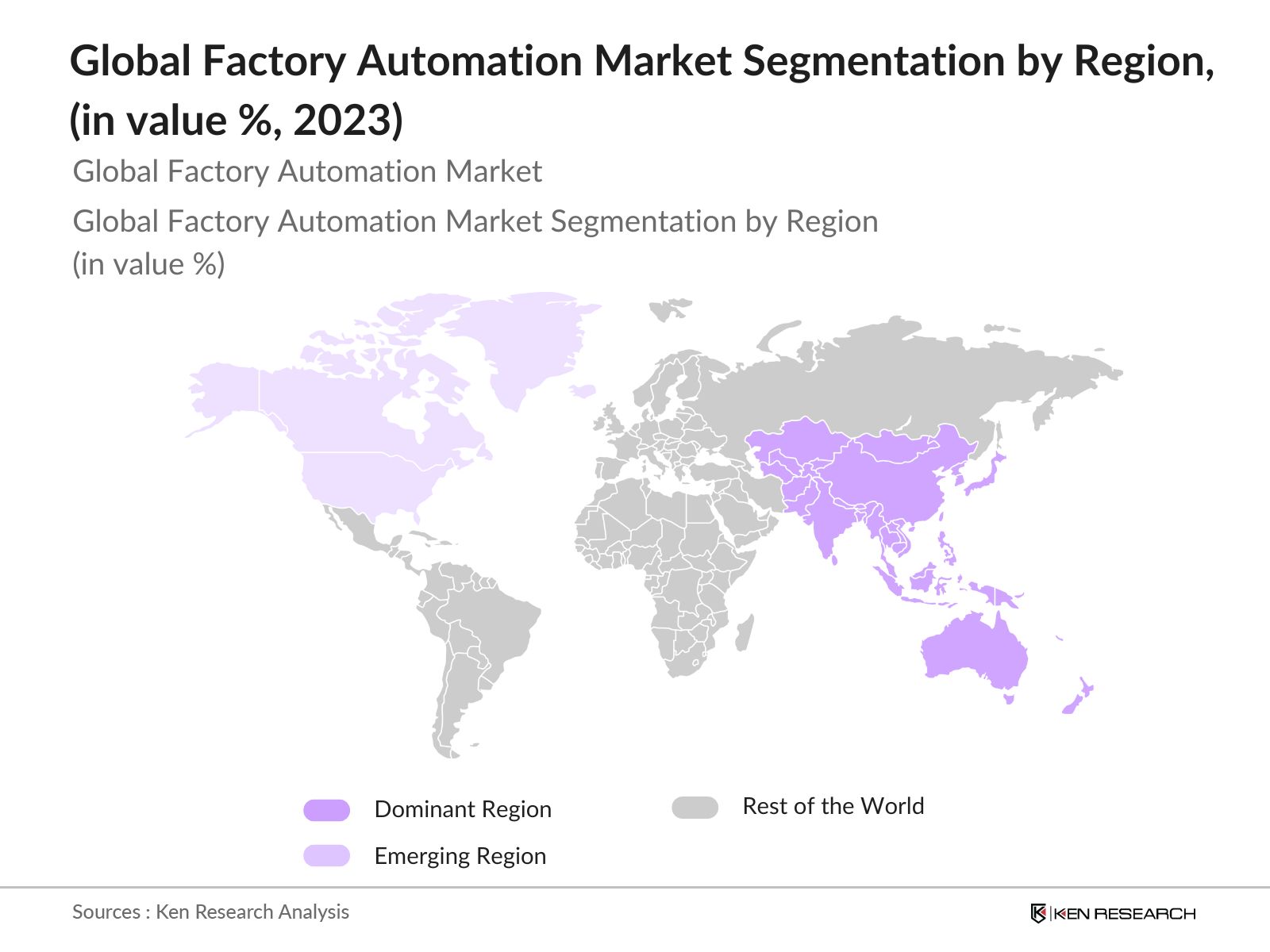
  • In 2023, Asia-Pacific dominated the global market due to the rapid industrialization in countries like China, Japan, and South Korea, coupled with the strong presence of key manufacturers and increasing government initiatives supporting smart manufacturing.

Global Factory Automation Market Size

Global Factory Automation Market Segmentation

The Global Factory Automation Market is segmented by technology type, component, and region.
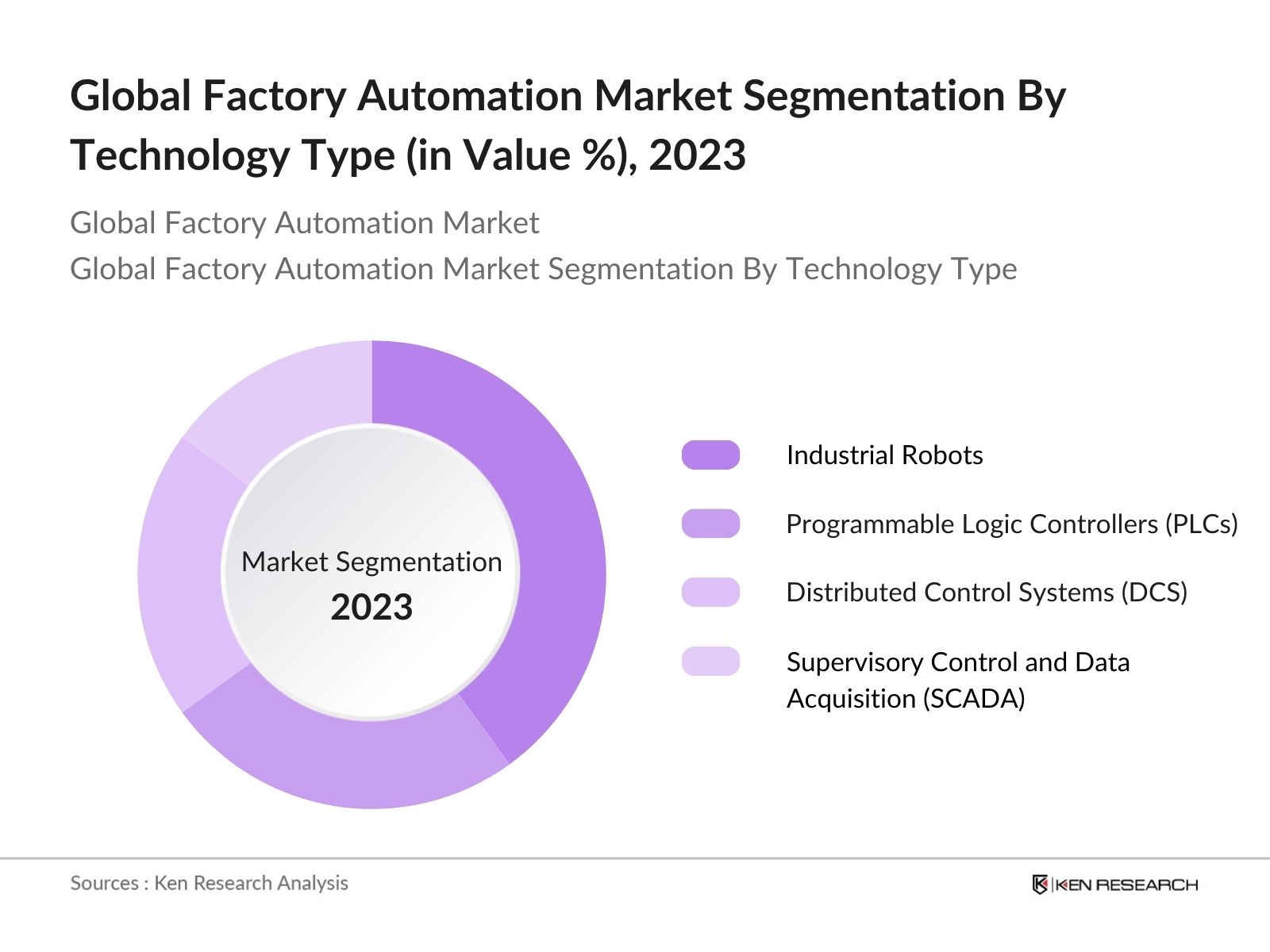
  • By Technology Type: The market is segmented into industrial robots, programmable logic controllers (PLCs), distributed control systems (DCS), and supervisory control and data acquisition (SCADA). In 2023, the industrial robots segment held the largest market share, driven by the widespread adoption in automotive and electronics manufacturing for tasks such as welding, painting, and assembly.

Global Factory Automation Market Segmentation by Technology Type

  • By Component: The market is segmented into hardware, software, and services. In 2023, the hardware segment held the largest market share, largely due to the essential role of sensors, controllers, and actuators in the implementation of automation technologies.
  • By Region: The market is segmented into Asia-Pacific, North America, Europe, Middle East & Africa, and Latin America. In 2023, Asia-Pacific held the largest market share, supported by rapid industrialization in countries like China, Japan, and South Korea, coupled with strong manufacturing capabilities and increasing government initiatives supporting smart manufacturing.

Global Factory Automation Market Segmentation by region

Global Factory Automation Market Competitive Landscape

Company Name

Establishment Year

Headquarters

Siemens AG

1847

Munich, Germany

ABB Ltd.

1988

Zurich, Switzerland

Rockwell Automation, Inc.

1903

Milwaukee, USA

Mitsubishi Electric Corporation

1921

Tokyo, Japan

Schneider Electric SE

1836

Rueil-Malmaison, France

  • Rockwell Automation, Inc.: Rockwell Automation, Inc. launched next-generation PLC systems in 2023, enhancing scalability and flexibility in industrial applications. These systems integrate with IIoT platforms, providing real-time data analytics and predictive maintenance. Companies report up to a 15% increase in production rates and a 42% reduction in quality variability.
  • Mitsubishi Electric Corporation: Mitsubishi Electric Corporation introduced a new line of industrial robots in 2023 featuring AI-based motion control, improving precision and efficiency in manufacturing. This technology can lead to a 20-25% increase in efficiency by optimizing motion and reducing cycle times, enhancing overall manufacturing productivity and effectiveness.

Global Factory Automation Market Analysis

Global Factory Automation Market Growth Drivers:

  • Rise of Smart Factories: The shift towards smart factories, where automation systems are integrated with digital technologies like AI, machine learning, and big data analytics, is a major growth driver. In 2023, the adoption of smart factory solutions increased by 20%, reflecting the industry's move towards higher efficiency and reduced human intervention.
  • Sustainability and Energy Efficiency: The growing emphasis on sustainable manufacturing practices is driving the adoption of energy-efficient automation technologies. In 2023, there was a 15% increase in the adoption of automation systems designed to minimize energy consumption, particularly in energy-intensive industries like steel and chemicals.
  • Expansion of Manufacturing in Emerging Markets: The expansion of manufacturing activities in emerging markets, particularly in Asia-Pacific and Latin America, is boosting demand for factory automation. In 2023, these regions collectively accounted for 43% of the global market, with investments in automation technologies to enhance production capabilities.

Global Factory Automation Market Challenges:

  • Cybersecurity Risks: As automation systems become more connected through IIoT and digital platforms, the risk of cyberattacks increases. In 2023, over 50% of manufacturers expressed concerns about their automation systems' vulnerability to cyber threats, with 34% of industrial control systems experiencing blocked malicious objects.
  • Skill Gap: The rapid adoption of advanced automation technologies has created a skill gap in the workforce. In 2023, 30% of manufacturers reported difficulties in finding skilled workers capable of managing and maintaining complex automation systems.

Global Factory Automation Market Government Initiatives:

  • Japans Robot Revolution Initiative: Japan's Robot Revolution Initiative aims to enhance robotics and AI in manufacturing. In 2023, this initiative contributed to a 25% increase in industrial robot deployment, supported by over $930 million in government funding for various sectors, including manufacturing and healthcare, according to the International Federation of Robotics (IFR).
  • Germanys Industrie 4.0: Germany's Industrie 4.0 strategy promotes digitalization in manufacturing. In 2023, the government provided subsidies and incentives that resulted in a 20% increase in automation investments. This initiative has led to a 30% rise in the adoption of smart factory technologies, enhancing Germany's competitiveness in advanced manufacturing.

Global Factory Automation Market Future Market Outlook

The Global Factory Automation Market is expected to grow robustly over the coming years, driven by the increasing adoption of smart manufacturing technologies, advancements in AI and robotics, and the growing need for energy-efficient and sustainable production processes.

Future Market Trends:

  • Growth of Edge Computing in Automation: By 2028, the adoption of edge computing in factory automation is expected to grow substantially, with 75% of organizations planning to implement edge solutions. This trend will enhance real-time data processing, reduce latency, and improve decision-making efficiency.
  • Expansion of AI-Driven Predictive Maintenance: By 2028, AI-driven predictive maintenance solutions are projected to reduce downtime by 30%, with 60% of manufacturers planning to adopt these technologies. This proactive approach enables early detection of equipment failures, optimizing maintenance schedules and enhancing overall operational efficiency.

Scope of the Report

By Technology Type

Industrial Robots

Programmable Logic Controllers (PLCs)

Distributed Control Systems (DCS)

Supervisory Control and Data Acquisition (SCADA)

By Component

Hardware

Software

Services

By Region

North America

Europe

Asia-Pacific

Middle East & Africa

Latin America

Products

Key Target Audience Organizations and Entities Who Can Benefit by Subscribing This Report:

  • Government and Regulatory Bodies

  • Banks and Financial Institutes

  • Investors and Venture Capitalists

  • Industrial Automation Companies

  • Manufacturing Companies

Time Period Captured in the Report

  • Historical Period: 2018-2023

  • Base Year: 2023

  • Forecast Period: 2023-2028

Companies

Players Mentioned in the Report:

  • Siemens AG

  • ABB Ltd.

  • Rockwell Automation, Inc.

  • Mitsubishi Electric Corporation

  • Schneider Electric SE

  • Honeywell International Inc.

  • Emerson Electric Co.

  • Yokogawa Electric Corporation

  • Fanuc Corporation

  • General Electric Company

  • Omron Corporation

  • Bosch Rexroth AG

  • Parker Hannifin Corporation

  • Hitachi, Ltd.

  • Fuji Electric Co., Ltd.

Table of Contents

1. Global Factory Automation Market Overview

1.1. Definition and Scope

1.2. Market Taxonomy

1.3. Market Growth Rate

1.4. Market Segmentation Overview

2. Global Factory Automation Market Size (in USD Bn), 2018-2023

2.1. Historical Market Size

2.2. Year-on-Year Growth Analysis

2.3. Key Market Developments and Milestones

3. Global Factory Automation Market Analysis

3.1. Growth Drivers

3.1.1. Rise of Smart Factories

3.1.2. Sustainability and Energy Efficiency

3.1.3. Expansion of Manufacturing in Emerging Markets

3.2. Restraints

3.2.1. Cybersecurity Risks

3.2.2. Skill Gap

3.3. Opportunities

3.3.1. Growth of Edge Computing in Automation

3.3.2. Expansion of AI-Driven Predictive Maintenance

3.4. Trends

3.4.1. Integration of IIoT with Factory Automation

3.4.2. Adoption of Advanced Robotics in Manufacturing

3.4.3. Increasing Focus on Real-time Data Analytics

3.5. Government Initiatives

3.5.1. Japans Robot Revolution Initiative

3.5.2. Germanys Industrie 4.0

3.6. SWOT Analysis

3.7. Stakeholder Ecosystem

3.8. Competition Ecosystem

4. Global Factory Automation Market Segmentation, 2023

4.1. By Technology Type (in Value %)

4.1.1. Industrial Robots

4.1.2. Programmable Logic Controllers (PLCs)

4.1.3. Distributed Control Systems (DCS)

4.1.4. Supervisory Control and Data Acquisition (SCADA)

4.2. By Component (in Value %)

4.2.1. Hardware

4.2.2. Software

4.2.3. Services

4.3. By Region (in Value %)

4.3.1. Asia-Pacific

4.3.2. North America

4.3.3. Europe

4.3.4. Middle East & Africa

4.3.5. Latin America

5. Global Factory Automation Market Cross Comparison

5.1. Detailed Profiles of Major Companies

5.1.1. Siemens AG

5.1.2. ABB Ltd.

5.1.3. Rockwell Automation, Inc.

5.1.4. Mitsubishi Electric Corporation

5.1.5. Schneider Electric SE

5.1.6. Honeywell International Inc.

5.1.7. Emerson Electric Co.

5.1.8. Yokogawa Electric Corporation

5.1.9. Fanuc Corporation

5.1.10. General Electric Company

5.1.11. Omron Corporation

5.1.12. Bosch Rexroth AG

5.1.13. Parker Hannifin Corporation

5.1.14. Hitachi, Ltd.

5.1.15. Fuji Electric Co., Ltd.

5.2. Cross Comparison Parameters (No. of Employees, Headquarters, Inception Year, Revenue)

6. Global Factory Automation Market Competitive Landscape

6.1. Market Share Analysis

6.2. Strategic Initiatives

6.3. Mergers and Acquisitions

6.4. Investment Analysis

6.4.1. Venture Capital Funding

6.4.2. Government Grants

6.4.3. Private Equity Investments

7. Global Factory Automation Market Regulatory Framework

7.1. Environmental Standards

7.2. Compliance Requirements

7.3. Certification Processes

8. Global Factory Automation Market Future Market Size (in USD Bn), 2023-2028

8.1. Future Market Size Projections

8.2. Key Factors Driving Future Market Growth

9. Global Factory Automation Market Future Market Segmentation, 2028

9.1. By Technology Type (in Value %)

9.2. By Component (in Value %)

9.3. By Region (in Value %)

10. Global Factory Automation Market Analysts Recommendations

10.1. TAM/SAM/SOM Analysis

10.2. Customer Cohort Analysis

10.3. Marketing Initiatives

10.4. White Space Opportunity Analysis

Disclaimer Contact Us

Research Methodology

Step: 1 Identifying Key Variables

Ecosystem creation for all the major entities and referring to multiple secondary and proprietary databases to perform desk research around the market to collate market-level information.

Step: 2 Market Building

Collating statistics on the Global Factory Automation market over the years and analyzing the penetration of products as well as the ratio of suppliers to compute the revenue generated for the market. We will also review product quality statistics to ensure accuracy behind the data points shared.

Step: 3 Validating and Finalizing

Building market hypotheses and conducting CATIs with market experts from different companies to validate statistics and seek operational and financial information from company representatives.

Step: 4 Research Output

Our research team approaches multiple automation technology providers and end-users to understand product segments, sales trends, consumer preferences, and other parameters. This supports us in validating the statistics derived from the bottom-up approach, ensuring that our findings accurately reflect the current market scenario.

Frequently Asked Questions

01. How big is the Global Factory Automation Market?

The Global Factory Automation Market was valued at USD 140.5 billion in 2023, driven by increasing demand for smart manufacturing technologies, advancements in automation, and the need for operational efficiency.

02. Who are the major players in the Global Factory Automation market?

The major players in the Global Factory Automation Market include Siemens AG, ABB Ltd., Rockwell Automation, Inc., Mitsubishi Electric Corporation, and Schneider Electric SE.

03. What are the growth drivers of the Global Factory Automation market?

The primary growth drivers of the Global Factory Automation Market include the growing demand for smart manufacturing, continuous advancements in automation technologies like AI and robotics, and the increasing need for energy-efficient and sustainable production processes.

04. What are the Global Factory Automation market challenges?

The challenges faced by the Global Factory Automation Market include high initial costs of automation systems, cybersecurity risks associated with connected industrial environments, and the skill gap in the workforce needed to manage and maintain advanced automation technologies.

Why Buy From Us?

RRR
Refine Robust Result (RRR) Framework

What makes us stand out is that our consultants follows Robust, Refine and Result (RRR) methodology. i.e. Robust for clear definitions, approaches and sanity checking, Refine for differentiating respondents facts and opinions and Result for presenting data with story

Our Reach Is Unmatched

We have set a benchmark in the industry by offering our clients with syndicated and customized market research reports featuring coverage of entire market as well as meticulous research and analyst insights.

Research
Shifting the Research Paradigm

While we don't replace traditional research, we flip the method upside down. Our dual approach of Top Bottom & Bottom Top ensures quality deliverable by not just verifying company fundamentals but also looking at the sector and macroeconomic factors.

Insite
More Insights-Better Decisions

With one step in the future, our research team constantly tries to show you the bigger picture. We help with some of the tough questions you may encounter along the way: How is the industry positioned? Best marketing channel? KPI's of competitors? By aligning every element, we help maximize success.

Trust
Transparency and Trust

Our report gives you instant access to the answers and sources that other companies might choose to hide. We elaborate each steps of research methodology we have used and showcase you the sample size to earn your trust.

support
Round the Clock Support

If you need any support, we are here! We pride ourselves on universe strength, data quality, and quick, friendly, and professional service.

Why Client Choose Us?

400000+ Reports in repository
150+ Consulting project a year
100+ Analysts
8000+ Client Queries in 2022