Ken Research Logo

Global Feminine Hygiene Products Market Outlook to 2030

Region:Global

Author(s):Vijay Kumar

Product Code:KROD2495

Published On

December 2024

Total pages

85

About the Report

Global Feminine Hygiene Products Market Overview

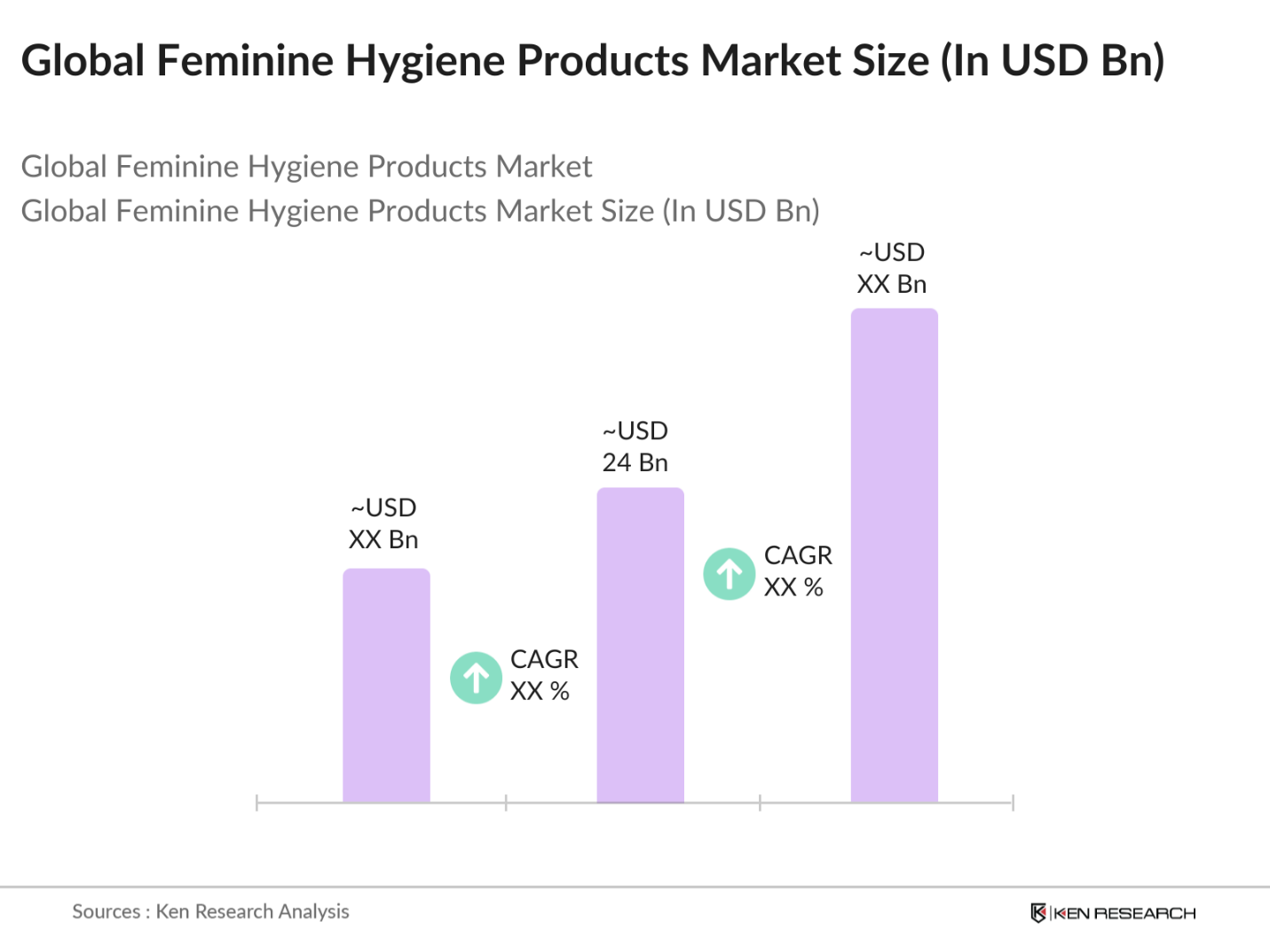
  • The global feminine hygiene products market reached a valuation of USD 24 billion based on historic 5-year data. driven by the rising awareness about menstrual health, increased female workforce participation, and growing demand for eco-friendly and sustainable products. This market's expansion is further fueled by government initiatives aimed at reducing period poverty and enhancing access to affordable hygiene products, particularly in developing regions like India and Africa.
  • Major players in the global feminine hygiene products market include Procter & Gamble, Kimberly-Clark, Unicharm Corporation, Johnson & Johnson, and Kao Corporation. These companies have maintained their strong market presence through continuous investments in research and development (R&D), strategic partnerships, and an extensive global distribution network.
  • In 2023, Procter & Gamble expanded its sustainable product line by introducing biodegradable sanitary napkins under the Always brand. This move highlights the companys ongoing efforts to cater to the increasing demand for environmentally friendly menstrual products in North America and Europe. Similarly, Unicharm Corporation launched its new line of reusable menstrual cups in Japan, gaining significant traction in the Asia-Pacific market.
  • North America continues to dominate the global feminine hygiene products market, mainly due to high consumer awareness, strong purchasing power, and the increasing availability of organic and biodegradable products. Government initiatives like the Period Poverty Task Force in the UK, which aims to provide free sanitary products in schools and public spaces, are also bolstering market growth. Additionally, Europe is seeing a surge in demand for reusable menstrual products as part of its push toward sustainability.

Global Feminine Hygiene Products Market Size

Global Feminine Hygiene Products Market Segmentation

The Global Feminine Hygiene Products Market can be segmented based on Product Type, Distribution Channel, and Region.

By Product Type: The market is segmented by product type into sanitary napkins, tampons, menstrual cups, and panty liners. In 2023, sanitary napkins held the dominant market share due to their widespread usage, affordability, and availability in developing countries. Brands like Always and Kotex have a strong presence in this segment, driven by consistent innovations and their large-scale distribution network.
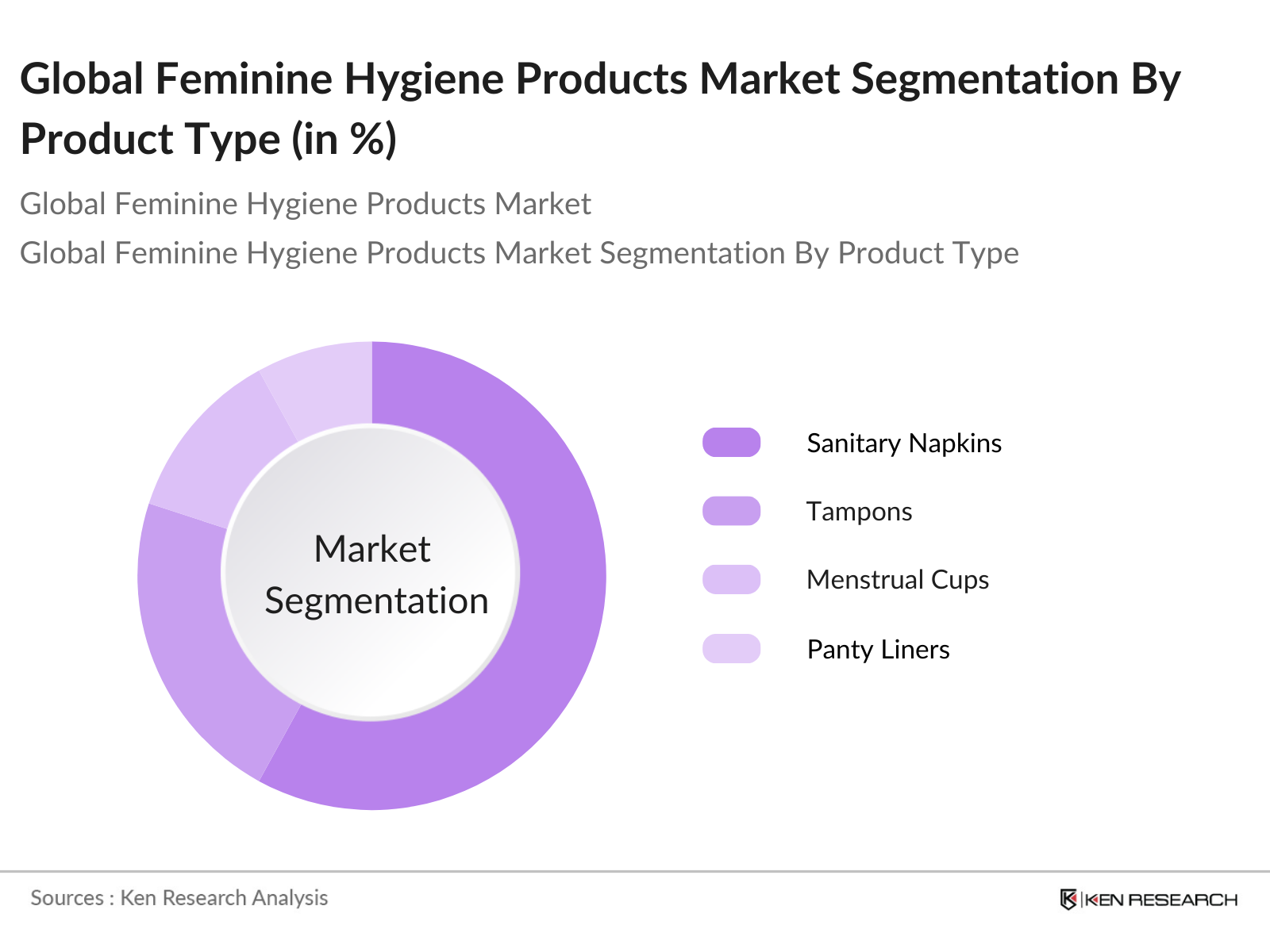
Global Feminine Hygiene Products Market Segmentation By Product Type

By Distribution Channel: The market is further segmented by distribution channel into supermarkets/hypermarkets, pharmacies, online stores, and specialty stores. In 2023, supermarkets and hypermarkets accounted for the highest market share, driven by their large customer base and bulk sales offers. Pharmacies are also a major channel, particularly in developing regions, where consumers rely on them for reliable sanitary products.
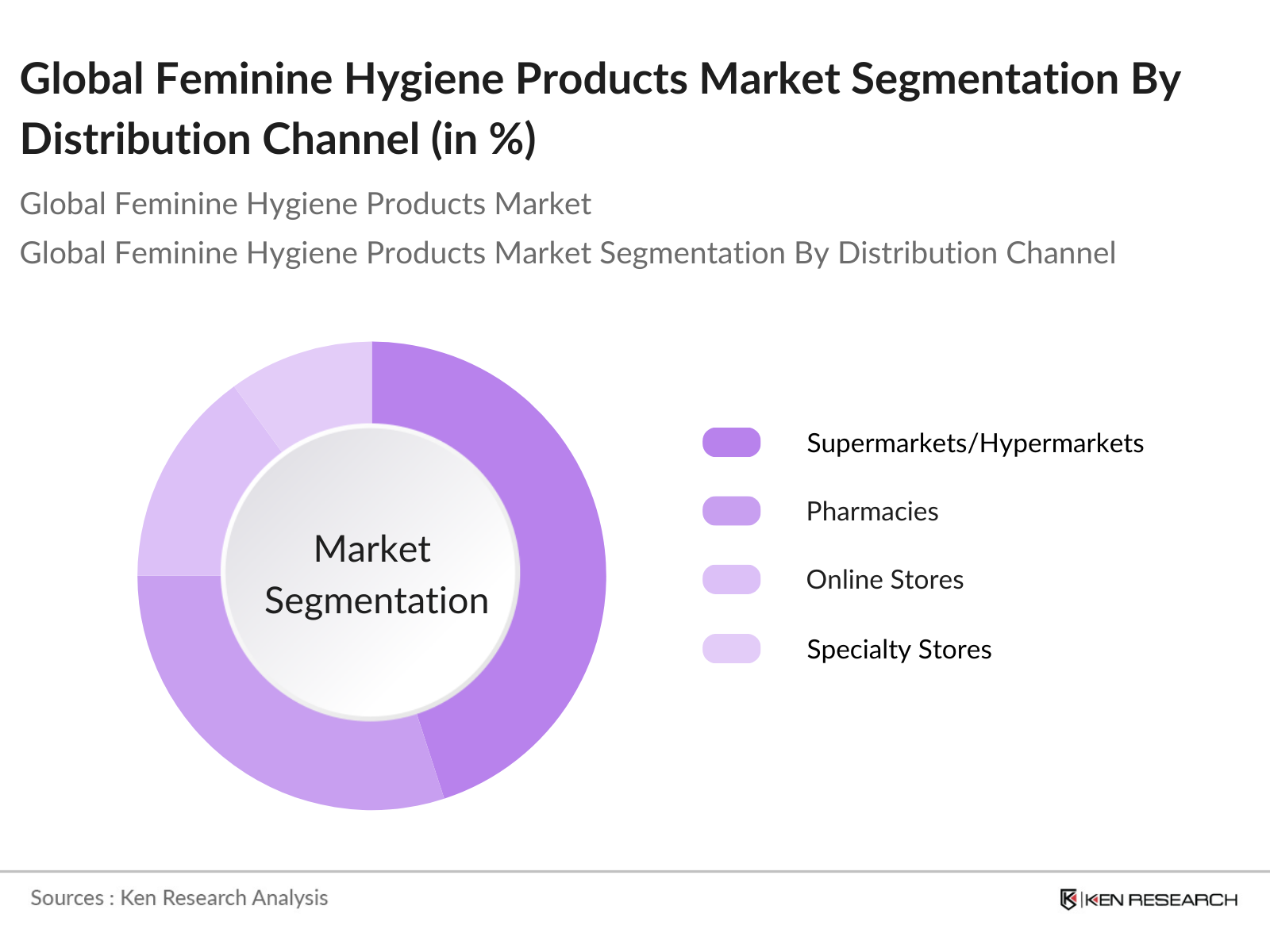
Global Feminine Hygiene Products Market Segmentation By Distribution Channel

By Region: Geographically, the feminine hygiene products market is segmented into North America, Europe, Asia-Pacific, Latin America, and the Middle East & Africa. North America held the dominant market share in 2023, primarily due to high consumer awareness and a significant focus on eco-friendly products.

Global Feminine Hygiene Products Market Competitive Landscape

Company Name

Headquarters

Establishment Year

Procter & Gamble

Cincinnati, USA

1837

Kimberly-Clark

Irving, USA

1872

Unicharm Corporation

Tokyo, Japan

1961

Johnson & Johnson

New Brunswick, USA

1886

Kao Corporation

Tokyo, Japan

1887

  • Kimberly-Clark: In 2023, Kimberly-Clark announced a USD 600 million investment in expanding its production facility in Mexico, aiming to increase the availability of its Kotex product line across Latin America. The expansion aligns with the companys goal of reaching underserved markets in the region and strengthening its footprint in the global feminine hygiene products market.
  • Johnson & Johnson: On April 5, 2023, Johnson & Johnson acquired Shockwave Medical for $13.1 billion. Shockwave specializes in intravascular lithotripsy technology, used to treat coronary and peripheral artery disease. This acquisition aims to enhance J&J's position in the rapidly growing cardiovascular market, driven by substantial unmet medical needs in this area.

Global Feminine Hygiene Products Market Analysis

Market Growth Drivers

  • Increased Awareness and Government Programs Promoting Menstrual Hygiene: In 2024, countries like India and Kenya introduced new national campaigns that promote menstrual hygiene and ensure free access to sanitary products in public schools and rural areas. For instance, Indias Ministry of Health and Family Welfare is providing 1.2 million sanitary napkins monthly to rural girls under the "Menstrual Hygiene Scheme." Kenyas "Dignity Kits" initiative distributed over 500,000 sanitary kits to school-aged girls in 2024, increasing access to hygiene products and boosting overall market demand.
  • Growing Adoption of Sustainable Products: With environmental concerns on the rise, consumers are increasingly turning to eco-friendly hygiene products. In 2024, sales of biodegradable sanitary napkins and reusable menstrual cups surged, particularly in North America and Europe. A report by the European Environment Agency noted that 60% of European women opted for reusable menstrual products in 2024 compared to only 35% in 2022.
  • Rising Demand from Developing Economies: In 2024, the feminine hygiene market in emerging economies like Indonesia, Brazil, and South Africa witnessed significant growth due to increasing product availability and rising disposable incomes. The Indonesian government, through its Ministry of Women Empowerment, initiated a program to increase sanitary product access in rural areas, with over 3 million packs of affordable sanitary pads distributed in 2024.

Global Feminine Hygiene Products Market Challenges

  • Affordability in Low-Income Regions: The high cost of feminine hygiene products remains a barrier in many low-income regions, where disposable incomes are limited. In 2023, a survey by Kenyas Ministry of Health indicated that 40% of women in rural areas could not afford basic sanitary products, leading to the continued use of traditional alternatives.
  • Environmental Impact of Disposable Products: Despite the growing demand for biodegradable products, disposable sanitary pads still account for over 80% of the total market in developing regions. The U.S. Environmental Protection Agency reported that over 20 billion sanitary napkins are discarded annually, contributing significantly to landfill waste.

Global Feminine Hygiene Products Market Government Initiatives

  • UKs Period Poverty Task Force (2024): This initiative expanded its reach to over 2 million women across the UK, providing free access to sanitary products in public schools and health institutions. The government allocated GBP 20 million to ensure menstrual health resources are available nationwide, promoting hygiene education and accessibility.
  • Indias Menstrual Hygiene Scheme (2023): The Indian government expanded this scheme to provide free sanitary napkins to 1.5 million adolescent girls in rural areas every month. The scheme, under the Ministry of Health and Family Welfare, aims to reduce school absenteeism and improve overall menstrual health awareness.

Global Feminine Hygiene Products Market Future Market Outlook

The global feminine hygiene products market is expected to experience significant growth through 2028, driven by government initiatives, increasing awareness about menstrual health, and a growing demand for eco-friendly products. The focus on sustainability will continue to shape the market, as more consumers shift toward organic and biodegradable solutions.

Future Market Trends

  • Increased Demand for Sustainable Products: By 2028, sustainable menstrual products, including reusable menstrual cups and biodegradable sanitary napkins, are expected to account for a significant portion of the market, particularly in North America and Europe. By 2028, companies are expected to invest heavily in research and development (R&D) for eco-friendly solutions, further boosting the adoption of sustainable menstrual products.
  • Technological Innovation in Menstrual Products: By 2028, advancements in menstrual hygiene products, such as smart menstrual cups and sensors integrated into hygiene products, will see increased adoption. Companies will focus on introducing personalized solutions that cater to individual menstrual health needs, offering products that monitor flow and provide hygiene alerts through mobile apps. This technological innovation will be particularly popular in developed markets like Japan and the U.S.

Scope of the Report

By Product

Sanitary Napkins

Tampons

Menstrual Cups

Panty Liners

By End-User

Individual Consumers

Hospitals and Clinics

Schools/Educational Institutions

By Region

North America

Europe

APAC

Latin America

MEA

By Distribution Channel

Supermarkets/Hypermarkets

Pharmacies

Online Stores

Specialty Stores

Products

Key Target Audience Organizations and Entities Who Can Benefit by Subscribing to This Report:

  • Feminine hygiene product manufacturers

  • Retailers and distributors

  • E-commerce platforms

  • Investments and venture capitalist firms

  • Government and regulatory bodies (e.g., FDA, Ministry of Health)

  • Non-governmental organizations (NGOs)

  • Sustainability advocacy groups

  • Raw material suppliers

  • Marketing and advertising agencies

  • Private-label manufacturers

Time Period Captured in the Report:

  • Historical Period: 2018-2023

  • Base Year: 2023

  • Forecast Period: 2023-2028

Companies

Players Mentioned in the Report

  • Procter & Gamble

  • Kimberly-Clark

  • Unicharm Corporation

  • Johnson & Johnson

  • Kao Corporation

  • Edgewell Personal Care

  • Ontex Group

  • Hengan International Group

  • Natracare

  • Rael

Table of Contents

1. Global Feminine Hygiene Products Market Overview

1.1. Definition and Scope

1.2. Market Taxonomy

1.3. Market Growth Rate

1.4. Market Segmentation Overview

2. Global Feminine Hygiene Products Market Size (in USD Billion), 2018-2023

2.1. Historical Market Size

2.2. Year-on-Year Growth Analysis

2.3. Key Market Developments and Milestones

3. Global Feminine Hygiene Products Market Analysis

3.1. Growth Drivers

3.1.1. Rising Awareness About Menstrual Hygiene

3.1.2. Government Initiatives for Menstrual Health

3.1.3. Increasing Demand for Organic and Biodegradable Products

3.2. Restraints

3.2.1. High Product Costs in Low-Income Regions

3.2.2. Environmental Concerns Around Disposable Products

3.2.3. Limited Awareness in Rural Areas

3.3. Opportunities

3.3.1. Growing E-commerce Penetration

3.3.2. Expansion into Emerging Markets

3.3.3. Innovation in Reusable Products

3.4. Trends

3.4.1. Shift Toward Sustainable Hygiene Products

3.4.2. Increased Adoption of Subscription-Based Sales Models

3.4.3. Integration of Technology in Menstrual Products

3.5. Government Regulations

3.5.1. UKs Period Poverty Task Force

3.5.2. Indias Menstrual Hygiene Scheme

3.5.3. Brazils Sanitary Product Subsidy Scheme

3.6. SWOT Analysis

3.7. Stakeholder Ecosystem

3.8. Competition Ecosystem

4. Global Feminine Hygiene Products Market Segmentation, 2023

4.1. By Product Type (in Value %)

4.1.1. Sanitary Napkins

4.1.2. Tampons

4.1.3. Menstrual Cups

4.1.4. Panty Liners

4.2. By Distribution Channel (in Value %)

4.2.1. Supermarkets/Hypermarkets

4.2.2. Pharmacies

4.2.3. Online Stores

4.2.4. Specialty Stores

4.3. By End-User (in Value %)

4.3.1. Individual Consumers

4.3.2. Hospitals and Clinics

4.3.3. Schools/Educational Institutions

4.4. By Region (in Value %)

4.4.1. North America

4.4.2. Europe

4.4.3. Asia-Pacific

4.4.4. Latin America

4.4.5. Middle East & Africa

5. Global Feminine Hygiene Products Market Cross Comparison

5.1. Detailed Profiles of Major Companies

5.1.1. Procter & Gamble

5.1.2. Kimberly-Clark

5.1.3. Unicharm Corporation

5.1.4. Johnson & Johnson

5.1.5. Kao Corporation

5.2. Cross Comparison Parameters (No. of Employees, Headquarters, Inception Year, Revenue)

6. Global Feminine Hygiene Products Market Competitive Landscape

6.1. Market Share Analysis

6.2. Strategic Initiatives

6.3. Mergers and Acquisitions

6.4. Investment Analysis

6.4.1. Venture Capital Funding

6.4.2. Government Grants

6.4.3. Private Equity Investments

7. Global Feminine Hygiene Products Market Regulatory Framework

7.1. Environmental and Product Safety Standards

7.2. Compliance Requirements

7.3. Certification Processes

8. Global Feminine Hygiene Products Future Market Size (in USD Billion), 2023-2028

8.1. Future Market Size Projections

8.2. Key Factors Driving Future Market Growth

9. Global Feminine Hygiene Products Market Future Segmentation, 2028

9.1. By Product Type (in Value %)

9.2. By Distribution Channel (in Value %)

9.3. By End-User (in Value %)

9.4. By Region (in Value %)

10. Global Feminine Hygiene Products Market Analysts Recommendations

10.1. TAM/SAM/SOM Analysis

10.2. Customer Cohort Analysis

10.3. Marketing Initiatives

10.4. White Space Opportunity Analysis

11. Disclaimer

12. Contact Us

Research Methodology

Step 1: Identifying Key Variables

Establishing an ecosystem for all major entities in the Global Feminine Hygiene Products Market by referencing a combination of secondary and proprietary databases. This involves gathering information at an industry level, understanding market dynamics, and identifying key trends to ensure a comprehensive market analysis.

Step 2: Market Building

Compiling statistics on the Global Feminine Hygiene Products Market over the years, analyzing market penetration across various segments, and evaluating the performance of key market players. This includes reviewing production capacities, market share, and sales data to compute the revenue generated within the market. Comprehensive quality checks are conducted to ensure accuracy.

Step 3: Validating and Finalizing

Conducting expert interviews through Computer-Assisted Telephone Interviews (CATIs) with key industry players and stakeholders in the feminine hygiene products market. These interviews are crucial for validating collected data and refining market forecasts, providing both operational and financial insights.

Step 4: Research Output

Collaborating with industry experts to understand customer preferences, sales patterns, and market challenges. A bottom-up approach is used to validate all data, ensuring the final statistics accurately reflect market conditions and support strategic decision-making.

Frequently Asked Questions

1. How big is the Global Feminine Hygiene Products Market?

The global feminine hygiene products market reached a valuation of USD 24 billion in 2023, driven by rising awareness about menstrual health, increasing adoption of sustainable products, and government initiatives to reduce period poverty in developing regions.

2. What are the challenges in the Global Feminine Hygiene Products Market?

Key challenges include the global feminine hygiene products market high cost of feminine hygiene products in low-income regions, limited awareness of menstrual health in rural areas, and environmental concerns related to disposable products. These factors continue to impact market growth in certain regions.

3. Who are the major players in the Global Feminine Hygiene Products Market?

Major players in the global feminine hygiene products market include Procter & Gamble, Kimberly-Clark, Unicharm Corporation, Johnson & Johnson, and Kao Corporation. These companies lead the market through their strong product portfolios, extensive global distribution networks, and focus on innovation.

4. What are the growth drivers of the Global Feminine Hygiene Products Market?

Growth drivers of the global feminine hygiene products market include government programs promoting menstrual health, increased demand for eco-friendly and sustainable hygiene products, and rising urbanization in developing economies, which is contributing to higher product adoption rates.

Why Buy From Us?

RRR
Refine Robust Result (RRR) Framework

What makes us stand out is that our consultants follows Robust, Refine and Result (RRR) methodology. i.e. Robust for clear definitions, approaches and sanity checking, Refine for differentiating respondents facts and opinions and Result for presenting data with story

Our Reach Is Unmatched

We have set a benchmark in the industry by offering our clients with syndicated and customized market research reports featuring coverage of entire market as well as meticulous research and analyst insights.

Research
Shifting the Research Paradigm

While we don't replace traditional research, we flip the method upside down. Our dual approach of Top Bottom & Bottom Top ensures quality deliverable by not just verifying company fundamentals but also looking at the sector and macroeconomic factors.

Insite
More Insights-Better Decisions

With one step in the future, our research team constantly tries to show you the bigger picture. We help with some of the tough questions you may encounter along the way: How is the industry positioned? Best marketing channel? KPI's of competitors? By aligning every element, we help maximize success.

Trust
Transparency and Trust

Our report gives you instant access to the answers and sources that other companies might choose to hide. We elaborate each steps of research methodology we have used and showcase you the sample size to earn your trust.

support
Round the Clock Support

If you need any support, we are here! We pride ourselves on universe strength, data quality, and quick, friendly, and professional service.

Why Client Choose Us?

400000+ Reports in repository
150+ Consulting project a year
100+ Analysts
8000+ Client Queries in 2022