
Global Flow Battery Market Outlook 2030
Region:Global
Author(s):Shivani Mehra
Product Code:KROD6909
Region:Global
Author(s):Shivani Mehra
Product Code:KROD6909
December 2024
82
By Product Type: The flow battery market is segmented by product type into redox flow batteries and hybrid flow batteries. Redox flow batteries dominate the market due to their higher energy capacity, scalability, and long-duration energy storage capabilities. They are ideal for large-scale energy storage applications such as utility-scale energy storage, which drives their dominance. The key advantage of redox flow batteries is their ability to decouple energy and power, offering flexibility in sizing the energy storage system. Hybrid flow batteries, although gaining interest, are still in the early stages of adoption due to their relatively lower capacity and performance.

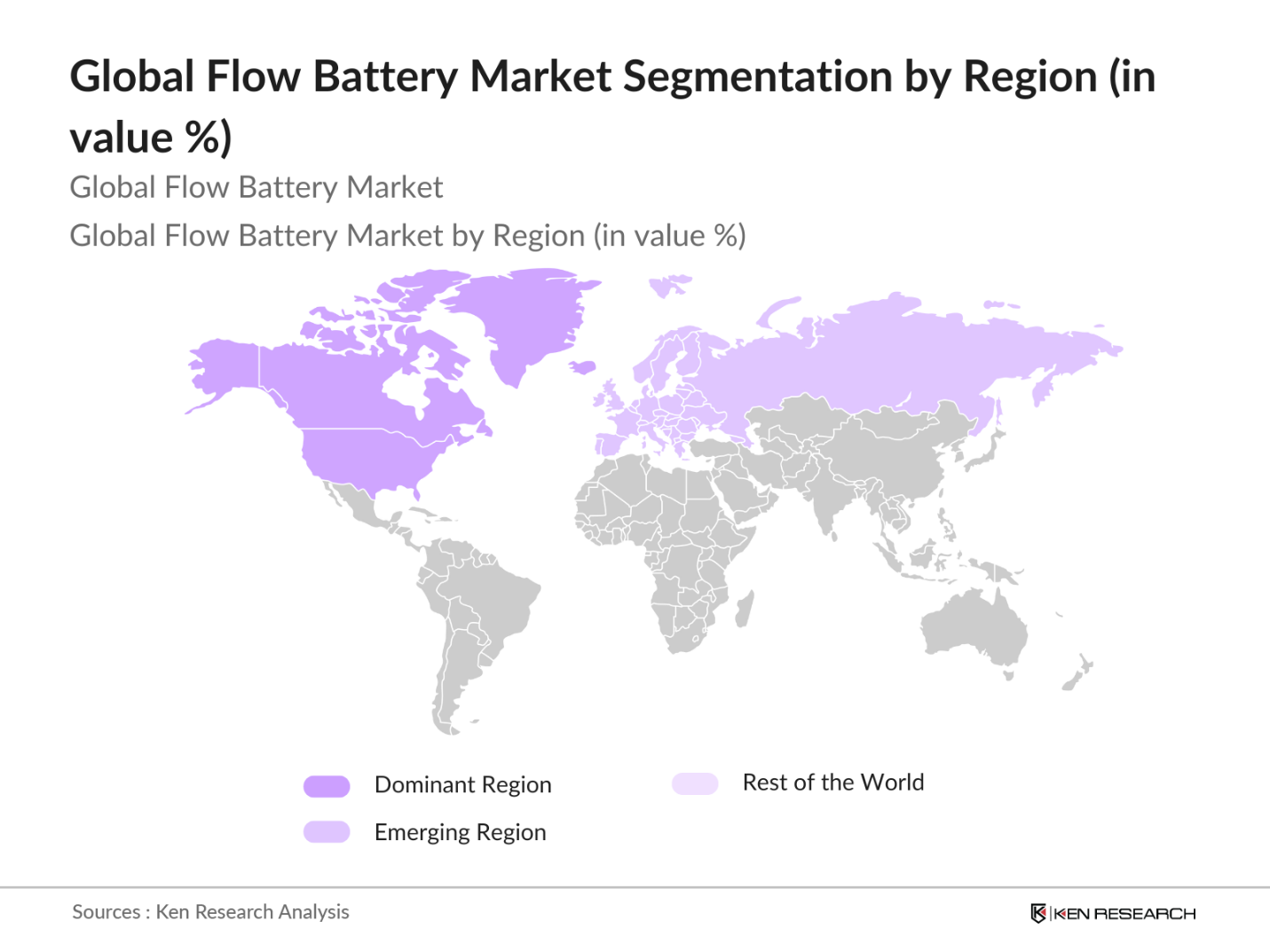
By Region: The flow battery market is segmented by region into North America, Europe, Asia Pacific, Middle East & Africa, and Latin America. North America is the dominant region, driven by significant investments in renewable energy projects and favorable government policies supporting energy storage. Europe follows closely due to its strong focus on reducing carbon emissions and transitioning to renewable energy sources. The Asia Pacific region is also growing rapidly, led by China, where government support for renewable energy storage and manufacturing capacity drives growth.
The flow battery market is consolidated with several key players dominating the market. These companies focus on technological innovation, strategic partnerships, and large-scale project deployments to maintain their market positions. The market is led by companies such as ESS Inc., Primus Power, and RedT Energy Plc. These players are investing heavily in research and development to improve battery efficiency and reduce costs, making flow batteries more competitive against other energy storage technologies such as lithium-ion batteries.
|
Company |
Establishment Year |
Headquarters |
Revenue (USD) |
Key Technology |
No. of Employees |
Installed Projects |
Technology Focus |
R&D Investments |
Key Partnerships |
|
ESS Inc. |
2011 |
United States |
$100 million |
||||||
|
Primus Power |
2009 |
United States |
$90 million |
||||||
|
RedT Energy Plc |
2013 |
United Kingdom |
$80 million |
||||||
|
Vionx Energy |
2010 |
United States |
$70 million |
||||||
|
Invinity Energy Systems |
2019 |
United Kingdom |
$60 million |
The global flow battery market is expected to show significant growth over the next five years, driven by increased renewable energy penetration, declining costs of critical materials like vanadium, and advancements in battery technology that enhance performance and reduce operational costs. Governments worldwide are introducing policies that mandate energy storage for grid stability, which is expected to boost the demand for flow batteries further. As technological innovations continue, flow batteries are expected to become more competitive with other forms of energy storage, opening up new opportunities in both developed and developing regions.
|
By Product Type |
Redox Flow Battery Hybrid Flow Battery |
|
By Application |
Utility-Scale Power Generation Commercial & Industrial Off-Grid Solutions |
|
By Technology |
Vanadium Redox Flow Battery Zinc Bromide Flow Battery Iron-Chromium Flow Battery |
|
By Storage Capacity |
Below 10 MW 10 MW50 MW Above 50 MW |
|
By Region |
North America Europe Asia Pacific Middle East & Africa Latin America |
1.1. Definition and Scope
1.2. Market Taxonomy
1.3. Flow Battery Technology Ecosystem
1.4. Market Segmentation Overview
1.5. Market Growth Metrics
1.6. Lifecycle Assessment
1.7. Regulatory Environment
2.1. Historical Market Size (In USD Bn)
2.2. Year-On-Year Growth Analysis (In Units and USD)
2.3. Key Market Milestones
2.4. Demand Analysis by Technology (Redox, Hybrid, Other Chemistries)
2.5. Installation Capacity Growth (In MW)
3.1. Growth Drivers
3.1.1. Renewable Energy Integration (Market Parameter: Energy Storage Duration)
3.1.2. Grid Modernization (Parameter: Demand Response Mechanisms)
3.1.3. Industrial and Commercial Storage Demand (Parameter: Back-up Power Supply Needs)
3.2. Market Challenges
3.2.1. High Initial Capital Costs (Parameter: CAPEX)
3.2.2. Limited Commercial Scale Deployments (Parameter: Installed Base)
3.2.3. Technical Complexities in Chemistry (Parameter: Electrolyte Stability)
3.3. Opportunities
3.3.1. Emerging Applications in Off-Grid Systems
3.3.2. Technological Innovations (Parameter: Extended Lifespan)
3.3.3. Declining Costs of Critical Materials (Parameter: Vanadium Pricing Trends)
3.4. Trends
3.4.1. Extended Discharge Time Batteries
3.4.2. Integration with Renewable Energy Microgrids
3.4.3. Customization for Industrial Applications
3.5. Government Regulations and Incentives
3.5.1. Energy Storage Mandates (Parameter: National Storage Targets)
3.5.2. Subsidies and Grants for Flow Battery Deployment
3.5.3. Public-Private Collaboration Programs
3.6. SWOT Analysis
3.7. Stakeholder Ecosystem
3.8. Porters Five Forces
3.9. Competitive Ecosystem
4.1. By Product Type (In Value %)
4.1.1. Redox Flow Battery
4.1.2. Hybrid Flow Battery
4.2. By Application (In Value %)
4.2.1. Utility-Scale Power Generation
4.2.2. Commercial and Industrial
4.2.3. Off-Grid Solutions
4.3. By Technology (In Value %)
4.3.1. Vanadium Redox Flow Battery
4.3.2. Zinc Bromide Flow Battery
4.3.3. Iron-Chromium Flow Battery
4.4. By Storage Capacity (In Value %)
4.4.1. Below 10 MW
4.4.2. 10 MW50 MW
4.4.3. Above 50 MW
4.5. By Region (In Value %)
4.5.1. North America
4.5.2. Europe
4.5.3. Asia Pacific
4.5.4. Middle East and Africa
4.5.5. Latin America
5.1. Detailed Profiles of Major Companies
5.1.1. ESS Inc.
5.1.2. Primus Power
5.1.3. RedT Energy Plc
5.1.4. Sumitomo Electric Industries
5.1.5. Vionx Energy
5.1.6. UniEnergy Technologies
5.1.7. SCHMID Group
5.1.8. Lockheed Martin Energy
5.1.9. Invinity Energy Systems
5.1.10. ViZn Energy
5.1.11. Gildemeister Energy Solutions
5.1.12. Pellion Technologies
5.1.13. NanoFlowcell
5.1.14. Pu Neng Energy
5.1.15. Enerox GmbH
5.2. Cross Comparison Parameters (No. of Employees, Headquarters, Inception Year, Revenue, Installed Projects, Technology Focus, Key Partnerships, R&D Investments)
5.3. Market Share Analysis
5.4. Strategic Initiatives
5.5. Mergers and Acquisitions
5.6. Investment Analysis
5.7. Venture Capital Funding
5.8. Government Grants
5.9. Private Equity Investments
6.1. Energy Storage Standards (Parameter: Compliance Requirements)
6.2. Safety Regulations (Parameter: Fire Safety Protocols)
6.3. Certification Processes (Parameter: UL, IEC Standards)
7.1. Future Market Size Projections
7.2. Key Factors Driving Future Market Growth
8.1. By Product Type (In Value %)
8.2. By Application (In Value %)
8.3. By Technology (In Value %)
8.4. By Storage Capacity (In Value %)
8.5. By Region (In Value %)
9.1. TAM/SAM/SOM Analysis
9.2. Customer Cohort Analysis
9.3. Marketing Initiatives
9.4. White Space Opportunity Analysis
In this initial phase, we constructed an ecosystem map that encompassed all the major stakeholders within the global flow battery market. Using extensive desk research and proprietary databases, we gathered industry-level information to identify and define the critical variables influencing market dynamics.
Next, we compiled and analyzed historical data related to the global flow battery market. This included assessing market penetration, key performance metrics, and the ratio of market participants to service providers. We further evaluated energy storage deployment statistics to ensure the reliability and accuracy of our revenue estimates.
Our market hypotheses were developed and subsequently validated through interviews with industry experts representing a diverse array of companies. These consultations provided valuable insights into market trends and operational performance, ensuring a refined and corroborated market dataset.
In the final phase, we engaged with multiple energy storage solution providers to gain detailed insights into product segments, sales performance, and consumer preferences. This interaction verified the data derived from the bottom-up approach, ensuring a comprehensive and validated analysis of the global flow battery market.
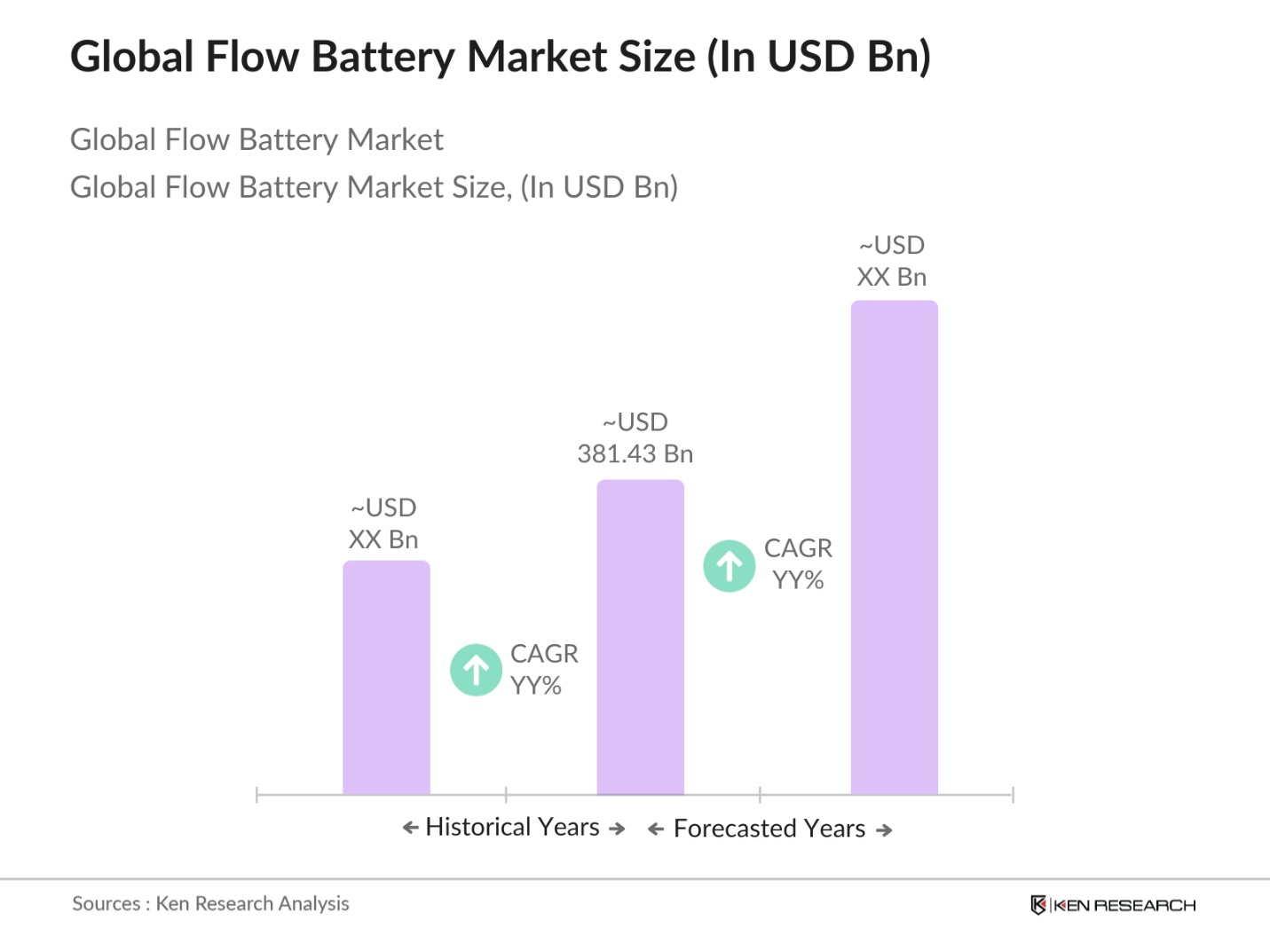
The global flow battery market was valued at USD 381.43 billion, driven by increased renewable energy integration and long-duration storage requirements.
Challenges in the global flow battery market include high initial capital costs, limited commercial-scale deployments, and technical complexities in battery chemistry.
Key players in the global flow battery market include ESS Inc., Primus Power, RedT Energy Plc, and Vionx Energy, which dominate due to their technological advancements and large-scale project deployments.
The market is driven by renewable energy integration, grid modernization initiatives, and increasing industrial demand for reliable backup power solutions.

What makes us stand out is that our consultants follows Robust, Refine and Result (RRR) methodology. i.e. Robust for clear definitions, approaches and sanity checking, Refine for differentiating respondents facts and opinions and Result for presenting data with story

We have set a benchmark in the industry by offering our clients with syndicated and customized market research reports featuring coverage of entire market as well as meticulous research and analyst insights.

While we don't replace traditional research, we flip the method upside down. Our dual approach of Top Bottom & Bottom Top ensures quality deliverable by not just verifying company fundamentals but also looking at the sector and macroeconomic factors.

With one step in the future, our research team constantly tries to show you the bigger picture. We help with some of the tough questions you may encounter along the way: How is the industry positioned? Best marketing channel? KPI's of competitors? By aligning every element, we help maximize success.

Our report gives you instant access to the answers and sources that other companies might choose to hide. We elaborate each steps of research methodology we have used and showcase you the sample size to earn your trust.

If you need any support, we are here! We pride ourselves on universe strength, data quality, and quick, friendly, and professional service.