















Global FRP Composites Market Outlook to 2030
Region:Global
Author(s):Shivani
Product Code:KROD10665
November 2024
88
About the Report
Global FRP Composites Market Overview
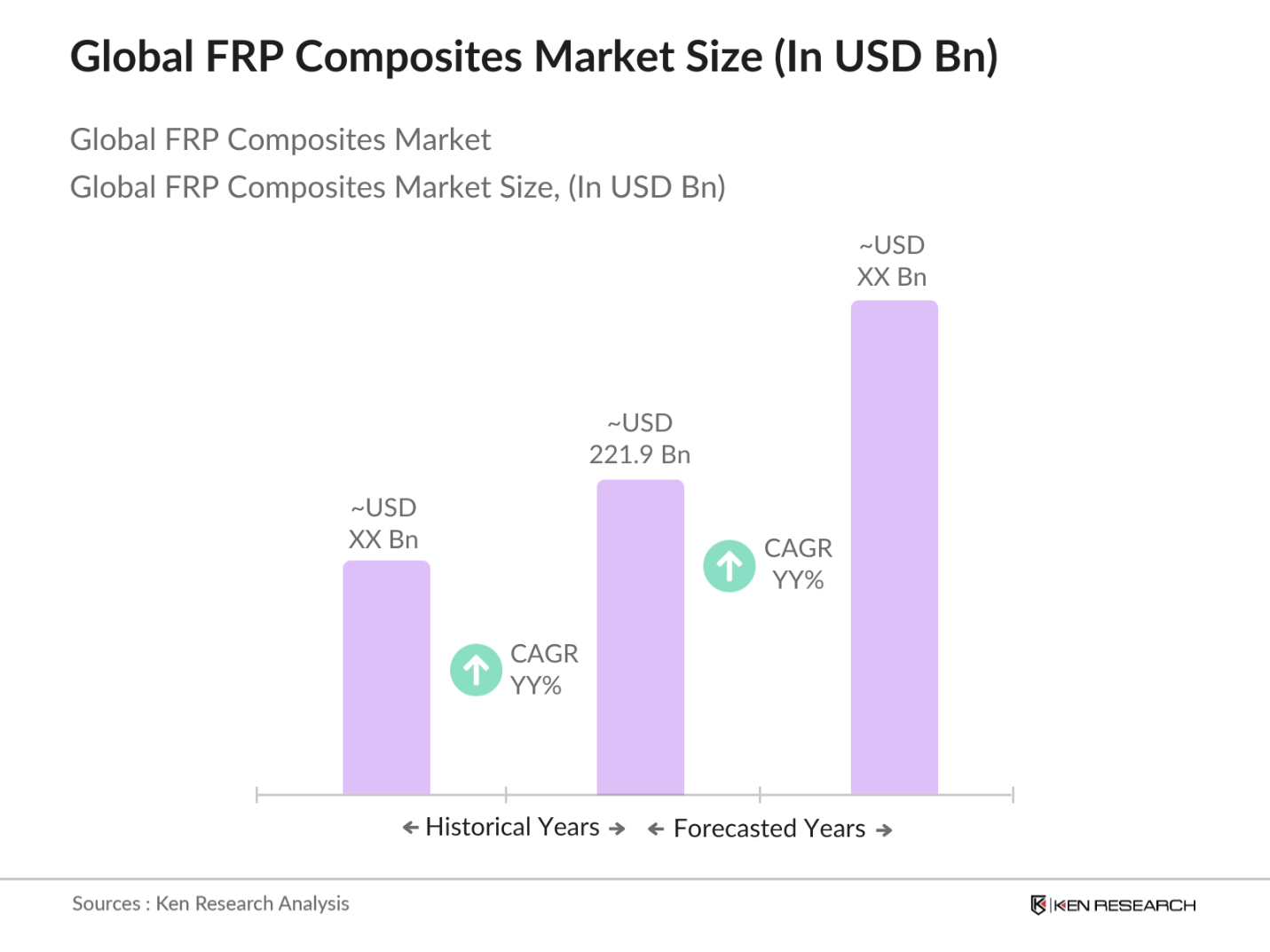
- The global fiber-reinforced polymer (FRP) composites market is valued at USD 221.9 billion, based on a five-year historical analysis. This market is primarily driven by the growing demand from the aerospace, automotive, and construction industries, where the need for lightweight, high-strength materials is paramount. Advancements in composite technology, combined with the increasing use of FRP in sustainable construction materials, further fuel the market growth. The increasing adoption of electric vehicles (EVs) also supports this, as FRP composites help reduce vehicle weight, thereby enhancing energy efficiency.
- Countries like the United States, China, and Germany dominate the market due to their advanced automotive, aerospace, and construction industries. In these regions, major industries extensively use FRP composites for manufacturing lightweight components to meet the stringent fuel efficiency and emission standards. The dominance of these countries is also attributed to the presence of large-scale manufacturing facilities, technological innovation, and a strong supply chain of composite materials.
- The U.S. government, under the Department of Energy, is promoting the use of advanced materials, including FRP composites, as part of its clean energy and advanced manufacturing strategies. Through the Advanced Manufacturing Office (AMO), over $10 billion has been allocated to improve materials efficiency, including the development of lightweight composites for wind energy and automotive sectors. This initiative aims to reduce energy consumption in production processes and encourage the use of FRP composites in renewable energy infrastructure.
Global FRP Composites Market Segmentation
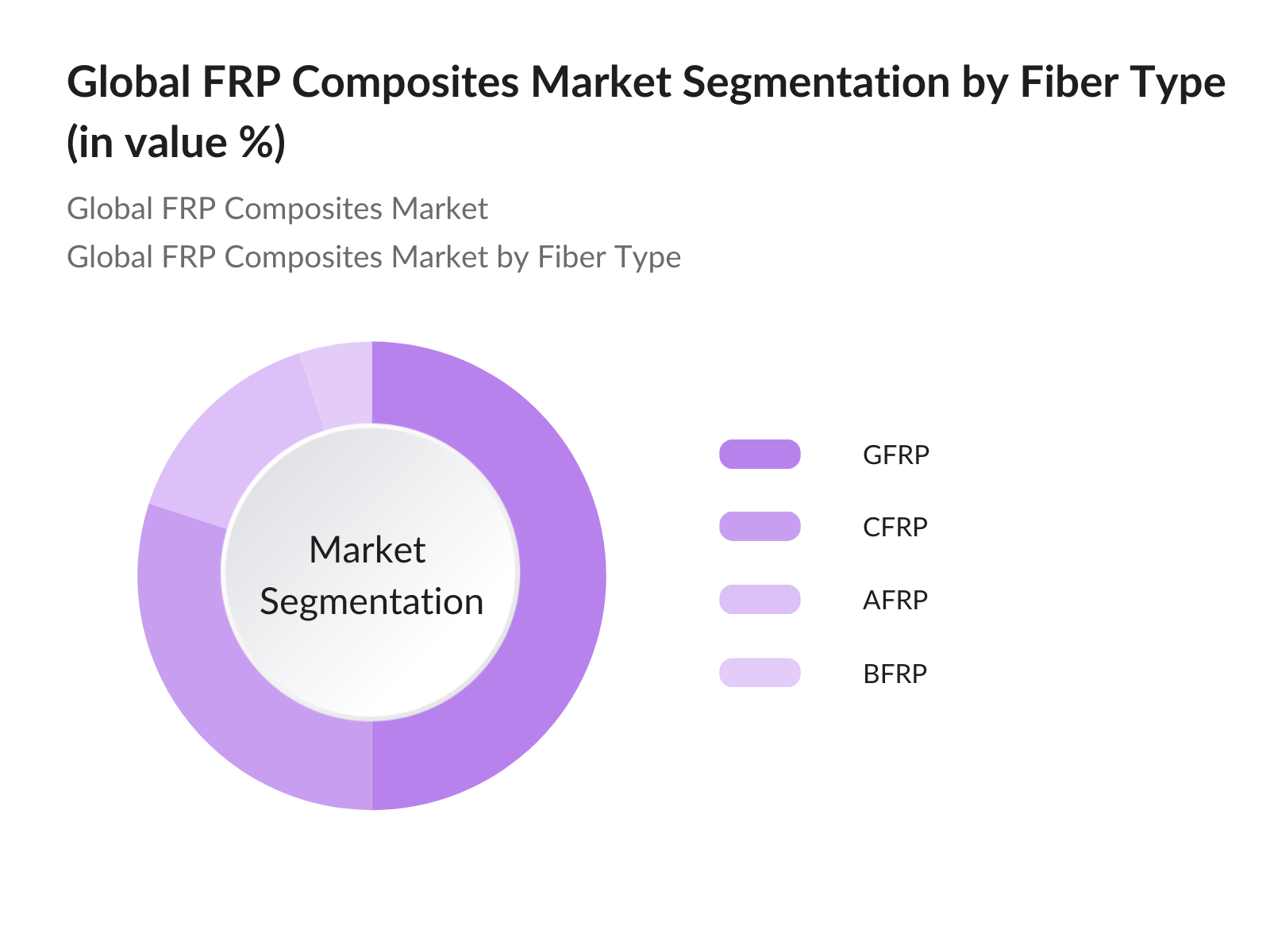
By Fiber Type: The FRP composites market is segmented by fiber type into Glass Fiber Reinforced Polymer (GFRP), Carbon Fiber Reinforced Polymer (CFRP), Aramid Fiber Reinforced Polymer (AFRP), and Basalt Fiber Reinforced Polymer (BFRP). Among these, GFRP has a dominant market share due to its wide applications in construction, automotive, and marine industries. Its cost-effectiveness and strong mechanical properties make it the go-to choice for industries that require high strength and resistance to environmental degradation.
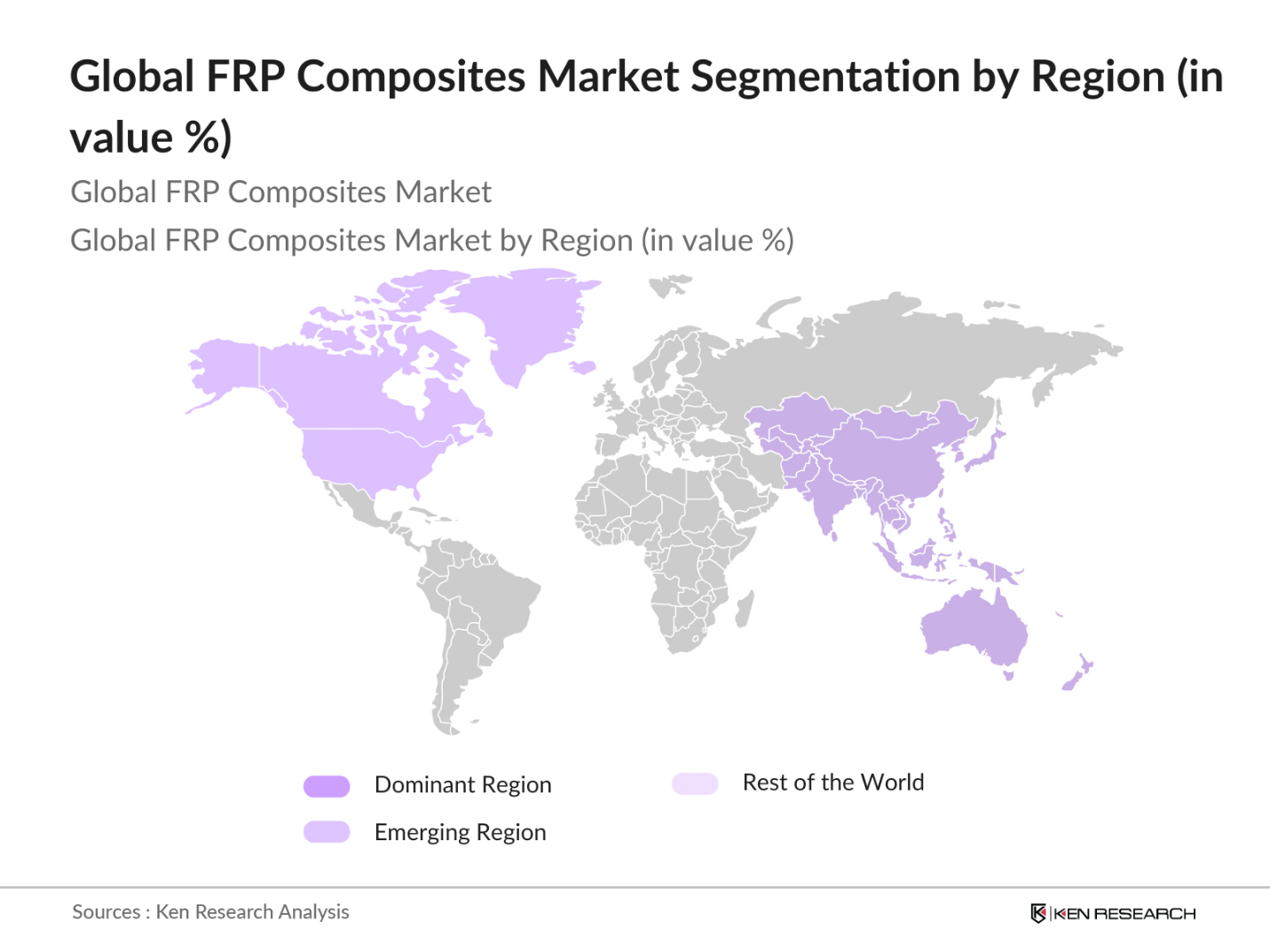
By Region: The FRP composites market is segmented into North America, Europe, Asia-Pacific, Latin America, and the Middle East & Africa. Asia-Pacific holds the largest market share due to the regions massive automotive and construction industries. Countries such as China, Japan, and South Korea are significant contributors, as they have extensive manufacturing infrastructure and government support for infrastructure development and sustainable energy solutions.
Global FRP Composites Competitive Landscape
The global FRP composites market is dominated by a few key players who control the majority of the market share. These companies have strong manufacturing capabilities, large-scale production facilities, and robust R&D departments to innovate new composite materials. The market is highly consolidated, with these companies leveraging their extensive supply chains and long-term contracts with end-use industries.
|
Company Name |
Year Established |
Headquarters |
Fiber Focus |
Manufacturing Process |
Global Reach |
Sustainability Practices |
Innovative Products |
Raw Material Source |
Strategic Partnerships |
|
Toray Industries Inc. |
1926 |
Japan |
Carbon Fiber |
- |
- |
- |
- |
- |
- |
|
Owens Corning |
1938 |
USA |
Glass Fiber |
- |
- |
- |
- |
- |
- |
|
Hexcel Corporation |
1948 |
USA |
Carbon Fiber |
- |
- |
- |
- |
- |
- |
|
Mitsubishi Chemical Corp. |
1933 |
Japan |
Carbon Fiber |
- |
- |
- |
- |
- |
- |
|
SGL Carbon |
1992 |
Germany |
Carbon Fiber |
- |
- |
- |
- |
- |
- |
Global FRP Composites Market Analysis
Market Growth Drivers
- Increased Demand from Aerospace & Defense Industry: The aerospace and defense sector heavily relies on Fiber Reinforced Polymer (FRP) composites due to their high strength-to-weight ratio. In 2023, global defense expenditures are expected to surpass $2.3 trillion, with significant portions dedicated to advanced materials like FRP composites for aircraft and defense equipment. The U.S. Department of Defense has been increasing its use of lightweight composites to enhance fuel efficiency in its aviation fleet, which alone accounts for over $200 billion in defense-related procurement annually. Additionally, the EU's defense budget has prioritized lightweight materials, including FRP composites, in its aerospace development plans.
- Rising Adoption in Construction & Infrastructure: FRP composites are being increasingly adopted in the construction industry due to their resistance to corrosion and superior durability. The global construction sector is projected to invest over $13 trillion in infrastructure projects by 2025. Government-backed initiatives, such as the U.S. Infrastructure Investment and Jobs Act, which allocates $1.2 trillion, emphasize using innovative, long-lasting materials like FRP composites to meet the requirements for sustainable and resilient infrastructure. Japan's infrastructure upgrade program also includes significant investments in FRP composites to replace aging steel and concrete structures, where corrosion-resistant materials are vital for long-term cost savings.
- Regulatory Support for Lightweight Materials: The push for more fuel-efficient vehicles and aircraft has led to regulatory mandates favoring lightweight materials, including FRP composites. In 2024, global emissions regulations, such as the European Unions CO2 emission standards for new vehicles, emphasize reducing emissions, which can be achieved through the use of lightweight materials like FRP composites. The U.S. Corporate Average Fuel Economy (CAFE) standards also encourage the adoption of lightweight materials in the automotive sector by offering tax incentives for manufacturers that incorporate materials like FRP to reduce vehicle weight and improve fuel efficiency.
Market Challenges:
- High Manufacturing Costs: Despite advancements in manufacturing technologies, the production of FRP composites remains costly due to the complexity of the materials and energy-intensive processes. For instance, producing carbon fiber composites costs approximately $10-$12 per kilogram, compared to $2-$4 per kilogram for steel. This makes widespread adoption in cost-sensitive sectors challenging. Energy prices, especially in key manufacturing hubs like Europe, have significantly increased in 2024, further adding to the cost burden. High labor costs in regions like North America and Europe also exacerbate the issue, limiting large-scale adoption outside high-end industries.
- Recycling Challenges: FRP composites pose significant recycling challenges, as their complex structure makes it difficult to separate fibers and resins for reuse. According to the European Union's Circular Economy Action Plan, most FRP composite waste is either incinerated or landfilled due to the lack of recycling technologies. This issue is particularly prominent in sectors like wind energy, where large-scale decommissioning of FRP-based turbine blades is anticipated in the coming years. Currently, the U.S. generates over 2 million tons of FRP composite waste annually, much of which remains unrecycled because of the lack of economically viable recycling processes.
Global FRP Composites Market Future Outlook
Over the next five years, the global FRP composites market is expected to experience substantial growth, driven by increased demand from industries like aerospace, automotive, wind energy, and construction. Government regulations emphasizing energy efficiency, sustainability, and carbon footprint reduction are pushing industries to adopt lightweight, high-strength composite materials like FRP. The automotive industry's shift towards electric vehicles (EVs) will also contribute to significant growth, as manufacturers aim to reduce vehicle weight for better performance and energy efficiency. Additionally, innovations in biocomposites and advancements in automation in the composite manufacturing process will open up new growth opportunities.
Market Opportunities:
- Increased Focus on Sustainability and Green Composites: Sustainability is a growing trend in the FRP composites market, with manufacturers and end-users increasingly seeking eco-friendly alternatives. In 2023, many new FRP composite products in the automotive and construction sectors are incorporating recycled or bio-based materials. Governments, particularly in the EU and the U.S., are providing incentives and regulatory support for companies developing green composites, which include natural fibers like hemp and flax. This shift toward sustainability is driven by strict environmental regulations and a growing consumer demand for greener, more sustainable products.
- Recycling Challenges: FRP composites pose significant recycling challenges, as their complex structure makes it difficult to separate fibers and resins for reuse. According to the European Union's Circular Economy Action Plan, a very small portion of FRP composite waste is recycled, with the majority being incinerated or landfilled. This issue is especially prevalent in the wind energy sector, where the decommissioning of FRP-based turbine blades is expected to increase in the coming years. Currently, the U.S. generates over 2 million tons of FRP composite waste annually, most of which remains unrecycled due to the absence of cost-effective recycling technologies.
Scope of the Report
|
By Fiber Type |
Glass Fiber Reinforced Polymer (GFRP) Carbon Fiber Reinforced Polymer (CFRP) Aramid Fiber Reinforced Polymer (AFRP) Basalt Fiber Reinforced Polymer (BFRP) |
|
By Resin Type |
Thermoset Resins Thermoplastic Resins |
|
By End-Use Industry |
Aerospace & Defense Construction & Infrastructure Automotive Wind Energy, Electrical & Electronics |
|
By Manufacturing Process |
Layup Process, Pultrusion Process Filament Winding Process Resin Transfer Molding (RTM) Injection Molding |
|
By Region |
North America Europe Asia-Pacific Latin America Middle East & Africa |
Products
Key Target Audience
Aerospace Manufacturers
Automotive OEMs
Wind Energy Developers
Construction and Infrastructure Firms
Defense and Military Contractors
Investments and Venture Capitalist Firms
Government and Regulatory Bodies (U.S. Department of Energy, European Aviation Safety Agency, etc.)
Raw Material Suppliers
Companies
Major Players
Toray Industries Inc.
Owens Corning
Hexcel Corporation
Mitsubishi Chemical Corporation
SGL Carbon
Teijin Limited
Solvay S.A.
Zoltek Companies, Inc.
SABIC
Plasan Carbon Composites
Exel Composites
Strongwell Corporation
Gurit Holding AG
PPG Industries, Inc.
AGY Holding Corp.
Table of Contents
1. Global FRP Composites Market Overview
1.1. Definition and Scope
1.2. Market Taxonomy
1.3. Market Growth Rate
1.4. Market Segmentation Overview
2. Global FRP Composites Market Size (In USD Mn)
2.1. Historical Market Size
2.2. Year-On-Year Growth Analysis
2.3. Key Market Developments and Milestones
3. Global FRP Composites Market Analysis
3.1. Growth Drivers
3.1.1. Increased Demand from Aerospace & Defense Industry
3.1.2. Rising Adoption in Construction & Infrastructure
3.1.3. Advancements in Composite Manufacturing Technologies
3.1.4. Regulatory Support for Lightweight Materials
3.2. Market Challenges
3.2.1. High Manufacturing Costs
3.2.2. Recycling Challenges
3.2.3. Limited Availability of Raw Materials
3.3. Opportunities
3.3.1. Expansion of Electric Vehicle Industry
3.3.2. Growing Adoption in Wind Energy Sector
3.3.3. Innovations in Biocomposites
3.4. Trends
3.4.1. Increased Focus on Sustainability and Green Composites
3.4.2. Usage of Advanced Resin Systems
3.4.3. Automation in Composite Manufacturing Processes
3.5. Government Regulation
3.5.1. Energy Efficiency Regulations
3.5.2. Environmental Compliance Standards for FRP Composites
3.5.3. Industry Safety Standards (ASTM, ISO, etc.)
3.6. SWOT Analysis
3.7. Stakeholder Ecosystem
3.8. Porters Five Forces
3.9. Competition Ecosystem
4. Global FRP Composites Market Segmentation
4.1. By Fiber Type (In Value %)
4.1.1. Glass Fiber Reinforced Polymer (GFRP)
4.1.2. Carbon Fiber Reinforced Polymer (CFRP)
4.1.3. Aramid Fiber Reinforced Polymer (AFRP)
4.1.4. Basalt Fiber Reinforced Polymer (BFRP)
4.2. By Resin Type (In Value %)
4.2.1. Thermoset Resins
4.2.2. Thermoplastic Resins
4.3. By End-Use Industry (In Value %)
4.3.1. Aerospace & Defense
4.3.2. Construction & Infrastructure
4.3.3. Automotive
4.3.4. Wind Energy
4.3.5. Electrical & Electronics
4.4. By Manufacturing Process (In Value %)
4.4.1. Layup Process
4.4.2. Pultrusion Process
4.4.3. Filament Winding Process
4.4.4. Resin Transfer Molding (RTM)
4.4.5. Injection Molding
4.5. By Region (In Value %)
4.5.1. North America
4.5.2. Europe
4.5.3. Asia-Pacific
4.5.4. Latin America
4.5.5. Middle East & Africa
5. Global FRP Composites Market Competitive Analysis
5.1. Detailed Profiles of Major Competitors
5.1.1. Toray Industries Inc.
5.1.2. Owens Corning
5.1.3. Mitsubishi Chemical Corporation
5.1.4. Hexcel Corporation
5.1.5. SGL Carbon
5.1.6. Teijin Limited
5.1.7. Solvay S.A.
5.1.8. Zoltek Companies, Inc.
5.1.9. SABIC
5.1.10. Plasan Carbon Composites
5.1.11. Exel Composites
5.1.12. Strongwell Corporation
5.1.13. Gurit Holding AG
5.1.14. PPG Industries, Inc.
5.1.15. AGY Holding Corp.
5.2. Cross Comparison Parameters (Revenue, Fiber Type Focus, Manufacturing Processes, Sustainability Practices, Global Presence, Product Innovation, Raw Material Sourcing, Market Share)
5.3. Market Share Analysis
5.4. Strategic Initiatives
5.5. Mergers And Acquisitions
5.6. Investment Analysis
5.7. Venture Capital Funding
5.8. Government Grants
5.9. Private Equity Investments
6. Global FRP Composites Market Regulatory Framework
6.1. Environmental Standards for Composite Usage
6.2. Recycling Regulations for Composite Materials
6.3. Certification and Compliance Procedures for Aerospace & Defense
6.4. Building Code Standards for Composite Materials in Construction
6.5. Safety Standards for Wind Energy Applications
7. Global FRP Composites Future Market Size (In USD Mn)
7.1. Future Market Size Projections
7.2. Key Factors Driving Future Market Growth
8. Global FRP Composites Future Market Segmentation
8.1. By Fiber Type (In Value %)
8.2. By Resin Type (In Value %)
8.3. By End-Use Industry (In Value %)
8.4. By Manufacturing Process (In Value %)
8.5. By Region (In Value %)
9. Global FRP Composites Market Analysts Recommendations
9.1. TAM/SAM/SOM Analysis
9.2. Customer Cohort Analysis
9.3. Marketing Initiatives
9.4. White Space Opportunity Analysis
Research Methodology
Step 1: Identification of Key Variables
This phase involves building an extensive ecosystem map that includes key stakeholders within the global FRP composites market. Desk research using proprietary databases and secondary sources is conducted to identify critical variables, such as market demand drivers and supply chain dynamics.
Step 2: Market Analysis and Construction
Historical market data is analyzed, including the penetration of FRP composites across industries such as aerospace, automotive, and construction. Supply-demand patterns are evaluated along with product pricing trends, ensuring comprehensive insights into market dynamics.
Step 3: Hypothesis Validation and Expert Consultation
Market hypotheses are validated through interviews with industry experts and stakeholders. These consultations help refine and corroborate key insights, providing in-depth operational and financial information from industry insiders.
Step 4: Research Synthesis and Final Output
Engagements with FRP composite manufacturers provide insights into production capacities, material innovations, and emerging trends. This step synthesizes findings from both primary and secondary research to deliver accurate, data-driven market insights.
Frequently Asked Questions
01. How big is the global FRP composites market?
The global fiber-reinforced polymer composites market is valued at USD 221.9 billion. This valuation is primarily driven by increased demand from industries such as aerospace, automotive, and construction.
02. What are the challenges in the FRP composites market?
Challenges include the high manufacturing cost of FRP composites, limited recycling capabilities, and the scarcity of raw materials in certain regions, all of which limit wider adoption.
03. Who are the major players in the global FRP composites market?
Key players in the market include Toray Industries Inc., Owens Corning, Hexcel Corporation, Mitsubishi Chemical Corporation, and SGL Carbon, who dominate due to their strong global presence, technological advancements, and long-term contracts with key industries.
04. What are the growth drivers of the FRP composites market?
The market is driven by the demand for lightweight materials in aerospace and automotive sectors, increased use of FRP in renewable energy (especially wind turbines), and advancements in composite manufacturing technologies.
Why Buy From Us?

What makes us stand out is that our consultants follows Robust, Refine and Result (RRR) methodology. i.e. Robust for clear definitions, approaches and sanity checking, Refine for differentiating respondents facts and opinions and Result for presenting data with story

We have set a benchmark in the industry by offering our clients with syndicated and customized market research reports featuring coverage of entire market as well as meticulous research and analyst insights.

While we don't replace traditional research, we flip the method upside down. Our dual approach of Top Bottom & Bottom Top ensures quality deliverable by not just verifying company fundamentals but also looking at the sector and macroeconomic factors.

With one step in the future, our research team constantly tries to show you the bigger picture. We help with some of the tough questions you may encounter along the way: How is the industry positioned? Best marketing channel? KPI's of competitors? By aligning every element, we help maximize success.

Our report gives you instant access to the answers and sources that other companies might choose to hide. We elaborate each steps of research methodology we have used and showcase you the sample size to earn your trust.

If you need any support, we are here! We pride ourselves on universe strength, data quality, and quick, friendly, and professional service.