















Global Fruits and Vegetables Market Outlook to 2030
Region:Global
Author(s):Sanjeev kumar
Product Code:KROD10187
December 2024
80
About the Report
Global Fruits and Vegetables Market Overview
- The global fruits and vegetables market is valued at USD 733.7 billion, driven by increasing consumer demand for healthier, natural foods and the rising awareness of the nutritional benefits of fresh produce. The market has seen sustained growth due to advances in supply chain logistics, cold storage facilities, and agricultural technologies like precision farming. This ensures better quality control and higher yield, particularly in key producing regions. Consumers are also increasingly willing to pay premium prices for organic and non-GMO products, which has further driven the market growth.
- Countries like the United States, China, and India dominate the fruits and vegetables market due to favorable climatic conditions, large arable land, and established agricultural practices. In China and India, the dominance is also supported by large domestic populations with rising income levels and changing dietary habits towards healthier food choices. In the United States, efficient supply chains and advancements in farming technologies have contributed to the countrys strong market position. Furthermore, these regions are home to key agricultural hubs that ensure year-round production and export capabilities.
- Vertical farming, a method that allows for year-round cultivation of crops in controlled environments, has seen increased interest globally. In 2023, vertical farming operations expanded significantly in urban centers like Singapore and Tokyo, where space is limited. These innovations have helped reduce water usage and transportation costs, making them attractive in regions with water scarcity.
Global Fruits and Vegetables Market Segmentation
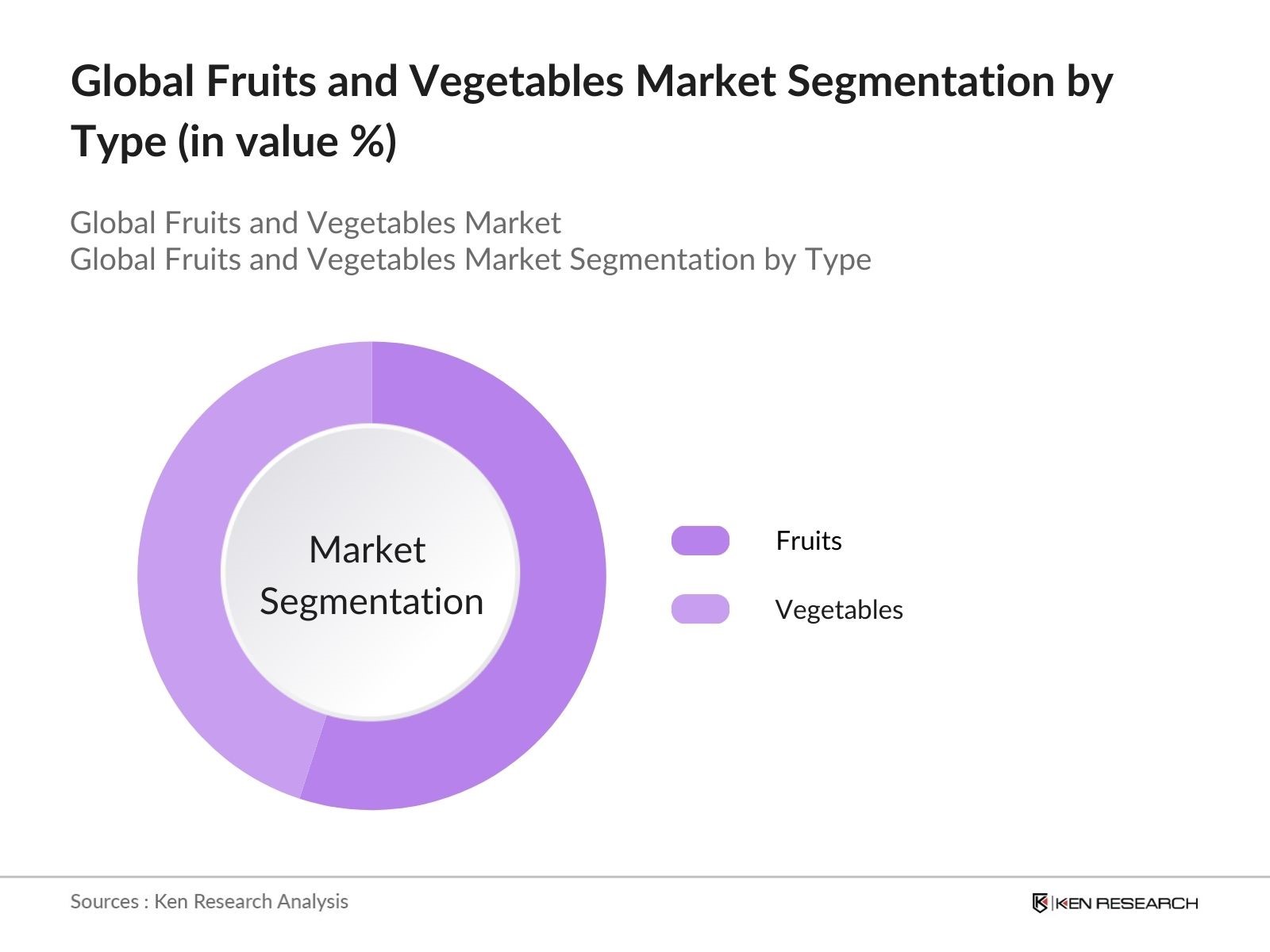
- By Type: The global fruits and vegetables market is segmented by type into fruits and vegetables. Fruits hold a dominant share due to the increasing consumption of fresh fruits like apples, bananas, berries, and citrus, largely driven by rising health consciousness and demand for nutrient-rich snacks. Fruits like apples and bananas are among the most consumed worldwide due to their affordability, convenience, and nutritional value. On the other hand, vegetables like leafy greens, cruciferous vegetables, and root vegetables are seeing growing demand, particularly in regions focusing on plant-based diets and healthier lifestyles.
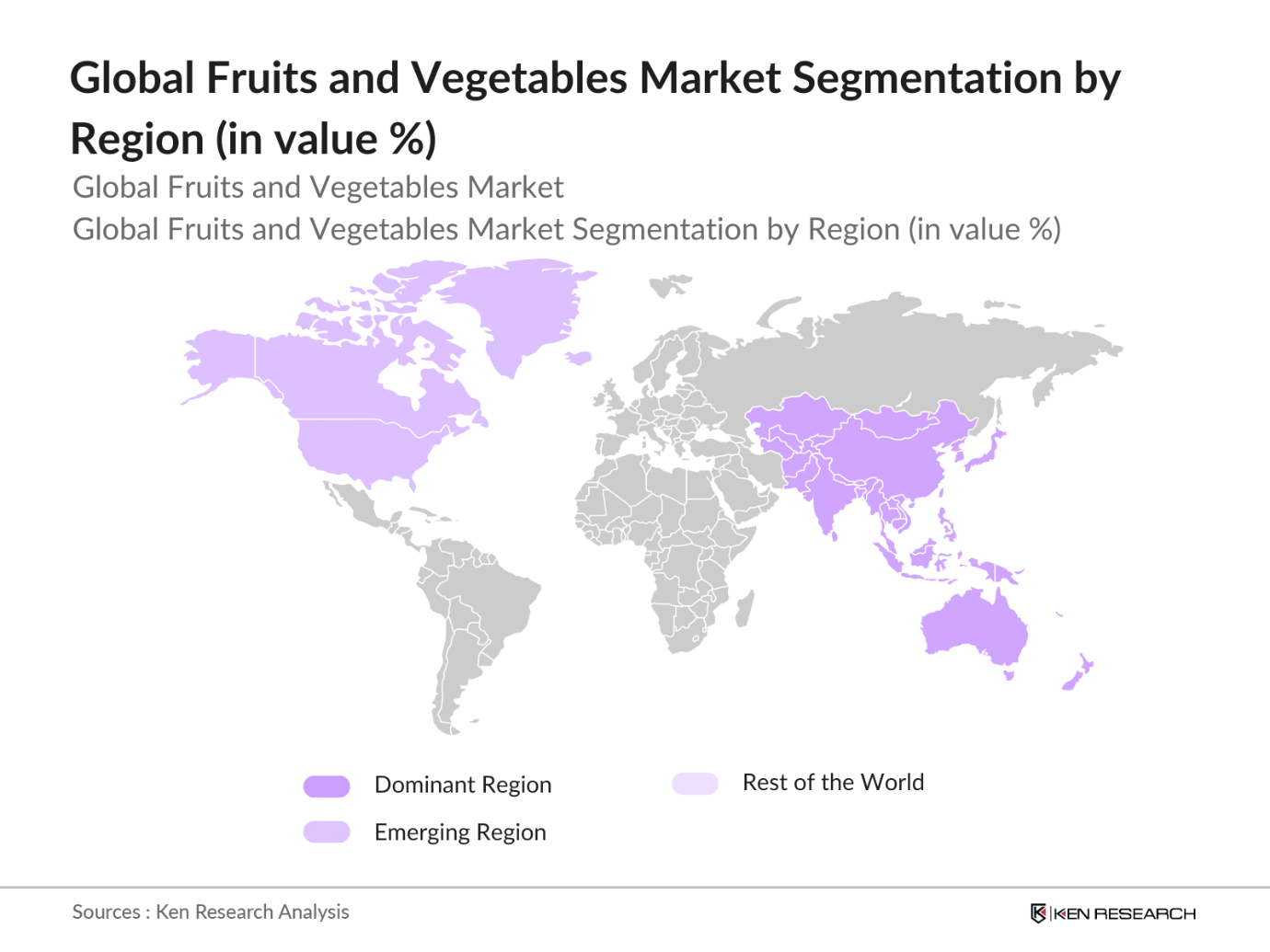
- By Region: Regionally, the market is segmented into North America, Europe, Asia-Pacific, Latin America, and the Middle East & Africa. Asia-Pacific holds the largest market share, driven by high demand in populous countries such as China and India. These countries have vast agricultural production bases and have seen significant investments in cold chain infrastructure, allowing for better quality control and extended shelf-life of fresh produce. North America and Europe follow due to their strong purchasing power, established supply chains, and growing consumer interest in organic produce.
- By Distribution Channel: The market is segmented by distribution channels into supermarkets & hypermarkets, convenience stores, online retailers, and farmer markets. Supermarkets and hypermarkets dominate the global market with a significant market share due to their vast distribution networks, ability to offer competitive pricing, and convenient access for consumers. These outlets also provide a wide variety of fresh produce, ensuring high turnover and availability of fresh fruits and vegetables. Online retailers are rapidly gaining traction, particularly in urban areas, as consumers value the convenience of home delivery and the ability to order a variety of products with ease.
Global Fruits and Vegetables Market Competitive Landscape
The global fruits and vegetables market is highly fragmented, with a mix of large multinational corporations and smaller local players. Large corporations like Dole Food Company, Fresh Del Monte Produce, and Greenyard have extensive distribution networks and advanced supply chain operations that allow them to dominate key regions globally. At the same time, local players in emerging markets play a significant role in fulfilling domestic demand, especially in countries like India and China, where smallholder farmers contribute a major portion of the supply.
|
Company |
Establishment Year |
Headquarters |
Revenue (USD Bn) |
No. of Employees |
Product Portfolio |
R&D Investment (USD Mn) |
Geographical Presence |
Sustainability Initiatives |
Export-Import Share |
|
Dole Food Company |
1851 |
Westlake Village, USA |
- |
- |
- |
- |
- |
- |
- |
|
Fresh Del Monte Produce |
1886 |
Coral Gables, USA |
|||||||
|
Greenyard |
1987 |
Sint-Katelijne-Waver, Belgium |
|||||||
|
Chiquita Brands International |
1870 |
Fort Lauderdale, USA |
|||||||
|
Bonduelle Group |
1853 |
Villeneuve-d'Ascq, France |
Global Fruits and Vegetables Industry Analysis
Growth Drivers
- Population Growth and Rising Demand for Fresh Produce: The global population is projected to reach nearly 8.5 billion in 2024, with higher demands for food supply, especially fresh produce like fruits and vegetables, to ensure food security and meet nutritional needs. As of 2023, the Asia-Pacific region, home to approximately 4.3 billion people, drives much of the global demand, with countries like India and China producing and consuming vast quantities of fruits and vegetables. Rising disposable incomes and urbanization are further boosting the need for fresh produce, particularly in emerging economies, which are focusing on enhancing agricultural outputs to cater to local and global markets
- Increasing Health Consciousness: Health concerns have spurred an increased preference for fresh and organic produce globally. In 2024, growing awareness about the benefits of a plant-based diet, which supports better heart health and reduces the risk of diseases like obesity, has significantly influenced consumption patterns. The United States, for example, saw a substantial increase in the consumption of fresh fruits and vegetables, with the market recording a revenue of $98.4 billion in 2023. The trend is further supported by a global push towards consuming more nutrient-rich foods
- Technological Advancements in Agriculture (Precision Farming, Hydroponics): The adoption of advanced agricultural practices, such as precision farming and hydroponics, is transforming the fruits and vegetables sector. Precision farming helps optimize resource use, while hydroponics and vertical farming allow for the year-round cultivation of produce. These methods have been widely adopted in the Asia-Pacific region, particularly in China and Japan, where space constraints have pushed innovation. Government subsidies and programs supporting these technologies have further accelerated their adoption.
Market Restraints
- Climate Change and Unpredictable Weather Patterns: Unpredictable weather patterns, exacerbated by climate change, have posed significant challenges to global fruit and vegetable production. In 2024, rising temperatures, droughts, and floods have disrupted supply chains, particularly in regions like Sub-Saharan Africa and Southeast Asia, where agriculture is heavily dependent on consistent weather. The adverse impacts of climate change are predicted to reduce agricultural productivity, leading to increased food insecurity in vulnerable regions
- Supply Chain Disruptions: The global fruits and vegetables market faces persistent supply chain challenges. In 2023, logistics disruptions, exacerbated by events like the COVID-19 pandemic, severely impacted the movement of fresh produce. These disruptions have led to increased food wastage and higher transportation costs, particularly in regions with underdeveloped infrastructure. Continued geopolitical tensions and trade restrictions have also compounded supply chain issues.
Global Fruits and Vegetables Market Future Outlook
Over the next five years, the global fruits and vegetables market is expected to experience steady growth, driven by increasing demand for organic produce, rising health consciousness, and the expansion of e-commerce platforms. Consumers are increasingly focused on sourcing fresh, high-quality fruits and vegetables that support a healthy diet, which is likely to stimulate innovations in farming, storage, and packaging solutions. Additionally, the adoption of vertical and hydroponic farming techniques is expected to play a significant role in meeting the growing demand for fresh produce, especially in urban areas.
Market Opportunities
- Growth of Organic Farming Practices: The shift towards organic farming practices presents significant growth opportunities for the global fruits and vegetables market. In 2023, the organic produce segment saw substantial growth, particularly in developed regions like Europe and North America, where consumer demand for pesticide-free and sustainably grown fruits and vegetables is high. Government initiatives supporting organic farming in countries like India and Germany have further boosted the sector
- Innovation in Packaging and Cold Chain Logistics: Advancements in cold chain logistics and innovative packaging solutions have helped extend the shelf life of fruits and vegetables, reducing waste and ensuring quality during transportation. As of 2023, global companies have increasingly adopted vacuum packaging and biodegradable materials, particularly for export markets. Cold chain logistics in Asia-Pacific and Latin America are rapidly expanding to meet international food safety standards.
Scope of the Report
|
By Type |
Fruits (Apples, Bananas, Berries, Citrus) |
|
Vegetables (Leafy Greens, Root Vegetables, Cruciferous) |
|
|
By Distribution Channel |
Supermarkets & Hypermarkets |
|
Convenience Stores |
|
|
Online Retailers |
|
|
Farmer Markets |
|
|
By Farming Method |
Organic Farming |
|
Conventional Farming |
|
|
By End-User |
Household |
|
Food Processing Industry |
|
|
Hospitality and Catering |
|
|
By Region |
North America |
|
Europe |
|
|
Asia-Pacific |
|
|
Latin America |
|
|
Middle East & Africa |
Products
Key Target Audience
Investors and Venture Capitalist Firms
Food and Agriculture Departments (USDA, FAO)
Retail Chains and Supermarkets
Exporters and Importers
Organic Farming Organizations
Government and Regulatory Bodies (EFSA, FDA)
Food Processing Companies
Cold Chain and Logistics Providers
Companies
Players Mentioned in the Report:
Dole Food Company
Fresh Del Monte Produce Inc.
Greenyard
The Kraft Heinz Company
General Mills Inc.
Danone S.A.
Bayer AG
Syngenta AG
Bonduelle Group
Sunkist Growers
Chiquita Brands International
Nature's Pride
Hain Celestial Group
Univeg Group
Total Produce
Table of Contents
1. Global Fruits and Vegetables Market Overview
1.1. Definition and Scope
1.2. Market Taxonomy
1.3. Market Growth Rate
1.4. Market Segmentation Overview
2. Global Fruits and Vegetables Market Size (In USD Bn)
2.1. Historical Market Size
2.2. Year-On-Year Growth Analysis
2.3. Key Market Developments and Milestones
3. Global Fruits and Vegetables Market Analysis
3.1. Growth Drivers
3.1.1. Population Growth and Rising Demand for Fresh Produce
3.1.2. Increasing Health Consciousness
3.1.3. Technological Advancements in Agriculture (Precision farming, hydroponics)
3.1.4. Expansion of Retail and Distribution Networks
3.2. Market Challenges
3.2.1. Climate Change and Unpredictable Weather Patterns
3.2.2. Supply Chain Disruptions
3.2.3. Rising Costs of Fertilizers and Pesticides
3.3. Opportunities
3.3.1. Growth of Organic Farming Practices
3.3.2. Innovation in Packaging and Cold Chain Logistics
3.3.3. Increasing Demand in Emerging Markets
3.4. Trends
3.4.1. Demand for Organic and Non-GMO Produce
3.4.2. Farm-to-Table Initiatives and Local Sourcing
3.4.3. Growing Interest in Vertical Farming
3.5. Government Regulations
3.5.1. Food Safety Regulations
3.5.2. Import-Export Tariffs
3.5.3. Subsidies for Sustainable Agriculture Practices
3.5.4. Water Usage and Irrigation Policies
3.6. SWOT Analysis
3.7. Stake Ecosystem (Farmers, Distributors, Retailers)
3.8. Porters Five Forces
3.8.1. Bargaining Power of Suppliers
3.8.2. Bargaining Power of Buyers
3.8.3. Threat of Substitutes
3.8.4. Threat of New Entrants
3.8.5. Competitive Rivalry
3.9. Competition Ecosystem
4. Global Fruits and Vegetables Market Segmentation
4.1. By Type (In Value %)
4.1.1. Fruits (Apples, Bananas, Berries, Citrus)
4.1.2. Vegetables (Leafy Greens, Root Vegetables, Cruciferous)
4.2. By Distribution Channel (In Value %)
4.2.1. Supermarkets & Hypermarkets
4.2.2. Convenience Stores
4.2.3. Online Retailers
4.2.4. Farmer Markets
4.3. By Farming Method (In Value %)
4.3.1. Organic Farming
4.3.2. Conventional Farming
4.4. By End-User (In Value %)
4.4.1. Household
4.4.2. Food Processing Industry
4.4.3. Hospitality and Catering
4.5. By Region (In Value %)
4.5.1. North America
4.5.2. Europe
4.5.3. Asia-Pacific
4.5.4. Latin America
4.5.5. Middle East & Africa
5. Global Fruits and Vegetables Market Competitive Analysis
5.1. Detailed Profiles of Major Companies
5.1.1. Dole Food Company
5.1.2. Fresh Del Monte Produce Inc.
5.1.3. Greenyard
5.1.4. The Kraft Heinz Company
5.1.5. General Mills Inc.
5.1.6. Danone S.A.
5.1.7. Bayer AG
5.1.8. Syngenta AG
5.1.9. Bonduelle Group
5.1.10. Sunkist Growers
5.1.11. Chiquita Brands International
5.1.12. Nature's Pride
5.1.13. Hain Celestial Group
5.1.14. Univeg Group
5.1.15. Total Produce
5.2. Cross Comparison Parameters (Revenue, Product Portfolio, Geographical Presence, Sustainability Initiatives, No. of Employees, R&D Expenditure, Operational Capacity, Export-Import Share)
5.3. Market Share Analysis
5.4. Strategic Initiatives
5.5. Mergers and Acquisitions
5.6. Investment Analysis
5.7. Venture Capital Funding
5.8. Government Grants
5.9. Private Equity Investments
6. Global Fruits and Vegetables Market Regulatory Framework
6.1. Food Safety Regulations
6.2. Organic Certification Requirements
6.3. Import-Export Compliance
6.4. Pesticide and Fertilizer Usage Regulations
7. Global Fruits and Vegetables Market Future Size (In USD Bn)
7.1. Future Market Size Projections
7.2. Key Factors Driving Future Market Growth
8. Global Fruits and Vegetables Market Future Segmentation
8.1. By Type (In Value %)
8.2. By Distribution Channel (In Value %)
8.3. By Farming Method (In Value %)
8.4. By End-User (In Value %)
8.5. By Region (In Value %)
9. Global Fruits and Vegetables Market Analysts Recommendations
9.1. TAM/SAM/SOM Analysis
9.2. Customer Cohort Analysis
9.3. Marketing Initiatives
9.4. White Space Opportunity Analysis
Research Methodology
Step 1: Identification of Key Variables
The first step involves creating a comprehensive ecosystem map of stakeholders in the global fruits and vegetables market. This includes detailed desk research utilizing various proprietary databases and secondary sources. The goal is to define and outline the key variables driving market performance, such as consumer demand patterns, production cycles, and technological advancements in agriculture.
Step 2: Market Analysis and Construction
Historical data is analyzed to determine the fruits and vegetables markets penetration, supply chain structures, and overall revenue generation. Detailed assessments of yield rates and market prices are conducted, focusing on key producing regions like Asia-Pacific and North America. This stage ensures the reliability and accuracy of growth projections.
Step 3: Hypothesis Validation and Expert Consultation
Market hypotheses are formulated and validated through expert interviews conducted via computer-assisted telephone interviews (CATIs). These industry insights, gathered from leading producers, retailers, and policymakers, help refine the research findings and align them with on-the-ground realities.
Step 4: Research Synthesis and Final Output
Final-stage research synthesizes data collected from multiple stakeholders, providing a comprehensive and detailed overview of the fruits and vegetables market. The statistics are corroborated through a bottom-up approach, ensuring the final report delivers accurate market insights.
Frequently Asked Questions
01. How big is the Global Fruits and Vegetables Market?
The global fruits and vegetables market is valued at USD 733.7 billion, driven by increased consumer demand for fresh produce, advancements in agricultural technologies, and enhanced distribution networks globally.
02. What challenges does the Global Fruits and Vegetables Market face?
The market faces challenges such as supply chain disruptions caused by unpredictable weather, high costs of inputs like fertilizers, and maintaining product freshness during transportation. Compliance with varying global food safety regulations also adds to operational complexity.
03. Who are the leading players in the Global Fruits and Vegetables Market?
Major players include Dole Food Company, Fresh Del Monte Produce, Greenyard, Bonduelle Group, and Chiquita Brands International. These companies have established extensive global networks, advanced supply chains, and strong brand recognition.
04. What drives the growth of the Global Fruits and Vegetables Market?
Growth is primarily driven by increasing health consciousness among consumers, rising demand for organic and non-GMO produce, and improved farming techniques like vertical and hydroponic farming that boost productivity and quality.
Why Buy From Us?

What makes us stand out is that our consultants follows Robust, Refine and Result (RRR) methodology. i.e. Robust for clear definitions, approaches and sanity checking, Refine for differentiating respondents facts and opinions and Result for presenting data with story

We have set a benchmark in the industry by offering our clients with syndicated and customized market research reports featuring coverage of entire market as well as meticulous research and analyst insights.

While we don't replace traditional research, we flip the method upside down. Our dual approach of Top Bottom & Bottom Top ensures quality deliverable by not just verifying company fundamentals but also looking at the sector and macroeconomic factors.

With one step in the future, our research team constantly tries to show you the bigger picture. We help with some of the tough questions you may encounter along the way: How is the industry positioned? Best marketing channel? KPI's of competitors? By aligning every element, we help maximize success.

Our report gives you instant access to the answers and sources that other companies might choose to hide. We elaborate each steps of research methodology we have used and showcase you the sample size to earn your trust.

If you need any support, we are here! We pride ourselves on universe strength, data quality, and quick, friendly, and professional service.