
Global Geospatial Analytics Market Report 2030
Region:Global
Author(s):Shivani Mehra
Product Code:KROD8210
Region:Global
Author(s):Shivani Mehra
Product Code:KROD8210
November 2024
89
By Type: The global geospatial analytics market is segmented by type into Geovisualization, Network & Location Analytics, and Surface & Field Analytics. Among these, Network & Location Analytics holds the dominant market share, primarily due to its application in optimizing supply chains, transportation logistics, and urban infrastructure planning. With the rising demand for precision in asset management and operations, companies across various sectors are increasingly adopting these analytics tools to enhance efficiency

By Region: The global geospatial analytics market is segmented by region into North America, Europe, Asia-Pacific, and the Rest of the World. North America holds a dominant position due to its advanced technological infrastructure and substantial investments in the defense sector, particularly in geospatial intelligence and surveillance. Meanwhile, Asia-Pacific is witnessing the fastest growth, driven by rapid urbanization and government-backed initiatives supporting smart city developments in countries like China and India.

The global geospatial analytics market is highly consolidated, with key players leveraging advancements in AI, machine learning, and cloud-based technologies. Major companies in the space focus on product innovation, partnerships, and mergers and acquisitions to maintain their competitive edge. Companies like ESRI and Hexagon AB lead the industry through their innovative mapping software and geospatial solutions
|
Company |
Establishment Year |
Headquarters |
Market Focus |
No. of Employees |
Key Innovation |
Revenue (USD Bn) |
Regional Focus |
Strategic Initiative |
|
ESRI |
1969 |
Redlands, USA |
- |
- |
- |
- |
- |
- |
|
Hexagon AB |
1992 |
Stockholm, Sweden |
- |
- |
- |
- |
- |
- |
|
Trimble Inc. |
1978 |
Sunnyvale, USA |
- |
- |
- |
- |
- |
- |
|
Bentley Systems |
1984 |
Exton, USA |
- |
- |
- |
- |
- |
- |
|
Fugro N.V. |
1962 |
Leidschendam, Netherlands |
- |
- |
- |
- |
- |
- |
Global Geospatial Analytics Market Challenges
Over the next five years, the global geospatial analytics market is poised to witness significant growth. The continuous evolution of AI, IoT, and big data technologies is expected to fuel demand, particularly in the sectors of smart cities, defense, and disaster management. The rise of 5G connectivity and the expansion of cloud-based platforms will further enhance the real-time application of geospatial data, leading to more precise decision-making processes for businesses and governments alike.
Market Opportunities:
|
By Type |
Geovisualization Network Analytics Surface Analysis Field Analytics |
|
By Technology |
GIS GPS Remote Sensing Other |
|
By Component |
Solutions Services Consulting Maintenance Deployment |
|
By Application |
Disaster Management Climate Adaptation Defense & Intelligence Urban Planning |
|
By Region |
North-East Midwest West Coast Southern States |
1.1 Definition and Scope
1.2 Market Taxonomy
1.3 Key Developments in Geospatial Analytics
2.1 Historical Market Size Analysis
2.2 Year-on-Year Growth
2.3 Key Milestones and Market Events
3.1 Growth Drivers
- Smart City Adoption (IoT Integration, Urban Planning)
- AI-based GIS Solutions
- IoT Sensors and Big Data Analytics
3.2 Market Restraints
- High Cost of Implementation
- Regulatory and Data Privacy Concerns
3.3 Opportunities
- Advancements in AR and VR
- 5G and Edge Computing Expansion
3.4 Market Challenges
- Lack of Skilled Workforce
- Limited Awareness of Geospatial Benefits
4.1 By Type (In Value %)
- Geovisualization
- Network & Location Analytics
- Surface & Field Analytics
4.2 By Technology (In Value %)
- GIS
- GPS
- Remote Sensing
- Other Technologies
4.3 By Component (In Value %)
- Solutions
- Services (Consulting, Deployment, Maintenance)
4.4 By Application (In Value %)
- Disaster Risk Reduction & Management
- Urban Planning
- Climate Change Adaptation
- Defense and Intelligence
4.5 By End-User Vertical (In Value %)
- Government
- BFSI
- Automotive & Transportation
- Energy & Utilities
- Agriculture
- Real Estate & Construction
5.1 Detailed Profiles of Major Companies
- ESRI
- Hexagon AB
- Trimble Inc.
- Google LLC
- Bentley Systems
- Fugro NV
- MDA LTD
- General Electric
- TomTom
- Alteryx Inc.
- Blue Marble Geographic
- Maxar Technologies
- RMSI
- Mapidea
- Sparkgeo
6.1 No. of Employees
6.2 Inception Year
6.3 Revenue
6.4 Market Share
6.5 Technological Innovations
6.6 Regional Dominance
6.7 Key Partnerships
6.8 Product Portfolio Diversification
7.1 Strengths
7.2 Weaknesses
7.3 Opportunities
7.4 Threats
8.1 Bargaining Power of Buyers
8.2 Bargaining Power of Suppliers
8.3 Threat of New Entrants
8.4 Threat of Substitutes
8.5 Industry Rivalry
9.1 Future Market Size Projections
9.2 Key Growth Drivers for Future
10.1 TAM/SAM/SOM Analysis
10.2 White Space Opportunity Identification
10.3 Marketing Initiatives for Expansion
We began by mapping out the key stakeholders and influencers in the geospatial analytics ecosystem. Our research relied on a combination of proprietary databases and secondary data sources to determine the most critical variables affecting market dynamics.
We then analyzed historical data on market penetration and service quality across various sectors. This involved studying the ratio of software adoption across regions and industries, which helped in assessing overall revenue generation and market demand.
Our team conducted expert interviews to validate the hypotheses formed during the analysis stage. These consultations provided insights into the operational strategies and challenges that industry leaders face, which were crucial for refining our data and projections.
In the final phase, we cross-referenced our data with multiple leading geospatial analytics companies. This step ensured the accuracy of our findings and provided a comprehensive overview of the market for this report.
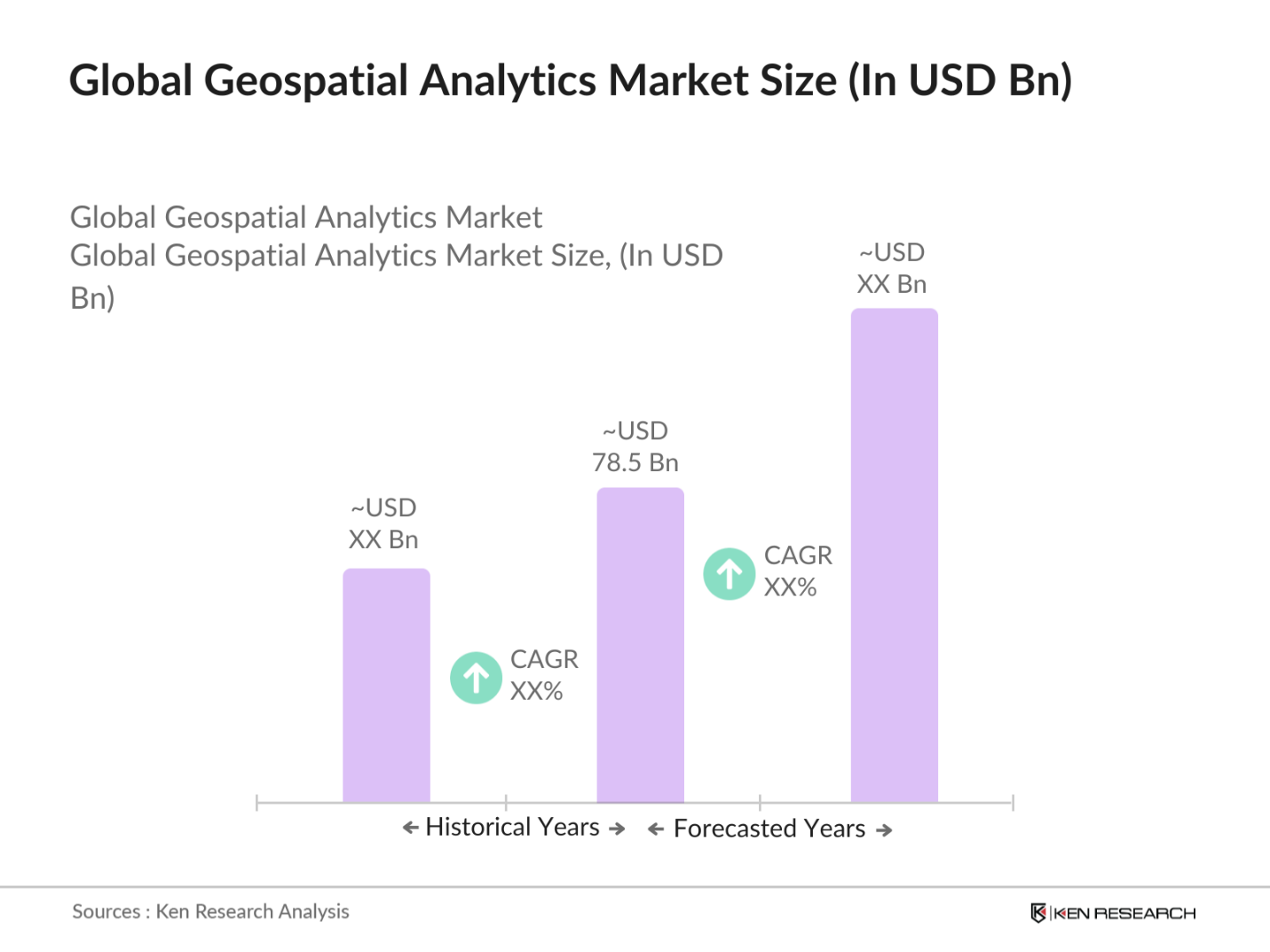
The global geospatial analytics market is valued at USD 78.5 billion, primarily driven by the increasing adoption of location-based services, AI integration, and the growing importance of data-driven decision-making across various sectors.
Key challenges include the high cost of implementing geospatial solutions, as well as legal and privacy concerns related to geospatial data collection and usage. Limited awareness of the benefits of these technologies also hampers market growth.
Key players include ESRI, Hexagon AB, Trimble Inc., Bentley Systems, and Fugro N.V. These companies dominate due to their robust product portfolios and focus on innovation.
The market is driven by the expansion of smart city initiatives, growing defense budgets, and the rise of real-time data analytics fueled by IoT and AI. The demand for geospatial data to support urban planning and disaster management is also on the rise.

What makes us stand out is that our consultants follows Robust, Refine and Result (RRR) methodology. i.e. Robust for clear definitions, approaches and sanity checking, Refine for differentiating respondents facts and opinions and Result for presenting data with story

We have set a benchmark in the industry by offering our clients with syndicated and customized market research reports featuring coverage of entire market as well as meticulous research and analyst insights.

While we don't replace traditional research, we flip the method upside down. Our dual approach of Top Bottom & Bottom Top ensures quality deliverable by not just verifying company fundamentals but also looking at the sector and macroeconomic factors.

With one step in the future, our research team constantly tries to show you the bigger picture. We help with some of the tough questions you may encounter along the way: How is the industry positioned? Best marketing channel? KPI's of competitors? By aligning every element, we help maximize success.

Our report gives you instant access to the answers and sources that other companies might choose to hide. We elaborate each steps of research methodology we have used and showcase you the sample size to earn your trust.

If you need any support, we are here! We pride ourselves on universe strength, data quality, and quick, friendly, and professional service.