















Global Gesture Recognition Technology Market Outlook to 2030
Region:Global
Author(s):Paribhasha Tiwari
Product Code:KROD2757
October 2024
87
About the Report
Global Gesture Recognition Technology Market Overview
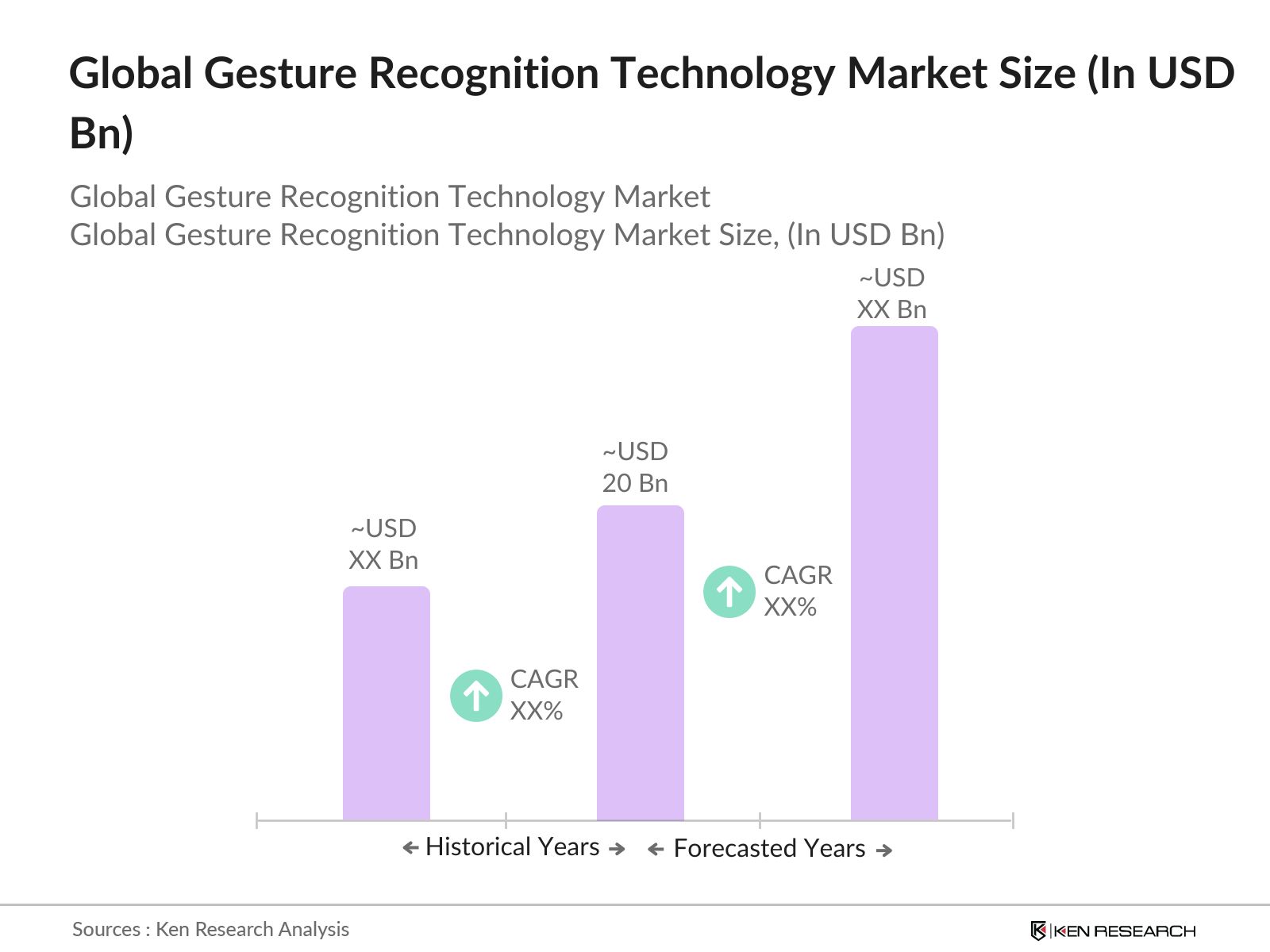
- The Global Gesture Recognition Technology market is valued at USD 20 billion, driven by the increasing adoption of advanced touchless technology across various sectors, particularly in automotive, consumer electronics, and healthcare. The demand for natural user interfaces, which enable interaction without physical touch, is fostering growth in this market. This trend is being accelerated by advancements in AI and machine learning technologies, enhancing the accuracy and responsiveness of gesture recognition systems. Additionally, the growing integration of gesture recognition technology in smart devices, home automation systems, and AR/VR platforms is further fueling market expansion.
- Countries such as the United States, China, and Germany dominate the gesture recognition market. The United States leads due to its strong presence in the technology sector, especially in AI and sensor technology, while Chinas dominance stems from its rapidly growing consumer electronics and automotive industries. Germany holds a significant share due to the high adoption of gesture recognition in automotive manufacturing, driven by its leadership in luxury vehicle production.
- Continuous improvements in sensor technologies, artificial intelligence (AI), and machine learning (ML) algorithms are enhancing the accuracy and reliability of gesture recognition systems. These advancements facilitate a more intuitive interaction between humans and machines, making gesture recognition increasingly popular in sectors like gaming, healthcare, and consumer electronics.
Global Gesture Recognition Technology Market Segmentation
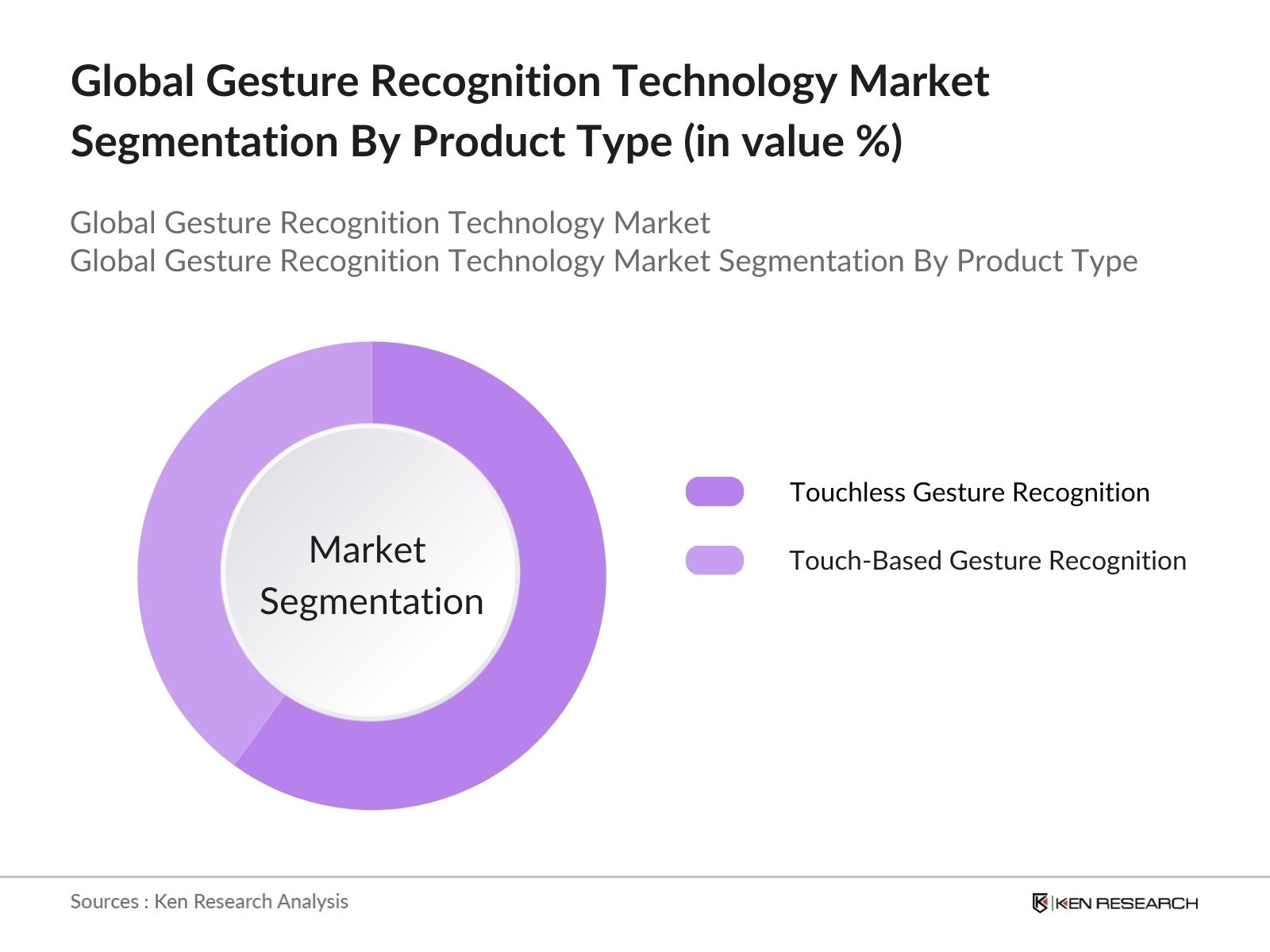
By Product Type: The gesture recognition technology market is segmented by product type into touch-based and touchless gesture recognition. Touchless gesture recognition dominates the market as industries seek more hygienic and intuitive interaction methods. This trend is especially prevalent in healthcare and consumer electronics, where touchless controls are increasingly integrated into smart devices, such as smart TVs and smartphones, to enhance user convenience. The adoption of touchless technology in automotive applications, like infotainment systems and driver assistance controls, also contributes to its dominance in this segment.
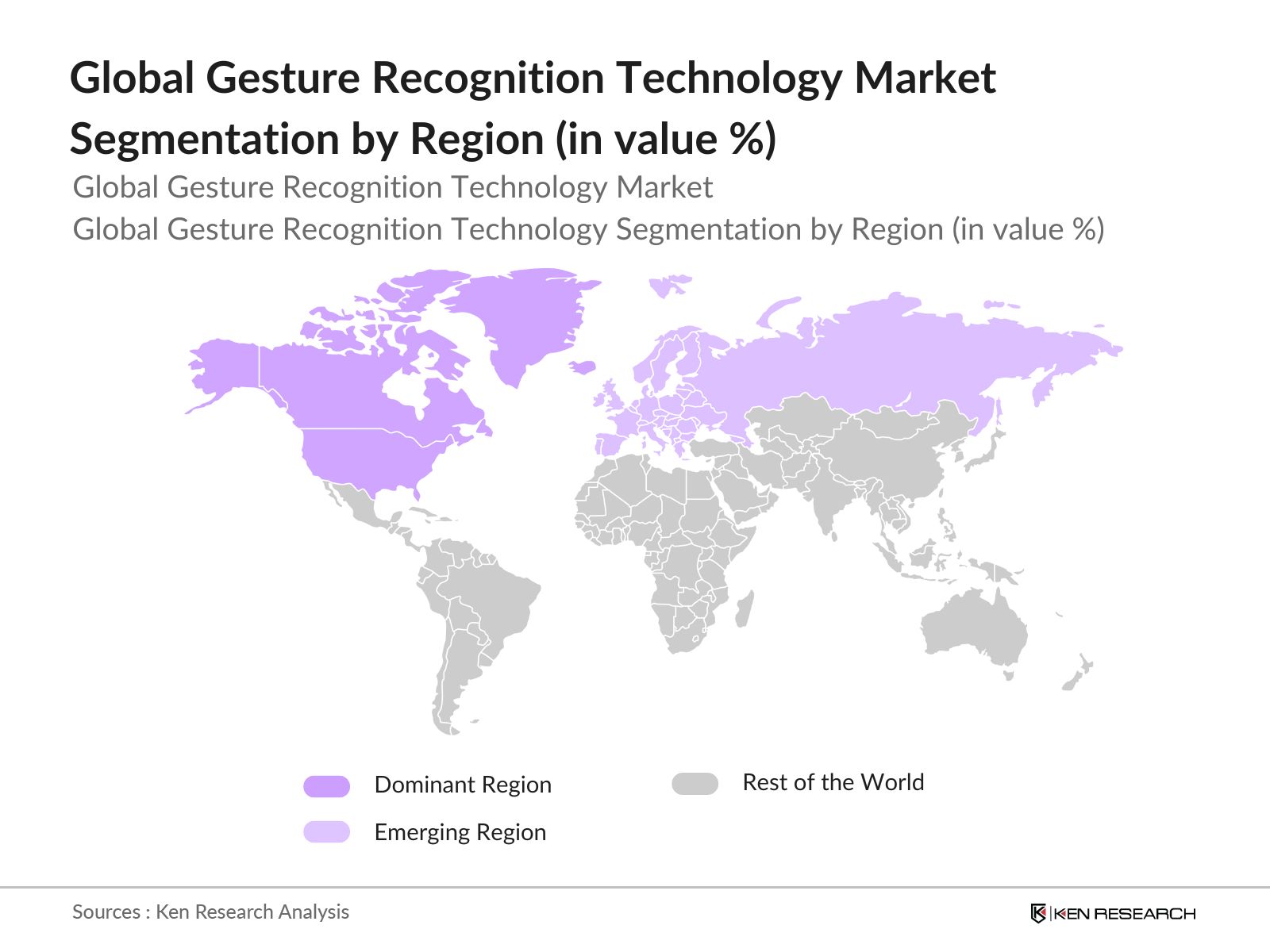
By Region: Regionally, the gesture recognition technology market is divided into North America, Europe, Asia Pacific, Latin America, and the Middle East & Africa. The market is led by North America, which holds the largest share due to the strong presence of major tech companies, widespread consumer adoption of advanced technologies, and substantial investment in research and development. The region's leadership in innovation and the integration of cutting-edge solutions into various industries have solidified its dominance in the market.
Global Gesture Recognition Technology Market Competitive Landscape
The Global Gesture Recognition Technology market is highly competitive, with both established companies and startups contributing to the development and commercialization of new technologies. The market is dominated by several key players that are driving innovation through partnerships, mergers, and significant investments in R&D.
|
Company Name |
Establishment Year |
Headquarters |
Revenue (2023) |
R&D Investment |
Product Portfolio |
Market Share |
Patent Holdings |
Global Presence |
|
Apple Inc. |
1976 |
Cupertino, USA |
||||||
|
Microsoft Corporation |
1975 |
Redmond, USA |
||||||
|
Google LLC |
1998 |
Mountain View, USA |
||||||
|
Intel Corporation |
1968 |
Santa Clara, USA |
||||||
|
Sony Corporation |
1946 |
Tokyo, Japan |
Global Gesture Recognition Technology Market Analysis
Growth Drivers
- Increasing Adoption of AI and ML (in automation, IoT): Artificial Intelligence (AI) and Machine Learning (ML) have become integral to gesture recognition systems, with countries like the United States and China leading the charge in automation. In 2024, investments in AI technology by governments are significant, with the U.S. government alone committing $1.5 billion for AI and IoT projects, driving demand for gesture recognition in sectors such as automotive and home automation. As per a 2023 report by the World Economic Forum, automation in manufacturing has risen to 34% globally, with IoT-connected devices expected to reach 50 billion by the end of 2025.
- Rising Demand for Touchless Interaction (in consumer electronics, automotive): The demand for touchless interaction technologies has surged due to the increased focus on hygiene, especially after the COVID-19 pandemic. In 2023, the global touchless technology adoption in consumer electronics grew by 40%, with a significant rise in automotive applications. According to the World Bank, touchless technology in automotive, particularly in Europe and North America, accounted for $750 million in investments in 2023, with many luxury car brands integrating gesture-based infotainment systems.
- Expansion of Augmented Reality and Virtual Reality (AR/VR in gaming, healthcare): The integration of gesture recognition with AR/VR is gaining momentum, especially in gaming and healthcare. In 2024, the U.S. healthcare industry allocated $2.1 billion for AR/VR applications to improve patient engagement and surgical precision, a 20% increase compared to 2022. The World Bank noted that gaming, a $300 billion industry in 2023, has seen increased adoption of gesture recognition for immersive experiences, particularly in North America and Asia. The increased usage of AR/VR in healthcare is further pushing the demand for gesture recognition technology, especially in rehabilitation and remote consultations.
Challenges
- High Development and Implementation Costs: The development and deployment of gesture recognition technology remain costly, especially in sectors like automotive and healthcare. According to the World Bank, companies investing in AI-driven gesture recognition faced an average cost of $350,000 per project in 2023. This has limited its widespread adoption, particularly in developing countries, where budgets for technology integration are more constrained. Additionally, the ongoing semiconductor shortage has driven up costs for the essential components of gesture recognition systems, further impacting implementation in 2024
- Limited Integration Across Legacy Systems: Integrating gesture recognition technology into legacy systems is another significant challenge, particularly in industrial settings. According to the International Monetary Fund (IMF), industries relying on older infrastructure face $50 billion in upgrade costs worldwide. In 2023, approximately 65% of U.S. manufacturing firms reported difficulties integrating new gesture-based systems with legacy machinery, leading to productivity losses estimated at $12 billion. This gap between new technologies and legacy systems slows the adoption of gesture recognition, especially in large-scale industries like manufacturing and healthcare.
Global Gesture Recognition Technology Market Future Outlook
Over the next five years, the global gesture recognition technology market is expected to experience significant growth driven by continuous advancements in artificial intelligence, machine learning, and sensor technologies. The growing demand for touchless interaction, particularly in sectors such as automotive, consumer electronics, and healthcare, will be a major growth driver. Additionally, as the world transitions towards smart cities and homes, the integration of gesture-based interfaces in smart devices and automation systems will accelerate. The convergence of gesture recognition with augmented reality (AR) and virtual reality (VR) platforms will also open up new opportunities for this technology. As businesses and consumers increasingly seek immersive and intuitive experiences, the role of gesture recognition in these applications will expand, further boosting the markets growth prospects.
Market Opportunities
-
Collaboration with OEMs (Original Equipment Manufacturers): Collaborating with OEMs is a key opportunity for gesture recognition technology developers to scale their innovations. In 2024, the automotive sector invested $18 billion in partnerships with OEMs to integrate gesture control into vehicles. In Japan, companies like Toyota and Honda expanded their collaboration with technology firms, aiming to introduce gesture-based controls across all models by 2025. Such collaborations allow gesture recognition companies to tap into the growing demand for advanced driver-assistance systems (ADAS), which reached $32 billion in investments in 2023.
- Advances in Gesture-Based Wearables and Smart Glasses: Wearables and smart glasses incorporating gesture recognition represent a growing opportunity in healthcare and industrial applications. According to the World Bank, the global wearables market expanded to 1.1 billion devices in 2023, with a significant portion including gesture control features. In healthcare, gesture-based wearables are being used to monitor patient vitals and assist in surgeries, with $3 billion in investments allocated for these technologies in 2024. The industrial sector has also seen a rise in the use of gesture-based smart glasses for maintenance and field operations, especially in Europe and the U.S.
Scope of the Report
|
Category |
Subcategory |
|
Product Type |
Touch-Based Gesture Recognition |
|
Touchless Gesture Recognition |
|
|
Technology |
Sensor-Based Gesture Recognition |
|
- Ultrasonic |
|
|
- Infrared |
|
|
- Capacitive Sensors |
|
|
Camera-Based Gesture Recognition |
|
|
Machine Learning and Neural Networks |
|
|
Application |
AR/VR Interaction |
|
User Authentication |
|
|
Smart Wearables |
|
|
Human-Machine Interface (HMI) |
|
|
Smart Home Controls |
|
|
End-User Industry |
Automotive |
|
Consumer Electronics |
|
|
- Smartphones |
|
|
- Gaming Consoles |
|
|
- Smart TVs |
|
|
Healthcare |
|
|
- Rehabilitation |
|
|
- Surgery Assistance |
|
|
Industrial |
|
|
- Robotics |
|
|
- Automation |
|
|
Smart Homes |
|
|
Region |
North America |
|
Europe |
|
|
Asia Pacific |
|
|
Latin America |
|
|
Middle East and Africa |
Products
Key Target Audience
Automotive Manufacturers
Consumer Electronics Manufacturers
Smart Device Manufacturers
Healthcare Technology Companies
Investments and Venture Capitalist Firms
Government and Regulatory Bodies (e.g., FCC, European Union Regulatory Authorities)
AI and Sensor Technology Providers
Wearable Device Companies
Companies
Players mentioned in the report:
- Apple Inc.
- Microsoft Corporation
- Google LLC
- Intel Corporation
- Sony Corporation
- Qualcomm Technologies Inc.
- Infineon Technologies AG
- Synaptics Incorporated
- Microchip Technology Inc.
- GestureTek
- Cognitec Systems GmbH
- Elliptic Labs
- XYZ Interactive Technologies
- PointGrab Ltd.
- Ultrahaptics Ltd.
Table of Contents
1. Global Gesture Recognition Technology Market Overview
1.1. Definition and Scope
1.2. Market Taxonomy
1.3. Market Growth Rate
1.4. Market Segmentation Overview
2. Global Gesture Recognition Technology Market Size (In USD Bn)
2.1. Historical Market Size
2.2. Year-On-Year Growth Analysis
2.3. Key Market Developments and Milestones
3. Global Gesture Recognition Technology Market Analysis
3.1. Growth Drivers
3.1.1. Increasing Adoption of AI and ML (in automation, IoT)
3.1.2. Rising Demand for Touchless Interaction (in consumer electronics, automotive)
3.1.3. Expansion of Augmented Reality and Virtual Reality (AR/VR in gaming, healthcare)
3.1.4. Growth of Smart Home and Smart City Projects
3.2. Market Challenges
3.2.1. High Development and Implementation Costs
3.2.2. Limited Integration Across Legacy Systems
3.2.3. Data Privacy and Security Concerns (GDPR, cybersecurity)
3.3. Opportunities
3.3.1. Collaboration with OEMs (Original Equipment Manufacturers)
3.3.2. Advances in Gesture-Based Wearables and Smart Glasses
3.3.3. Expansion of Gesture Technology in Healthcare and Industrial Robotics
3.4. Trends
3.4.1. Increasing Integration with IoT Devices
3.4.2. Development of 3D Gesture Recognition Systems
3.4.3. Rise of Gesture-Based AR/VR Interfaces
3.5. Government Regulation
3.5.1. Privacy Standards (GDPR, HIPAA)
3.5.2. Industry-Specific Regulations (Healthcare, Automotive)
3.5.3. Government Initiatives for Technological Adoption
3.6. SWOT Analysis
3.7. Stakeholder Ecosystem
3.8. Porter’s Five Forces
3.9. Competitive Landscape
4. Global Gesture Recognition Technology Market Segmentation
4.1. By Product Type (In Value %)
4.1.1. Touch-Based Gesture Recognition
4.1.2. Touchless Gesture Recognition
4.2. By Technology (In Value %)
4.2.1. Sensor-Based Gesture Recognition (Ultrasonic, Infrared, Capacitive Sensors)
4.2.2. Camera-Based Gesture Recognition
4.2.3. Machine Learning and Neural Networks
4.3. By End-Use Industry (In Value %)
4.3.1. Automotive
4.3.2. Consumer Electronics (Smartphones, Gaming Consoles, Smart TVs)
4.3.3. Healthcare (Rehabilitation, Surgery Assistance)
4.3.4. Industrial (Robotics, Automation)
4.3.5. Smart Homes
4.4. By Application (In Value %)
4.4.1. AR/VR Interaction
4.4.2. User Authentication
4.4.3. Smart Wearables
4.4.4. Human-Machine Interface (HMI)
4.4.5. Smart Home Controls
4.5. By Region (In Value %)
4.5.1. North America
4.5.2. Europe
4.5.3. Asia Pacific
4.5.4. Latin America
4.5.5. Middle East and Africa
5. Global Gesture Recognition Technology Market Competitive Analysis
5.1. Detailed Profiles of Major Companies
5.1.1. Apple Inc.
5.1.2. Microsoft Corporation
5.1.3. Google LLC
5.1.4. Intel Corporation
5.1.5. Qualcomm Technologies Inc.
5.1.6. Sony Corporation
5.1.7. Infineon Technologies AG
5.1.8. Synaptics Incorporated
5.1.9. Microchip Technology Inc.
5.1.10. GestureTek
5.1.11. Cognitec Systems GmbH
5.1.12. Elliptic Labs
5.1.13. XYZ Interactive Technologies
5.1.14. PointGrab Ltd.
5.1.15. Ultrahaptics Ltd.
5.2. Cross Comparison Parameters (Revenue, Market Share, R&D Investments, Product Portfolio, Patent Holdings, Mergers and Acquisitions, Partnerships)
5.3. Market Share Analysis
5.4. Strategic Initiatives
5.5. Mergers and Acquisitions
5.6. Investment Analysis
5.7. Venture Capital Funding
5.8. Government Grants
5.9. Private Equity Investments
6. Global Gesture Recognition Technology Market Regulatory Framework
6.1. Data Privacy Laws and Compliance (GDPR, CCPA)
6.2. Certification and Safety Standards (ISO, IEC)
6.3. Industry-Specific Regulations (Healthcare, Automotive, Consumer Electronics)
7. Global Gesture Recognition Technology Future Market Size (In USD Bn)
7.1. Future Market Size Projections
7.2. Key Factors Driving Future Market Growth
8. Global Gesture Recognition Technology Future Market Segmentation
8.1. By Product Type (In Value %)
8.2. By Technology (In Value %)
8.3. By End-Use Industry (In Value %)
8.4. By Application (In Value %)
8.5. By Region (In Value %)
9. Global Gesture Recognition Technology Market Analysts Recommendations
9.1. TAM/SAM/SOM Analysis
9.2. Customer Cohort Analysis
9.3. Marketing Initiatives
9.4. White Space Opportunity Analysis
Disclaimer
Contact Us
Research Methodology
Step 1: Identification of Key Variables
The first step involved identifying critical variables influencing the global gesture recognition technology market, such as technological advancements, adoption trends, and regulatory factors. This phase utilized extensive desk research from proprietary databases and secondary sources, including company reports, press releases, and industry journals.
Step 2: Market Analysis and Construction
In this phase, historical data regarding market size, penetration rates, and product adoption across various regions and industries were analyzed. The gathered data were then evaluated to estimate revenue generation and project future growth. Market penetration in automotive and consumer electronics industries was a key focus.
Step 3: Hypothesis Validation and Expert Consultation
Market hypotheses were developed and validated through expert consultations. Industry professionals, including technology developers, market analysts, and key stakeholders from top companies, were interviewed via computer-assisted telephone interviews (CATI). These insights were instrumental in refining the market forecast and validating the gathered data.
Step 4: Research Synthesis and Final Output
In the final stage, insights from industry consultations and data analysis were synthesized to develop the final report. Key metrics such as product segment performance, market dynamics, and consumer preferences were cross-verified to ensure the accuracy of the analysis. The report was then finalized with a comprehensive outlook on market opportunities and challenges.
Frequently Asked Questions
01. How big is the Global Gesture Recognition Technology Market?
The global gesture recognition technology market is valued at USD 20 billion, driven by the increasing integration of AI and touchless interaction in various sectors such as automotive, healthcare, and consumer electronics.
02. What are the challenges in the Global Gesture Recognition Technology Market?
Key challenges in the global gesture recognition technology market include high development costs, limited compatibility with legacy systems, and concerns over data privacy and security. The slow pace of regulatory approval for new applications also poses a barrier to rapid market growth.
03. Who are the major players in the Global Gesture Recognition Technology Market?
Major players in the global gesture recognition technology market include Apple Inc., Microsoft Corporation, Google LLC, Intel Corporation, and Sony Corporation, dominating due to their strong R&D investments and product innovation.
04. What are the growth drivers of the Global Gesture Recognition Technology Market?
The Global gesture recognition technology market is primarily driven by advancements in artificial intelligence, increasing demand for touchless technology, and the growing adoption of gesture recognition in smart homes, automotive, and healthcare industries.
Why Buy From Us?

What makes us stand out is that our consultants follows Robust, Refine and Result (RRR) methodology. i.e. Robust for clear definitions, approaches and sanity checking, Refine for differentiating respondents facts and opinions and Result for presenting data with story

We have set a benchmark in the industry by offering our clients with syndicated and customized market research reports featuring coverage of entire market as well as meticulous research and analyst insights.

While we don't replace traditional research, we flip the method upside down. Our dual approach of Top Bottom & Bottom Top ensures quality deliverable by not just verifying company fundamentals but also looking at the sector and macroeconomic factors.

With one step in the future, our research team constantly tries to show you the bigger picture. We help with some of the tough questions you may encounter along the way: How is the industry positioned? Best marketing channel? KPI's of competitors? By aligning every element, we help maximize success.

Our report gives you instant access to the answers and sources that other companies might choose to hide. We elaborate each steps of research methodology we have used and showcase you the sample size to earn your trust.

If you need any support, we are here! We pride ourselves on universe strength, data quality, and quick, friendly, and professional service.