
Global Glycine Market Outlook 2030
Region:Global
Author(s):Shivani Mehra
Product Code:KROD6237
November 2024
85
About the Report
Global Glycine Market Overview
- The global glycine market is valued at USD 5010.05 billion, driven by its increasing demand across various industries such as pharmaceuticals, animal feed, and food and beverages. Glycine's key role as an amino acid in protein synthesis and its widespread use as a nutritional supplement, feed additive, and chemical intermediate have propelled its growth. The markets expansion is further supported by advancements in bio-based production techniques, especially in the pharmaceutical and functional food sectors, which are anticipated to boost demand across the globe.
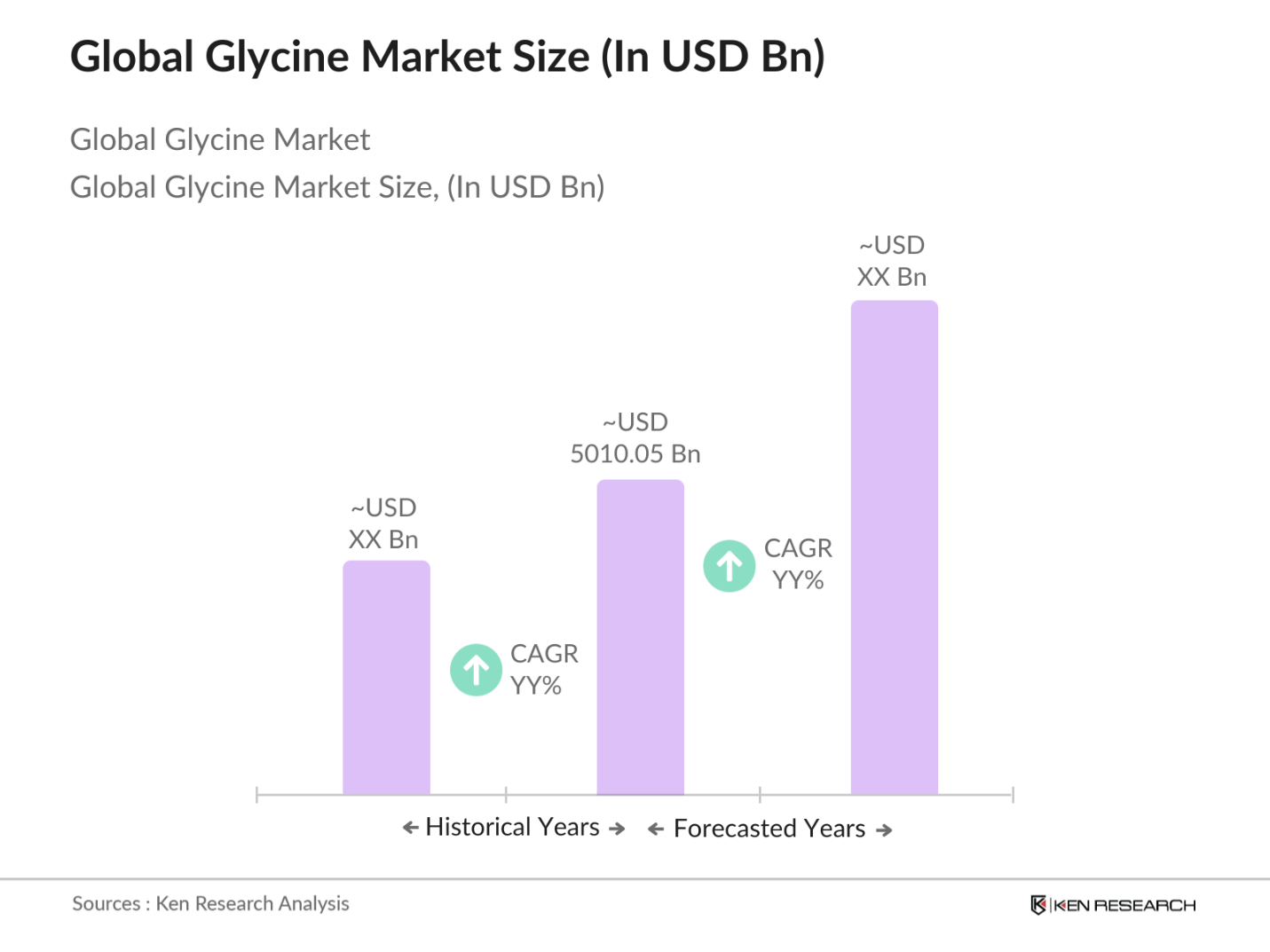
- China and the United States dominate the global glycine market due to their robust chemical manufacturing sectors, pharmaceutical industries, and significant livestock production, which requires glycine in feed formulations. China's extensive industrial base and cost-efficient production processes enable it to remain a top glycine producer and exporter. Meanwhile, the United States benefits from high investments in research and development, as well as stringent quality control standards, which enhance its leadership in pharmaceutical and high-grade glycine production.
- The international regulatory landscape for glycine is governed by bodies such as Codex Alimentarius, which sets food safety standards. The World Health Organization reports that over 180 countries adhere to these standards, impacting glycine usage in pharmaceuticals, food additives, and animal feed. Regulatory bodies continue to update these standards, with new guidelines expected in 2023 to address safety concerns and environmental impacts.
Global Glycine Market Segmentation
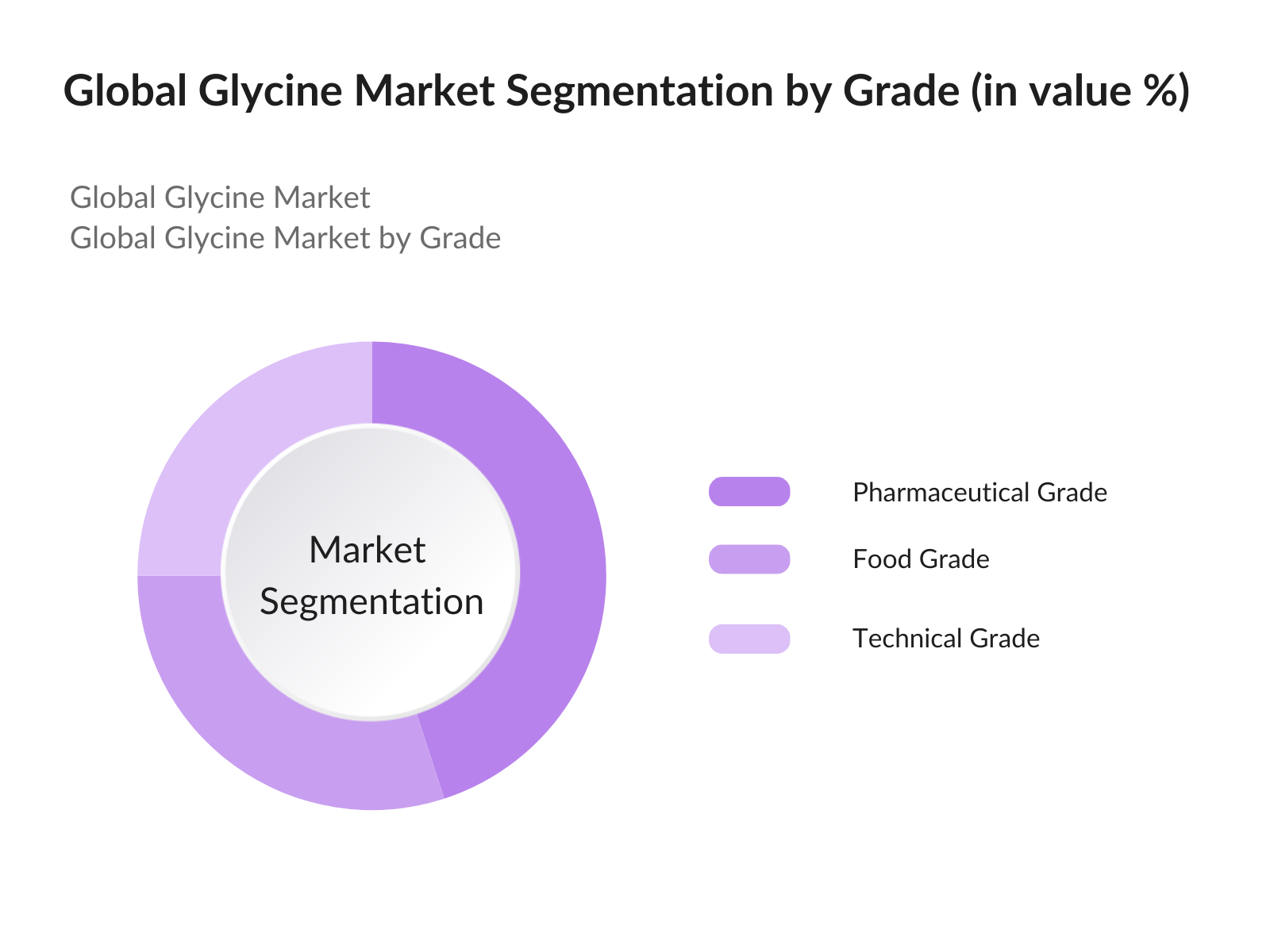
By Grade: The global glycine market is segmented by grade into food grade, pharmaceutical grade, and technical grade. Among these, pharmaceutical grade glycine holds a dominant market share due to the increasing use of glycine in therapeutic formulations and as a key ingredient in intravenous (IV) solutions. This high-grade form is required for stringent regulatory compliance, especially in markets like the U.S. and Europe, where pharmaceutical standards are among the highest globally.
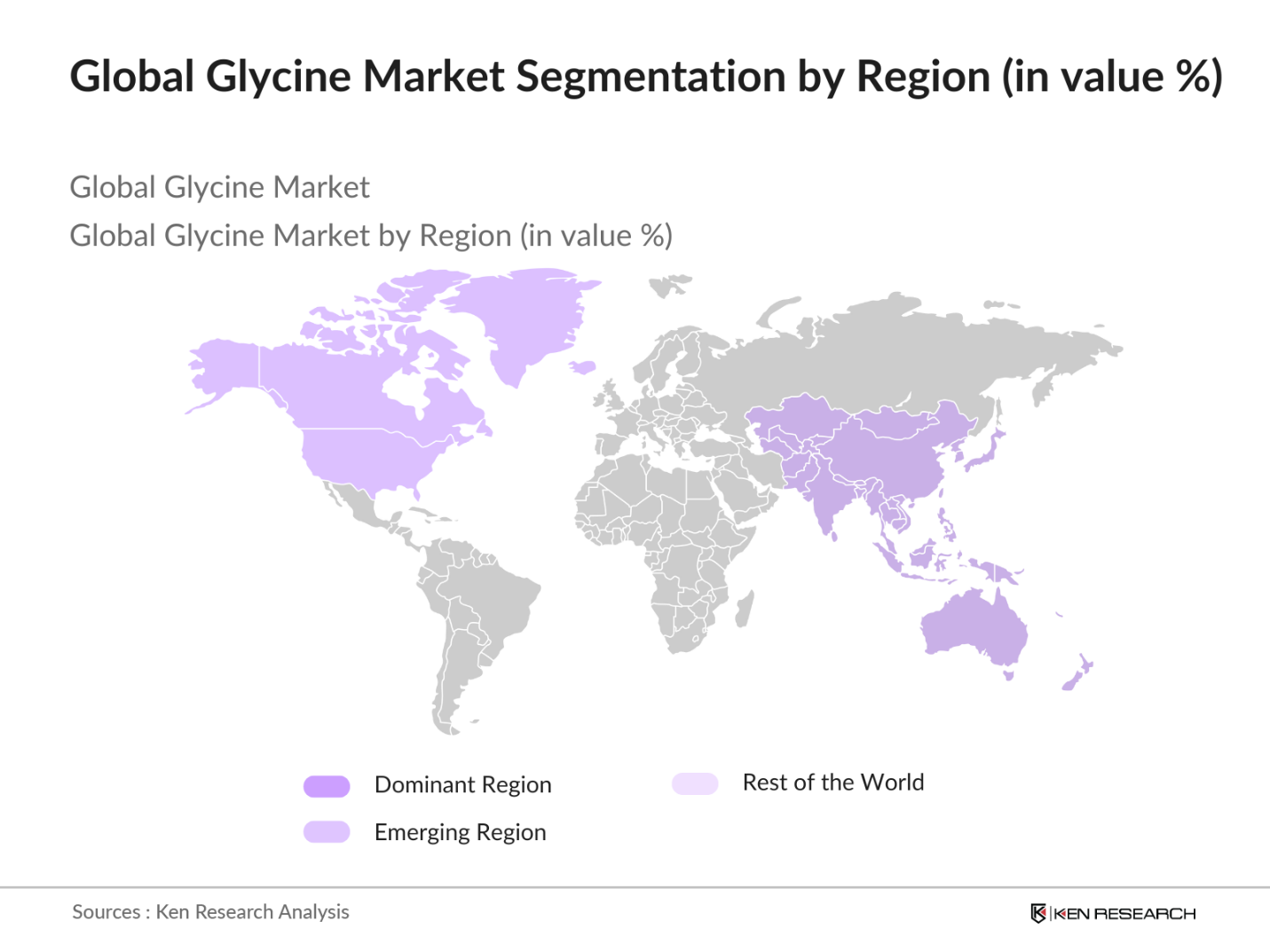
By Region: The global glycine market is geographically segmented into North America, Europe, Asia-Pacific, Latin America, and Middle East & Africa. Asia-Pacific leads the market, primarily due to the significant production and consumption of glycine in China, Japan, and India. The regions large agricultural sector and chemical manufacturing industries have driven the demand for glycine in both feed and industrial applications, making it a key growth region in the global market.
Global Glycine Market Competitive Landscape
The global glycine market is characterized by the presence of both multinational corporations and regional manufacturers. Companies are leveraging technological advancements and expanding their production capacities to maintain competitiveness in the market.
|
Company |
Establishment Year |
Headquarters |
No. of Employees |
Revenue (2023) |
Product Portfolio |
R&D Investments |
Market Share (%) |
Geographical Presence |
Strategic Initiatives |
|
Ajinomoto Co., Inc. |
1909 |
Tokyo, Japan |
- |
- |
- |
- |
- |
- |
- |
|
Evonik Industries AG |
2007 |
Essen, Germany |
- |
- |
- |
- |
- |
- |
- |
|
GEO Specialty Chemicals, Inc. |
1993 |
Ohio, USA |
- |
- |
- |
- |
- |
- |
- |
|
Shijiazhuang Donghua Jinlong Chemical |
1998 |
Hebei, China |
- |
- |
- |
- |
- |
- |
- |
|
Nantong Guangrong Chemical Co., Ltd. |
2004 |
Nantong, China |
- |
- |
- |
- |
- |
- |
- |
Global Glycine Market Analysis
Market Growth Drivers
- Increasing Demand in Pharmaceutical Applications: The demand for glycine in the pharmaceutical industry is growing due to its use in drug formulation and as an excipient in medicines. Glycine's role in the production of antacids, analgesics, and immunosuppressive drugs has expanded significantly. According to data from the World Health Organization (WHO), global pharmaceutical sales are expected to rise by over $100 billion from 2022 to 2025, with glycine playing a crucial role in this surge due to its biocompatibility and low toxicity. This trend is evident in markets like the United States, China, and Europe, where pharmaceutical manufacturing has grown steadily.
- Rising Demand for Feed Additives in Livestock Industry: Glycine is increasingly being used as a feed additive in the livestock sector, particularly in the production of poultry and swine feed. The United Nations Food and Agriculture Organization (FAO) reports that global meat production exceeded 340 million tons in 2023, with a steady increase expected in the next two years. Glycine, which helps in the production of proteins and improves nutrient absorption in animals, is key to this growth. Livestock feed markets in regions like North America and Asia-Pacific are significant contributors to glycine's demand.
- Growing Use of Glycine in Chemical Intermediates: The use of glycine as a chemical intermediate in the production of herbicides, particularly glyphosate, has grown substantially. Glycine is integral to the synthesis of several agricultural chemicals, and its importance is increasing in regions with large agricultural sectors like Brazil and India. This growth is driven by the need for enhanced crop yields and food security, making glycine a critical component in supporting large-scale agricultural operations. As demand for efficient farming practices continues to rise, glycines role in this sector remains vital for the production of herbicides and other agrochemical products.
Market Challenges
- Regulatory Restrictions on Feed Additives: Regulations surrounding the use of glycine as a feed additive are tightening, especially in the European Union and parts of Asia. The European Food Safety Authority (EFSA) issued stricter guidelines in 2023, limiting the use of certain amino acids, including glycine, due to potential environmental concerns. This has led to a reduction in demand from regulated markets, where compliance has increased costs for livestock producers.
- Competition from Substitutes: Substitutes like methionine and lysine are becoming more popular in animal feed, posing a threat to glycine's market share. The FAO reports that alternative amino acids have gained traction in 2023 due to their lower cost and widespread availability, particularly in emerging markets like Southeast Asia and Latin America. This competition has forced glycine manufacturers to innovate and differentiate their products to maintain demand.
Global Glycine Market Future Outlook
Over the next five years, the global glycine market is expected to grow significantly, driven by rising demand across pharmaceutical, animal feed, and food and beverage industries. The increasing focus on bio-based glycine production, coupled with the expansion of glycine applications in emerging markets, will play a pivotal role in driving market growth. Investments in research and development, particularly in the pharmaceutical sector, are expected to further boost glycines market prospects.
Market Opportunities:
- Adoption of Bio-based Glycine Production: The shift towards sustainable and bio-based production of glycine is gaining momentum, especially in Europe and North America. According to the European Environment Agency (EEA), investment in bio-based chemicals increased by 15% in 2023, driven by stringent environmental regulations. Companies are exploring renewable raw materials for glycine production to reduce their carbon footprints, leading to the development of eco-friendly products.
- Increasing Research in Pharmaceutical Formulations: Pharmaceutical companies are investing in research to enhance glycines efficacy in drug formulations. The World Intellectual Property Organization (WIPO) recorded over 200 patents related to glycine in pharmaceuticals in 2023, indicating significant innovation in this space. Glycine is being studied for its potential to improve drug absorption and reduce side effects, making it a valuable compound in developing next-generation drugs.
Scope of the Report
|
By Grade |
Food Grade Pharmaceutical Grade Technical Grade |
|
By Application |
Pharmaceuticals Animal Feed Food and Beverages Chemical Intermediates Cosmetics and Personal Care |
|
By Production Process |
Synthetic Process Natural Process |
|
By Form |
Powder Liquid |
|
By Region |
North America Europe Asia-Pacific Latin America Middle East & Africa |
Products
Key Target Audience
Pharmaceutical Companies
Chemical Manufacturers
Animal Feed Producers
Food and Beverage Manufacturers
Nutraceutical and Supplement Brands
Government and Regulatory Bodies (e.g., U.S. FDA, EFSA)
Investments and Venture Capitalist Firms
Large Scale Industrial Consumers (Chemicals, Feed)
Companies
Players Mention in the Report
Ajinomoto Co., Inc.
Evonik Industries AG
Chattem Chemicals, Inc.
GEO Specialty Chemicals, Inc.
Shijiazhuang Donghua Jinlong Chemical Co., Ltd.
Yuki Gosei Kogyo Co., Ltd.
Showa Denko K.K.
Nantong Guangrong Chemical Co., Ltd.
Hubei Xingfa Chemicals Group Co., Ltd.
Baoding Baofeng Chemical Industry Co., Ltd.
Newtrend Group
Meihua Holdings Group Co., Ltd.
Nantong Feiyu Fine Chemical Co., Ltd.
Hebei Donghua Chemical Group
Shijiazhuang Donghua Jinlong Chemical Co., Ltd.
Table of Contents
1. Global Glycine Market Overview
1.1 Definition and Scope
1.2 Market Taxonomy
1.3 Market Growth Rate
1.4 Market Segmentation Overview
2. Global Glycine Market Size (In USD Bn)
2.1 Historical Market Size
2.2 Year-on-Year Growth Analysis
2.3 Key Market Developments and Milestones
3. Global Glycine Market Analysis [Market Drivers, Challenges, Opportunities]
3.1 Growth Drivers
3.1.1 Increasing Demand in Pharmaceutical Applications
3.1.2 Rising Demand for Feed Additives in Livestock Industry
3.1.3 Growing Use of Glycine in Chemical Intermediates
3.2 Market Challenges
3.2.1 Regulatory Restrictions on Feed Additives
3.2.2 Fluctuating Raw Material Costs
3.2.3 Competition from Substitutes
3.3 Opportunities
3.3.1 Expanding Industrial Applications
3.3.2 Rising Demand in Nutraceuticals and Functional Foods
3.3.3 Increased Production in Emerging Markets
3.4 Market Trends [Glycine Applications, Technology Advancements]
3.4.1 Adoption of Bio-based Glycine Production
3.4.2 Increasing Research in Pharmaceutical Formulations
3.4.3 Shift Towards Sustainable Feed Solutions
3.5 Regulatory Framework
3.5.1 International Standards and Regulations
3.5.2 Regional Compliance Requirements
3.5.3 Certification and Licensing Processes
3.6 SWOT Analysis
3.7 Stake Ecosystem
3.8 Porters Five Forces Analysis
3.9 Competitive Ecosystem
4. Global Glycine Market Segmentation [Segmentation Parameters]
4.1 By Grade (In Value %)
4.1.1 Food Grade
4.1.2 Pharmaceutical Grade
4.1.3 Technical Grade
4.2 By Application (In Value %)
4.2.1 Pharmaceuticals
4.2.2 Animal Feed
4.2.3 Food and Beverages
4.2.4 Chemical Intermediates
4.2.5 Cosmetics and Personal Care
4.3 By Production Process (In Value %)
4.3.1 Synthetic Process
4.3.2 Natural Process
4.4 By Form (In Value %)
4.4.1 Powder
4.4.2 Liquid
4.5 By Region (In Value %)
4.5.1 North America
4.5.2 Europe
4.5.3 Asia-Pacific
4.5.4 Latin America
4.5.5 Middle East & Africa
5. Global Glycine Market Competitive Analysis [Market Share, Strategic Initiatives]
5.1 Detailed Profiles of Major Companies
5.1.1 Ajinomoto Co., Inc.
5.1.2 Evonik Industries AG
5.1.3 Chattem Chemicals, Inc.
5.1.4 GEO Specialty Chemicals, Inc.
5.1.5 Shijiazhuang Donghua Jinlong Chemical Co., Ltd.
5.1.6 Yuki Gosei Kogyo Co., Ltd.
5.1.7 Showa Denko K.K.
5.1.8 Nantong Guangrong Chemical Co., Ltd.
5.1.9 Hubei Xingfa Chemicals Group Co., Ltd.
5.1.10 Baoding Baofeng Chemical Industry Co., Ltd.
5.1.11 Newtrend Group
5.1.12 Meihua Holdings Group Co., Ltd.
5.1.13 Shijiazhuang Donghua Jinlong Chemical Co., Ltd.
5.1.14 Nantong Feiyu Fine Chemical Co., Ltd.
5.1.15 Hebei Donghua Chemical Group
5.2 Cross Comparison Parameters [No. of Employees, Headquarters, Inception Year, Revenue, Product Portfolio, Regional Presence, Market Share, Strategic Partnerships]
5.3 Market Share Analysis
5.4 Strategic Initiatives
5.5 Mergers and Acquisitions
5.6 Investment Analysis
5.7 Government Grants and Subsidies
5.8 Private Equity and Venture Capital Investments
6. Global Glycine Market Regulatory Framework
6.1 International Guidelines for Glycine Production
6.2 Environmental and Safety Compliance
6.3 Quality Certification Requirements
6.4 Export/Import Regulations
7. Global Glycine Future Market Size (In USD Bn)
7.1 Future Market Size Projections
7.2 Key Factors Driving Future Market Growth
8. Global Glycine Future Market Segmentation
8.1 By Grade (In Value %)
8.2 By Application (In Value %)
8.3 By Production Process (In Value %)
8.4 By Form (In Value %)
8.5 By Region (In Value %)
9. Global Glycine Market Analysts Recommendations
9.1 TAM/SAM/SOM Analysis
9.2 Competitive Positioning and Market Differentiation
9.3 Entry Barriers and Market Expansion Strategies
9.4 White Space Opportunity Analysis
9.5 Key Marketing and Distribution Channels
Disclaimer Contact UsResearch Methodology
Step 1: Identification of Key Variables
The initial phase focuses on constructing an ecosystem map that encompasses all key stakeholders within the global glycine market. This step involves extensive desk research using secondary sources and proprietary databases to collect comprehensive industry-level data and identify the key variables influencing market dynamics.
Step 2: Market Analysis and Construction
This phase compiles historical data on glycine market penetration, application ratios, and revenue generation. An assessment of glycine demand across various industries, along with product quality and supply chain efficiency, ensures the reliability of revenue estimates.
Step 3: Hypothesis Validation and Expert Consultation
Market hypotheses are formulated and validated through interviews with industry experts from glycine manufacturing companies. These consultations provide financial and operational insights, which are used to corroborate market data and refine estimates.
Step 4: Research Synthesis and Final Output
The final phase involves direct engagement with glycine producers and distributors to acquire insights into product segments, consumer preferences, and sales performance. This information is combined with the bottom-up approach to ensure a comprehensive and validated analysis of the global glycine market.
Frequently Asked Questions
01. How big is the Global Glycine Market?
The global glycine market is valued at USD 5010.05 billion, driven by its rising applications in pharmaceuticals, animal feed, and food and beverages.
02. What are the major challenges in the Global Glycine Market?
The glycine market faces challenges such as fluctuating raw material prices, regulatory constraints on feed additives, and competition from alternative amino acids.
03. Who are the major players in the Global Glycine Market?
Key players include Ajinomoto Co., Inc., Evonik Industries AG, GEO Specialty Chemicals, and Shijiazhuang Donghua Jinlong Chemical Co., Ltd., which dominate due to their strong production capacities and innovation.
04. What are the growth drivers of the Global Glycine Market?
The market is propelled by increased demand for glycine in animal feed, pharmaceuticals, and food products, as well as advancements in bio-based production processes.
Why Buy From Us?

What makes us stand out is that our consultants follows Robust, Refine and Result (RRR) methodology. i.e. Robust for clear definitions, approaches and sanity checking, Refine for differentiating respondents facts and opinions and Result for presenting data with story

We have set a benchmark in the industry by offering our clients with syndicated and customized market research reports featuring coverage of entire market as well as meticulous research and analyst insights.

While we don't replace traditional research, we flip the method upside down. Our dual approach of Top Bottom & Bottom Top ensures quality deliverable by not just verifying company fundamentals but also looking at the sector and macroeconomic factors.

With one step in the future, our research team constantly tries to show you the bigger picture. We help with some of the tough questions you may encounter along the way: How is the industry positioned? Best marketing channel? KPI's of competitors? By aligning every element, we help maximize success.

Our report gives you instant access to the answers and sources that other companies might choose to hide. We elaborate each steps of research methodology we have used and showcase you the sample size to earn your trust.

If you need any support, we are here! We pride ourselves on universe strength, data quality, and quick, friendly, and professional service.