
Global Green Ammonia Market Outlook to 2030
Region:Global
Author(s):Paribhasha Tiwari
Product Code:KROD4956
Region:Global
Author(s):Paribhasha Tiwari
Product Code:KROD4956
December 2024
85

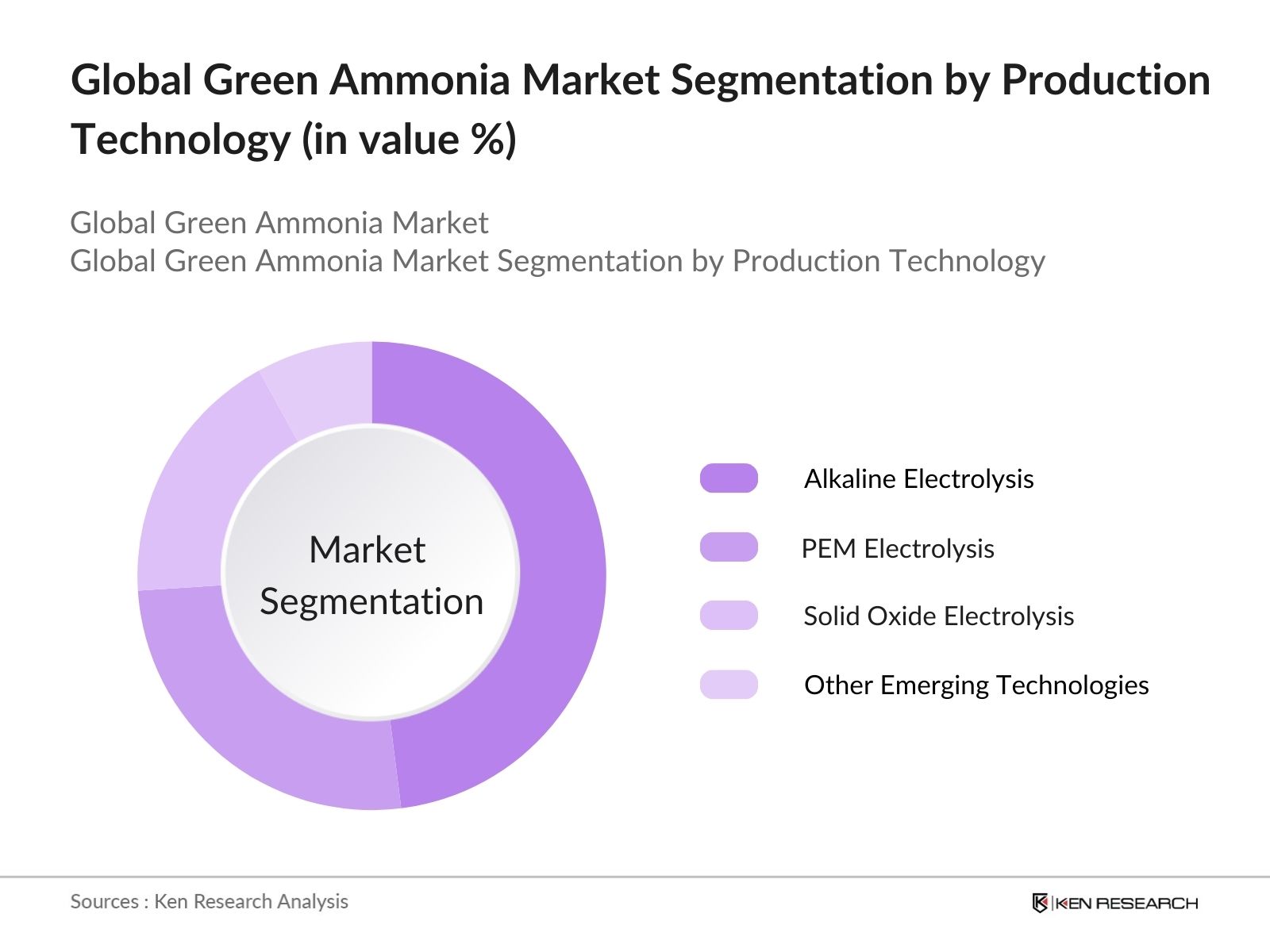
By Production Technology: The global green ammonia market is segmented by production technology into alkaline electrolysis, PEM electrolysis, solid oxide electrolysis, and other emerging technologies.
Alkaline electrolysis dominates this segment due to its proven efficiency and cost-effectiveness in large-scale ammonia production. As one of the oldest electrolysis methods, it benefits from established infrastructure and lower capital costs, making it the most widely adopted technology for green ammonia production. The availability of cheap renewable energy sources, especially in countries like the U.S. and Australia, supports its dominance.
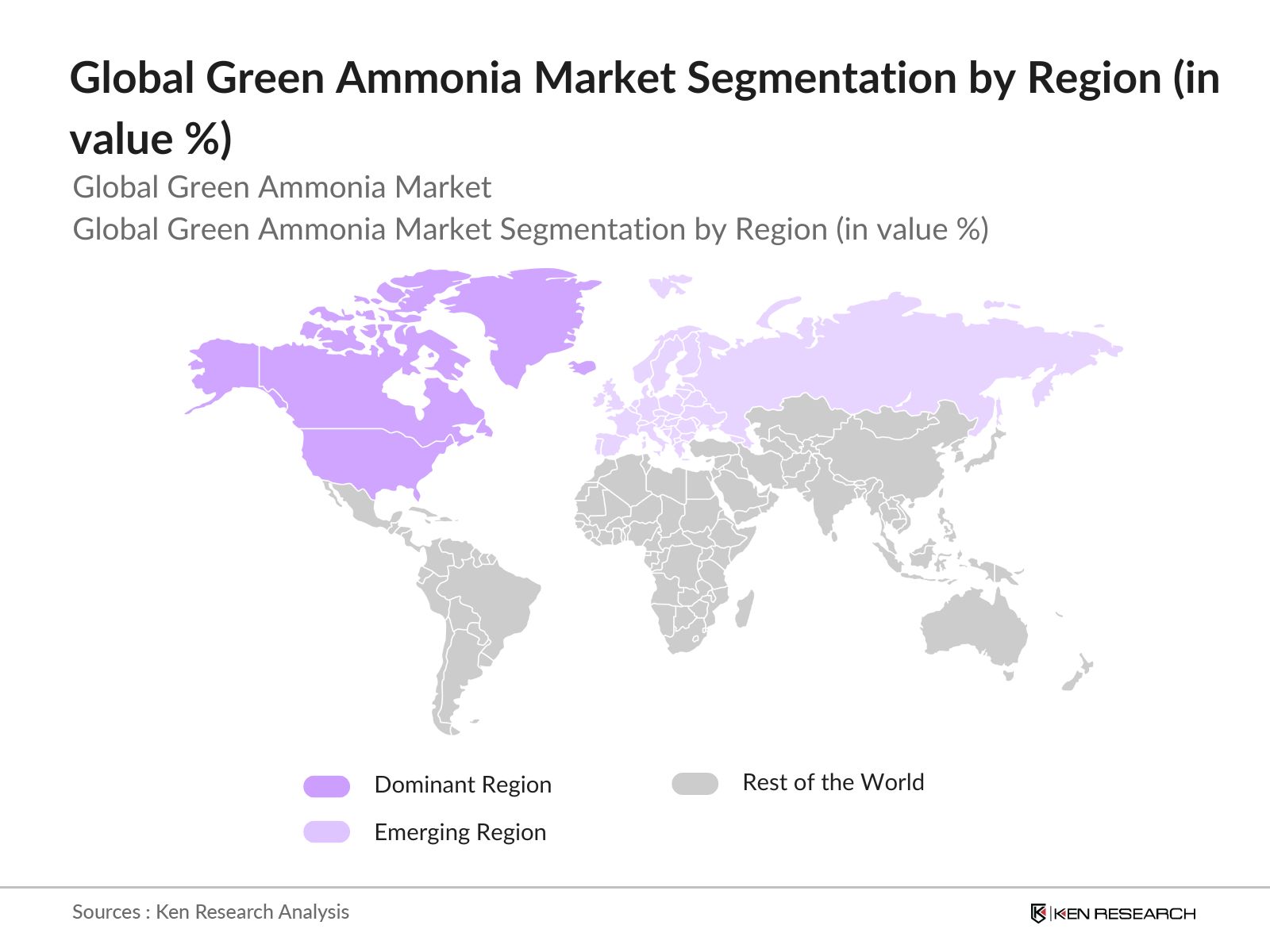
By Region: By region, the market is segmented in North America, Europe, Asia Pacific, Latin America and Middle East & Africa. North America dominates the global green ammonia market. The region's leadership is driven by the United States, which has significant investments in renewable energy infrastructure and green hydrogen production facilities. Strong governmental support and large-scale ammonia projects further enhance the region's dominance in the market.
The global green ammonia market is characterized by key players focusing on technological innovation, renewable energy partnerships, and strategic expansions. The market is consolidated with a few major companies dominating production and distribution networks. Leading firms leverage their expertise in renewable energy and hydrogen production to strengthen their foothold in the green ammonia space.
|
Company Name |
Establishment Year |
Headquarters |
Electrolyzer Technology |
Renewable Energy Partner |
Production Capacity |
Geographical Reach |
R&D Investment |
Strategic Partnerships |
Green Hydrogen Utilization |
|
Yara International ASA |
1905 |
Oslo, Norway |
- | - | - | - | - | - | - |
|
Siemens AG |
1847 |
Berlin, Germany |
- | - | - | - | - | - | - |
|
ITM Power |
2001 |
Sheffield, UK |
- | - | - | - | - | - | - |
|
CF Industries |
1946 |
Illinois, USA |
- | - | - | - | - | - | - |
|
ThyssenKrupp |
1811 |
Essen, Germany |
- | - | - | - | - | - | - |
Over the next five years, the global green ammonia market is expected to experience robust growth, driven by increased investments in renewable energy projects and a strong push for sustainable agriculture practices. The continuous development of green hydrogen infrastructure and the integration of ammonia as a carbon-neutral fuel in the maritime and power sectors will further fuel market expansion. Technological advancements in electrolyzes, combined with government incentives for green energy, are also projected to accelerate adoption in industrial applications.
|
By Production Technology |
Alkaline Electrolysis PEM Electrolysis Solid Oxide Electrolysis Other Emerging Technologies |
|
By Application |
Fertilizers Industrial Feedstock Marine Fuel Power Generation |
|
By Energy Source |
Solar-Powered Ammonia Wind-Powered Ammonia Hydro-Powered Ammonia Biomass-Powered Ammonia |
|
By End-Use Industry |
Agriculture Maritime Power & Energy, Chemicals |
|
By Region |
North America Europe Asia-Pacific Latin America Middle East & Africa |
1.1. Definition and Scope
1.2. Market Taxonomy
1.3. Market Growth Rate (Green ammonia production capacity, energy efficiency metrics, hydrogen feedstock availability)
1.4. Market Segmentation Overview (Production Technology, Application, Energy Source, End-Use Industry, Region)
2.1. Historical Market Size
2.2. Year-On-Year Growth Analysis (Production volumes, Renewable energy integration)
2.3. Key Market Developments and Milestones (Hydrogen-based ammonia projects, renewable energy mandates)
3.1. Growth Drivers
3.1.1. Increasing Demand for Green Fertilizers
3.1.2. Global Decarbonization Goals (Net-zero targets, carbon footprint reduction)
3.1.3. Government Incentives and Subsidies (Hydrogen energy subsidies, renewable energy credits)
3.1.4. Renewable Energy Advancements (Cost efficiency of solar and wind energy)
3.2. Market Challenges
3.2.1. High Initial Capital Investment (Electrolysis infrastructure, renewable energy infrastructure)
3.2.2. Limited Hydrogen Supply Chain (Hydrogen transportation and storage)
3.2.3. Energy Conversion Efficiency (Loss in green hydrogen production)
3.3. Opportunities
3.3.1. Strategic Collaborations with Renewable Energy Providers
3.3.2. Expansion of Offshore Wind-Powered Ammonia Projects
3.3.3. Technological Innovations in Electrolyzers and Hydrogen Storage
3.4. Trends
3.4.1. Shift Toward Carbon-Neutral Shipping Fuel (Ammonia as marine fuel)
3.4.2. Development of Small-Scale Green Ammonia Plants
3.4.3. Industrial Adoption of Green Ammonia for Power Generation
3.5. Government Regulation
3.5.1. Renewable Energy Policies and Green Hydrogen Legislation
3.5.2. Ammonia Emission Standards (Emission reduction mandates)
3.5.3. Carbon Pricing and Credits
3.6. SWOT Analysis
3.7. Stakeholder Ecosystem (Renewable energy suppliers, ammonia producers, industrial users)
3.8. Porters Five Forces (Renewable energy suppliers, hydrogen technology providers)
3.9. Competitive Ecosystem
4.1. By Production Technology (In Value %)
4.1.1. Alkaline Electrolysis
4.1.2. Proton Exchange Membrane (PEM) Electrolysis
4.1.3. Solid Oxide Electrolysis
4.1.4. Other Emerging Technologies
4.2. By Application (In Value %)
4.2.1. Fertilizers
4.2.2. Industrial Feedstock
4.2.3. Marine Fuel
4.2.4. Power Generation
4.3. By Energy Source (In Value %)
4.3.1. Solar-Powered Ammonia
4.3.2. Wind-Powered Ammonia
4.3.3. Hydro-Powered Ammonia
4.3.4. Biomass-Powered Ammonia
4.4. By End-Use Industry (In Value %)
4.4.1. Agriculture
4.4.2. Maritime
4.4.3. Power & Energy
4.4.4. Chemicals
4.5. By Region (In Value %)
4.5.1. North America
4.5.2. Europe
4.5.3. Asia-Pacific
4.5.4. Latin America
4.5.5. Middle East & Africa
5.1 Detailed Profiles of Major Companies
5.1.1. Yara International ASA
5.1.2. Siemens AG
5.1.3. ITM Power
5.1.4. Nel Hydrogen
5.1.5. ThyssenKrupp
5.1.6. CF Industries
5.1.7. Air Products and Chemicals, Inc.
5.1.8. BASF SE
5.1.9. Engie SA
5.1.10. Linde Plc
5.1.11. Fertiglobe
5.1.12. Haldor Topsoe
5.1.13. Trafigura Group
5.1.14. Shell Plc
5.1.15. Iberdrola SA
5.2 Cross Comparison Parameters (Production Capacity, Electrolyzer Technology, Renewable Energy Integration, Green Hydrogen Utilization, R&D Investment, Geographical Presence, Strategic Partnerships, Revenue Share from Green Ammonia)
5.3 Market Share Analysis
5.4 Strategic Initiatives (Partnerships, alliances with renewable energy firms)
5.5 Mergers and Acquisitions
5.6 Investment Analysis
5.7 Venture Capital Funding
5.8 Government Grants
5.9 Private Equity Investments
6.1 Renewable Energy Regulations (Green hydrogen policies, ammonia production standards)
6.2 Compliance Requirements (Hydrogen purity standards, safety regulations)
6.3 Certification Processes (Certifications for green hydrogen, renewable ammonia labeling)
7.1 Future Market Size Projections
7.2 Key Factors Driving Future Market Growth (Growth in renewable energy, demand for sustainable agriculture)
8.1 By Production Technology (In Value %)
8.2 By Application (In Value %)
8.3 By Energy Source (In Value %)
8.4 By End-Use Industry (In Value %)
8.5 By Region (In Value %)
9.1 TAM/SAM/SOM Analysis (Total Addressable Market, Serviceable Available Market, Serviceable Obtainable Market)
9.2 Customer Cohort Analysis (Agriculture, maritime, energy customers)
9.3 Marketing Initiatives (Outreach for renewable ammonia, sustainability messaging)
9.4 White Space Opportunity Analysis (Emerging markets, unaddressed energy sources)
The research begins with constructing an ecosystem map to outline the major stakeholders within the global green ammonia market. This process involves extensive desk research utilizing proprietary databases and industry reports to identify critical variables influencing the market.
This phase involves compiling and analyzing historical data related to the green ammonia market. Data points such as production capacity, energy source integration, and ammonia utilization in different industries are assessed to construct accurate market models.
In this step, industry hypotheses are validated through consultations with industry experts and green ammonia producers. Primary interviews provide operational insights that help refine market forecasts and ensure accurate projections.
Finally, the data is synthesized, and conclusions are drawn based on a mix of top-down and bottom-up approaches. The findings are verified through direct engagement with green ammonia producers, ensuring accuracy and depth in the market analysis.
The global green ammonia market is valued at USD 700 Million, driven by rising demand in sustainable agriculture and decarbonization efforts across industrial sectors.
Key challenges in the global green ammonia market include high capital investment for production infrastructure, limited hydrogen supply chain development, and energy efficiency concerns in electrolysis technology.
Key players in the global green ammonia market include Yara International, Siemens AG, ITM Power, CF Industries, and ThyssenKrupp, who dominate due to their strong renewable energy partnerships and production capacity.
Growth of global green ammonia market is driven by increasing adoption of green ammonia in sustainable agriculture, its potential as a carbon-neutral fuel in the maritime sector, and supportive government policies.

What makes us stand out is that our consultants follows Robust, Refine and Result (RRR) methodology. i.e. Robust for clear definitions, approaches and sanity checking, Refine for differentiating respondents facts and opinions and Result for presenting data with story

We have set a benchmark in the industry by offering our clients with syndicated and customized market research reports featuring coverage of entire market as well as meticulous research and analyst insights.

While we don't replace traditional research, we flip the method upside down. Our dual approach of Top Bottom & Bottom Top ensures quality deliverable by not just verifying company fundamentals but also looking at the sector and macroeconomic factors.

With one step in the future, our research team constantly tries to show you the bigger picture. We help with some of the tough questions you may encounter along the way: How is the industry positioned? Best marketing channel? KPI's of competitors? By aligning every element, we help maximize success.

Our report gives you instant access to the answers and sources that other companies might choose to hide. We elaborate each steps of research methodology we have used and showcase you the sample size to earn your trust.

If you need any support, we are here! We pride ourselves on universe strength, data quality, and quick, friendly, and professional service.